Where on (Google)Earth? #98 (and some updated stats)
BGC found my Wo(G)E birthday location near Reyes, Bolivia. The very first Where on (Google)Earth was Point Reyes just north of San Francisco.
BGC does not have a blog so he asked me to post his location for him.
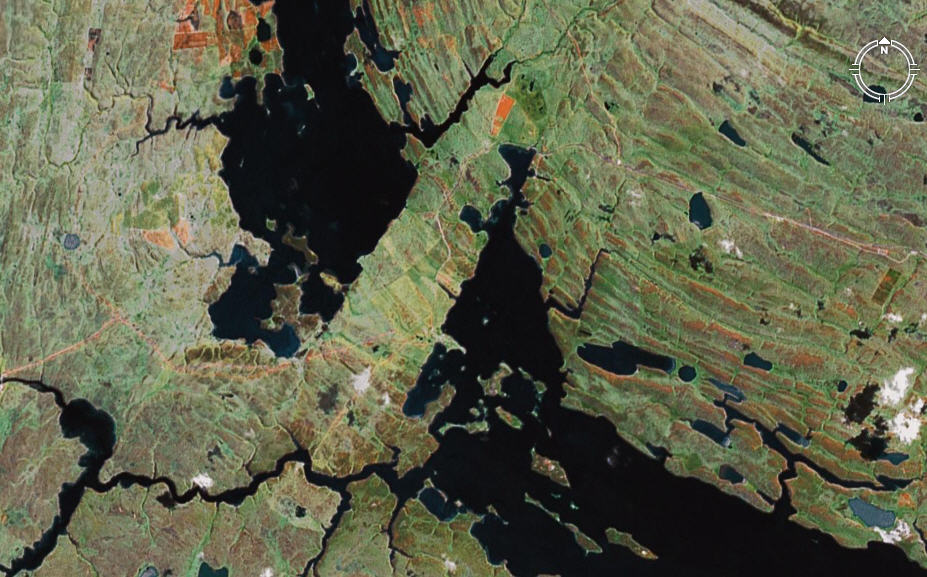
To make this a little more challenging, I trimmed the scale and image attribution information off the bottom of the image. The winner of this must include some geologic information … whatever is going on here, it is pretty cool.
The Schott Rule is in effect: you must wait one hour for every previous Wo(G)E that you have won.
Post Time: January 19th, 2008, 6:30 PM Pacific Standard Time (convert to your time zone here)
~
I updated some stats earlier today. These are wins by player through Wo(G)E #97:
Ron Schott – 28
Kent (magma?) – 7
sagan – 7
Lab Lemming – 6
BrianR – 5
Kim – 5
Zoltán – 5
Thermochronic – 4
Yami – 4
JMA – 4
Geology Joe – 3
Jim Repka – 3
John Van Hosen – 2
BGC – 2
…and then there are an additional 12 players with only one win. You’ll have to start winning some to see your name :)
Check out some interesting spatial stats regarding one year’s worth of Wo(G)E locations Lab Lemming put together here.
~~~~~~~~~~~~~~~~~~~~~~~~~~~~~~~~~~~~~~~~~~~~~~~~~~~~~~~~~~~~~~~~
Dissertation update – final production
Yesterday was a fantastic day.
In the morning I had my format check with the registrar. This is where you take a copy of your dissertation document in and they measure margins, check the ordering of the preface, and so on. Everything was in perfect order, the guy checking it out seemed very pleased with me. I got the feeling he sees some documents that are in pretty bad shape.
The university requires four copies and then I want two (one for my adviser and one for me). So, I went to work printing out five more copies of a 300-page document. A lot of paper!
The text was pretty straightforward, it just took a while. The figures, on the other hand, were a real pain in the butt. The previous day, I spent the afternoon testing out different paper types and printer settings for all my figures. Each figure is different, so some looked better when converted to PDF, some looked better printed from Adobe Illustrator. Some figures were printed on a inkjet printer, some on a laser. Some looked better on presentation quality paper, some looked good on the fancy watermarked thesis paper that I used for the text. I had to create a list of all this.
I had some ink cartridge issues (of course) … had to do nozzle tests, head cleaning, blah blah blah. I hate printing.
But, by 5:30pm I was done! I thought for sure I’d be going in this weekend to finish the job. I’m very glad I was able to get it done in one day like that. And it looks good. Nobody is going to read it of course, but it’ll be fun to pull it off my bookshelf in 30 years and look at it.
Next Wednesday, I have my final submission appointment. This is where they hand me a piece of paper that proves I have completed all requirements for the PhD. Crazy.
The last month has been pretty crazy. My happiness related to finishing this goal is mixed with some sadness. One of my committee members passed away after a seven-year battle with cancer. He was a marine geologist at the USGS and collaborated a lot with our group. After my defense in December his health deteriorated rapidly. Now that I have some time, I’m going to put together a post honoring him as he was a giant in my field. He was a great mentor and friend too.
I only have a couple weeks until I start my new job. It would’ve been nice to have more time off in between these chapters of my life but it just didn’t work out that way.
~~~~~~~~~~~~~~~~~~~~~~~~~~~~~~~~~~~~~~~~~~~~~~~~~~~~~~~~~~~~~~
Where on (Google)Earth? #97 – 1st Anniversary!
Well, well, well … one year ago today (January 18th, 2007), the first Where on (Google)Earth was posted (I think I still owe Thermochronic a t-shirt).
Wow, almost 100 installments in one year!
I’m really happy that this game has been so successful. A lot of credit goes to Ron for first suggesting that we make a series in which the winner hosts the next one. That format has certainly contributed to making the geoblogosphere more connected.
Back in October 2007, I compiled some stats of the winners. I will update that this weekend. Ron has updated his .kmz file as well: http://ron.outcrop.org/kml/WoGE.kmz
In case you haven’t played in a while, it has expanded even more in recent weeks as a result of establishing more connectivity in the geoblogosphere. There is now a blog site devoted to WoGE called A Thin Section. Essentially, those who win but don’t have a blog can suggest a location to A Thin Section and it’ll be posted there. Additionally, the site will provide a link to where the current WoGE is being hosted (in case you can’t find it).
Thanks to everybody for playing! I hope we can continue having fun with this game.
Without any further ado, here is Where on (Google)Earth #97.

Just for birthday fun, there is no Schott Rule for this one! I often think that the locations I choose will be difficult and then they end up being easy for somebody. If this one sits around for a couple days without any action, I’ll provide a clue.
Good luck!
~~~~~~~~~~~~~~~~~~~~~~~~~~~~~~~~~~~~~~~~~~~~~~~~~~~~~~~~~~~~~~~
Avulsion dynamics and experimental sedimentation (repost)
Sorry … this is another re-post … I am incredibly busy with final touches on the dissertation. My adviser is leaving to go out of the country very soon and I need to get his signature before then! It’s going to happen, but I still have some things to take care of. If you’ve been reading this blog for the last year, you’ve seen this before. But, if you are a relatively new to Clastic Detritus … read on!
~
Last year, I discussed some work being done in experimental sedimentation. I highlighted the work being done by sedimentologists and dynamicists at the University of Minnesota’s St. Anthony Falls Lab in particular.
The video below is from some of their work…I encourage you to explore their data archive if you want to find more. This video shows a time lapse of sedimentation occuring on an experimental delta. This particular experiment nicely shows the dynamics of shifting pathways of sediment transport and/or deposition/erosion, otherwise known as avulsion. The deposit here would be more akin to a braided fan delta as it is not developing long-lived channels with cohesive levees.
The annotation shows where and when avulsion and expansion of channelized flow occurs. Also keep your eye on where deposition is occuring. This interplay of deposition and avulsion continues in a very dynamic (and seemingly unpredictable) fashion. Qualitatively, this isn’t really anything we haven’t known for a long time. The point with these experiments is that we can measure every last little detail. These researchers are really just scratching the surface — eventually they would like to try develop some fundamental quantitative relationships that might lead to predictive guidelines. But, it will take many years of experimentation to amass the data needed to converge on these relationships.
The photo below was on their website several months ago…it shows that they are now experimenting with systems that do produce cohesive levees, which is a key ingredient for understanding the dynamics of most river deltas.

~~~~~~~~~~~~~~~~~~~~~~~~~~~~~~~~~~~~~~~~~~~~~~~~~~~~~~~~~~~~~~
Sea-Floor Sunday #8: Submarine canyon offshore San Diego, California
NOTE: This is a re-post from August 2007 (I’m busy trying to get the final touches done on my dissertation … new posts coming soon).
~
Below is one of the latest multibeam bathymetric images released by the US Geological Survey. Go to this page to view and download the large-format PDFs.
If you’d like to know more about the technical details of the concept, design, and acquisition of multibeam sonar data, check out resources here and here.
 This one is definitely worth clicking on to see the high-res version. The densely populated onshore area to the right is San Diego, California. For a more regional context of southern California geologic provinces, check out this page. The San Andreas fault is 10s of km inland from this location, but subsidiary strike-slip faults dominate the tectonic fabric.
The major submarine canyon cutting into the narrow continental shelf is called La Jolla Canyon. The head of that canyon comes very close to the pier at Scripps Institute of Oceanography if any of you have been there. Note the transition from the deeply incised submarine canyon to a submarine channel system as you go into deeper water. Also note the meandering nature of the individual channel “threads” within the belt. This submarine channel eventually empties into the elongate San Diego Trough basin, which is off the image to the left and in even deeper water.
A paper that i’m a co-author on that came out in Geology in September 2007 deals with this canyon-channel system in more detail and its history over the last 40,000 years. Click here to read more about that study.
The USGS page also has some great perspective views … here is the link again, check it out.
~~~~~~~~~~~~~~~~~~~~~~~~~~~~~~~~~~~~~~~~~~~~~~~~~~~~~~~~~~~~~~
Where on (Google)Earth? #90
JMA found BGC’s Scottish coast location for #89. Since JMA also does not have a blog, he emailed me a location and I’ll post it here for him.
For any new players to Where on (Google)Earth, simply put the lat-long or detailed description of the location in the comments below. A lot of us will typically say a little something about the geography or geology and sometimes we share our tactics for searching. If you win, you get to host the next one.
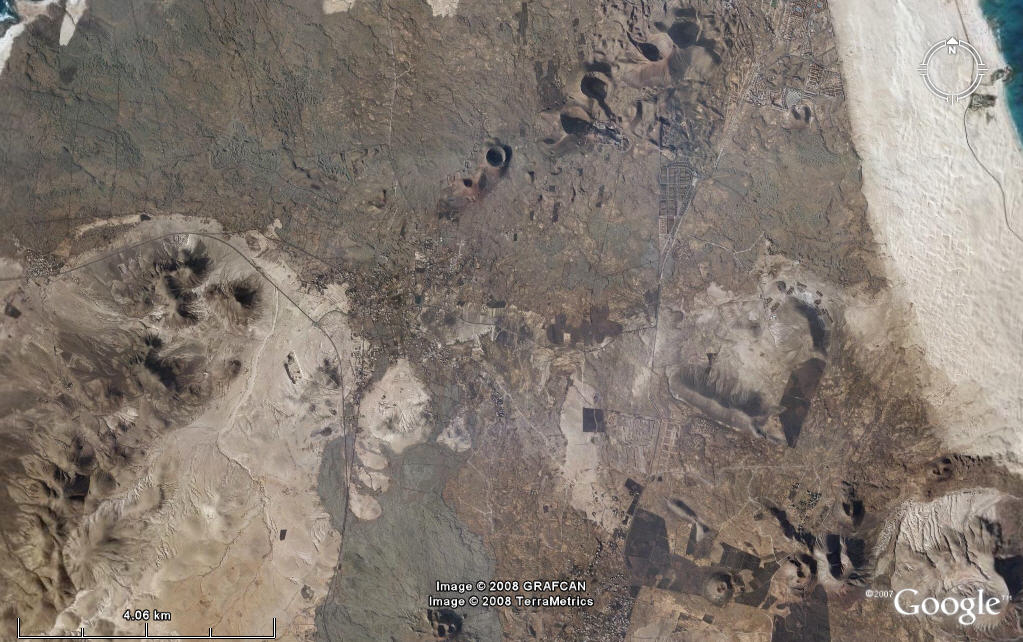
As usual, the Schott Rule is in effect (previous winners must wait one hour for every win that they have before offering a solution).
Good luck!
Post Time: January 12th, 2008, 10:05 AM Pacific Standard Time (convert to your time zone here)
~~~~~~~~~~~~~~~~~~~~~~~~~~~~~~~~~~~~~~~~~~~~~~~~~~~~~~~~~~~~~~
Friday Field Foto #38: Hawk in Patagonia
Not all my photographs from doing geological field work are of rocks or scenery. A consequence of doing field work in remote areas is encountering wildlife (ideally, not as prey).
A few years ago, I was in Patagonia looking at some Cretaceous turbidites and we stopped to take a little break when we got to the top of a ridge. The weather was decent (for once) and it was a beautiful view, so we sat there and enjoyed some lunch. After about 20 minutes a hawk landed on the relatively narrow ridge we were sitting on … maybe 10-15 meters away from us.

It just sat there for 10-15 minutes … long enough for me to put the big zoom lens on the camera and get a good photograph. I don’t think we were near its nest or anything — it was neither aggressive nor defensive … it actually seemed quite indifferent. We were so mesmerized watching it, we couldn’t get up and get back to work until it flew off. Unfortunately, it flew off soon after I snapped this photo so we started working again.
Click here to see more photographs of wildlife (mostly from Patagonia). Click here to see all Friday Field Fotos.
Happy Friday!
~~~~~~~~~~~~~~~~~~~~~~~~~~~~~~~~~~~~~~~~~~~~~~~~~~~~~~~~~~~~~~
Where on (Google)Earth? #89
BGC found the location I wish I had spent more time in while doing field work in Patagonia. Santiago de Chile is pretty far from the southern tip of the continent (>3 hour flight), but you need to go through there on your way. I always wanted to spend time hanging out but was always in too much of a rush because our field season was during the academic year (February-March). What a shame.
Anyway … BGC does not have a blog and cannot host the next one. In this case, BGC gets the credit for the win and then e-mailed me a location to post for #89. For future reference, this is a great solution for those of you who want to play but don’t have a blog of your own.
For any new players to Where on (Google)Earth, simply put the lat-long or detailed description of the location in the comments below. A lot of us will typically say a little something about the geography or geology and sometimes we share our tactics for searching. If you win, you get to host the next one.

As usual, the Schott Rule is in effect (previous winners must wait one hour for every win that they have before offering a solution).
Good luck!
Post Time: January 10th, 2008, 3:30pm Pacific Standard Time (convert to your time zone here)
~~~~~~~~~~~~~~~~~~~~~~~~~~~~~~~~~~~~~~~~~~~~~~~~~~~~~~~~~~~~~~
Dissertation revisions (#2)
As I mentioned in a post a few days ago, I am in the midst of doing corrections and revisions of my dissertation. Happily, things are progressing well. Additional meetings with committee members since the defense have cleared up some confusion on what exactly it was I had to revise.
In a lot of cases, interesting issues and questions arise during the closed-door component of a defense (i.e., after you give the presentation). Committee members bring up issues that your work instigated, but that you didn’t necessarily solve (or set out to solve). From a purely scientific point of view, this is great; your work made people think about what’s next. Science never stops. But, as a now mentally-drained candidate sitting there listening to the discussion and trying to answer as best you can, thoughts go through your head that they want you to do more work. Thankfully, in my case, most of these issues need to be addressed in the text in one way or another as remaining problems but I don’t need to personally do more analysis.
As one committee member put it, “You want people to have a clear idea of what you did and what needs to be done next.” Sometimes it feels that addressing problems and limitations of your work is somehow taking value away from it. As I progress in the practice of science, however, I appreciate the value of papers/studies that discuss what doesn’t necessarily work that well or what isn’t quite understood yet. As a reader, I can then get inspired and think of a novel method or application of an existing method to the problem.
This kind of goes back to my cog-in-the-wheel post a few days before my defense last month. It might not feel personally satisfying to not figure something out, but, from a collective perspective, this is important information for making incremental progress.
~~~~~~~~~~~~~~~~~~~~~~~~~~~~~~~~~~~~~~~~~~~~~~~~~~~~~~~~~~~~~
A few new geoscience blogs on the scene
Ron’s New Year’s Eve post discussed the expansion of the geoblogosphere over the past year. Since that post, a few geology related blogs have crossed my path — check ’em out when you get a chance:
- NOVA Geoblog is the blog of a geologist and earth science instructor at Northern Virginia Community College. It was started just last month and already has several interesting posts of broad interest.
- Magma Cum Laude was also started in December 2007 and gets my vote for the best blog name…love it! The blogger, Tuff Cookie, has already won a Where on (Google)Earth quiz as well.
- While reading the comments over at Highly Allochthonous, I came across a brand spankin’ new blog (as of yesterday!) called Harmonic Tremors — another clever name, as this blogger is also a musician.
- UPDATE: Ron clued me in to what could be our best connection to the German geoblogosphere, The Lost Geologist.
- UPDATE #2: I found Geotripper commenting at another site. Looks like several blogs were started as New Year’s resolutions…this one is brand new as well.
It still seems like I’m missing another one that I recently became aware of. And there are probably others too … let me in the comments if you have or know of a geology-related blog.
~~~~~~~~~~~~~~~~~~~~~~~~~~~~~~~~~~~~~~~~~~~~~~~~~~~~~~~~~~~~~~


 Clastic Detritus