Thanks to all for participating in the New Year’s resolution poll (over 130 votes) — here are the results (by percentage):

It looks like people want to get healthier … maybe we should all do more field work! I’m happy to see how many are planning to submit papers — but I was hoping to see more planning to chair technical sessions at meetings. If you want to see what you study have a higher profile at meetings, you need to be the one to make it happen. I’m also a bit surprised at how few are planning to start a blog — have we reached saturation point? And good luck to those planning on finishing their graduate studies!
–
In addition to making plans or resolutions, the end of the calendar year is also a nice time to make some predictions for the upcoming year. Most of the predictions you read about or see on TV will be about the economy, technology, fashion, and the like.
I will now make these predictions about geological processes that will occur in 2009:
(1) Erosion will continue in mountainous areas
(2) Deposition will continue in lowland, coastal, shelf, and deep-marine areas
(3) Uplift will continue in the Himalayas, parts of the Andes, and many other areas
(4) Subsidence will continue in deltaic areas
(5) Some volcanoes will erupt (some will be bigger than others)
(6) Plates will continue to interact with one another and create earthquakes (some will be bigger than others)
… and so on.
~~~~~~~~~~~~~~~~~~~~~~~~~~~~~~~~~~~~~~~~~~~~~~~~~~
New Year’s resolution poll
UPDATE (12/30/2008): I’ve compiled the results of this poll on this post.
–
There are a few posts about New Year’s resolutions going around (here and here).
Since the majority of my readers are actively involved in science in one way or another — students, faculty at colleges/universities, researchers at universities, working in industry, teachers, science writers/reporters, and so on — I figured this poll might be another way to approach the resolution theme.
If I set it up correctly, you should be able to choose more than one answer.
I hope to accomplish several of these in 2009.
~~~~~~~~~~~~~~~~~~~~~~~~~~~~~~~~~~~~~~~~~~~~~~~~~~
AGU Blogging #4: Friday & meeting summary
I’m glad I did not say I would try and live blog during the AGU meeting — I was far too busy the whole time … I would have failed miserably. But the busy-ness was good — I saw a lot of good science, met a lot of great people, and had an overall great meeting.
Friday was all about submarine canyons for me — I just love submarine canyons. The morning was a poster session and the afternoon an oral session. I always feel a little bad for those who get stuck with the Friday afternoon slot for a talk — at least half the attendees have already left, those who are still there are moving a little slower — lazily strolling around instead of scurrying around between talks, the exhibits are being dismantled, and so on. But, the session was actually fairly well attended. Some incredibly interesting talks about studies involving repeat surveys of submarine canyons over time showing the changes in their morphology. There were two talks that stand out in my mind — one about dynamic sedimentary waveforms on the floor of Monterey Canyon and one about seismic-reflection profiling of the ‘Swatch of No Ground’ canyon offshore Bangladesh before and after a typhoon.
–
In general, the meeting was very fruitful for me — I was able to both catch up with colleagues I haven’t talked to in a long time and get to know others whose work I’m familiar with but never had a chance to meet.
If you are a younger scientist and haven’t been to a lot of meetings yet, I encourage you to go to as many as possible. And nowadays it’s super easy and cheap to create your own business cards — do it and trade cards with those you chat with. You never know who might become a research collaborator or even a future employer.
Although I missed the geoblogger meet-up on Wednesday evening, I was able to track down Ron at his session on Thursday and we had a nice lunch. Next time I won’t miss the chance to meet others in the geoblogosphere … I promise!
–
Like many, I have some holiday traveling coming up so posts will likely be sparse in the next couple of weeks.
~~~~~~~~~~~~~~~~~~~~~~~~~~~~~~~~~~~~~~~~~~~~~~~~~~
AGU Blogging #3: Day 3 overview
Today was extremely hectic … but really fun.
The negative part of a meeting being in the same town that you live in is that it’s easier to get pulled back to work — when you go out of town, that’s it — you’re out of town. I actually had to go to work this morning for a meeting that really didn’t amount to anything. But, whatever.
I made it to the meeting by lunchtime and had a good lunch with a co-worker and a couple of researchers that we are collaborating with.
The poster session I was co-chairing was all afternoon and it was busy the whole time — it was well attended and all the presenters said they received some great feedback. I ended up getting into some good, in-depth discussions with almost all of the presenters.
Before I knew it, over four hours had passed! Time flies when you’re having fun.
The session officially ended but spilled over the time and several of us ended up sharing a few beers and continuing to discuss many of the topics of the session. An unfortunate consequence of this was that I missed the geoblogger meet-up that was planned … sucks. Hopefully, I will still have a chance to meet my blogging colleagues tomorrow or Friday.
~~~~~~~~~~~~~~~~~~~~~~~~~~~~~~~~~~~~~~~~~~~~~~~~~~
AGU Blogging #2: Day 2 overview
The morning started off with heavy rain as I got on BART. But, by the time I got off at Powell station, the clouds broke and the sun was even shining a bit.
I spent part of the morning in this session, browsed the exhibits (I’m trying very hard to not buy any more books — this will likely fail the the end of the week), and then the rest of the morning looking at some very cool posters (these and these).
I then randomly ran into two different friends from grad school days … who were separately wandering around … so the three of us went out to lunch.
I spent the rest of the afternoon looking at posters and had a blast … got into some great discussions with several people and had a really good time.
A bunch of us then took BART to The Mission and had a great dinner.
That was my day 2.
~~~~~~~~~~~~~~~~~~~~~~~~~~~~~~~~~~~~~~~~~~~~~~~~~~
AGU Blogging #1: Overview of Day 1
Since I’m just a guy with a blog and not a reporter or anything, my posts about the annual AGU meeting probably won’t cover much of the high-profile stories and press releases. I’m just gonna write about what I do … hope that’s cool.
(If you want some actual real-time reporting of the latest and greatest from the meeting, check out posts from Andrew and Dave all week … they have their fingers on the pulse of AGU more than I do)
–
Here’s a quick rundown of AGU Day 1 from my perspective:
7:30-9:15: I actually had to go to work this morning for a meeting that could not be rescheduled — it went well.
9:15-10:30: Made my way from work to the BART station — and then to the Moscone Center in downtown San Francisco.
10:30-11:15: Picked up my badge, browsed the program, jotted down what I wanted to check out for the next couple of days, and chatted with some friends that I ran into.
11:15-12:30: Had lunch with my co-chair — we actually ended up discussing many of the issues and topics that will be in our session. It was a very scientifically productive lunch!
12:30-1:30: Okay, this might sound lame — I went for a second lunch! But this time with a different friend that I haven’t seen in years (we did our master’s work together). I was full from my own lunch, but I sat and enjoyed a nice beer while my buddy ate lunch and we had a chance to catch up.
1:30-3:00: Had a very nice (and long) conversation with my advisor from my Ph.D. He’s one of these very busy guys and it is quite difficult to get his ear for such a long time. We discussed all sorts of things — a paper we are writing, what is going on back in the department since I left, how my job is going, and new directions for research in our field. While talks, posters, and the general dissemination of scientific results is certainly the foundation for meetings like this … being able to interact (live and in person) with collaborators, mentors, students, etc. is really the best part.
3:00-6:00: Finally … some science! I spent the rest of the afternoon in the session about the NanTroSEIZE project. Many of the talks were presenting for the first time the results from recent drilling into the Nankai Trough and accretionary prism. Some of the drilling results confirm initial interpretations that were based solely on seismic reflection — some results are interesting and even surprising. This is the real deal — you got a hypothesis for the composition and age of the rocks — drill a well and find out! It was awesome!! Very, very cool stuff … I hope I can someday be involved in such a world-class and exciting research project.
There are two more sessions presenting results from this work tomorrow and Wednesday.
–
So, that was Day 1 … perhaps a little bit of a slow start. I’m rampin’ up … can’t wait for tomorrow. Science!
~~~~~~~~~~~~~~~~~~~~~~~~~~~~~~~~~~~~~~~~~~~~~~~~~~
100-things-meme (geologist edition)
MJC Rocks over at Geotripper decided to turn the more generic 100-things-meme that was going around into a geologist’s 100-things-meme. What a great idea! Several others have joined in — I wonder if the collective geoblogosphere has seen all 100?
The things I’ve seen are in bold — and commentary is in (paranthetical italics).
–
1. See an erupting volcano (I’m a loser for living in California and not going to Hawaii yet)
2. See a glacier (Glacier Grey and Perito Moreno in Patagonia; Canadian Rockies as well)
3. See an active geyser such as those in Yellowstone, New Zealand or Iceland (I’ve also never been to Yellowstone!)
4. Visit the Cretaceous/Tertiary (KT) Boundary. Possible locations include Gubbio, Italy, Stevns Klint, Denmark, the Red Deer River Valley near Drumheller, Alberta. (I guess I haven’t seen it where it’s nicely preserved, but have seen plenty of successions that straddle the boundary)
5. Observe (from a safe distance) a river whose discharge is above bankful stage (not really a ‘river’, but a small creek in New York State)
6. Explore a limestone cave. Try Carlsbad Caverns in New Mexico, Lehman Caves in Great Basin National Park, or the caves of Kentucky, Tennessee, Alabama, and Georgia. (Carlsbad Caverns, New Mexico)
7. Tour an open pit mine, such as those in Butte, Montana, Bingham Canyon, Utah, Summitville, Colorado, Globe or Morenci, Arizona, or Chuquicamata, Chile. (I’ve seen one, but not toured one)
8. Explore a subsurface mine.
9. See an ophiolite, such as the ophiolite complex in Oman or the Troodos complex on the Island Cyprus. (I guess I haven’t seen a ‘true’ ophiolite, but have seen lots of pillow lavas in CA Coast Ranges)
10. An anorthosite complex, such as those in Labrador, the Adirondacks, and Niger. (I went on a canoe trip to the Adirondacks when I was in high school, before I was a geologist, I guess it doesn’t count)
11. A slot canyon. Many of these amazing canyons are less than 3 feet wide and over 100 feet deep. They reside on the Colorado Plateau. (in Utah)
12. Varves, whether you see the type section in Sweden or examples elsewhere (Castile Formation, west Texas)
13. An exfoliation dome, such as those in the Sierra Nevada
14. A layered igneous intrusion, such as the Stillwater complex in Montana or the Skaergaard Complex in Eastern Greenland.
15. Coastlines along the leading and trailing edge of a tectonic plate. (if this is referring to convergent/active and passive margins, then yes, North America)
16. A gingko tree, which is the lone survivor of an ancient group of softwoods that covered much of the Northern Hemisphere in the Mesozoic. (here in California)
17. Living and fossilized stromatolites (Yes! Living microbialites in a lake in Patagonia, and found some real small ancient ones in Utah)
18. A field of glacial erratics (upstate New York, and some in Patgonia)
19. A caldera (somewhere in New Mexico during field camp — I don’t remember the name!)
20. A sand dune more than 200 feet high (Great Sand Dunes Nat’l Monument, Colorado)
21. A fjord (Ushuaia, Tierra del Fuego, Argentina)
22. A recently formed fault scarp (Basin and Range, Nevada)
23. A megabreccia (Devonian Alamo Breccia in southern Nevada)
24. An actively accreting river delta (Peyto Lake, Canada; the Mississippi from a helicopter, and various others)
25. A natural bridge (Utah)
26. A large sinkhole
27. A glacial outwash plain (Patagonia and Canadian Rockies)
28. A sea stack
29. A house-sized glacial erratic
30. An underground lake or river
31. The continental divide (Rocky Mountains, Colorado and Chile-Argentina border)
32. Fluorescent and phosphorescent minerals
33. Petrified trees (not whole trees, just pieces)
34. Lava tubes
35. The Grand Canyon. All the way down. And back. (dang, only from rim)
36. Meteor Crater, Arizona, also known as the Barringer Crater, to see an impact crater on a scale that is comprehensible (I spotted it from a plane once, does that count?)
37. The Great Barrier Reef, northeastern Australia, to see the largest coral reef in the world.
38. The Bay of Fundy, New Brunswick and Nova Scotia, Canada, to see the highest tides in the world (up to 16m)
39. The Waterpocket Fold, Utah, to see well exposed folds on a massive scale. (oh yeah, love it!)
40. The Banded Iron Formation, Michigan, to better appreciate the air you breathe.
41. The Snows of Kilimanjaro, Tanzania
42. Lake Baikal, Siberia, to see the deepest lake in the world (1,620 m) with 20 percent of the Earth’s fresh water.
43. Ayers Rock (known now by the Aboriginal name of Uluru), Australia. This inselberg of nearly vertical Precambrian strata is about 2.5 kilometers long and more than 350 meters high
44. Devil’s Tower, northeastern Wyoming, to see a classic example of columnar jointing
45. The Alps. (in southeastern France)
46. Telescope Peak, in Death Valley National Park. From this spectacular summit you can look down onto the floor of Death Valley – 11,330 feet below. (only looked up at it from the floor of Death Valley)
47. The Li River, China, to see the fantastic tower karst that appears in much Chinese art
48. The Dalmation Coast of Croatia, to see the original Karst.
49. The Gorge of Bhagirathi, one of the sacred headwaters of the Ganges, in the Indian Himalayas, where the river flows from an ice tunnel beneath the Gangatori Glacier into a deep gorge.
50. The Goosenecks of the San Juan River, Utah, an impressive series of entrenched meanders.
51. Shiprock, New Mexico, to see a large volcanic neck
52. Land’s End, Cornwall, Great Britain, for fractured granites that have feldspar crystals bigger than your fist.
53. Tierra del Fuego, Chile and Argentina, to see the Straights of Magellan and the southernmost tip of South America.
54. Mount St. Helens, Washington, to see the results of recent explosive volcanism. (only from a plane)
55. The Giant’s Causeway and the Antrim Plateau, Northern Ireland, to see polygonally fractured basaltic flows.
56. The Great Rift Valley in Africa.
57. The Matterhorn, along the Swiss/Italian border, to see the classic “horn”.
58. The Carolina Bays, along the Carolinian and Georgian coastal plain
59. The Mima Mounds near Olympia, Washington
60. Siccar Point, Berwickshire, Scotland, where James Hutton (the “father” of modern geology) observed the classic unconformity. (I wish … someday)
61. The moving rocks of Racetrack Playa in Death Valley
62. Yosemite Valley
63. Landscape Arch (or Delicate Arch) in Utah
64. The Burgess Shale in British Columbia (no, but I was near it)
65. The Channeled Scablands of central Washington
66. Bryce Canyon
67. Grand Prismatic Spring at Yellowstone
68. Monument Valley
69. The San Andreas fault (I just drove over it yesterday!)
70. The dinosaur footprints in La Rioja, Spain
71. The volcanic landscapes of the Canary Islands
72. The Pyrennees Mountains (hopefully sometime in 2009)
73. The Lime Caves at Karamea on the West Coast of New Zealand
74. Denali (an orogeny in progress)
75. A catastrophic mass wasting event (I’ve seen plenty of examples of ancient mass wasting deposits, but not an actual event)
76. The giant crossbeds visible at Zion National Park
77. The black sand beaches in Hawaii.
78. Barton Springs in Texas
79. Hells Canyon in Idaho
80. The Black Canyon of the Gunnison in Colorado
81. The Tunguska Impact site in Siberia
82. Feel an earthquake with a magnitude greater than 5.0. (nope, 4.5 is the largest I’ve felt)
83. Find dinosaur footprints in situ (well, I wasn’t the first to “find” them, but spotted some in Colorado)
84. Find a trilobite (or a dinosaur bone or any other fossil)
85. Find gold, however small the flake
86. Find a meteorite fragment
87. Experience a volcanic ashfall
88. Experience a sandstorm (west Texas)
89. See a tsunami
90. Witness a total solar eclipse
91. Witness a tornado firsthand. (in Wyoming from a very safe distance — same day as Devil’s Tower actually)
92. Witness a meteor storm, a term used to describe a particularly intense (1000+ per minute) meteor shower
93. View Saturn and its moons through a respectable telescope.
94. See the Aurora borealis, otherwise known as the northern lights.
95. View a great naked-eye comet, an opportunity which occurs only a few times per century. (Hale-Bopp in 1997)
96. See a lunar eclipse
97. View a distant galaxy through a large telescope
98. Experience a hurricane
99. See noctilucent clouds
100. See the green flash (I’m still not sure if I believe that)
–
37 out of 100 … not horrible … but, not great either.
~~~~~~~~~~~~~~~~~~~~~~~~~~~~~~~~~~~~~~~~~~~~~~~~~~
Sea-Floor Sunday #37: Crater Lake, Oregon
Okay … this is obviously not the sea floor … but Bathymetry Image Sunday just doesn’t have the same ring to it.
This week’s image is courtesy of the USGS and is a perspective image of Crater Lake in Oregon.
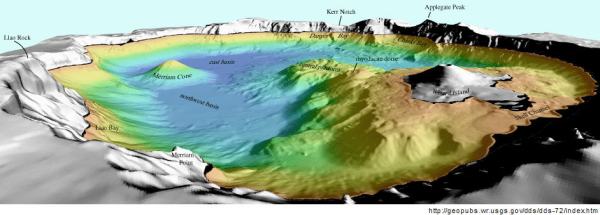
This image is from this USGS site — here’s a blurb about Crater Lake.
Crater Lake, the deepest lake in the United States, occupies a caldera in Mount Mazama, a Cascade Range volcano that once stood about 3,700 meters (12,000 feet) above sea level. About 7,700 years ago in a catastrophic eruption that lasted only a few days, Mount Mazama ejected about 50 cubic kilometers (12 cubic miles) of magma in the form of pumice and ash. Near the end of the eruption, the mountain collapsed upon itself to form a large caldera. After this climactic event, volcanic activity resumed within the caldera, creating Wizard Island and other new landforms. All but the uppermost portion of the Wizard Island volcano is hidden from view below the surface of Crater Lake.
Everything you’ve ever wanted to know about Crater Lake can be found here.
~~~~~~~~~~~~~~~~~~~~~~~~~~~~~~~~~~~~~~~~~~~~~~~~~~
Personal book database – LibraryThing
I recently started adding books that I own into the site LibraryThing.com, which is a nifty online tool for organizing the books on your shelf. It is more than just a personal database — you can write your own review and it has a social aspect to it (e.g., discussion forums about specific books). I haven’t had the time to explore those features — for now, I’m simply adding a few books every now and then.
Adding books is super easy — you simply search for the title and/or author and it will typically find it very quickly. It even has options for different covers of books that may have numerous editions so you can get the one that exactly matches your copy. If you click on the image below you can see what I’ve added to date (which is mostly popular science books). There are a bunch more on my shelves that I hope to add over time.
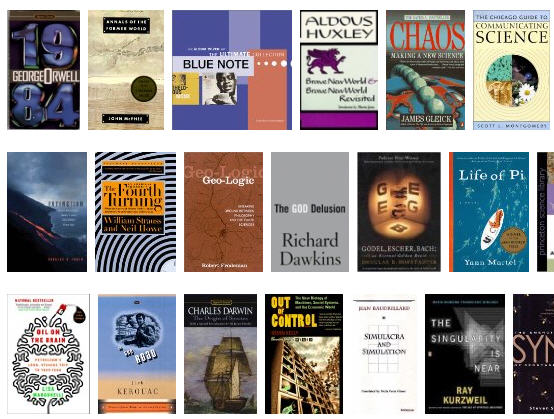
You can also see the tags I’ve added for the books to get a sense of the kind of books are in my library.
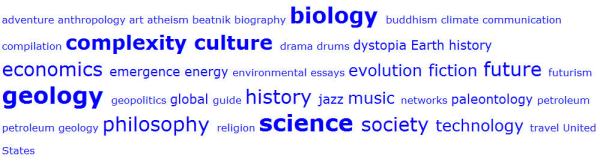
When you click on a tag it’ll take you to a global list of other books with that tag. This is a neat way to look for other books you might like — I suppose it’s similar to the people-who-bought-this-also-bought-this features on sites like Amazon or Barnes & Noble, but it is a bit different because it’s created by a community of readers instead of book sellers.
I don’t know if I’ll ever take the time to write reviews and I doubt I’ll participate in the discussion forums, but it’s a nice way to keep track of what I’ve read and what I own but haven’t had a chance to read yet.
~~~~~~~~~~~~~~~~~~~~~~~~~~~~~~~~~~~~~~~~~~~~~~~~~~
Friday Field Foto #73: Bootlegger Wash, Utah
This week’s Friday Field Fotos are from the fantastic Cretaceous of Utah. A field trip to investigate the shelf, shallow marine, and coastal plain depositional packages exposed in the Book Cliffs and surrounding areas is necessary for any budding stratigrapher … in fact, I’d say any geologist! How fun would that be to have a geoblogosphere field trip — someday perhaps.
The images today are photomosaics taken from the same spot (roughly) — in an area called Bootlegger Wash (east of the town of Green River). In 2002 I went out with the rest of my research group for eight or nine days to help collect some data for two students who were doing projects here. Both photos are old-school, low-res (pre-GigaPan) mosaics.
The first photo below is the afternoon we arrived and shows us getting the campsite set up. The Book Cliffs outcrops are in the distance.
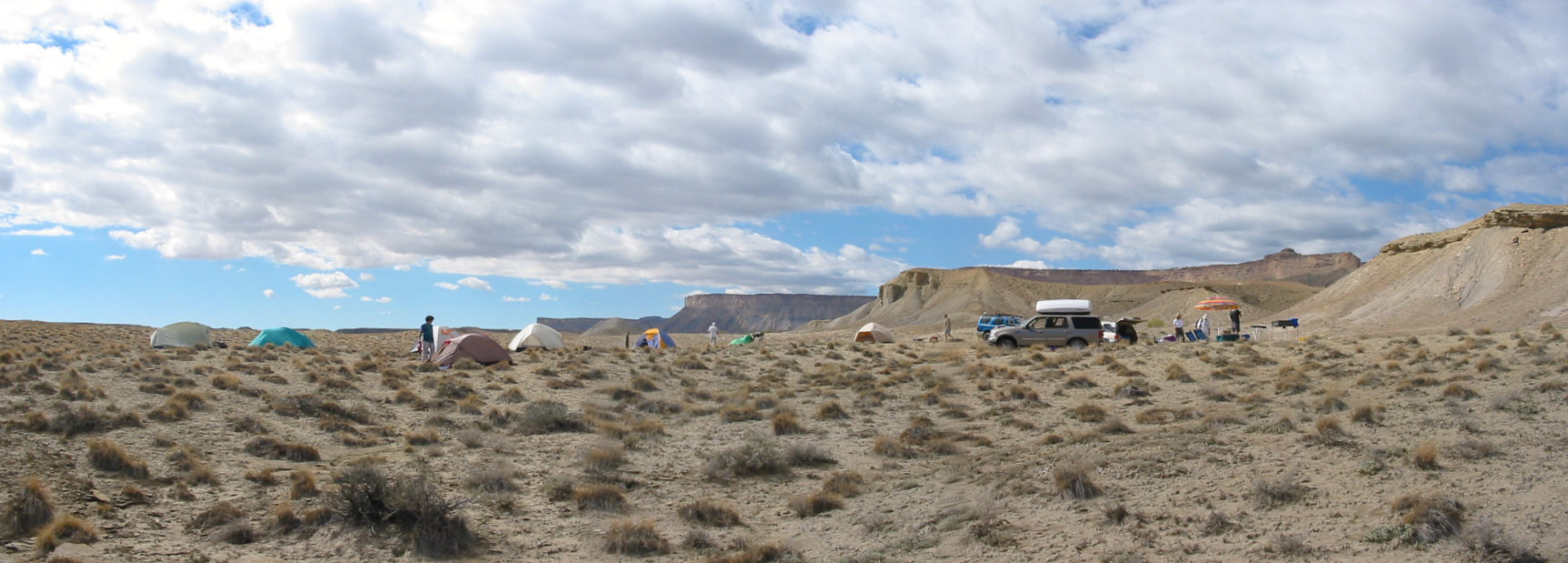
Campsite at Bootlegger Wash, Utah (© 2008 clasticdetritus.com)
If you were to hike a few hundred meters from camp and face southeast during sunset, you would see this (below).
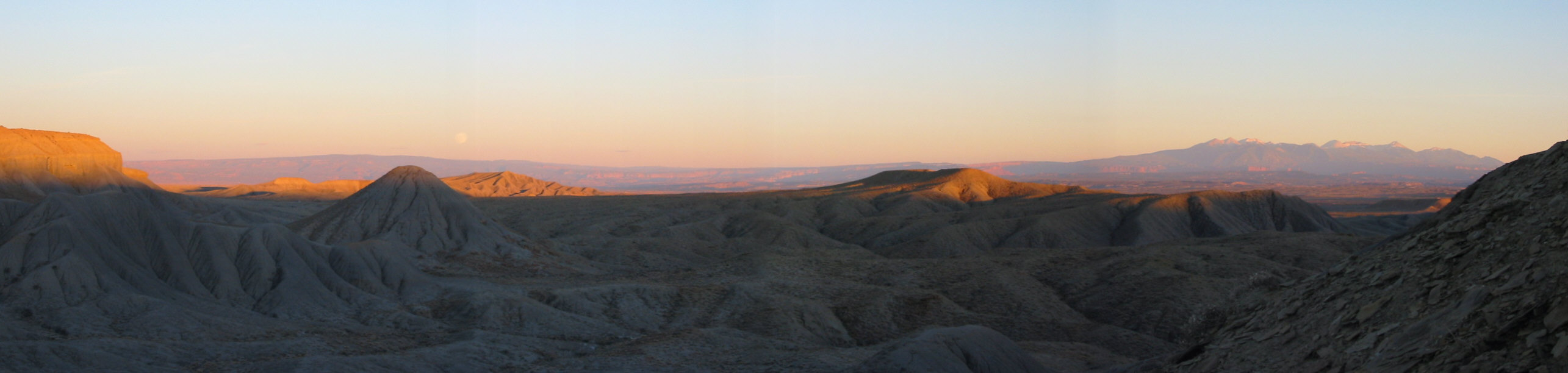
Sunset from Bootlegger Wash, Utah (© 2008 clasticdetritus.com)
In the far right of the photo are the Lasalle Mountains and Arches Nat’l Park in the distance.
–
Happy Friday!
~~~~~~~~~~~~~~~~~~~~~~~~~~~~~~~~~~~~~~~~~~~~~~~~~~


 Clastic Detritus