Post-defense blogging
Well…it’s all over.
My defense was on Friday morning and all-in-all it went smoothly. My talk went really well (I thought)…I even had a good time giving it. The closed-door session went the whole two hours and was pretty good. One committee member brought up some problems in one of my dissertation chapters. He made some good points about mis-usage of terminology…and some other comments that I don’t necessarily agree with fully. Maybe I’ll expound on those at some point in the near future. It’s not a big deal…I’m happy to make the revisions, and it won’t be that difficult.
My family and friends were all there waiting for me after the closed-door session and we celebrated with some champagne and orange juice.
It’s been a great weekend…my family came out and we’ve spent the last two days touring around San Francisco. It’s fun being a tourist in your own city sometimes.
It still hasn’t really sunk in just yet that the defense is over. It might take another couple of weeks.
I’ll be attending the AGU conference from Tuesday through Friday, so you can look forward to some posts about that in the next few days.
~~~~~~~~~~~~~~~~~~~~~~~~~~~~~~~~~~~~~~~~~~~~~~~~~~~~~~~~~~~~~~
AGU presentation next week
The American Geophysical Union (AGU) Fall Meeting is here in San Francisco next week. This meeting is one of, if not the, biggest congregations of earth, planetary, and space scientists in the world every year. It usually attracts about 15,000 or so.
I love AGU. All the spheres are represented — litho, hydro, strato, tropo, iono, cryo, magneto, and so on. There is plenty of great stuff to see. As these posts from Thermochronic, Yami, and Andrew discuss, AGU typically gets a lot of media attention as well.
I was invited to give a talk about some work I’ve done (and will defend tomorrow) looking at the characteristics and controls of deep-marine sedimentation patterns from a basin offshore of southern California.
The title of the session is:
The first part of the session is focused on fluid transfer and the second part on sediment transfer. The session is on Wednesday and my talk is second-to-last: 11:50am in MW 3001. Check the program when you get there just in case times and/or rooms change. So, come on by before heading out to lunch and check it out.
The title of my talk is:
Controls on Coarse-Grained Sediment Delivery and Distribution in the Holocene Santa Monica Basin, California: Implications for Evaluating Source-to-Sink Flux at Millennial Time Scales in a Deep-Marine Basin
That’s a mouthful. I’ve included the text of the abstract below, or you can find it here.
~
Accumulations of terrigenous sediment in deep-marine basins commonly represent the terminal position for source-to-sink sediment flux across a continental margin. The sedimentary succession in the sink records the interactions of external, or allogenic, controls (e.g., eustasy, climatic conditions, tectonic activity) and intrinsic, or autogenic, dynamics (e.g., sediment gravity flow processes and development of depositional relief). Analyzing terrigenous sediment from a sink to determine the relative contributions and thus, the history of external controls has been difficult owing to limited knowledge of event timing. In this study, six new radiocarbon (14C) dates are integrated with five previously published, but recalibrated, dates from a 12.5 meter-thick turbidite section from ODP Site 1015 in Santa Monica Basin, offshore southern California (33°42.925″N; 118°49.185″W; water depth = 900 m). This borehole is tied to high-resolution seismic-reflection profiles that cover a 1,000 km2 area of the middle and lower Hueneme submarine fan and most of the basin plain. This regional stratigraphic framework provides the highest temporal resolution to date for a thick-bedded Holocene turbidite succession, permitting an evaluation of source-to-sink controls at millennial (103 yr) scales. The depositional history from 7 ka to present indicates that the recurrence interval for large turbidity current events is relatively constant (300-360 yrs), but the volume of sediment deposited on the fan and in the basin plain has increased by a factor of two during this period. Moreover, the amount of sand per event (i.e., thickness of turbidite bed) on the basin plain during the same interval increased by a factor of six. Maps of sediment distribution derived from correlation of seismic-reflection profiles indicate that this trend cannot be attributed exclusively to autogenic processes (e.g., lobe progradation). The observed variability in sediment accumulation rates is thus mainly controlled by allogenic factors, including: (1) increased discharge of Santa Clara River as a result of increased magnitude and frequency of ENSO events from approximately 2 ka to present; (2) decreasing rates of sea-level rise (i.e., sea level reaches present stand approximately 7 ka); and (3) an apparent change in routing of coarse-grained sediment within the staging area at approximately 2-3 ka (i.e., from direct river input to indirect, littoral cell input into Hueneme submarine canyon). The Holocene history of the Santa Clara River-Santa Monica Basin source-to-sink system demonstrates how the interaction of varying sediment flux and changes in dispersal pathways affects the basinal stratigraphic record.
~
Hope to see you there! A group of geology bloggers, including me, are also planning to meet up and interact with each other in the real-life world. Pay attention to this post over at Green Gabbro, or keep your eyes peeled for another post with more details about this meet-up.
~~~~~~~~~~~~~~~~~~~~~~~~~~~~~~~~~~~~~~~~~~~~~~~~~~~~~~~~~~~~~
48 hours to go…some thoughts about science
I apologize that my posting is rather thin and light this week … my defense is on Friday morning so I’m a bit preoccupied. :)
Not necessarily crazy busy, like the days leading up to the handing-in-the-draft deadline, but simply preoccupied. I’m actually enjoying being able to focus on a single presentation for several days in a row. Typically, my talks at meetings end up going fairly well but I haven’t actually formally practiced a talk in years. I usually don’t have the time.
But, the presentation on Friday is arguably the most important of my scientific career thus far. Are the results of my research some giant breakthrough in sedimentary geology? Not likely. I think people (some scientists included) need to understand how science progresses — through incremental steps over long periods. Yes, there are certainly big leaps (breakthroughs) that are attributed to individuals or small groups of researchers, but those need to be considered within the context of the incremental progression. The breakthroughs could not happen by themselves. The breakthroughs get a lot of attention, but attention means diddly-squat in the bigger picture. Breakthroughs are a lot easier to report on and write about in popular media. But they, by themselves, are not what science is. It seems increasingly more difficult for people to appreciate the significance of the summed result of lots of science over many years (e.g., evolution). They want to point to a single person, or small group that is responsible (which also makes it easier to attempt to knock it down). Perhaps this simplified view is easier to grasp, but it doesn’t make it right. Those going into science, those kids that have an interest and curiosity, should appreciate the process and the bigger picture. If not, they may get disillusioned quickly.
Doing science is being a small cog in a giant wheel. Unfortunately, it seems this view is taken rather negatively nowadays. As if being a part of something bigger takes away from individuality. I think that’s a bogus viewpoint. If what I do ends up getting acknowledged beyond my small specialist clique, that’s great! But, I don’t expect it to. I’m not in science for fortune and glory. Surely, I would enjoy the accolades and try to capitalize on it (i.e., get more funding to do more), but visions (delusions) of grandeur certainly don’t motivate me.
If you are a student just beginning in science and have visions of being the “famous researcher” with all the press and talk show appearances, chances are you will not be that person…sorry. If you have ambitions of making important contributions to something bigger than you, then you are on the right track. I’m a huge fan of the notion “the whole is greater than the sum of its parts”. Science is bigger and more important than any one researcher.
Anyway…I started this post talking about preparing for this presentation. I got a little sidetracked. I guess my main point is that I don’t get frustrated that all this work over many years will, in the end, represent a rather small incremental step forward. I don’t view that result as something negative. I view it as science.
~~~~~~~~~~~~~~~~~~~~~~~~~~~~~~~~~~~~~~~~~~~~~~~~~~~~~~~~~~~~~
A little break in the action…
I haven’t seen this bit in a while…one of my favorites.
This is a lot funnier if you are a fan of both hockey and the movie Pulp Fiction.
Okay…back to defense preparation.
~~~~~~~~~~~~~~~~~~~~~~~~~~~~~~~~~~~~~~~~~~~~~~~~~~~~~~~~~~~~~~
Sea-Floor Sunday #6: Hudson Shelf Valley
 Hey, all you east-coasters! Perhaps you thought I forgot about the fantastic submarine seascapes off the east coast of North America. I suppose I’m biased to the continental margin in my backyard, as evidenced by all my posts about California (e.g., here, here, and here).
To remedy that, today’s Sea-Floor Sunday highlights the area offshore of New Jersey, New York City, and Long Island. Specifically, the Hudson Shelf Valley cutting across the continental shelf.
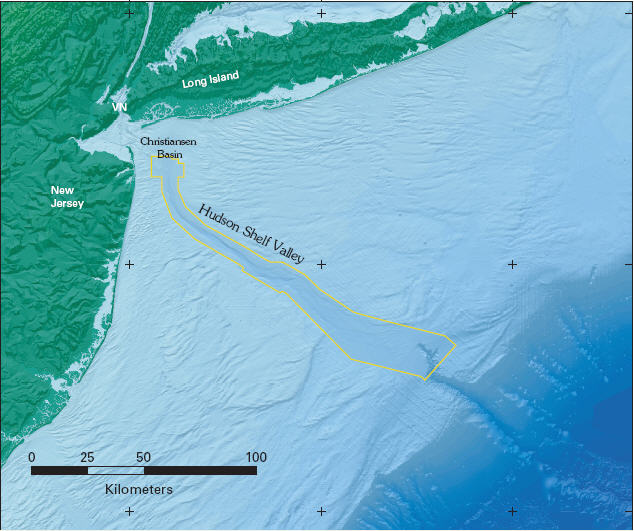
For those unfamiliar with east coast United States geography, New York City is at the far western end of Long Island (where it says “VN” on the image above), where the Hudson River empties into the Atlantic Ocean (image from here; click on it to see a higher-res version).
The first general aspect to point out is how broad this shelf is compared to the west coast of the US. At this location, the shelf is 180 km (110 mi) wide; along much of California it is on the order of 15 km (9 mi) wide, more-or-less. This is a function of a “passive” continental margin vs. an active margin. Along the east coast, the continental to oceanic crust transition is an old rifted margin. The active spreading center (the Mid-Atlantic Ridge) is now 2,800 km (1,700 mi) away. In this area, the rifting of continents started in the Triassic (225 million years ago). In other words, this margin has been relatively quiet (tectonically) since then, hence the “passive” adjective. In contrast, the west coast is an active margin…the plate boundary (i.e., San Andreas Fault system) is right there and moving now.
The figure below (from here) is a generalized cross section of the east coast continental margin (the Baltimore Canyon is just south of the Hudson area shown in the map above). The greens and yellows represent a couple hundred million years of sedimentary fill that overlaps this old rifted margin. You can see how the continental shelf can get so wide…the current shelf break is way out there far from shore as a result of sedimentary systems building out into the ocean. They are trying their hardest to fill that oceanic basin.

Okay…back to the Hudson Shelf Valley. The image below is a perspective image looking to the northwest and nicely shows the valley extending from where the modern Hudson River mouth is (image from here; click on it to see a higher-res version).

During the Last Glacial Maximum (~25,000-18,000 years ago) the sea level was much lower. The coastline was out at the present shelf break (on the image above, this is almost to the head of the Hudson submarine canyon, which is just barely visible in dark purple). Take a look at that generalized cross section above again…bring sea level down just a bit and you can see how that sedimentary shelf can build out. So, this shelf valley was the path of the Hudson River during this lowstand in sea level.
But, its morphology as we see it today is not simply a relict river valley. Deglaciation following the ice age did not happen smoothly everywhere. As we map the sea floor more and study the evolution of these systems we are discovering evidence for huge meltwater flooding events. I blogged about the Lake Missoula outburst here and the English Channel event here. Research has revealed that this valley was also the conduit for similar large meltwater pulses during deglaciation in latest Pleistocene (~13,000-14,000 years ago; see cited references below).
It’s difficult to know precisely how much these catastrophic events shaped the morphology of the Hudson Shelf Valley we see now, but it was likely significant. It is also important to remember that our knowledge of deglaciation events such as these is biased to the Pleistocene-Holocene boundary simply because it is the most recent. The Quaternary has several glacial-interglacial cycles. It is highly likely that each deglaciation period generated numerous meltwater flood events around the planet that were then overprinted with younger events. The development of human civilization coincides with (and likely is successful as a result of) the most recent deglaciation. Stories and myths about catastrophic flooding events are a part of most cultures and religions for a reason.
Recently, Ole, Chris, and Zoltan all commented on the Black Sea flooding event. While this event is not tied to a specific ice-dam outburst event, it is also the product of rising sea levels following deglaciation.
—
Thieler, E.R., Butman, B., Schwab, W.C., Allison, M.A., and Danforth, W.W., 1999. Large relict bedforms at the distal end of the Hudson Shelf Valley result from a glacial break-out flood. Eos Trans. AGU, v. 80, no. 17 (supplement), p. S193.
Uchupi, E., Driscoll, N., Ballard, R.D., and Bolmer, S.T., 2001, Drainage of late Wisconsin glacial lakes and the morphology and late Quaternary stratigraphy of the New Jersey – southern New England continental shelf and slope: Marine Geology, v. 172, p. 117-145
Images and information presented here from this great USGS site.
Check out additional info on this NOAA site.
~~~~~~~~~~~~~~~~~~~~~~~~~~~~~~~~~~~~~~~~~~~~~~~~~~~~~~~~~~~~~~~
Planet Earth series
I know…I’m late to the party. There was tons of chatter about this 11-part series when it premiered several months ago. We don’t have cable and had to wait until we could get the DVDs via Netflix. There are only a two things that might make me break down and get cable sometime soon though (Jon Stewart and hockey playoffs). We’ll see.
Anyway…if I were not feeling so blog-lazy (i’ve been preoccupied lately), I would look into what others have said about the program and compare those to my own, etc. and so on … bah. Instead, I’m just gonna tell you what I think about it. How’s that?
We’ve only seen the first few discs so far and I am absolutely enthralled. The footage is spectacular! The version we get from Netflix is with David Attenborough narrating. I guess there was some complaints about the Sigorney Weaver version … I definitely like Attenborough, so I’m glad Netflix sends this one.
Each episode highlights a different setting on our planet (mountains, deserts, coasts, caves, etc.) and how it serves as a habitat for life. What I like about the series is that it mixes physical processes and conditions as they showcase the animals. Most “nature shows” are about animals. I know…biology, life, etc. is great. I get it.
But, as a geologist, it’s nice to see a high-profile program like this cover the important physical processes that life is superimposed on. For example, they did a great job of explaining how the Himalayas influence the climate and weather in the region and how, in turn, that affects the behavior and interdependence of the animals within the ecosystem. As we progress in natural science, we are appreciating more and more the linkages between these categories that define our specific fields of study. Nature is the ultimate complex system with all the sub-systems and components interacting and influencing all the other parts. That perspective is implicit within this program.
I think I remember reading some blog posts wondering if they ‘dumbed it down’ too much and other posts complaining about what wasn’t included that should’ve been, and so on. So far, I am very pleased. They can’t explain it all, and they also need to keep it accessible to a general public. This is a television show after all. Sure, I could nit-pick it some and, if I were in a different mood, maybe I would have. But I remember some of the posts complaining about it had the all-too-familiar tone of someone either jaded their interest wasn’t highlighted or that it didn’t quite live up to their expectations. I’ll let them quibble about that…I like the show…simple as that.
If you are a fan of quality photography/cinematography, then this show is worth it just for that. The sweeping, overhead views of migrating caribou or hunting African dogs or elephants braving a dust storm are incredible. I also enjoy the short segments at the end showing some “behind the scenes” of the work. For those that have done field work in remote and/or rugged places, you will appreciate and recognize the sense of humor exhibited by the researchers and photographers.
When we complete the series, maybe I’ll post again about my thoughts. for now, I give it a thumbs up.
(click on the image above to go to the website)
~~~~~~~~~~~~~~~~~~~~~~~~~~~~~~~~~~~~~~~~~~~~~~~~~~~~~~~~~~~~~
Feedback for next The Accretionary Wedge topic
Please head on over to this post at The Accretionary Wedge site and provide suggestions to Yorrike (Chris) regarding the topic for the next edition of TAW.
–
~~~~~~~~~~~~~~~~~~~~~~~~~~~~~~~~~~~~~~~~~~~~~~~~~~~~~~~~~~~~~~
38,561
I only became aware of International Dissertation Writing Month (InaDWriMo) very recently. I missed the boat. But, I did finish writing my own dissertation…or at least a draft of it. So, I guess I participated with knowing it. :)
StyleyGeek (from link above) suggest 45,000 words as a goal. While reading that post, I realized I had no idea how many words were in my dissertation…so I decided to check.
38,561
This includes references and captions. Is this a lot for a dissertation? Not much at all? I don’t know. It seemed like a lot write. It is subdivided into three chapters that are all within a few thousand words of each other regarding total count. Each chapter is a stand-alone paper. In other words, there is very little mention or cross-referencing of the other chapters. This is done because they were prepared for publication from the start (one was submitted in July).
This approach is very different from my master’s thesis, which was one long tome that needs substantial tinkering to turn into a submittable paper (sigh…someday). I very much like the approach for my PhD. Why write some 500-page treatise that few people will ever read. Why turn the treatise into publishable papers later, when you can just do that now? If you’re going into academia, you’re gonna need these pubs anyway.
But…I have received comments from a few people that one, long dissertation document provides a much more in-depth study of the particular subject. I’m not sure I agree…at least for my own case. My chapters (papers) do not contain every last little bit of information that I used in the study. These details are included in a substantial appendix, which is referred to throughout the dissertation (appendices not included in that word count above). So, similar to a data repository for a published paper, one can dive into the nitty-gritty if they want. But, I don’t discuss all of it in the text of the paper. It doesn’t need to be there. Like I said…this is the format of published papers, and I am glad that my institution does it this way. I feel way more prepared now to design, write, and submit (hopefully) publishable papers.
Finally…while the number of words is something measurable which can keep you motivated, we should not forget what the real goal is: quality over quantity.
Any thoughts on this matter? How is/was the format of your thesis or dissertation?
–
Note: saxifraga, over at Rising to the Occasion, participated in InaDWriMo within the context of finishing manuscripts for submission…check it out here.
~~~~~~~~~~~~~~~~~~~~~~~~~~~~~~~~~~~~~~~~~~~~~~~~~~~~~~~~~~~~~~~
Get devolutionized
I received this image through the grapevine … it is a scan out of a local newspaper. The event has already passed, but that doesn’t really matter, it is one out of numerous of such events.
What really bothers me is the “how to fight the culture wars” bit. It’s not about evolution or science at all…it’s just a platform to emotionalize people and coax them onto their “side” of the “war”.
How sad…how very sad.

~~~~~~~~~~~~~~~~~~~~~~~~~~~~~~~~~~~~~~~~~~~~~~~~~~~~~~~~~~~~~~
Friday Field Foto #36: Thrust fault contact
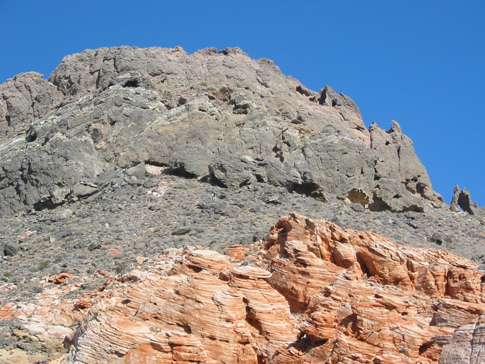
This is near the Valley of Fire region in southernmost Nevada.
The gray rocks are Paleozoic carbonates, the vibrant orangish rocks are Jurassic eolian rocks. Older on top of younger — yay for thrust faults! If I remember, I think this is called the Keystone Thrust.
Note the person on the hillslope just below the gray cliff for scale.
~~~~~~~~~~~~~~~~~~~~~~~~~~~~~~~~~~~~~~~~~~~~~~~~~~~~~~~~~~~~~


 Clastic Detritus