This is my second time hosting the geoscience blog carnival – The Accretionary Wedge. The other time was the inaugural edition waaay back in September of 2007.
For this installment of The Accretionary Wedge I am asking for posts that speculate about the future of the Earth within the context of geological processes/events.
I was inspired by reading the book Year Million in which an assortment of scientists, technologists, social scientists, economists, etc. ponder what will be in a million years from now. The majority of the essays discuss the course of civilization, technology trends, biological evolution, and the general fate of the human world.
Originally, I was going to propose the million years … but I think that is too limiting. You can speculate about 10,000 yrs, 100,000 yrs, a million, ten million, 100 million and so on.
I’m not necessarily looking for well-constrained predictions … this is mostly meant to be fun speculation. Be creative!! Although if you do want to project the configuration of plates and long-term climate cycles and all that rigorously — go for it.
Please put a link to your post below or e-mail me the link by Friday, January 30th and I will put them together before the end of that weekend. I’ll put out a reminder post in another couple weeks.
–
Note: The December ’08 installment will now be in March ’09; see this page on the archive site for the schedule and feel free to volunteer to host (and come up with a fun topic)
~~~~~~~~~~~~~~~~~~~~~~~~~~~~~~~~~~~~~~~~~~~~~~~~~~
Friday Field Foto #75: Nonconformity in the Franklin Mountains
This week’s Friday Field Foto is from the geological wonderland of west Texas/southeastern New Mexico.
A nonconformity is a type of unconformity where sedimentary rocks directly overlie igneous or metamorphic rocks. In this case, the Cambrian-Ordovician (540-440 Ma) Bliss Sandstone sits atop the intrusive igneous rocks of the Red Bluff Complex, which are dated as 1.17 Ga. The reddish igneous rocks are in the lower right and the Cambrian sandstones are the lighter-colored rocks in the middle of the hill (the bedded rocks near the top is yet another formation but I forgot the name).

Franklin Mountains, El Paso, Texas (© 2009 clasticdetritus.com)
This photo may not look like much, but what’s really cool about this (and other outcrops along the Franklins) is that in places the lowermost Bliss sandstone beds onlap the older igneous rocks. That is, the older rocks had a undulating topography such that the lowest areas (valleys) accumulated sediment first. It is very cool to think about this ~500 million year old landscape with rolling hills.
You’ll commonly see unconformities referred to as “missing time” — that is, there is a break in the stratigraphic record (in this case, at least 630 m.y., which is more time than the entire Phanerozoic!). But, the time isn’t really “missing” … it’s simply recorded in a different way. Some time is recorded by rock, some time is recorded by surface. Think about the surface of the Earth right now — the current snapshot in geological time. The distribution (not to mention rates and potential preservation) of deposition is extremely variable. Thus, the “completeness” of the stratigraphic record is also variable. Referring to unconformities as “missing” time is misleading — there is a story there, it’s just recorded in the strata in a different way.
–
check out more photographs of the Bliss Sandstone in the Franklin Mts here and here
~~~~~~~~~~~~~~~~~~~~~~~~~~~~~~~~~~~~~~~~~~~~~~~~~~
States and countries visited meme
I saw this one going around some of the paleo blogs earlier today.
You go to this site and click on all the states you’ve visited. Here’s mine (I didn’t include states where I’ve only been to the airport).
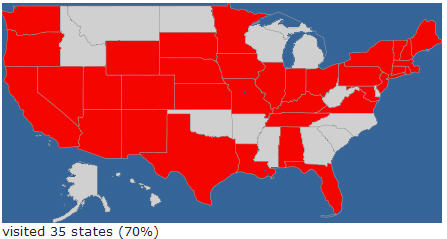
Not too bad … but, I can’t believe I haven’t been up to Idaho and Montana yet!
UPDATE: Here are the states that I’ve lived in (had a permanent address and was there more than a couple months).
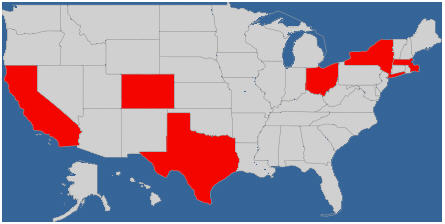
You can also do this by country (below).
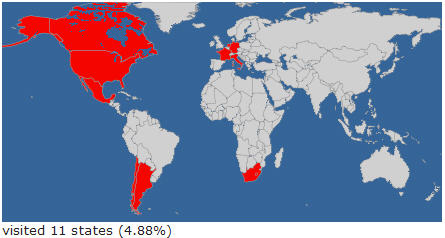
Pretty pathetic. I need to get myself over to Asia … I’ve always wanted to visit Japan.
~~~~~~~~~~~~~~~~~~~~~~~~~~~~~~~~~~~~~~~~~~~~~~~~~~
 The Pacific Section AAPG is holding their annual meeting in Ventura, California from May 3rd-6th, 2009.
Section meetings can be quite a bit smaller and typically include technical sessions with a local or regional spin. If the combination of good sessions with enthusiastic presenters happens, these section meetings can also be a lot of fun and scientifically fruitful.
Almost a year ago USGS marine geologist Bill Normark passed away after a seven-year battle with cancer. He was on my Ph.D. committee and a significant positive influence to my scientific and personal life.
Bill pioneered the investigation of modern submarine fan systems in the late ’60s and early ’70s (following in the footsteps of Francis Shepard) and stayed at the cutting edge throughout his career. Using the latest technology, whether it was seismic-reflection or autonomous vehicles, Bill explored sedimentary systems on the sea floor with passion and enthusiasm. He had the rare combination of being meticulous with details and never losing sight of the bigger picture. His publication record is ridiculous … I don’t even know where to start.
He was an inspiration and mentor to numerous sedimentary and marine geologists over the years. Some colleagues and I decided that the PSAAPG meeting would be a great venue to honor Bill’s contributions to the field. He spent the bulk of his career at the USGS office in Menlo Park, CA and studied nearly all the submarine fan systems along the western margin over the years. Bill also instigated (along with Emiliano Mutti) serious discussions about the values and limitations of comparing modern and ancient submarine fan systems. Their 1987 paper is one of a handful of papers I recommend to those just beginning to study turbidite systems.
We are chairing two sessions that honor Bill’s legacy:
Modern Sea-Floor and Quaternary Turbidite Systems Offshore Western Margin of the United States in Honor of Bill Normark
and
Making the Link from Modern to Ancient Turbidite Systems: An Integrated Approach in Honor of Bill Normark
You can find these sessions along with the other proposed sessions here. If you do any research along these lines and would like to present at the meeting, you can find information about submitting here. The deadline is January 31st, 2009.
~~~~~~~~~~~~~~~~~~~~~~~~~~~~~~~~~~~~~~~~~~~~~~~~~~
California Academy of Sciences
I apologize for the lack of in-depth geoscience posts lately. To be perfectly honest, I am incredibly busy right now and will be even busier in the short-term future. I really hope I can carve out some time to write quality posts but it’s not looking good. I’m not done blogging completely, but posts will almost certainly become less frequent and not as well-researched and detailed as I would like. Just a warning.
–
 The California Academy of Sciences in Golden Gate Park may not be a gigantic museum but what it lacks in quantity is more than made up for in quality.
The museum (also called ‘The Academy’) recently re-opened after several years of significant renovations — so significant that it is essentially a brand new building. The new building is a marvel of the latest in energy efficiency.
The Academy is now the largest public Platinum-rated building in the world, and also the world’s greenest museum. The Academy earned the platinum rating (highest rating possible) for Leadership in Energy and Environmental Design (LEED). This commitment to sustainability extends to all facets of the facility – from the bike racks and rechargeable vehicle stations outside the building to the radiant sub-floor heating inside the building to the energy-generating solar panels on top of the building!
Not only does the roof have solar panels — the roof is alive!
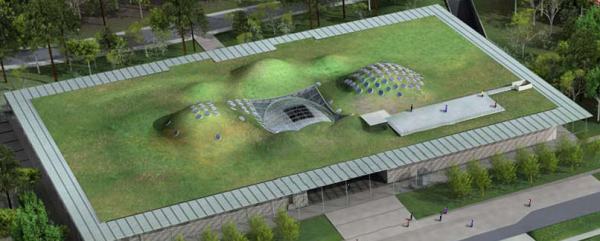
Since the Academy re-opened it has been jam-packed every weekend. My wife and I finally got a chance to check it out in late November 2008. The one thing we always do for the museums/galleries here in the area we live is to make sure to leave plenty of stuff to see next time. The California Academy of Sciences has two giant, four-story spheres that dominate the interior of the building — one is the planetarium and one is a rainforest. It seemed like everyone was going for the planetarium so we headed straight for the rainforest exhibit — we’ll save the planetarium for next time.
The photos below are from this visit (explanations are beneath the photo).

Living rainforest exhibit, California Academy of Sciences (© 2009 clasticdetritus.com)
The base of the rainforest has a deep ‘pool’ with fish in it.

Living rainforest exhibit, California Academy of Sciences (© 2009 clasticdetritus.com)
Every minute or so the mist/fog machine turns on for a few seconds — to help moisten the plants and animals.

Living rainforest exhibit, California Academy of Sciences (© 2009 clasticdetritus.com)
As visitors make their way up the rainforest each level has information discussing the types of animals that like to live in that part of the forest.

Gecko in the living rainforest exhibit, California Academy of Sciences (© 2009 clasticdetritus.com)
Most of the amphibians and reptiles aren’t roaming around the exhibit freely but within glass enclosures. This gecko was hanging out on the glass and I couldn’t resist snapping a picture of its feet.

Frog in the living rainforest exhibit, California Academy of Sciences (© 2009 clasticdetritus.com)
Check out the green and red frog in the lower left of the photo (if anybody knows the name of this species feel free to comment below).

Living coral reef exhibit, California Academy of Sciences (© 2009 clasticdetritus.com)
After checking out the rainforest, we took the elevator to the bottom floor. Just beyond the rainforest is the coral reef exhibit — and what makes this unique is that it is an actual living coral reef.
At a depth of 25 feet and holding 212,000 gallons of water, the Philippine Coral Reef is one of the deepest exhibits of live corals in the world. It houses a broad range of aquatic life from the coral reefs and mangroves of the Philippines, one of the most diverse reef systems in the world. These animals include delicate soft and hard corals, blacktip reef sharks, stingrays, and more than 2,000 colorful reef fish.

Albino alligator, California Academy of Sciences (© 2009 clasticdetritus.com)
We spent a lot of time in the aquarium and then checked out this pair of alligators on our way out (one of them is a lot easier to see than the other).
–
note: all photos taken by me and can be found on this Flickr page
~~~~~~~~~~~~~~~~~~~~~~~~~~~~~~~~~~~~~~~~~~~~~~~~~~
Sunday potpourri
There seems to be a lot of great interwebs stuff to read and distract you from doing real work in the last couple of weeks.
–
(1) Did you miss cryology and co.’s ‘The Twelve Days of Geology’? If so, go check it out … it’s quite good.
(2) Kim has a thrust belt in her driveway.
(3) Callan found a video of John McPhee and Eldridge Moores on YouTube.
(4) Suvrat discusses external and intrinsic controls on sedimentation and asks the geoblogosphere a question about how the size of your research lab might influence the ideas you research.
(5) Chris M. plays around with the Earth Impact Simulator (you put in all sorts of parameters like asteroid size, angle of impact, composition, etc. and it tells you about the resulting damage).
(6) David tells us about the rocks at Stonehenge.
(7) Maria injects a bit of caution for those getting all worked up about the Yellowstone quakes.
(8) I’ve enjoyed the three-part series of guest posts from Ken Miller over at The Loom where he eloquently dismantles attempts from Intelligent Design cranks to resurrect the same old arguments … again. Part 3 is here, links to parts 1 and 2 can be found there.
(9) Google is planning on putting data centers out in the ocean … huh?
(10) Very cool interactive feature from the Understanding Science website about how science really works.
(11) Check out this fantastic and comprehensive review of what the Mars rovers Spirit and Opportunity have done with their nearly five years of field work on the red planet.
(12) Finally … in case you are wondering where it is — Where on (Google)Earth #155 is over on Peter’s SmugMug site. It has been stalled there for over a month — get the location and host the next one!
~~~~~~~~~~~~~~~~~~~~~~~~~~~~~~~~~~~~~~~~~~~~~~~~~~
Sea-Floor Sunday #38: 3-D image of Atlantic Ocean from 1920s
This week’s Sea-Floor Sunday image is from the treasure trove that is the NOAA Photo Library website. What is it? Here’s a blurb from their site:
NOAA is descended from the oldest physical science agencies in the United States Federal Government including the Coast Survey (1807), Weather Service (1870) and Fish Commission (1871) … the NOAA collection includes thousands of weather and space images, hundreds of images of our shores and coastal seas, and thousands of marine species images ranging from the great whales to the most minute plankton.
While looking through their catalog of images I came across this very cool 3D rendering of bathymetric data from the late 1920s.

credit: NOAA Photo Library (http://www.photolib.noaa.gov/htmls/map00077.htm)
Click on the image to go to the NOAA Photo Library page for this image (or click here for the full resolution version).
This 3-D view of the equatorial Atlantic seafloor was produced following the German METEOR Expedition of 1925-1927. The Mid-Atlantic Ridge snakes down the middle of the Atlantic Ocean between Brazil on the left and Africa on the right.
Although the resolution of the data isn’t very good, the detail of the image itself is exquisite. Below is a zoomed in part of the image.

credit: NOAA Photo Library
I highly recommend checking out NOAA’s site … lots of great stuff.
~~~~~~~~~~~~~~~~~~~~~~~~~~~~~~~~~~~~~~~~~~~~~~~~~~
Friday Field Foto #74: Deep-marine mud
This week’s Friday Field Foto is from a short research cruise on went on a few years ago just off the coast of central California. This kind of field work is different from what I usually show, but is field work nonetheless.
The goal of the cruise was to collect some samples from an area of the sea floor (~1,000 m water depth) where a high-resolution mapping and profiling survey had been done several weeks before.

Push core samples of deep-marine mud, offshore central California (© 2008 clasticdetritus.com)
Two tools were used to collect sediment samples — a vibracoring system that gets 1-2 m thick cores and a push core system that retrieves 20-30 cm thick cores, which are shown above. A quick description is done and a suite of smaller samples are taken from the cores for later analysis.
Happy Friday!
~~~~~~~~~~~~~~~~~~~~~~~~~~~~~~~~~~~~~~~~~~~~~~~~~~
Climate cycles recorded in Mars sediments?
 I first saw this press release on the Arizona Geology blog a couple weeks ago and it caught my eye. Cycles in sediments — I love that topic. Who doesn’t?!
A study led by researchers from Caltech used high-resolution images of the surface of Mars (from HiRISE) to document and analyze ancient sedimentary layering exposed at the surface of the red planet. Before discussing the study and the paper, I just want to make a comment about press releases. As with most press release titles, I’m not a huge fan of this one:
Caltech Researchers Find Ancient Climate Cycles Recorded in Mars Rocks
Yes, I realize these titles are written to attract readers. And, yes, I realize that the real titles of papers are typically full of jargon … but, here’s the title of the paper:
Quasi-Periodic Bedding in the Sedimentary Rock Record of Mars
See the difference? The title for the actual paper directly fits the results of their study — what they found with the data they collected and analyzed. The press release title jumps immediately to an interpretation and implications of those results. Maybe you think I’m splitting hairs and/or being overly cranky, but there is a difference. Here is a statement in the abstract about the rhythmic bedding:
This repetition likely points to cyclicity in environmental conditions, possibly as a result of astronomical forcing.
The repetition in the bedding is what the study documents, a reasonable interpretation of the repetition is that it’s a function of cyclicity in the controls on bedding — and, finally a statement about the possibility of that cyclicity itself being forced by orbital geometry (e.g., Milankovitch) factors. This is what you do in a paper like this — report your results and then discuss interpretations. This is in contrast to the statement from the press release that jumps directly to the potential implications. The reason I bring this up is because I fear that the language in press releases can really throw some people off. I strongly urge those who typically read only press releases to track down the actual papers from time to time. I realize access is an issue for many … but at least read the abstract, which is almost always available for free.
–
Okay, enough of that … this paper, which was published in Science by Lewis et al. in December 2008, is very cool. You can find the paper here, or read the press release here.
The study area for this work is an area on Mars called Arabia Terra where layered sedimentary rocks are beautifully preserved within craters. The image below, which is from the Mars Reconnaissance Orbiter (MRO) website, shows the nature of these exposures in Becquerel Crater.

The authors of the study used 1 m-resolution stereo images from the HiRISE equipment onboard the MRO to analyze the bedding. The images were integrated with a digital terrain model (DTM), which allowed correcting for structural dip. Spectral analyses* of both thickness and color (i.e., image grayscale/brightness values) revealed statistically significant quasi-periodicity of the layering. Their analysis also revealed multiple orders of layering — beds (meter scale) and ‘bundles’ of beds (10s of meters scale). To see the actual results and read about their methods please see the original paper.
The observation of rhythmic layering on Mars at multiple locations across the Arabia region constitutes evidence of cyclic variation in ancient surface conditions.

Credit: Topography, Caltech; HiRISE Images, NASA/JPL/University of Arizona (click on image to go to source)
The biggest question on my mind while reading this paper is what the depositional environment was for these sediments. Johnson et al. address this question directly when they state:
The nature of the sedimentation process that deposited the Arabia layers remains uncertain. However, the observation of regularly cyclic bedding rules out processes that occur in a purely stochastic manner, including volcanism and impact cratering. … the size-frequency distributions of many stochastic depositional processes are skewed toward smaller events and can be described in many cases by a power law. Such processes include turbidites, flood events, landslides, volcanic eruptions, and impacts …
If I had to wildly speculate provide an educated guess — I would say that these strata represent chemical sedimentation processes of some kind (e.g., precipitation out of solution). To get such rhythmically-bedded deposits that are so consistently thick across a large area usually requires relatively “quiet” conditions (i.e., not a lot of highly energetic processes like waves and currents moving sediment around). Perhaps in the interior of a large lake or similar body of water. But, this is just a hunch — it would be fun to chat with the authors to hear their speculation.
The paper then discusses the intriguing implication of these rhythmic deposits — that they were caused by climate cycles. If the observed cyclicity is not a function of stochastic depositional processes or internal dynamics (sometimes referred to as autogenic cycles) then external forcings are at play. In this case, the authors draw upon research that has been done on Earth regarding the signature of Milankovitch cycles in strata.
Based on a pattern of layers within layers measured at … Becquerel crater the scientists propose that each layer was formed over a period of about 100,000 years and that these layers were produced by the same cyclical climate changes [link].
How cool is that!? This is an intriguing study because if we can find more areas on Mars where this method can be applied then we’ll have a better chance at unraveling the planet’s climate history (at geological time scales), which will help us better understand the planet’s overall geological history. This is why these orbiters, landers, and rovers are so important — they are collecting so much information that researchers can do science with.
–
Reading this paper and writing this post got me thinking about planetary science in general. An interesting area of research is investigating and testing various remote sensing tools and methods here on Earth where researchers can “ground truth” the results and comparing that with results from Mars (or other bodies). Obviously, there will always be specific aspects of other planetary bodies that are different from Earth — tests like that may not always return valuable results, especially for very specific questions. But I think it is valuable to do such studies to get a general sense of which methods work in different situations and why.
Within the context of the Lewis et al. study, it would be interesting to see if something like this has been done for a location on Earth — where rhythmic bedding was analyzed quantitatively by remote sensing methods and from direct measurement on the ground. How might they compare? How significant would the measurement error be between the methods? Etc.
It’s very exciting to see how methods of sedimentary research that have been utilized on Earth are influencing the investigation of sediments and sedimentary rocks on other planets.
–
–
K. W. Lewis, O. Aharonson, J. P. Grotzinger, R. L. Kirk, A. S. McEwen, T.-A. Suer (2008). Quasi-Periodic Bedding in the Sedimentary Rock Record of Mars Science, 322 (5907), 1532-1535 DOI: 10.1126/science.1161870
* See this post from the climate science blog Open Mind for some general information about how researchers use statistical methods to extract information about cycles.
Note: this blog post is a very short summary of some of the aspects of this study and is not meant to be a thorough review — please read the original paper for more.
~~~~~~~~~~~~~~~~~~~~~~~~~~~~~~~~~~~~~~~~~~~~~~~~~~


 Clastic Detritus