Geoblogosphere week in review (August 2-8, 2010)
Here are several posts from the geoscience blogosphere last week highlighting interesting writing/blogging:
- Dave Petley of Dave’s Landslide Blog started covering the Indus River flooding in Pakistan last week with this post discussing the inevitable southward progression of the flood wave and then continued fantastic coverage throughout the week (Aug 3, Aug 4, Aug 5). The latest post from a couple days ago is here.
- Erik Klemetti of Eruptions is asking for some feedback about his coverage of the Eyjafjallajökull eruption this past spring — and, wow, as of this writing he had over 180 comments!
- Garry Hayes of Geotripper shares some photographs from a former student climbing El Capitan in Yosemite (which takes ten days). Wow!
- Mark Wilson of Wooster Geologists shares a quick story of how his presentation at a conference was interrupted by a fire alarm only a minute before the conclusion!
- Ole Nielsen of olelog briefly discusses a paper that came out in PNAS about using frogs to address plate tectonics.
- Chris Rowan of Highly Allocthonous shares his thoughts on the largely strike-slip movement related to a 4.8 earthquake that occurred in the Grand Teton Mountains of Wyoming this past week.
- Speaking of the Tetons, Julia of Stages of Succession highlights reports about Wyoming state officials considering (threatening?) selling a large chunk of Grand Teton National Park.
- A new geoscience blog on the scene by Katharine N. called Hydrofelicity has a nice summary of group of groundwater contaminants known as DNAPL (Dense Non-Aqueous Phase Liquids). This is some good background for those wondering what contaminant hydrogeologists deal with.
- Ryan of The Martian Chronicles talks about his trip to Glacier National Park to observe and interpret some very old sedimentary rocks — and he ends the post with a doozy of a photo geopuzzle.
–
In the wake of the most recent Accretionary Wedge, which reflected on the role of geoscience blogs, there were a couple of follow-up posts of note:
- Chris Rowan of Highly Allocthonous continued the discussion of geoscience blogging within the context of the announcement and unveiling of a new science blogging collective called Scientopia. The comment thread is especially valuable in that it seems to have sparked an idea to create a group blog about geoscience as it relates to policy and society. We’ll see who steps up and takes the reins on that one.
- Ron Schott of Ron Schott’s Geology Home Companion organized the first ‘Current Issues in the Geoblogosphere’ online discussion via Skype this past weekend. Several bloggers participated and they covered a lot of different topics. Check out this fantastic bullet-list summary of the topics discussed and find a link to download and listen to the audio here.
–
~~~~
–
List of most recent week-in-review posts: https://clasticdetritus.com/category/week-in-review/
If you want to subscribe to a feed of week-in-review posts (but not entire blog feed) use: https://clasticdetritus.com/category/week-in-review/feed/
This week’s Friday Field Foto is from the Upper Cretaceous Magallanes Basin strata in southern Chile. The “natural” outcrops in this region are exceptional, but a geologist will always take advantage of roadcuts when they can. The national park in this region is attracting more visitors with each passing year, which has resulted in some road improvements and construction. The photo below is an essentially brand new roadcut exposing the fine-grained deep-marine sedimentary rocks of the Punta Barrosa Formation.
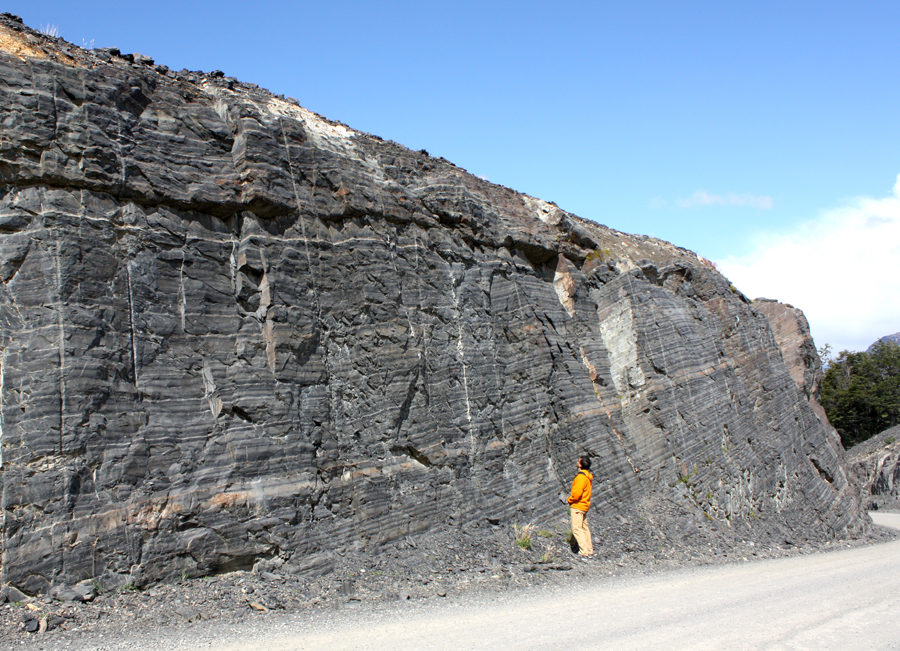
Cretaceous Punta Barrosa Formation, southern Chile (© 2010 clasticdetritus.com)
Happy Friday!
Serpentinite and California’s state rock

Starting today I will be doing weekly posts for the San Francisco Bay Area public TV/radio station KQED’s community science blog. They produce a television program called QUEST that highlights greater Bay Area science and scientists and have a fantastic companion website with interactive maps, video reports, writing, and more. While my posts for QUEST will certainly have a local spin to them, I hope the greater geoscience readership will enjoy them.
My first post won’t be news to most of my regular readers — it covers some of the basic facts about serpentinite that have already been blogged/written about by Garry Hayes at Geotripper, Andrew Alden at About.com, Silver Fox at Looking for Detachment and many others on Twitter (use #CAserpentine to see the latest). The point of the post was to communicate fundamental information to a slightly broader audience and the work and advocacy of my fellow geoscience bloggers made this a relatively easy task. Thank you!
Use this to subscribe to the entire QUEST community science blog: http://www.kqed.org/quest/blog/feed/
To keep track of all my posts for QUEST, bookmark this: http://www.kqed.org/quest/blog/author/brianromans/
Geoblogosphere week in review (July 26-August 1, 2010)
I don’t have any review to post this week. Instead, you should head over to David Bressan’s blog History of Geology to read the summary (and then all the individual posts) for this month’s geoscience blog carnival, The Accretionary Wedge.
This month’s installment was conceived by David and Michael Welland (of Through the Sandglass) and asked other geoscience bloggers to reflect on the current state of their blogging and the role(s) of science blogging in general.
–
~~~~
–
Week-in-review posts from past month:
If you want to subscribe to the week-in-review posts (but not the entire blog feed) use this link: https://clasticdetritus.com/category/week-in-review/feed/
This week’s Sea-Floor Sunday is from a region I know almost nothing about — the western margin of Australia. I came across this informative site from the Australian Department of the Environment, Water, Heritage, and the Arts. They do a lot of things and one thing they do is manage initiatives to preserve their coastal and offshore ecosystems. Having quality, high-resolution maps of the seafloor is a basic necessity — imagine trying study and manage ecosystems on land without a decent map.
Here’s a beautiful shaded-relief image of Perth submarine canyon (see the GoogleEarth image at the bottom for regional context):

Perth submarine canyon (credit: Australia Department of the Environment and Heritage)
Here’s a blurb directly from the site about the mapping that was done in Perth Canyon:
Two of the voyages in 2005 focused on mapping benthic ecosystems (that is, ecosystems at the bottom of the sea) on the deep continental shelf and slope in Australia’s south-west to understand evolution and biogeography. The voyages in this region focused on the Perth Canyon, a unique feature 22 kilometres seaward of Rottnest Island off Perth. The Perth Canyon is as wide and deep as the United States’ Grand Canyon, and during summer, blue whales feed on swarming krill in upwelling zones around its rim. The remarkable marine species recovered and sea floor images captured during these voyages will inform marine planning in south-west waters.
Below is a GoogleEarth image for regional context:

I can’t resist posting another photo I took on a flight from Vancouver to Oakland recently for this week’s Friday Field Foto. If you ever find yourself booking one of these flights make sure to get the window seat on the right side of the plane going north and on the left side of the plane going south. I can’t promise that’s the flight path for every flight but it worked out for me!
This is a photograph of Mt. Saint Helens in southern Washington State facing east. I like this shot because it nicely shows the relationship of the river system that is carrying the volcaniclastic detritus away.

Mt. Saint Helens and North Fork Toutle River (© 2010 clasticdetritus.com)
Happy Friday!
2010 AGU Fall Meeting — sessions I’m excited about

The dog days of summer are here, which means that abstract preparation and submission season for two gigantic annual scientific meetings for Earth scientists (at least in North America) is upon us! The 2010 Geological Society of America (GSA) Annual Meeting is October 31st-November 3rd in Denver, Colorado and the 2010 American Geophysical Union (AGU) Fall Meeting is December 13th-17th in, as always, San Francisco, California.
Unfortunately, I cannot attend the GSA meeting this year — just too much other stuff going on and had to prioritize travel. Such is life. So, hopefully some other geoscience bloggers who attend will keep us all updated in real time. There was a big meetup of people in Portland last year, which was a blast. I hope those who go to the meeting organize another one and try to make it a tradition.
I will be attending the AGU meeting in December. I spent some time browsing the scientific program and found numerous interesting sessions. Not all of them will actually happen — it depends on how many submissions they get. Having done this myself a couple times I remember the cutoff number being somewhere between 10 and 20 submissions to guarantee the session.
Technical sessions at AGU are sponsored and co-sponsored by one or more themes. In the past, the science I was interested in could be found in either in the Hydrology, Ocean Sciences, or sometimes Tectonophysics themes. A few years ago AGU decided to add a theme they call Earth and Planetary Surface Processes, which has been a great addition in my opinion. As a sedimentary geologist, I’m mostly interested in surface processes (and surface evolution) that operates over time scales longer than what we can measure. I’m interested in the processes that are net accumulative over geologic time — that is, processes that produce the stratigraphic record. I’m also interested in learning from those who study longer-term landscape evolution in eroding environments. The Earth and Planetary Surface Processes theme is an appropriate venue, I think, for bringing together these disciplines.
Earth and Planetary Surface Processes (EP) as primary sponsor
- Quantifying Present and Ancient Rates of Earth Surface Processes — This session addresses exactly what I was just discussing above. It will highlight the application of dating methods such as cosmogenic nuclides, optically stimulated luminescence (OSL), and more for constraining surface process rates. It’s all about dates and rates!
- Quantifying Event-Scale Landscape Change — This session will focus on the influence of discrete events (e.g., storm, flood, earthquake, etc.) on how the landscape changes.
- The Morphodynamics of Big Rivers: What Do and Don’t We Know? — The term ‘morphodynamics’ refers to the linkage of process and form. This session asks questions about how the morphodynamics of big rivers might be different from their smaller cousins.
- Megaflooding: Causes, Processes, and Effects — Events with sudden and significant discharge — who doesn’t find these fascinating.
- Sorting Out River Patterns — This session aims to bring together numerical/physical experimentation and remote sensing data from natural systems to investigate river patterns.
- Transient Landscapes: Capturing Responses to Changing Boundary Conditions — The investigation of how landscapes are pushed out of ‘quasi-equilibrium’ state. My rhetorical response would be: aren’t all landscapes ‘transient’ depending on the time scale of investigation?
- Morphogenesis, From Micro-scale Experiments to Landscape Dynamics — I’ll simply copy/paste in part of the session description for this one: “We are particularly interested in studies dealing with the characteristic length and time scales that control the emergence of specific geomorphological features.”
- Linking Life to Landscape Dynamics — With the exception of traces and tracks left by animals in sediment or sedimentary rock I don’t think about the relationship of life to how landscapes evolve very often. But I certainly should! This session looks very interesting and I hope they get a lot of quality submissions.
- Source to Sink Insights into Integrated Sedimentary System Evolution — A couple of close collaborators of mine are chairing this one — I wanted something like this to happen but didn’t feel like proposing it myself so I convinced them to do it :)
Other sessions where EP is listed as co-sponsor:
- Pattern Formation in Earth System Sciences — The description for this one is quite broad. Sometimes sessions like this result in an interesting compilation of different disciplines addressing the same theme — but, in other cases, they end up being a collection of disparate presentations. I hope its the former because it sounds like an interesting idea.
- Submarine Landslides: Characterization, Processes and their Sedimentary Record — If you’ve been reading this blog for a while you already know my love of submarine sedimentation.
- Unique Applications of Multibeam Sonars: New Developments and New Applications — I’m excited to see some new seafloor mapping results. Those who invent new methods and improve existing methods of mapping the seafloor commonly show off the state-of-the-art at AGU.
Ocean Sciences (OS) as primary sponsor (and EP not a co-sponsor):
- Carbon System Dynamics in Large River-Dominated Coastal Margins — I’ve been interested in the sedimentary dynamics in such supply-dominated margins for a while so I’m hoping to learn a lot more about how the export of terrestrial carbon from land to sea is related.
Tectonophysics (T) as primary sponsor:
- The Wilson Cycle Revisited: Orogenic Cycles in Space and Time — Big picture, deep time, plate tectonics.
- The Formation and Deformation of the Mediterranean Basins, Continental Margins and Arcs — Another interest of mine is how we can use the sedimentary record in tectonically active regions to help reconstruct and constrain tectonic evolution.
There’s obviously a lot more than what I list here — this is just what I’m interested in. Take a look at the entire program and consider submitting your work.
Papers I’m Reading — July 2010
Here is this month’s installment in the papers I’m reading series:
- Di Achille, G. and Hynek, B.M., 2010, Ancient ocean on Mars supported by global distribution of deltas and valleys: Nature Geoscience, doi:10.1038/ngeo891. [link]
- Sambrook Smith, G.H., et al., 2010, Can we distinguish flood frequency and magnitude in the sedimentological records of rivers?: Geology, doi: 10.1130/G30861.1. [link]
- Lamb, M.P., et al., 2010, Linking river-flood dynamics to hyperpycnal-plume deposits: Experiments, theory, and geological implications: Geological Society of America Bulletin, doi: 10.1130/B30125.1. [link]
- Heinrich, R., et al., in press, Climate and sea level induced turbidite activity in a canyon system offshore the hyperarid western Sahara (Mauritania): The Timiris Canyon: Marine Geology, doi: 10.1016/j.margeo.2010.05.011. [link]
- Zahid, K.M. and Barbeau, D.L. Jr., 2010, Provenance of eastern Magallanes Basin sediments: Heavy mineral analysis reveals Paleogene tectonic unroofing of the Fuegian Andes hinterland: Sedimentary Geology, doi: 10.1016/j.sedgeo.2010.06.006. [link]
- Herman, F., et al., in press, Uniform erosion rates and relief amplitude during glacial cycles in the southern Alps in New Zealand, as revealed from OSL-thermochronology: Earth and Planetary Science Letters, doi: 10.1016/j.epsl.2010.06.019. [link]
–
Note: the links above may take you to a subscription-only page; as a policy I do not e-mail PDF copies of papers to people (sorry).
Geoblogosphere week in review (July 19-July 25, 2010)
Here are several posts from the geoscience blogosphere last week highlighting some interesting writing:
- Suvrat Kher of Rapid Uplift discusses the geologic context of shale gas resources in India and relationship to growing demand for energy.
- Michael Welland of Through the Sandglass writes about an ingenious idea to use calcite-precipitating bacteria to construct sandstone bricks out of sand to then use as building material.
- Check out geoscience educator Ed Adams’ (from Geology Happens) ‘Why I Blog’ post up at AGU’s Plainspoken Scientist blog.
- Ryan from The Martian Chronicles discusses a recent paper in Nature Geoscience about evidence for a global ocean on Mars.
- Ian Stimpson from Hypo-theses writes about how his self-imposed challenge to post a photo and corresponding information (including coordinates) of a rock every day in 2010 is going. I’m impressed he’s made it this far, and I hope he makes it all the way — what a nice resource this will be for years to come.
- Life-Long Scholar from Musings of a Life-Long Scholar writes about finding motivation to work. This is a great post and a must-read especially for grad students in the midst of writing their theses.
- Kim Hannula of All of My Faults Are Stress-Related talks about where some of her geology blogging activities are and will be in the future.
- Garry Hayes of Geotripper continues his excellent coverage and blogging about the bill in the California state assembly to remove serpentinite as the state rock.
There were also several posts contributing to the upcoming Accretionary Wedge geoscience blog carnival about the role of geoblogs and geobloggers in communicating science. These will be compiled by David Bressan soon so I will wait to link to them until that time. In the meantime, if you haven’t contributed yours, you still can (due July 29) here.
–
~~~~
–
Week-in-review posts from past month:
If you want to subscribe to the week-in-review posts (but not the entire blog feed) use this link: https://clasticdetritus.com/category/week-in-review/feed/
This week’s Sea-Floor Sunday is a nice video explanation (less than 2 minutes in duration) of what multibeam bathymetry data is using the Puerto Rico Trench, the deepest spot in the Atlantic Ocean.


 Clastic Detritus