Words not in my dissertation that should be
In scientific/technical writing, there’s an opportunity to use words that you may not use on a daily basis. And when you spend most of your waking hours writing for months at a time, you begin to see patterns in the words you use. I definitely have words I use…and I most likely overuse them. I’m getting pretty sick of these, for example:
– indicate
– suggest
– record
– reflect
– demonstrate
During the course of research, you end up reading a lot in addition to all the writing. This is when I usually notice words that are awesome that I should be using.
Here’s a short list of some my favorites. I like them because they sound very “scholarly” and if you use them in popular writing or spoken in casual conversation, you usually come off as a snooty ass (or maybe British).
– aforementioned
– whilst
– heretofore
– foregoing
– prodigious
I also didn’t have the guts to title a chapter or a section “On the ______ “. Putting the “on” there is pretty sweet.
What are some of your favorite words or phrases?
~~~~~~~~~~~~~~~~~~~~~~~~~~~~~~~~~~~~~~~~~~~~~~~~~~~~~~~~~~~~~
Elegant video explanation of complex mathematical transformations
This might be making the rounds in the geek-o-sphere, I’m not paying much attention right now.
This is a fantastic use of a format such as YouTube for explaining a scientific topic. This video very elegantly explains complex mathematic transformations in just a couple of minutes.
I’m not a mathematician so I can’t comment on how accurate this representation is … just that it is a well-done visualization. Check it out (if the embedded video is broken below, go here).
~~~~~~~~~~~~~~~~~~~~~~~~~~~~~~~~~~~~~~~~~~~~~~~~~~~~~~~~~~~~~~~~
Spectacular 3D seismic-reflection images of a subduction zone
Three-dimensional seismic-reflection imaging is not new. The petroleum industry has been utilizing this tool to characterize the complex geometries of the subsurface for nearly two decades. Science has benefited from these data tremendously.
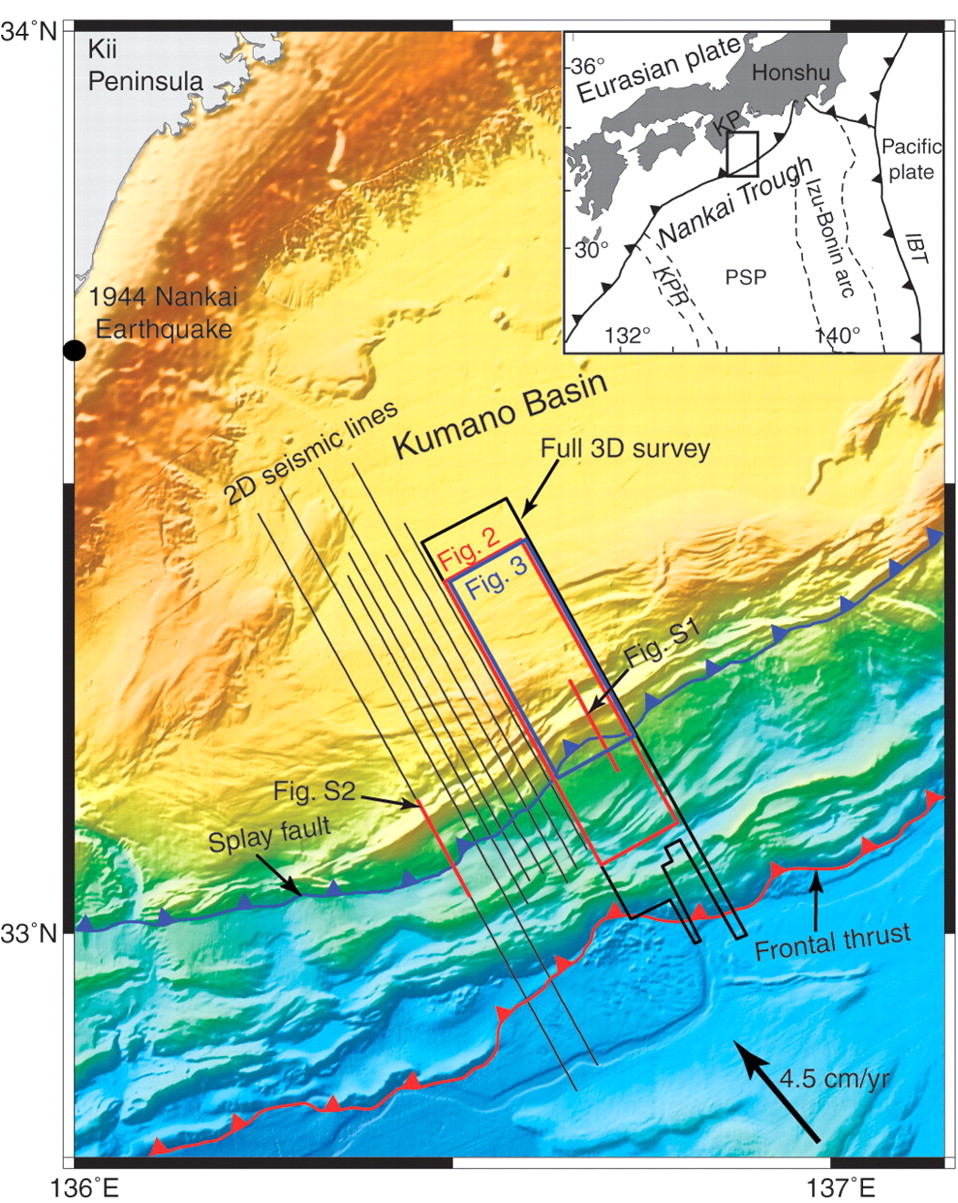
However, the bulk of the 3D seismic data are from sedimentary basins (that’s where the hydrocarbons are). A paper in last week’s issue of Science showcases some new data collected from the Nankai Trough, which is a subduction zone. A couple of months ago I blogged about future drilling projects in this same region.
The figures below are directly from the Moore et al. paper.
This first one is a map showing the bathymetry and location of the seismic surveys. The folding associated with the convergence shows up quite nice as those “wrinkles” on the sea floor.
This next one is a perspective block diagram beautifully showing both cross-sectional and map views of the accretionary wedge. This is a nice big, high-res image so it is worth clicking on.

The paper is worth checking out for more images and a nice discussion on the large-scale thrust fault geometries related to this convergent plate margin.
If you don’t have access to Science, here’s a blurb about the study from ScienceDaily.
~~~~~~~~~~~~~~~~~~~~~~~~~~~~~~~~~~~~~~~~~~~~~~~~~~~~~~~~~~~~~
Creationists getting way more press than they deserve
I can’t stop what I’m doing right now and write a letter to the editor of NY Times, but I might have to.
This piece by Hanna Rosin really irks me…and, if I were in a slightly more angst mood, it might drive me to downright anger.
The way she goes out of her way to give these cranks a megaphone for the ridiculousness they spew is enough to make we want to take a walk to cool off a bit.
I simply don’t have the time to tear apart this ugly piece of journalism. The language feebly attempts to call them what they are (cranks), but never actually does it. And, then, she actually steps it up a bit with subtle implications of some “turning of the tide” amongst scientists. Like this piece of s@#t sentence:
Creationist ideas about geology tend to appeal to overly zealous amateurs, but this was a gathering of elites, with an impressive wall of diplomas among them (Harvard, U.C.L.A., the Universities of Virginia, Washington and Rhode Island). They had spent years studying the geologic timetable, but they remained nevertheless deeply committed to a different version of history.
Notice the well-placed “but” and mention of prestigious institutions. Nice try…but that doesn’t provide a single bit of support for their acceptance of a 6,000 year-old Earth. I don’t care where these people got their degrees…accepting the view that the vast majority of sedimentary rock on this planet is the result of a single flood a few thousand years ago is beyond ridiculous.
The scary potential result of an article like this is that your everyday normal NY Times reader might sit back and say “hmmm…I guess there is some disagreement within science regarding the age of the Earth”. Maybe only 1% of the readers, but that’s too many.
So, I call upon the free press of science bloggers to tear this apart. I don’t have the time right now. I’m sure Pharyngula and others will get on this if they haven’t already. Hanna Rosin needs to know she can’t get away with this crap.
I might break my keyboard.
~~~~~~~~~~~~~~~~~~~~~~~~~~~~~~~~~~~~~~~~~~~~~~~~~~~~~~~~
Agadir Basin debris flow event: a preface
As most of my readers know, I have spent my graduate student career researching both ancient and modern deep-marine sedimentary systems. In particular, the processes and products of sediment gravity flows.
It’s not often that my specific field of study makes it into Nature or Science. I was pleasantly surprised to see this paper tucked in with all the stem cell papers in last week’s Nature. It’s difficult not to spend some time reading this paper and then spend some more time writing a nice summary post about the paper. Very difficult. But…after a few days away for the holiday this past weekend, I need to get into defense-preparation mode. Bad timing. Although, perhaps I can convince myself that reading and posting about this paper is part of that.
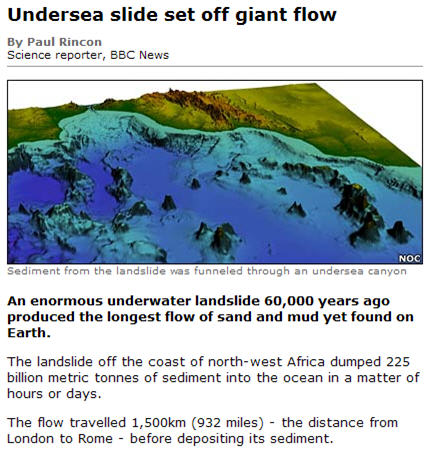
In the meantime, check out the short BBC blurb about a study that characterized a very large debris flow event and deposit offshore of northwest Africa that occurred 60,000 years ago.
~~~~~~~~~~~~~~~~~~~~~~~~~~~~~~~~~~~~~~~~~~~~~~~~~~~~~~~~~~~~~~~
Sea-Floor Sunday #5: Submarine volcanoes in the Kermadec Arc
I don’t have a lot of information on today’s installment of Sea-Floor Sunday. I simply was searching around on the internet for interesting images.
I found these from a great site that summarizes a recent set of research cruises called the New Zealand American Submarine Ring of Fire 2005 (NZASRoF’05) Expedition. NOAA’s Ocean Explorer website about these cruises and associated submersible dives can be found here.
Here’s a blurb from the NZASRoF’05 site:
The submersibles will be used to explore the geology, biology and chemistry of submarine volcanoes along the largely unexplored Kermadec Arc that extends N-NE of New Zealand’s North Island. These volcanoes and the adjacent Kermadec Ridge lie westward of the 800 mile-long Kermadec Trench, where the western edge of the vast Pacific plate descends beneath the Australasian plate to the west
The images below are of two submarine volcanoes along the Kermadec Arc, northeast of New Zealand. Click on them for a bigger version.
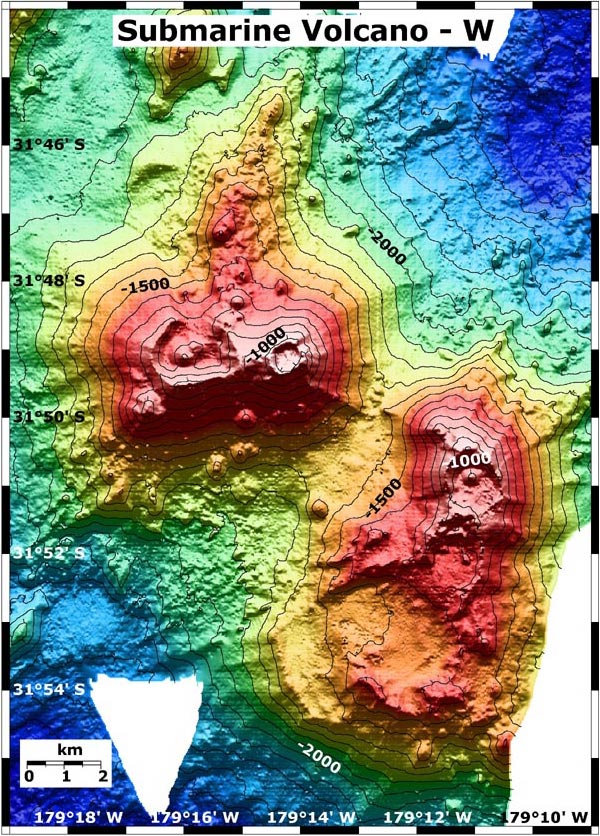
The 3D perspective image below is from the same data and looking to the northeast. The distance between the center of the two cones is about 5 km.

This page from the NOAA webpage discusses these images a little more.
~~~~~~~~~~~~~~~~~~~~~~~~~~~~~~~~~~~~~~~~~~~~~~~~~~~~~~~~~~~~
Meme of Four
Just what I needed after handing in the thesis draft…a silly meme. Although not officially tagged by Kate, I do still have AC in my feed, so here it goes:
4 jobs you’ve had:
1. cook at bistro
2. grounds crew at golf course (best job ever!)
3. dishwasher (for 2 weeks)
4. petroleum geologist
4 movies you could watch over & over:
1. Raiders of the Lost Ark
2. Nacho Libre
3. Close Encounters of the Third Kind
4. Contact
4 places you’ve lived:
1. Buffalo, New York (go Sabres)
2. Golden, Colorado
3. Houston, Texas
4. San Francisco, California
4 TV shows you love to watch:
1. Deadwood
2. Six Feet Under
3. House
4. Kitchen Nightmares (I admit it)
4 places you’ve been on holiday vacation:
1. Rome
2. Seattle
3. northern Minnesota
4. Chile (I did a little touring while working down there)
4 websites you visit daily:
1. GoogleReader (you are all in there)
2. New York Times
3. geology.com/news
4. Clastic Detritus (that site is awesome!)
4 of your favorite foods:
1. burritos
2. pizza
3. sushi
4. asiago cheese bread (from bakery in my neighborhood)
4 places you’d rather be:
1. skiing in Colorado
2. looking at rocks anywhere
3. at a hockey game
4. in NYC hangin’ out with buddies
4 lucky people to tag:
saxifraga, John VH, Zoltan, and Andrew
~~~~~~~~~~~~~~~~~~~~~~~~~~~~~~~~~~~~~~~~~~~~~~~~~~~~~~~~~~
It’s in their hands…
Whew.
My committee has my dissertation.
I spent the last two days printing and putting on the finishing touches. I needed to get 4 copies of the thing reproduced. For this ‘draft’ version, it doesn’t have to be on super fancy paper or any of that, but I wanted it to look good. Why put in all that effort into making figures and illustrations if they are then reproduced on crappy paper out of a crappy printer. So, although I didn’t go too crazy, I did spend time fiddling with print settings and paper types to get things to look the way I wanted. The chapter that is based on field work is chock full of photographs. These photos are my data…they need to look good. The other chapters have line drawing, graphs, and tables…those are, in my opinion, relatively easy (or at least easier) to get to “look” good. I’ve spent more time than I care to share trying to get field photographs to reproduce nicely (and, if preparing for a journal, in grayscale no less). Maybe I’ll post about the steps I take in Photoshop to do that…i’m sure a lot of you (like Ron, for example) have experience in that and tips to share as well.
I’ve been waiting to post about the results of my first chapter, which is a detailed outcrop study in Patagonia, until it is “in press”. I submitted the thing in June for pete’s sake! The online status thinga-ma-jig now says it’s awaiting final decision. So hopefully I’ll know something soon. Wouldn’t that be a boost of confidence if I got a big fact “rejected” a couple of days before my defense?
I’ll worry about that later…now it’s time to actually get a restful sleep for a change.
~~~~~~~~~~~~~~~~~~~~~~~~~~~~~~~~~~~~~~~~~~~~~~~~~~~~~~~~~~~~
This about sums it up

Yep.
~~~~~~~~~~~~~~~~~~~~~~~~~~~~~~~~~~~~~~~~~~~~~~~~~~~~~~~~~~~~~~
Sea-Floor Sunday #4: Structural deformation revealed off the coast of California (repost)
Deadline. Quickly. Approaching.
No time for a new post…but, here’s a rerun from several months ago.
–
A great web resource if you are interested in marine science in California is SIMoN, which stands for Sanctuary Integrated Monitoring Network; it is a portal for all things related to the Monterey Bay National Marine Sanctuary. Much of the site involves the biological and habitat aspects (it is a sanctuary after all) but there is also great stuff regarding the geology and geomorphology of the area.
The image below (see page on SIMoN here for all the details) is from an area offshore of the central California near Half Moon Bay (just south of San Francisco and north of Santa Cruz). This area is called Mavericks and is a popular surfing spot.
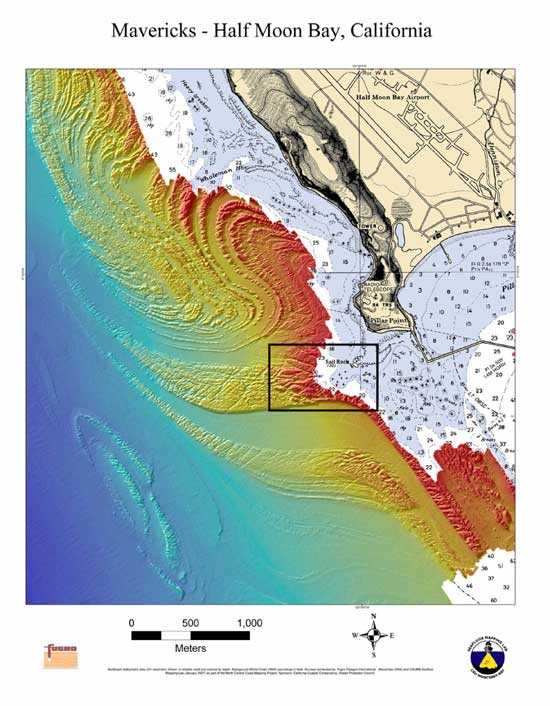
What is most striking is how nicely the structural deformation of Pliocene sedimentary rocks is shown with this image. Movement on the San Gregorio fault (a wholly owned subsidiary of the San Andreas) has produced this folding and the layered nature of the strata has resulted in the differential erosion and alternating ridges and ‘valleys’ seen on the bathymetry.
And check out this little fly-over movie too (if movie is not embedded, go here).
~~~~~~~~~~~~~~~~~~~~~~~~~~~~~~~~~~~~~~~~~~~~~~~~~~~~~~~~~~~~


 Clastic Detritus
