A lot of traveling in 2012
A couple years ago a family member asked me how many days a year I travel so I decided to keep track of it for 2012. Here are the number of nights I stayed at a location; total of 142 nights away from home (nearly 40% of the year).
- Blacksburg, VA (home) – 232
- JOIDES Resolution – 60
- ~Puerto Natales, Chile – 31
- Phoenix, AZ – 11
- Long Beach, CA – 5
- Charlotte, NC – 5
- Calgary, Alberta – 4
- Punta Arenas, Chile – 3
- Tabernash, CO – 3
- Salt Lake City, UT – 3
- San Francisco, CA – 2
- Menlo Park, CA – 2
- Hamilton, Bermuda – 2
- Columbia, SC – 2
- Lewisburg, PA – 2
- airplanes – 2
- Green River, UT – 1
- Danville, CA – 1
- St. Johns, Newfoundland – 1
- Charlottesville, VA – 1
- Reston, VA – 1
I’ve got some travel for 2013 already booked — field work, IODP sampling, conferences — but this year should be significantly less time away. But who knows, maybe some amazing opportunity will come my way.
Check out 2012 travel summaries by Georneys and Highly Allochthonous as well (I’m sure there are others who have posted summaries as well, feel free to include links in comments).
Friday Field Photo #179: Mediano Anticline, Spanish Pyrenees

Getting back into the swing of things after a nice holiday break. Here’s a shot from the foothills of the Pyrenees in Spain (near the town of Ainsa) of the Mediano Anticline.
Happy Friday!
Friday Field Photo #178: More Patagonian Turbidites
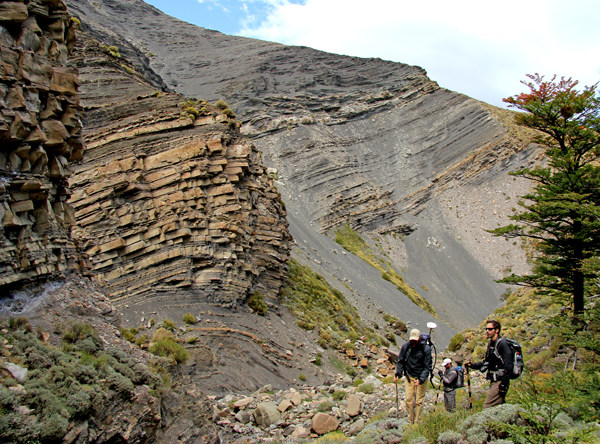
As we deal with logistics and planning for the upcoming field work season in Patagonia I’ve been going through lots of photographs from previous trips. Nothing much special to say about this one except: these rocks are amazing!
Happy Friday!
Friday Field Photo #177: Flute Marks on Base of Turbidite Bed
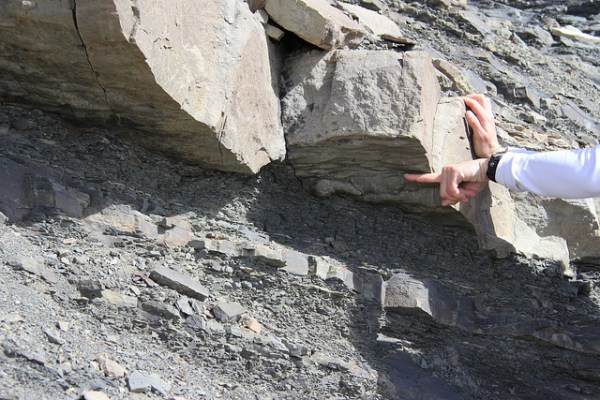
This week’s photo is from the Cretaceous strata in Patagonia I’ve been working on for several years. I’m heading down there again this coming field season (January-February) and this time taking one of my new graduate students. I’ll only be down there for a bit over a week because of teaching and other obligations, but that’ll be enough to get my student oriented for his nearly two-month-long field season.
The sandstone bed in the photo above has some beautiful flute marks on the base. These elongate sole marks are formed by small-scale scour into the underlying substrate as a sediment-laden turbidity current flows down a marine slope. The sand that was carried in the flow is then deposited into the scours creating a cast. In most cases, these structures flare out in a down-current direction, which gives us paleocurrent direction. My field partner is pointing in the direction of paleoflow. I’m not sure how many flute marks I’ve measured for paleocurrent over the years — it must be in the thousands by now.
Happy Friday!
Image: my Flickr
A River of Hydrocarbons Flowing on Titan
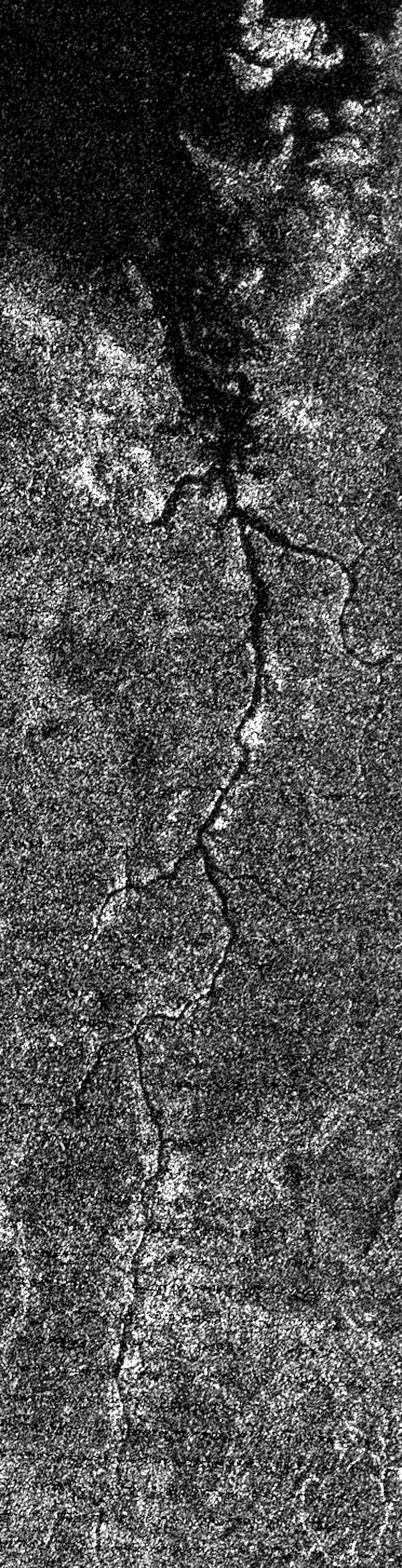
The Cassini spacecraft continues to return amazing images and data of Saturn and it’s moons. Here’s a new image of a river of liquid ethane/methane (~400 km long) on Titan. Amazing!
Here’s a description that goes with the image:
The river valley stretches more than 400 km from its ‘headwaters’ to a large sea, and likely contains hydrocarbons. The image was acquired on 26 September 2012, on Cassini’s 87th close flyby of Titan. The river valley crosses Titan’s north polar region and runs into Kraken Mare, one of the three great seas in the high northern latitudes of the moon.
Image credit: NASA/JPL–Caltech/ASI
New Documentary Film About IODP Expedition 342
–
The Consortium for Ocean Leadership has released the final documentary film associated with Integrated Ocean Drilling Program (IODP) Expedition 342 that I sailed on last summer. (If the embedded video above is not showing up on your computer/device, then go here.) This is a 20-minute documentary produced by ScienceMediaNL that combines footage from the six previously released episodes* into a single, coherent film. I think it does a great job of explaining the purpose of the expedition and capturing the feeling of doing ship-based Earth science. It’s a bit weird to see that two months of my life — two months without seeing land — condensed into a succinct story.
For those interested in the findings of the expedition, the preliminary report, which is >250 pages and includes >70 figures, was published online in late October. This report contains much of the fundamental data associated with retrieving the 5.4 km of sediment cores — however, most of the actual science will be produced after we sample the cores and do our analyses.
* See all six episodes that were filmed, edited, and uploaded to YouTube while aboard the JOIDES Resolution here.

One of the drill sites from IODP Expedition 342 this past summer recovered sediments that spanned the Cenomanian-Turonian boundary (~93 Ma). This interval, known as Oceanic Anoxic Event 2 (OAE2), is well studied from numerous stratigraphic sections around the world and interpreted to record an event of very low to no oxygen in parts of the global ocean.
There was a lot of excitement as the cores that spanned this interval were being split. One of my colleagues from the core description team, Chris Junium of Syracuse University, has done quite a bit of research on this event and is pointing out the rather obvious bed of gray to black organic-rich shale within a succession of carbonate-rich pelagic oozes. The film maker we had on board was there to capture the excitement (check out the short movies he made from the expedition here).
Happy Friday!
How I (try to) get things done
I need to be more productive when it comes to my research. I look at some of my peers and wonder how they can produce so much quality science — all while writing grant proposals, mentoring students, teaching classes, building/maintaining labs, reviewing papers, going to conferences, serving on committees, attending workshops, interacting with sponsors, writing other papers, and much more.
I’m always on the lookout for ways to improve my productivity as a researcher. The thoughts here are specific to my job, but I hope it’s relevant and useful to students, post-docs, and other researchers in government or industry. There are definitely some technology-related ideas in here, but this isn’t meant to be a list of the latest gizmos, gadgets, or web apps; nor is it a summary of how the internet will revolutionize science. There are a gazillion web posts out there focused on that stuff — I’m interested in approaches and tools that can help me be productive in my work whether they are digital or analog, collaborative or solitary. I’m interested in the end, not the means.
Write It Down
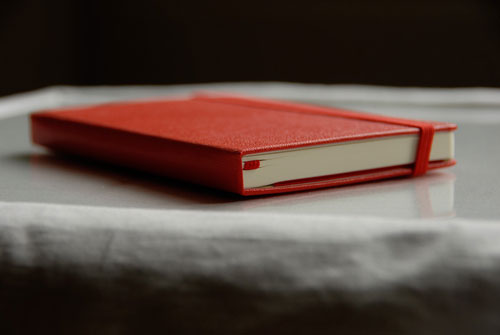 If there’s one thing I’ve learned in the past decade of doing this it’s to write everything down. I have at least two notebooks with me at all times that I use to capture random ideas, questions, to-do lists, or other thoughts related to my work. During grad school several years ago I started to carry around a spiral notebook. Over the years I’ve grown to love the minimalist design of Moleskine notebooks. These are popular for a reason, they are a quality product. I even like how the paper feels. I can easily carry one of these around almost anywhere I go and when I fill one up it is archived on the bookcase in my office. But it need not be a fancy-schmancy hard-cover book, great ideas can be written down in a $2 notebook as well.
The other notebook I have with me all the time is digital. I’ve been using Evernote for about two years now and love it. Evernote has a whole bunch of functionality for archiving digital information, but the functionality I like best is the ability to sync across all the computers/devices I use. For example, if I’m standing in line at the market and an idea pops into my head I can quickly jot it down using the mobile app. Then when I launch the desktop app on the computer in my office or on my laptop at home it’s all there. It’s a virtual notebook that is simple to use and that works. (My plea to Evernote is to keep it simple; don’t try to fix what isn’t broke as you grow.)
Writing things down isn’t merely a reminder. The act of writing (or speaking, teaching, sketching, etc.) forces you to formalize thoughts. I’m sure you’ve had that experience where you think you know how to describe the research problem you are working on, but when the time comes to put it into words you realize how nebulous that thought was. Even if you never go back and read what you wrote in that notebook, you’ve likely helped solidify an idea.

Writing/Editing Papers or Proposals
Right now I have several manuscripts/proposals in the ‘in preparation’ stage, occupying various positions along a continuum between vague idea and ready-to-submit. I mostly use Microsoft Word to write. Yes, I realize that Word has issues and I realize there are other word processing methods (e.g., LaTeX) out there that people will argue are far superior. I realize it’s not techie-fashionable to use Word. Whatever. Word is what I know and, more importantly, what the vast majority of my collaborators use. The ‘track changes’ feature on Word works pretty well when there are three or more authors. I’ve tried to use GoogleDocs for collaborating a few times but have found it clunky.
When it comes down to getting a paper or proposal done it’s a waste of time to try and convince five co-authors that they need to sign up for some web app or get some software that promises to change the way we collaborate. But, I am open to new ideas and always like to hear how others write collaboratively.
Drafting Figures/Illustrations
A lot of my work involves creating figures that combine various types of data to be used in talks and publications. I use Adobe Illustrator to integrate images, line art, and text annotation into a single illustration. I’m certainly no artist, but can now create diagrams with Illustrator’s drafting functionality with some efficiency (example below from a paper I published a few years ago).

For graphs/plots I typically use Excel and then make them ‘pretty’ in Illustrator. This is a waste of my time so I’m in the process of learning how to make graphs/plots in the statistical package R and matplotlib in Python. I’m still a newbie when it comes to these code-driven tools, but the little I know motivates me to get better. Never stop learning.
Reading/Reviewing Papers or Proposals
I keep track of the latest articles in my discipline with journal RSS feeds aggregated by GoogleReader. I also get asked to referee papers for journals regularly and end up reviewing about 4-8 a year. It’s a lot of work to review a paper, but I’m happy to do it because this is how peer review works. Plus, reviewing papers keeps me updated on the latest work in my field. (While I’m thinking of it, please include line numbers on the manuscripts you submit. This makes reviewing so much easier.)
So there is always a lot of reading to be done. Nowadays, I do nearly all my literature reading and paper reviewing on my iPad. I print papers out every once in a while, but I’d say that >80% of my reading is digital now. There are a bunch of iPad apps out there these days, but I use the iAnnotate app. It syncs up with Dropbox and has easy-to-use markup tools. I especially like the zoom-in text annotation feature that shrinks the stubby text that results from finger/stylus writing down to fit into the small margins of modern PDFs.
Remote Collaboration
At some point in the past year Dropbox transitioned from convenient to necessary. I have shared folders with several collaborators and with my graduate students. E-mail remains the primary means of communication, but now it’s to say ‘I added a revised version of the proposal’ or ‘Check out the new paper by so-and-so’ in Dropbox instead of attaching the file to the email. I don’t have to search my email for that attachment if I forgot or didn’t take the time to download it and put somewhere.
The other tool that is quite useful is the telephone! E-mail is great for keeping correspondence documented and laying out specific tasks and such, but there are times where picking up the phone and talking to a collaborator is far more productive. I’m also realizing how valuable a short trip to visit with collaborators can be. I recently spent three days with two collaborators where we essentially sequestered ourselves in a room and worked like maniacs to finish up a proposal. We got more accomplished in that focused three days of work than the previous nine months combined.
Personal Productivity: Ride the Wave
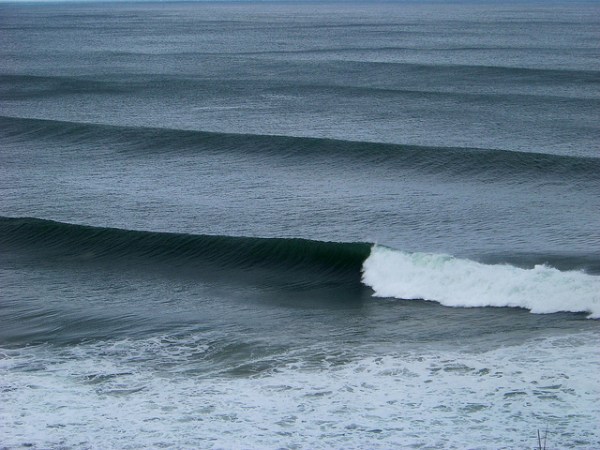
I’m one of those people for which significant productivity comes in short spurts. I’ll toil for several hours (even days) on some text for a paper or proposal and then, all of the sudden, I’ll produce a few pages of words I’m quite happy with in less than an hour. Or, at longer time scales, I’ll have a string of 3 to 4 days where I make tangible progress within a couple weeks of effort. I’ve learned to recognize when this is happening and try to take advantage of it. Like a surfer waiting for that perfect wave, sometimes I just need to spend some time paddling around out there waiting for it. When I was in grad school this productivity wave came in the evening or late night. Nowadays, it tends to come in the early morning. Whenever the wave comes, learn to recognize it and ride it.
I’ve also learned to that if I’m not being productive with one task that I might as well make progress on something else (productive procrastination?). For example, if I’m trying to get some writing done and the words are just not flowing, I’ll spend that time working on drafting a figure instead. However, it’s easy to fall into a trap of jumping from one thing to another and not getting much of anything accomplished. Thus, there are times when I do force myself to work on a task that is screaming for attention.
Learning Tips and Tricks From Others
I’m constantly on the lookout for interesting ideas from others about how they maximize their productivity. This may be from collaborators, peers in my field, researchers in different disciplines, mentors, or students. I’m willing to learn from everyone. I don’t think any one person has the ultimate recipe, so I try to collect ideas from all sorts of people. Some work out, some don’t — just keep trying things.
Writing this post is, in fact, a way for me to see what others are doing. Please add your thoughts about what works or doesn’t work for you in the comment thread.
(Also check out this post, which has a lot of really good advice and tips and motivated me to compile my own thoughts on the subject.)
–
NOTE: Because I mention specific products in this post I may attract those who want me to mention their product on this blog. This is not going to happen. I will not reply to any email inquiring about a ‘guest post’, review, or other such thing. I encourage people to leave comments with information/advice about tools they use, but if the comment is an advertisement I will delete it.
Images: (1) Red Moleskine notebook; (2) Fading — PHD Comics; (3) Summary figure from Romans et al. (2009); Sedimentology; (4) Clean and secluded 3-5ft waves (from Flickr user Skeggsy)
RSS feeds for sedimentary geology and related journals
Here is a list of peer-reviewed journals I have in my RSS feed reader. The title of the journal links to their homepage; the address to the right of the journal title is the RSS address that you copy/paste into GoogleReader (or some similar aggregator). I recently checked most of these to see if they were up-to-date, but I may have missed a few.
(Note: these are just the journals I follow; this is by no means meant to be comprehensive list of all geoscience journals)
General science:
- Nature — http://www.nature.com/nature/current_issue/rss/
- Science — http://www.sciencemag.org/rss/current.xml
General geology (journals that include multiple sub-disciplines):
- Earth-Science Reviews — http://rss.sciencedirect.com/publication/science/5802
- Earth & Science Planetary Letters (EPSL) — http://rss.sciencedirect.com/publication/science/0012821X
- Geological Journal — http://www3.interscience.wiley.com/rss/journal/1903
- Geological Society of America (GSA) Bulletin –http://gsabulletin.gsapubs.org/rss/current.xml
- Geology — http://geology.gsapubs.org/rss/current.xml
- Geophysical Research Letters (GRL) — http://www.agu.org/pubs/rss/gl_rss.xml
- Journal of the Geological Society (Geological Society of London) — no RSS feed available
- Journal of Geophysical Research (JGR) – Solid Earth — http://www.agu.org/pubs/rss/jb_rss.xml
- Nature Geoscience — http://www.nature.com/ngeo/current_issue/rss/
- Terra Nova –http://www3.interscience.wiley.com/rss/journal/118535585
- The Journal of Geology –http://www.journals.uchicago.edu/action/showFeed?ui=0&mi=0&ai=t4&jc=jg&type=etoc&feed=rss
Sedimentary and marine geology:
- Basin Research –http://www3.interscience.wiley.com/rss/journal/118541711
- Facies — http://www.springerlink.com/content/110833/?sortorder=asc&export=rss
- Journal of Sedimentary Research (JSR) — http://jsedres.geoscienceworld.org/rss/recent.xml
- Marine and Petroleum Geology — http://rss.sciencedirect.com/publication/science/00253227
- Marine Geology — http://rss.sciencedirect.com/publication/science/5818
- Palaios – http://palaios.geoscienceworld.org/rss/recent.xml
- Palaeogeography, Palaeoclimatology, Palaeoecology – http://rss.sciencedirect.com/publication/science/5821
- Sedimentary Geology — http://rss.sciencedirect.com/publication/science/00370738
- Sedimentology — http://www3.interscience.wiley.com/rss/journal/118503415
Surface Processes/Geomorphology
- Earth Surface Processes & Landforms – http://onlinelibrary.wiley.com/rss/journal/10.1002/(ISSN)1096-9837
- Geomorphology — http://rss.sciencedirect.com/publication/science/0169555X
- JGR Earth Surface – http://www.agu.org/pubs/rss/jf_rss.xml
Petroleum geology:
- American Association of Petroleum Geologists (AAPG) Bulletin — http://aapgbull.geoscienceworld.org/rss/recent.xml
- Journal of Petroleum Geology — http://www3.interscience.wiley.com/rss/journal/117977017
- Petroleum Geoscience — http://api.ingentaconnect.com/content/geol/pg/latest?format=rss
Tectonics
- Tectonics — http://www.agu.org/pubs/rss/tc_rss.xml
- Tectonophysics — http://rss.sciencedirect.com/publication/science/5830
Oceanography/Paleoceanography:
- JGR Oceans – http://www.agu.org/pubs/rss/jc_rss.xml
- Paleoceanography – http://www.agu.org/pubs/rss/pa_rss.xml
All AGU journals can be found here: http://www.agu.org/journals/rss.shtml
Busy, busy, busy
 I’m now about one-third of the way through my second year as a junior faculty member. It’s been fantastic so far, I do enjoy it, but I feel like I can barely come up for a breath sometimes. This job is exciting and challenging, but also frantic and oh-so-close-to overwhelming sometimes. The commonly used metaphor about juggling and having too many balls in the air is so true. It’s impossible to keep them all in the air, but so far I haven’t dropped any really important ones. I think.
The consequence of all the excitement and challenge of getting a research program up and running and getting new courses developed has resulted in very little activity on this blog. There are fleeting moments where I think I’ll write a post about something interesting in the geoscience world — but then I quickly get funneled back into working on something else.
However, there are some items of note. I’ve got some graduate students now and they are settling in nicely. We’ve started a ‘paper in the pub’ series where we get together at a local watering hole and discuss a paper chosen by one of us. It’s fun to talk science outside the confines of the department and to get to know each other as well. I started this website for our research group, which has information about projects, links to papers, and some updates about activities from time to time as well.
I’m in the process of setting up a grain-size measurement lab. The instrumentation is in place and we’ll be getting it ready to make measurements in the next month. I’ll be using the lab to do grain-size analysis of the deep-sea sediment cores acquired this past summer on IODP Expedition 342. By the way, the preliminary report for the expedition has been published and is accessible here. It’s chock full of information about our preliminary findings of the drilling expedition.
I’m teaching introductory sedimentary geology (known as sed-strat) for our undergraduate majors again this fall. It’s a great group of students. I’ll be teaching a seismic stratigraphy course next semester, the content for which I’m working on now.
So, lots of stuff going on! I’ll try to get back to some more regular and substantive posting.


 Clastic Detritus