I try not to recycle press releases without reading the paper first, but I wanted to point to what looks like an interesting new paper in Nature about the tempo of extinctions and its relationship to global changes in sea level throughout Earth history.
I think the press release is preceding the publication of the paper because I can’t seem to find it … I’ll update this post with a link when it comes out, presumably later today or tomorrow.
Here are a few tidbits from the press release:
Since the advent of life on Earth 3.5 billion years ago, scientists think there may have been as many as 23 mass extinction events, many involving simple forms of life such as single-celled microorganisms. During the past 540 million years, there have been five well-documented mass extinctions, primarily of marine plants and animals, with as many as 75-95 percent of species lost.
For the most part, scientists have been unable to pin down the causes of such dramatic events. In the case of the demise of the dinosaurs, scientists have a smoking gun, an impact crater that suggests dinosaurs were wiped out as the result of a large asteroid crashing into the planet. But the causes of other mass extinction events have been murky, at best.
The abrupt external causes of mass extinctions, such as impacts, certainly deserve the attention they receive from the mainstream press and general public. These infrequent yet important events changed the course of Earth history and evolution in dramatic ways. But, it is nice to see a paper that discusses how the tectonic and surface processes of the Earth have influenced the course of life.
Arnold I. Miller, a palaeobiologist and professor of geology at the University of Cincinnati, says the new study [by Shanan Peters] is striking because it establishes a clear relationship between the tempo of mass extinction events and changes in sea level and sediment: ‘Over the years, researchers have become fairly dismissive of the idea that marine mass extinctions like the great extinction of the Late Permian might be linked to sea-level declines, even though these declines are known to have occurred many times throughout the history of life. The clear relationship this study documents will motivate many to rethink their previous views.’
I saw Shanan Peters give a talk about two years ago about some of this work. That particular talk summarized research he was doing with a huge database of stratigraphic sections. Putting together the time and place of depositional environments over large swaths of Earth history is how we produce paleogeographic maps depicting to what extent and long continents have been flooded by oceans.
As those epicontinental seas drained, animals such as mosasaurs and giant sharks went extinct, and conditions on the marine shelves where life exhibited its greatest diversity in the form of things like clams and snails changed as well.
In other words, sea level goes down, the shallow sea, which we know from the modern world is teeming with life, recedes and species perish.
This does not mean that external events didn’t cause mass extinctions – they certainly did. The point being that understanding the causes of mass extinctions doesn’t require invoking an external event.
The new Wisconsin study, Peters says, does not preclude other influences on extinction such as physical events like volcanic eruptions or killer asteroids, or biological influences such as disease and competition among species. But what it does do, he argues, is provide a common link to mass extinction events over a significant stretch of Earth history.
~~~~~~~~~~~~~~~~~~~~~~~~~~~~~~~~~~~~~~~~~~~~~~~~~~~~~~~~~~~~~~~~~~
The final punctuation mark
Today I attended my own graduation ceremony (which is why there’s no Sea-Floor Sunday this week … sorry).
I defended my PhD back in December, worked on revisions and officially submitted the dissertation in January, and then started a new job utilizing said PhD in February. All those milestones were more climactic than today’s event … but it was still nice to put that final mark on this long educational journey. It was fun to have my advisor “hood” me and all that too.
Now I’m officially officially done!
UPDATE:
 As promised in the comments below, here’s a photo of me and my adviser at graduation yesterday (note fancy-schmancy hood, which is more like a super-hero cape, and diploma in hand).
~~~~~~~~~~~~~~~~~~~~~~~~~~~~~~~~~~~~~~~~~~~~~~~~~~~~~~~~~~~~~~~~~~~~~~~~~
Accretionary Wedge #10: Geology in song lyrics
The theme for this month’s Accretionary Wedge geoscience blogging carnival is the aesthetics in geology — in literature, painting, poetry, all the arts. This is being hosted by and was the idea of John VH over at Geologic Musings in the Taconic Mountains. Go check it out.
As I write this post, most of the rest of the geoblogosphere’s posts on this subject are out. Go read those. At the risk of sounding all excusey, this week has been a crazy one and I’ve had no time to sit and think about this. But, I didn’t want to bail out completely, so I used this as one of those word-association experiments. What’s the very first thing that comes to mind? What came to my mind when thinking about this topic is a song by the band Phish from the early ’90s called ‘Rift’.
Rift
Last night, in the moments my thoughts were adrift
And coasting a terrace, approaching a rift
Through which I could spy several glimpses beneath
Of the darkness the light from above could not reach
I spied wings of reason, herself taking flight
And upon yonder precipice saw her alight
And glared back at me one last look of dismay
As if she were the last one she thought I’d betray
So much better I said to myself
And drawing quite close to the top of the shelf
I struggled with destiny upon the ledge
And gasped when defeated he slipped off the edge
And silence contagious in moments like these
Consumed me and strengthened my will to appease
The passion that sparked me one terrible night
And shocked and persuaded my soul to ignite
–
Why this song? Probably because it came up on my iPod on random the other day (that’s a pretty boring reason, I know).
Firstly, and obviously, the title of the song is geologic … rift! The imagery that the lyrics allude to are unambiguous. The words ‘precipice’, ‘edge’, ‘ledge’, ‘shelf’, and ‘terrace’ conjure up images of standing at the rim of a vast valley or basin – a rift valley as it were. The bottom of this rift valley is dark, there is an impression of it being bottomless. What is down there? What does it mean to ‘slip of the edge’ and into the darkness?
Although the imagery might be unambiguous in this case, the metaphor is subjective and interpretable, which is why we enjoy art in the first place. Enjoy this month’s theme and, as I said above, please go check out the fantastic posts by the others.
~~~~~~~~~~~~~~~~~~~~~~~~~~~~~~~~~~~~~~~~~~~~~~~~~~~~~~~~~~~~~~~~~~~~~~~~~~
Friday Field Foto #55: Antidunes!
Man, this week has been crazy … just one of those weeks, I guess … I haven’t had a chance to sit down and catch up on any of the happenins in the geoblogosphere. I apologize to anyone I’ve left hangin’ in any discussions going on.
Instead of links and useful information (that stuff takes more time than you think!) … for this week’s Friday Field Foto, I’m simply going to post a photo and a bonus video of some antidunes. Everybody loves antidunes! My post about the submarine cyclic steps briefly discussed supercritical flow, which is what produces antidunes. One of the best places to find antidunes is where a stream comes out at a sandy beach. In the photo below, the current is going from left to right. In supercritical flow, the bedforms are “in phase” with the fluid wave and migrate upstream (from right to left).
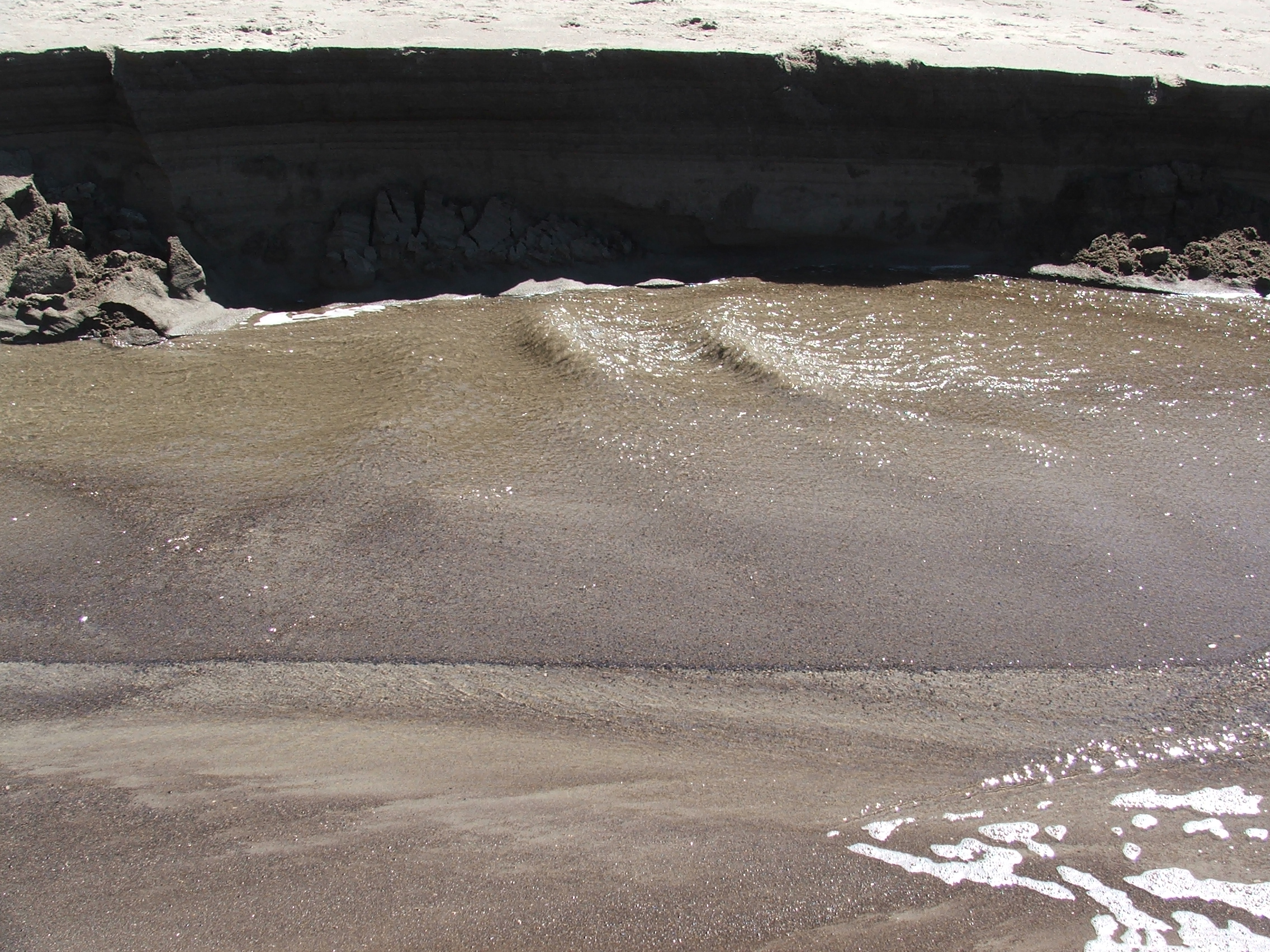
The photo is okay … but the video is key (even if the resolution of the video function from my digital camera is craptastic). Watch how the standing waves grow and migrate (slowly) upstream (away from the camera) and then break. If the video isn’t embedded properly, go here.
Happy Friday!
~~~~~~~~~~~~~~~~~~~~~~~~~~~~~~~~~~~~~~~~~~~~~~~~~~~~~~~~~~~~~~~~~~~~~~~~~~~~~~~
Sea-Floor Sunday #21: Cyclic steps in the deep sea
After several larger-scale sea-floor images highlighting tectonic features, I’m going to zoom in a bit for today’s Sea-Floor Sunday and show you some very cool geomorphological features that develop on the sea floor.
What the heck is a “cyclic step”? We’ll get to that later … first, I want to show a regional map to give you some context. The area we’ll look at in more detail is called the Shepard Meander, a huge meander bend in the Monterey submarine channel. In the map below, it is just barely on the image in the lower left (annotation mine). The Monterey submarine canyon, which is offshore of the central Californian coast, transitions from a canyon cut into the bedrock of the continental shelf to a submarine channel system off in deeper water that has both erosional and depositional features associated with it.

(MBARI 2003)
The rest of the images and much of the information for this post are from a 2006 paper in Sedimentology by Fildani et al. called “Channel formation by flow stripping: large-scale scour features along the Monterey East Channel and their relation to sediment waves”.
There is far too much in this paper to do justice to it in one blog post – I will simply be showing a few images of these very interesting features. I recommend you take a look at the paper if you want to get into the nitty-gritty.
So, let’s zoom in a bit on the Shepard Meander. Take a close look at this bathymetric map (Fig. 2 from their paper). Note the Shepard Meander in the upper right of the map. The width of this view is approximately 35 km.

(Fig. 2, Fildani et al., 2006)
The Shepard Meander is obvious and striking on this map, but the channel itself is not the focus of this paper. If you take another look at the map above, note the train of arcuate “scoop”-shaped scour features in the bathymetry. They are four prominent scours heading directly away from the bend in the channel and decreasing in relief away from the channel.
The next image below (Fig. 3 from the paper) shows the bathymetric profile, at 10x and 2x vertical exaggeration. Note the scale bar — these are huge features, each of them kilometers across.
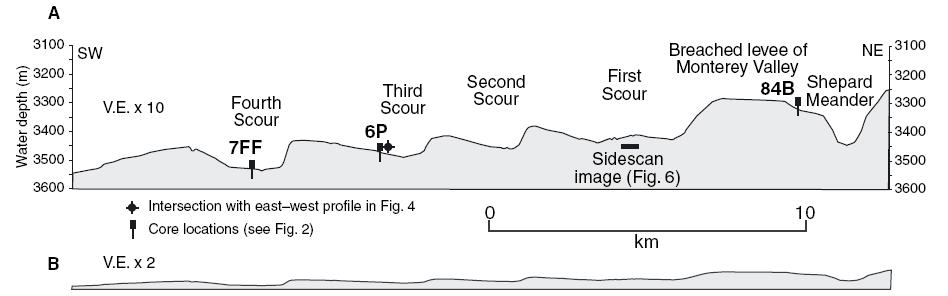
(Fig. 3, Fildani et al., 2006)
Although the Monterey submarine channel (to the right in profiles above) is certainly eroding at the base of the channel, it is important to note that a component of the channel relief is because it has muddy/silty depositional levees that build up along the sides of the channel thalweg.
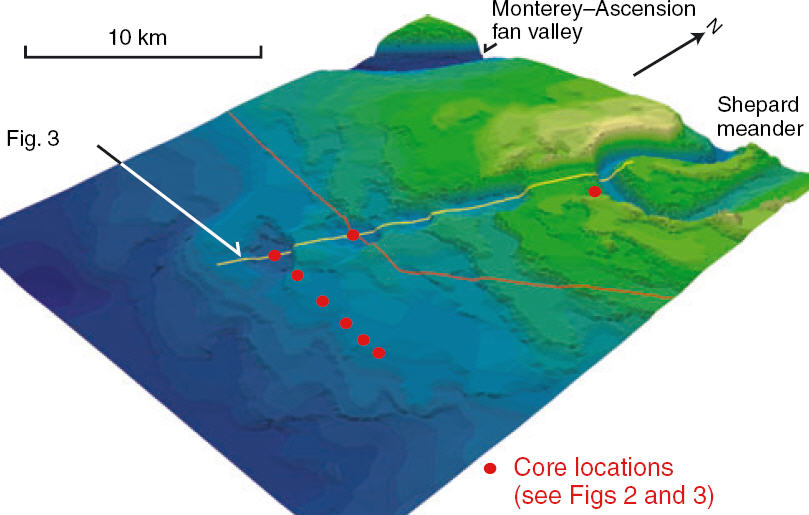
For yet another view of this train of scours, the image below (Fig. 5A from their paper) is a colored perspective image of the bathymetry with Shephard Meander on the right side of the image.
(Fig. 5A, Fildani et al., 2006)
What’s evident in this image (and if you go back to contour map above and look closely) are the depositional features on either side of the scour train. Although they appear “terraced” in the image above, this is a bit misleading because they are actually rather smooth depositional sediment waves – essentially a field of gigantic bedforms.
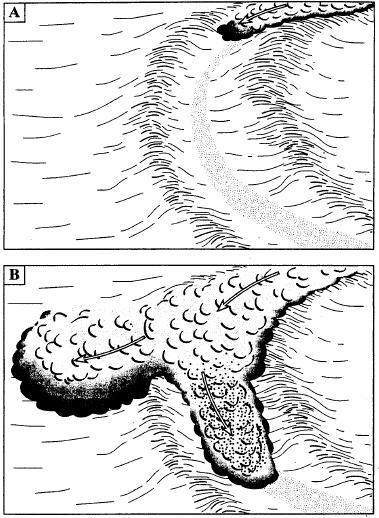
So, what’s going on here? We have a sediment wave field with a train of scours in the middle of it adjacent to and pointing away from a major bend in a submarine channel. If we go back to the title of the paper, they mention a process called flow stripping. This phenomenon, which was first discussed as an important process in the deep sea by Piper & Normark (1983), is best explained with an illustration.
(Fig. 7, Peakall et al., 2000)
An important aspect to remember about turbidity currents (i.e., sediment-laden, gravity-driven currents that occur in the submarine world) is that they can be thicker than the channel that confines them. As the turbidity current comes roaring down the channel and approaches a bend (see image above from Peakall et al., 2000), the lower part of the flow, which has the coarser material, will continue along the axis. The upper, typically more muddy, part of the flow is taller than this confinement so it “spills” out of the channel. In other words, the flow is stripped.
If you scroll up a bit and look at the images of the Shepard Meander and the associated sediment waves and scour train again, you can imagine this process occurring at the channel bend. So, the flow stripping process explains how sediment gets out the channel, but what about these scours?
At the risk of oversimplifying, essentially what is happening here is analogous to the formation of antidunes. If you remember back to your sed/strat class, antidunes are bedforms that typically develop under conditions of supercritical flow. As I mentioned above, please read the paper for the full story of the sedimentary processes and mechanics since, as always, this analogy can only be taken so far.
You may be thinking … well that makes sense for the sediment waves, but what about the scours? Finally, we get to the title of the paper. Cyclic steps are phenomena documented and studied by geomorphologists from bedrock channels. Basically, cyclic steps are erosional features produced by supercritical flow, whereas sediment waves are depositional features produced by supercritical flow.
Again, this is best communicated with an illustration. The photos below (Fig. 8 from Fildani et al., 2006) show examples of cyclic steps from a bedrock channel (A) and in a simulated bedrock channel (B).

(Fig. 8, Fildani et al., 2006)
To wrap this up … the final question is: why do these cyclic steps occur outside the submarine channel? This ties it back to the flow stripping process. As the top part of the turbidity current is stripped away from the main part of the flow at the bend it is (1) now going down a steeper gradient – the levee slope is steeper than the thalweg gradient and (2) the flow is all of the sudden a lot thinner. These two conditions contribute to the flow becoming supercritical.
As resolution of bathymetric mapping gets better and better, researchers are finding cyclic steps in other submarine fan systems around the world. One of the interesting implications is if these scour trains are incipient channels – that is, when the levee is finally breached fully, the new channel will find this pathway and develop in that position.
–
References:
Fildani, A., Normark, W.R., Kostic, S., and Parker, G., 2006, Channel formation by flow stripping: large-scale scour features along the Monterey East Channel and their relation to sediment waves: Sedimentology. doi: 10.1111/j.1365-3091.2006.00812.x
Peakall, J., McCaffrey, W., and Kneller, B., 2000, A process model for the evolution, morphology, and architecture of sinuous submarine channels: Journal of Sedimentary Research, v. 70, p. 434-448.
Piper, D.J.W. and Normark, W.R., 1983, Turbidite depositional patterns and flow characteristics, Navy submarine fan, California Borderland: Sedimentology, v. 30, p. 681-694.
Bathymetric image of regional Monterey Canyon area from this MBARI website.
~~~~~~~~~~~~~~~~~~~~~~~~~~~~~~~~~~~~~~~~~~~~~~~~~~~~~~~~~~~~~~~~~~~~~
Interesting juxtaposition of news headlines
The image below is a screen-grab of CNN.com a few minutes ago. The main headline is about how today’s huge spike in the price of oil is tied to the events of the day. And then off to the side is another story about how some Americans will keep paying for their gas guzzlers because their big vehicle is at the foundation of how their lives are structured. Many simply cannot get rid of it all of the sudden. Others are willing to pay extra just because they like it.

CNN reports these as separate stories … the red lines are the connections I’ve drawn.
I realize that the daily to weekly ups and downs on commodity prices are significantly influenced by geopolitical events, release of economic forecasts, and so on. But, I think it’s important to always realize the longer-term/bigger-scale influences as well. Our news is delivered in such a way that the short-term and the here-and-now is overly emphasized in my opinion.
I’m not saying it’ll be easy to change the American lifestyle. And I realize that I always harp on the demand side of the energy equation … it is because I’m a tad nervous about the supply side.
Although it is already forgotten in light of today’s spike, just a day ago, a report came out stating that:
Crude futures prices fell June 4 to the lowest level in a month in the New York market among indications that demand for gasoline is declining
Interesting. Demand declines, prices decline. There might be something to that!
~~~~~~~~~~~~~~~~~~~~~~~~~~~~~~~~~~~~~~~~~~~~~~~~~~~~~~~~~~~~~~~~~~~~
As I was saying the other day, there are so many geoscience-related blogs nowadays (which is awesome!) that if you miss a day or two you might miss some posts … they are coming fast and furious!
So, in case you missed it, I’m going to post it here. The geology blog Geological Musings in the Taconic Mountains has returned from a hiatus just in time to host the June 2008 Accretionary Wedge (a geoscience blog carnival).
What’s the topic? I think it’s going to be a good one.
You’ll have to go here to check out the details. The deadline for submissions is June 15th.
~~~~~~~~~~~~~~~~~~~~~~~~~~~~~~~~~~~~~~~~~~~~~~~~~~~~~~~~~~~~~~~~~~~~~~~~
Friday Field Foto #54: Dust storm in west Texas
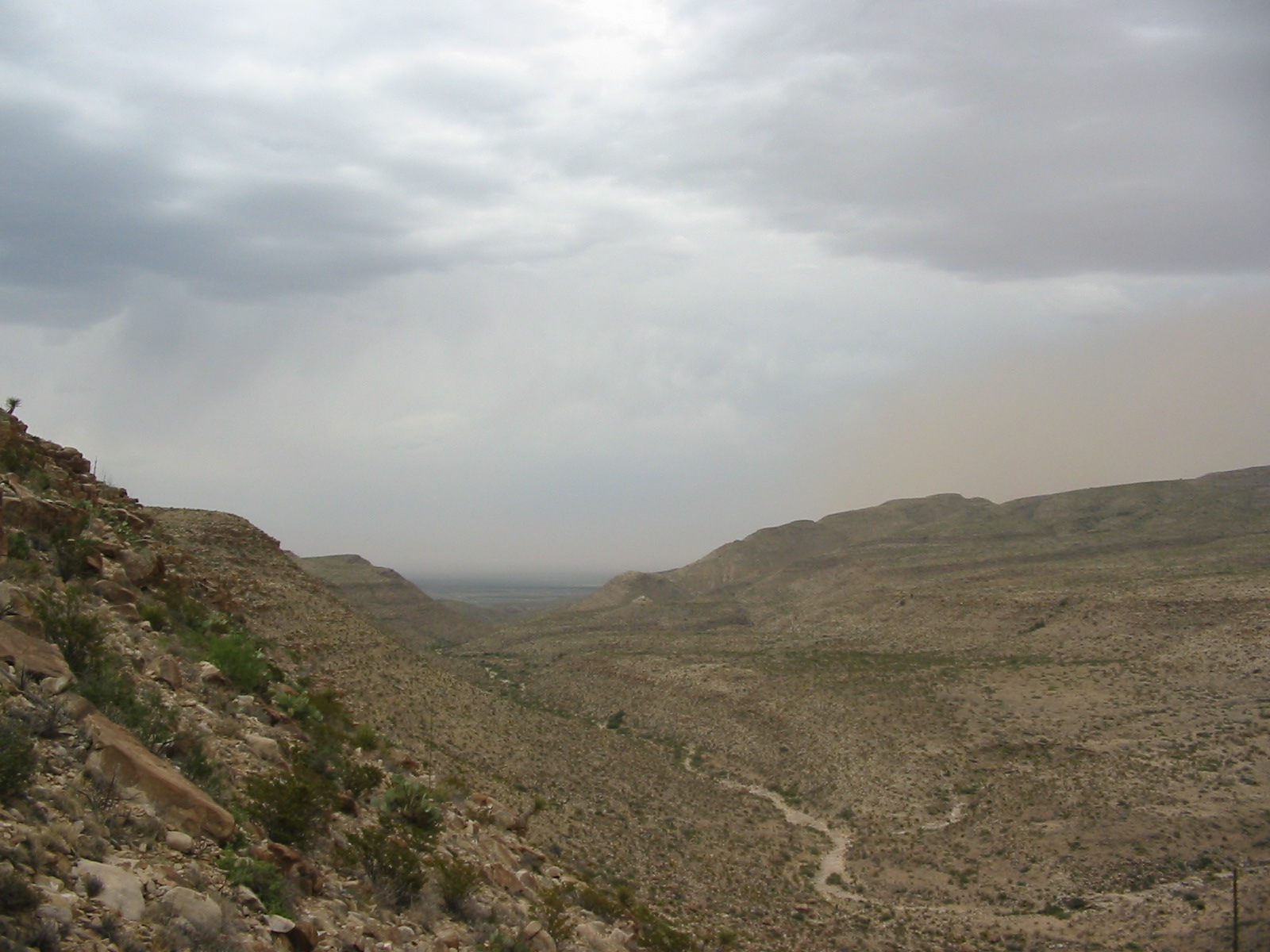
I did my master’s research on the Permian Brushy Canyon Formation in the Delaware and Guadalupe mountains of west Texas (I’ve shown some photos here, here, and here). The outcrop belt is adjacent to the Salt Basin Graben, which is the easternmost Basin and Range basin. In the photo below, the cactus-covered cliffs in the foreground are the Brushy Canyon outcrops and the mountains way in the distance on the skyline are other Permian rocks on the other side of the Salt Basin Graben.
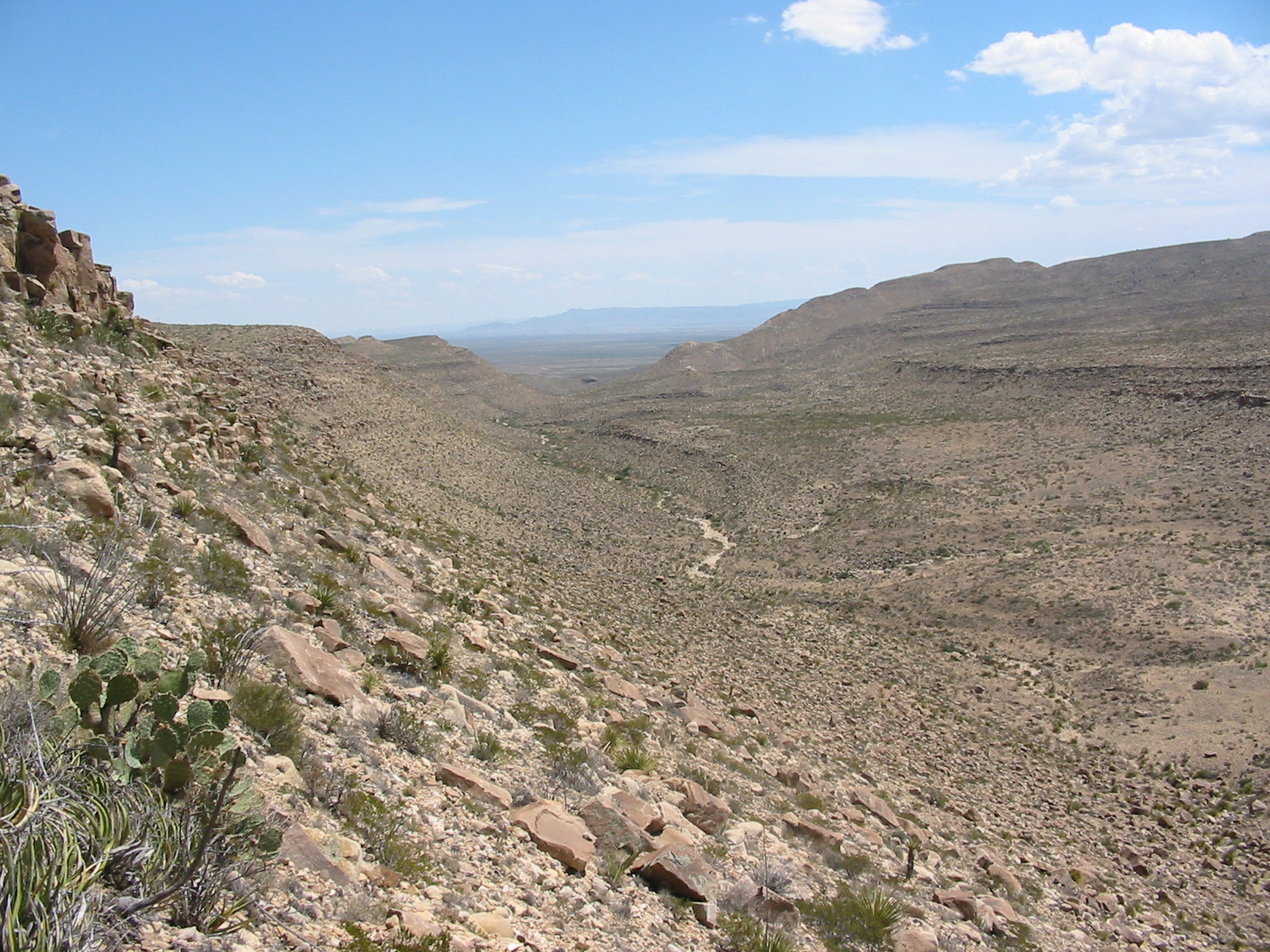
Every once in a while, the storms that came through this area in the summer would create these ridiculously vigorous dust storms that would move up the axis of the valley. The photograph above is about an hour before the photo below (from almost the same spot). Note that light brownish ‘cloud’ very low in the sky. About 10 minutes after this photograph, this thing hit us in the hills like a freight train. We were taking cover in any little overhangs we could find. Good times.
Happy Friday!
~~~~~~~~~~~~~~~~~~~~~~~~~~~~~~~~~~~~~~~~~~~~~~~~~~~~~~~~~~~~~~~~~~~~~~
Highstand Fans paper – Comment and Reply
One of the primary purposes of publishing papers is that it gives the community – other experts in your field – an opportunity to read, digest, and comment on your work. Most of the time, discussion and interaction among researchers is conducted at conferences or via one-on-one correspondence (e-mail/phone). Every once in a while, however, researchers will ‘officially’ comment through the journal in which the original paper came out.
In September 2007, we published a paper in Geology about the occurrence and significance of submarine fan growth and activity during sea level highstands. If you don’t have access to Geology or you want to read a shorter summary with less jargon, I’ve blogged about it before in this post.
Doug Inman, professor emeritus from Scripps Institution of Oceanography and a giant in the field of oceanography submitted a comment to our paper a couple months ago (click here for full-text html; click here for pdf). Inman conducted some of the pioneering work regarding the connection of sedimentary processes in coastal areas with what is happening in the deep sea offshore of southern California.
Inman’s primary comment on our work has to do with implications to sediment budgets within the context of our results:
We wish to compare this “natural” flux of sediment into the Ocean-side littoral cell with that measured by Covault et al. as accumulating in the La Jolla fan at a rate of 2.9 km3/k.y. = 2.9 × 10⁶ m3/yr over the period 13 ka to the present.
After laying out some of the nitty-gritty of sediment bulk density and calculations of sediment flux into tons per year, Inman says:
[Submarine] fan deposition rates over the past 13 ka of 2.9 × 10⁶ to 3.8 × 10⁶ ton/yr are in remarkably close agreement with the estimated natural sediment flux of 2.2 ×10⁶ ton/yr into the Oceanside littoral cell during historic times, considering the gross approximations of the calculations and the vast difference in time scales between the two estimates, and that sediment flux into the cell was likely to have been much greater during parts of the Holocene.
So, Inman isn’t commenting on any error or misunderstanding in our work, but wanting to apply our results to something he has worked on for decades – historic sediment budgets in coastal southern California. Implicit in this official comment is that perhaps this is something we should have addressed in our paper.
In this process, the authors of the paper that is the subject of a submitted comment have the opportunity to reply (you can read it in full here). In terms of addressing the main point about comparing our sediment accumulation rates (at the 10,000 yr scale) to sediment accumulation rates from the historical record (10-100 yr scale), we state:
…we avoided directly comparing rates of historical sediment flux into the Oceanside littoral cell and Quaternary La Jolla fan growth, which span three orders of magnitude with respect to duration.
This ties in to a post I wrote about the Sadler (1981) paper (and a lot of subsequent confirmation) regarding comparing sediment accumulation rates from different measured time intervals. Read that post and then the original Sadler paper to get into the details. But, essentially, there is an inherent bias as a result of unsteady processes (in this case, the nature of deposition and hiatus, but this applies to many of the processes on the Earth’s surface) such that rates of accumulation are lower for longer measured time intervals. This is why we avoided making the comparison Inman did in his comment.
That said, I think Inman makes a good point that deserves further investigation. Reconciling how to compare the rates we’ve measured in the last century or so with calculations from the geologic record goes beyond our particular paper and study.
This was the first official Comment and Reply I have been involved in and it was kind of fun in a way. I enjoyed it.
~~~~~~~~~~~~~~~~~~~~~~~~~~~~~~~~~~~~~~~~~~~~~~~~~~~~~~~~~~~~~~~~~~~~~~
Clinton supporters – get over it
Caution … political rant ahead …
Tonight we saw the primary season for the United States presidential campaign come to end (finally). And Barack Obama received the number of delegates he needed to clinch the nomination for the Democrats. It’s over.
I was just watching the local news and they were interviewing a bunch of Hillary Clinton supporters who were saying that they are so upset and bitter that they are going to vote for John McCain.
What? Ha! … oh wait, I think they’re serious. For real?
These aren’t so-called independents “on the fence” … these are hard-core Democrats. I really hope, for the future of this country, that these people just need a couple weeks to get over their bitterness. You are not a Democrat if you defect and vote for McCain. Period. That’s fine … people switch parties … it happens. But, don’t give me this schist that you are still a Democrat. Admit that you are no longer a Democrat and deal with it (whatever that entails).
So, what to do? Sit down, take a deep breath, and compare the policies being discussed by Clinton, Obama, and McCain. Are Clinton supporters going to sit there and seriously say that McCain’s policies are more aligned with Clinton? Are you going to vote for McCain to spite Obama? I don’t think so.
My guess (hope?) is that Clinton does the right thing and, in a few days or a week, after the dust settles, she’ll convince her supporters that becoming a Republican is not the best use of their time.
If you are a Clinton supporter, a Democrat, and can prove to me that McCain’s policies are more aligned with Hillary’s … please do so below. I’m not talking about identity politics or character, or if something was unfair, blah blah freakin’ blah. Give me some nutrients.
~
UPDATE (6/5/08):
The above post was from the night of the primary and directed towards those who were literally threatening to vote for McCain … to become a so-called ‘crossover’ voter.
This is the text of an e-mail Hillary Clinton sent her supporters (found here):
Dear X,
I wanted you to be one of the first to know: on Saturday, I will hold an event in Washington D.C. to thank everyone who has supported my campaign. Over the course of the last 16 months, I have been privileged and touched to witness the incredible dedication and sacrifice of so many people working for our campaign. Every minute you put into helping us win, every dollar you gave to keep up the fight meant more to me than I can ever possibly tell you.
On Saturday, I will extend my congratulations to Senator Obama and my support for his candidacy.
This has been a long and hard-fought campaign, but as I have always said, my differences with Senator Obama are small compared to the differences we have with Senator McCain and the Republicans.
I have said throughout the campaign that I would strongly support Senator Obama if he were the Democratic Party’s nominee, and I intend to deliver on that promise.
When I decided to run for president, I knew exactly why I was getting into this race: to work hard every day for the millions of Americans who need a voice in the White House.
I made you — and everyone who supported me — a promise: to stand up for our shared values and to never back down. I’m going to keep that promise today, tomorrow, and for the rest of my life.
I will be speaking on Saturday about how together we can rally the party behind Senator Obama. The stakes are too high and the task before us too important to do otherwise.
I know as I continue my lifelong work for a stronger America and a better world, I will turn to you for the support, the strength, and the commitment that you have shown me in the past 16 months. And I will always keep faith with the issues and causes that are important to you.
In the past few days, you have shown that support once again with hundreds of thousands of messages to the campaign, and again, I am touched by your thoughtfulness and kindness.
I can never possibly express my gratitude, so let me say simply, thank you.
Sincerely,
[Hillary]
Hillary Rodham Clinton
~~~~~~~~~~~~~~~~~~~~~~~~~~~~~~~~~~~~~~~~~~~~~~~~~~~~~~~~~~~~~~~~~~~~~


 Clastic Detritus
