Friday Field Foto #69: Patterns in a Tierra del Fuego beach
This week’s Friday Field Foto doesn’t show off any geologic relationship … I just think it looks cool.
While looking at some Miocene beach cliff exposures on the Atlantic coast of Tierra del Fuego last March I was distracted by the patterns in the sand created as the tide went out.

Patterns in the sand during low tide (© 2008 clasticdetritus.com)
Happy Friday!
~~~~~~~~~~~~~~~~~~~~~~~~~~~~~~~~~~~~~~~~~~~~~~~~~~
Map of U.S. carbon dioxide emissions per capita
I’m trying to find time to finish up some posts I’ve had in draft phase for weeks, but am having trouble finding the time — hopefully, I’ll finish up a nice long post about a paper I have out tonight or tomorrow.
In the meantime, I came across this interesting map from the Center for American Progress website. They put together a map showing carbon dioxide emissions per state in 2005. If you click on the map below it’ll take you to their site. When you click on each state, it’ll give you the per captia amount (in metric tons).

The lighter blue colors are the states with the lowest per capita emissions whereas the darkest blue are the highest.
I live in California, which probably has the highest total emissions (due to its high population) — possibly, maybe somebody can look up that map — but has relatively low (for the States) emissions by person.
~~~~~~~~~~~~~~~~~~~~~~~~~~~~~~~~~~~~~~~~~~~~~~~~~~
Friday Field Foto #68: Table Mountain, Cape Town
This week’s Friday Field Foto highlights an iconic natural landmark – Table Mountain in Cape Town, South Africa. Last April I took a trip to this region to look at some Permian sedimentary rocks. We had about a day in Cape Town before heading north to the field area and spent a nice afternoon trying not to sleep (jet lag) and taking in the sites of the city. Unfortunately, we didn’t have time to get to the top to take in the breathtaking views.

Table Mountain, Cape Town, South Africa (© 2008 clasticdetritus.com)
This view of the looming flat-topped mountain, called Table Mountain, is from the main tourist area along the waterfront (we went to a great Portuguese restaurant!).
I’m sure Christie at the Cape can provide much more detail about the geology of this mountain. If I remember, the prominent gray layered rocks in the upper half of the mountain are part of the Ordovician (443-488 million years old) Table Mountain Sandstone. Below that (again, if I remember correctly) is Precambrian metamorphic rocks that is intruded, in places, by granite.
Happy Friday!
~~~~~~~~~~~~~~~~~~~~~~~~~~~~~~~~~~~~~~~~~~~~~~~~~~
Note to readers
I will be away from a computer for about a week and have disabled the commenting … I hate to discourage any discussion (especially on this post), but I’ve been getting a bit more spam in the last week for some reason. Spammers are getting better at not getting caught by the filter and their stuff ruins comment threads and turns people away.
If you do comment, it will be held for moderation and I’ll approve it when I get back.
~~~~~~~~~~~~~~~~~~~~~~~~~~~~~~~~~~~~~~~~~~~~~~~~~~
Fun with electoral maps
NOTE: This post is from October 13th, 2008 — check the actual pollster sites I link to below for the most up-to-date numbers.
I’m getting excited for the election … mostly because it is dominating my idle thoughts and I’m starting to feel some fatigue!
If you’re not from the States and don’t know what the electoral college is or why we do it this way, check out this site (or the Wikipedia page is pretty good too). Essentially, instead of a direct popular vote, each state has a number of electors equal to the number of Senators and Representatives in Congress. The larger the state’s population, the more Representatives it has, and the more electoral votes it has. For example, California, New York, Texas, and Florida have between 27 and 55 whereas Montana, Wyoming, and South Dakota have only three. I don’t really want to get into a debate of whether this is good or bad … at least not right now … certainly for the election in three weeks, this is the system. UPDATE: From a commenter – check out this site for discussion of why we should have and how to achieve a national popular vote system.
There are a total of 538 total electoral votes, a candidate needs 270 to win the election.
There are several pollster sites out there that update the national map based on daily polling*. Some go into excruciating detail about their methodology. This post is really about defending or criticizing specific pollsters or whether or not this is valid … blah blah blah … this is mainly just for fun.
So, today is October 13th, 2008 – the election is three weeks from today.
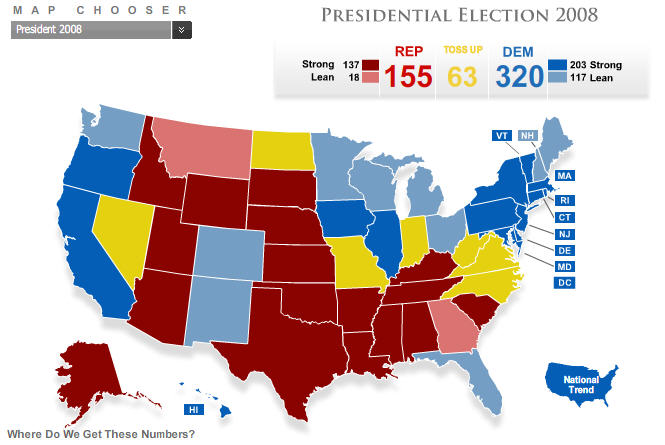
Here’s the map from Pollster.com.
Electoral map from Pollster.com on 10-13-2008
In this version, the deep red are strong McCain, pink are weak McCain, deep blue stong Obama, and light blue weak Obama. The yellow states are considered by this pollster to be a “tossup” at this point (sometimes called a “swing state”). If you go to their site you can hover over each state and get the internal numbers just for that state. The total number of electoral votes for each candidate come from adding the strong and weak states. In this case, Obama has already surpassed 270 by a long shot. But remember, this isn’t necessarily a prediction of November 4th, but a prediction if the election were held today based on polling numbers. If you check these day to day, they can change … although they tend to become more solidified as the election draws near. As an aside, it’s quite astonishing that North Dakota, Indiana, West Virginia, and Missouri are “tossup” states on this map!
–
The next map is from RealClearPolitics.com.

Electoral map from RealClearPolitics from polling on 10-13-2008 (realclearpolitics.com)
Theirs is essentially the same as Pollster.com’s – the only differences that they give North Dakota to McCain and give Virginia to Obama.
–
Finally, is a map is from a site called Electoral-Vote.com.

Electoral map from electoral-vote.com on 10-13-2008
This screenshot was taken on the same day as the other sites above (Oct. 13th, 2008). This site is a bit less hesitant about calling a state. They only show one state (Missouri) as exactly tied and attribute all the other electoral votes to a candidate even if it’s close. As a result, they have Obama and McCain with 346 and 181 electoral votes, respectively. There are some differences between theirs and the above maps in the swing states. Again, please visit these sites for all the details about their methodology.
One of the cool features of electoral-vote.com is that they have a button to see “this day in 2004” so you can see what the race looked like on the same day for that election. Below is the electoral map for the 2004 election (Bush vs. Kerry) for October 13th based on polling data.

Electoral prediction for 2004 election based on 10-13-2004 polling data (electoral-vote.com)
Although they didn’t exactly predict the actual outcome (Bush ended up with 286) the point here is that it was a very close race with three weeks to go. I remember following it and the numbers bounced around a bit but it was always pretty close. If you go back up to the electoral-vote.com map for 2008, note the line on the bottom that says “Dem pickups (vs 2004)” – there are nine states there that Obama is currently polling better than McCain that Bush won four years ago.
Another cool thing about electoral-vote.com is that they have a cartogram option such that the states are sized proportional to their electoral votes (population).
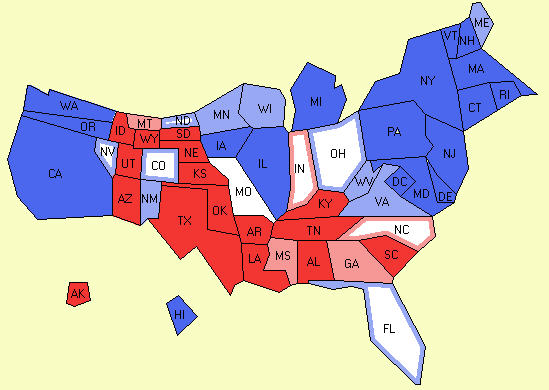
Cartogram of electoral map from 10-13-2008 polling data (electoral-vote.com)
Kinda puts things in perspective.
–
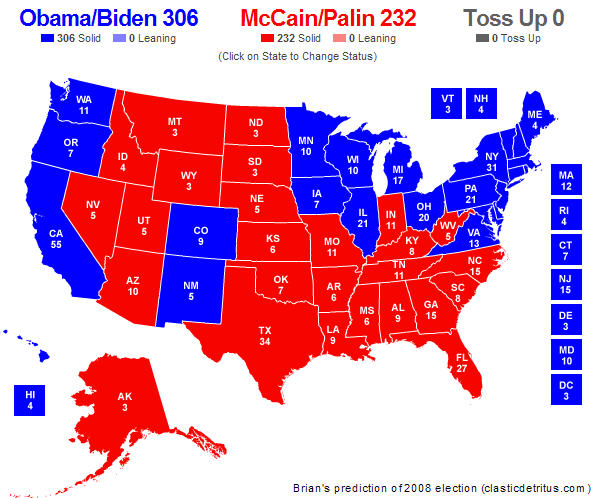
On many of these sites you can play around with the map and make your own. So here it is — this is my prediction!
My prediction for the 2008 U.S. presidential election
Although Obama is polling extraordinarily well for a Democrat in states like North Carolina, West Virginia, Missouri, Nevada, Indiana, and North Dakota I think those will stay red. I’m even going to give Florida to McCain … Florida is fickle … difficult to predict. But I will go ahead and turn Virginia blue. Ohio is very close right now, but I think it’ll also go Obama.
I could be wrong, but this is what I’m gonna go with (barring some super-duper October surprise that fundamentally changes the race). Also, this prediction assumes no voting “irregularities”.
If anyone else wants to make a prediction, link to it in the comments … could be fun.
–
* The major news networks have electoral maps on their websites but none of them show Obama with more than 270 electoral votes even though polling shows otherwise. This is most likely due to the fact that they want it to be close, they want a horse race … what else would they talk about? If it weren’t a “dead heat” all the time, then you wouldn’t tune in to their idiotic commentary 24/7. If Obama’s lead opens up even more, watch the major networks drive the narrative that it is “very close”.
~~~~~~~~~~~~~~~~~~~~~~~~~~~~~~~~~~~~~~~~~~~~~~~~~~
Sea-Floor Sunday #32: Mud volcano and associated mud flows
This week’s Sea-Floor Sunday grabs another great image from the Virtual Seismic Atlas website.

credit: Virtual Seismic Atlas (http://www.seismicatlas.org/)
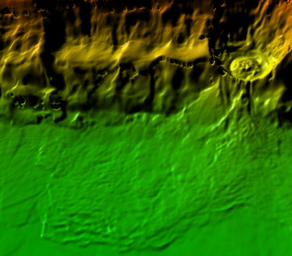
The image above is the sea floor offshore Nigeria showing an active uplifting ridge with a mud volcano. Unfortunately there is no scale included on this image … my guess is that ridge is 3-5 km across. Also note the mud flows that have come off the flank of this ridge.
The image below zooms in a bit to highlight the mud flow texture.
credit: Virtual Seismic Atlas (http://www.seismicatlas.org/)
You can find this image here at the Virtual Seismic Atlas site.
See this Sea-Floor Sunday post from a couple weeks back showing another perspective of the Nigerian continental slope.
–
Note: All images above are property of Virtual Seismic Atlas (VSA). They are available for personal or educational purposes, but please visit their site and read terms of use [pdf] before doing so.
~~~~~~~~~~~~~~~~~~~~~~~~~~~~~~~~~~~~~~~~~~~~~~~~~~
I’m a big dork
A t-shirt with this design is on its way to my house!

(© smilingsquid)
You can find it here on Etsy, which is a site for buying and selling handmade items. My soon-to-be wife loves this site and found this shirt for me the other day. If you want to find unique handmade items from real people and support small-scale independent businesses this is the place.
This particular design is from two sisters called ‘smilingsquid’:
We are two sisters. My fabulously talented older sister does most of the t-shirt designs. I contribute awful puns, run the store, and sometimes design a shirt or two (the really simple ones). We now have a shop where our designs are available on things we can’t make ourselves, including mugs, refrigerator magnets, clocks, messenger bags, and totes: http://www.cafepress.com/smilingsquid
There is plenty of other fun stuff … check it out.
~~~~~~~~~~~~~~~~~~~~~~~~~~~~~~~~~~~~~~~~~~~~~~~~~~
Friday Field Foto #67: Alluvial fans in Death Valley
This week’s Friday Field Foto is of some coalescing alluvial fans on the west side of Death Valley, California.

Alluvial fans, Death Valley, CA (© 2008 clasticdetritus.com)
This one is a photomosaic so you’ll definitely want to click on it to see the bigger version. Below is another image zoomed in.

Alluvial fan, Death Valley, CA (© 2008 clasticdetritus.com)
Happy Friday!
~~~~~~~~~~~~~~~~~~~~~~~~~~~~~~~~~~~~~~~~~~~~~~~~~~
150 years of changes of the Chandeleur barrier islands
A couple of weeks ago, Dave over at Geology News had a couple of posts about the impact of hurricanes on the landscape – first, there was a post about what barrier islands are and how they form and then a post showing amazing (and quite scary) before-and-after photos of Bolivar Peninsula in the wake of Ike. Hindered Settling went into some detail regarding the redistribution of sediment with similar before-and-after photos of Galveston.
The New York Times produced a great graphic showing the changes that the Chandeleur barrier islands, which are just northeast of the Mississippi Delta, have undergone in the last 150 years. As you can tell, they are shrinking quite rapidly.

Graphic from the New York Times; Data sources from the USGS, Univ. of New Orleans, Louisiana State Univ., and Louisina Dept. of Natural Resources
Click on the image above to see a bigger version and then go to the original New York Times article to learn more.
Barrier islands are dynamic depositional features that are constantly being constructed, molded, sculpted, and eroded over time scales that certainly matter to humans (decades to centuries). The combination of diminished sediment delivery from the river combined with subsidence and rising sea levels make these transient features vulnerable to storms.
–
UPDATE (10/9/2008): Geology.com has a nice summary of storm surge damage on the Gulf Coast from hurricane Ike.
~~~~~~~~~~~~~~~~~~~~~~~~~~~~~~~~~~~~~~~~~~~~~~~~~~


 Clastic Detritus