Some photos from a trip to the Arctic
I just returned from a trip to Svalbard, which is an island group in the Arctic Ocean about 1000 km from the geographic North Pole. I was asked to guest lecture and help teach a part of a sedimentary geology field course.
We never actually made it to a couple planned field sites because of bad weather during the trip combined with general snow/ice conditions from the winter and spring. Oh well … these things happen in a scientific discipline that requires going to the field. Fortunately, the backup plans for other geological things to see and do were fantastic so I don’t think the quality of the class suffered.
Svalbard is located from 74°N to 81°N and was my first time above the Arctic Circle (~66°N). Here is a very nice polar projection topographic/bathymetric map with location of Svalbard annotated by me.
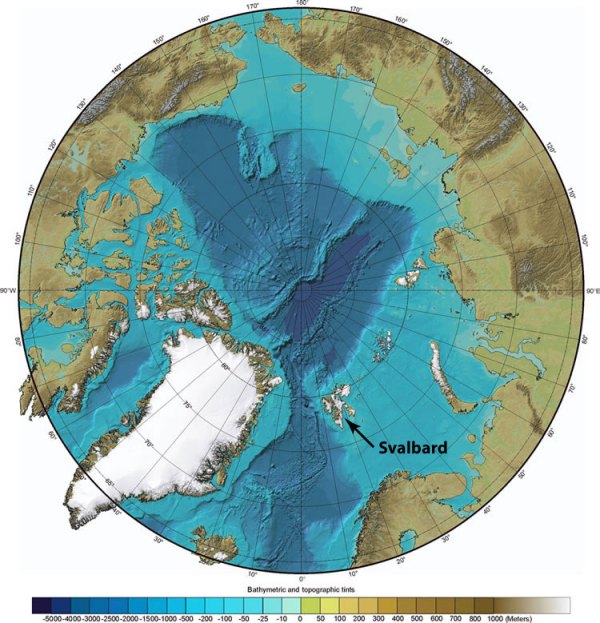
Topographic/bathymetric map of the Arctic (credit: http://www.ngdc.noaa.gov/mgg/bathymetry/arctic/arctic.html)
Although I was fully expecting and prepared for 24 hours of sunlight, it was still an interesting experience. Took a few nights to get used to … I kept waking up in middle of the “night” thinking I had overslept and was late for the day’s activities. Being in the field makes you very aware of the patterns of the sun throughout a day, so it was also an interesting experience to have the sun mostly circling me rather than rising and setting.
I’ll try and write some more about this experience soon, but in the meantime here are a few photographs with a bit of explanation (below the photo).

Svalbard from the air (© 2009 clastic detritus)
Out of the window of the plane as we approached Longyearbyen, Svalbard — which, by the way, is the nothernmost location on Earth one can fly to any time of year.

Town of Longyearbyen, Svalbard (© 2009 clastic detritus)
The town of Longyearbyen is the largest settlement on Svalbard (about 2,000 residents) and sits in a valley among cliffs of Eocene sedimentary rocks.

Braid-delta from the air, Svalbard (© 2009 clastic detritus)
There aren’t any roads that connect the few settlements on Svalbard, so traveling from one place to another requires either boats or planes. To get to some particular outcrops we took an 18-minute flight in a small plane that shuttles workers from Longyearbyen to an active coal-mining settlement. Although short, this flight provided an opportunity to get a bird’s-eye view of the spectacular glacial-outwash sediment dispersal systems in the region. The photo above shows this beautiful plume of sediment from a braid-delta system.

Arctic tundra, Svalbard (© 2009 clastic detritus)
A dusting of snow on the squishy and very muddy tundra. In terms of flora, this low mossy grass and several species of small wildflowers are about it.

Svalbard field work (© 2009 clastic detritus)
Field work in Svalbard requires carrying (and being trained to use) hunting rifles in case of polar bear encounters. Over 15 or so years and many thousands of researchers doing field work, only one bear has been shot and killed (apparently by polar bear researchers). I have very little experience with guns and was pleasantly suprised at the multiple bullseyes I got during training.

Reindeer, Svalbard (© 2009 clastic detritus)
On the way back from a hike (on which Mother Nature conquered me … yet again) a couple of juvenile reindeer followed us for a bit.

Eocene strata in Svalbard (© 2009 clastic detritus)
The outcrops near the coal-mining settlement still have some equipment and structures from old-time installations. The rocks above the coal level are a mixture of coastal plain with increasingly more marine influence upwards.

Glacier in Svalbard (© 2009 clastic detritus)
Near the toe of the Hoganasbreen glacier in the evening.

Braided river system, Svalbard (© 2009 clastic detritus)
Our short flight back to Longyearbyen provided another opportunity to get some photos of the sediment dispersal systems. It was a bit of a hazy day so the photos aren’t very crisp, but still show the features nicely.

Alluvial fan in Svalbard (© 2009 clastic detritus)
Alluvial fan developing in the Adventdalen valley near Longyearbyen.

Mouth of Adventdalen River near Longyearbyen, Svalbard (© 2009 clastic detritus)
The mouth of the Adventdalen River is somewhat influenced by tidal currents in the fjord giving it this distinctive pattern.

Adventdalen River tidal flat (© 2009 clastic detritus)
The muddy tidal flat near the mouth of the Adventdalen River.

Alluvial fan and Adventdalen River, Svalbard (© 2009 clastic detritus)
Here is that same alluvial fan — now from the ground.

Sled dogs near Longyearbyen, Svalbard (© 2009 clastic detritus)
Finally, just before we left the field on my last day we were hiking back to where our vehicle was and spotted the summer training program for the sled dogs.
To see these photos (and more) at higher resolution, check out my Flickr set here.
This was a great trip … I feel fortunate to have been able to go. I met some really great people that I hope to collaborate with in the future as well.
Suspending sediment in a fluid
Blogging will be even lighter than usual for the next two weeks … I am doing some traveling and going to see some rocks I’ve been wanting to visit for several years. More on that when I return.
Before I leave, I’ll leave you with this image of a recent sand storm in Saudi Arabia … which reminded me of something.
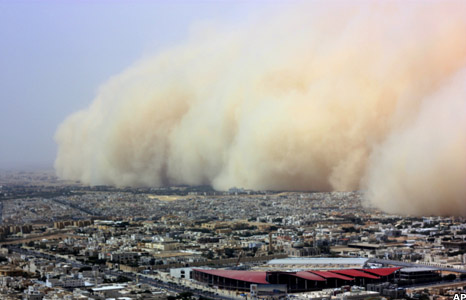
Sand storm in Riyad, Saudi Arabia, June 2009 (credit: International News Bureau; http://www.intnewsbureau.com/riyad-sand-storm-massive-sandstorm-hits-saudi-arabia/)

Experimental turbidity current (click on image to go to Flickr set; see this site for associated research - http://www.physics.utoronto.ca/nonlinear/turbidity/turbidity.html )
Geopuzzle (updated)
I’ve been so busy lately that I completely forgot to do a bit of research for a reader that e-mailed me a photograph of some interesting (and beautiful) rocks.
So, I decided to make it a geopuzzle and let the collective intelligence of the blogosphere discuss, debate, and ultimately solve.
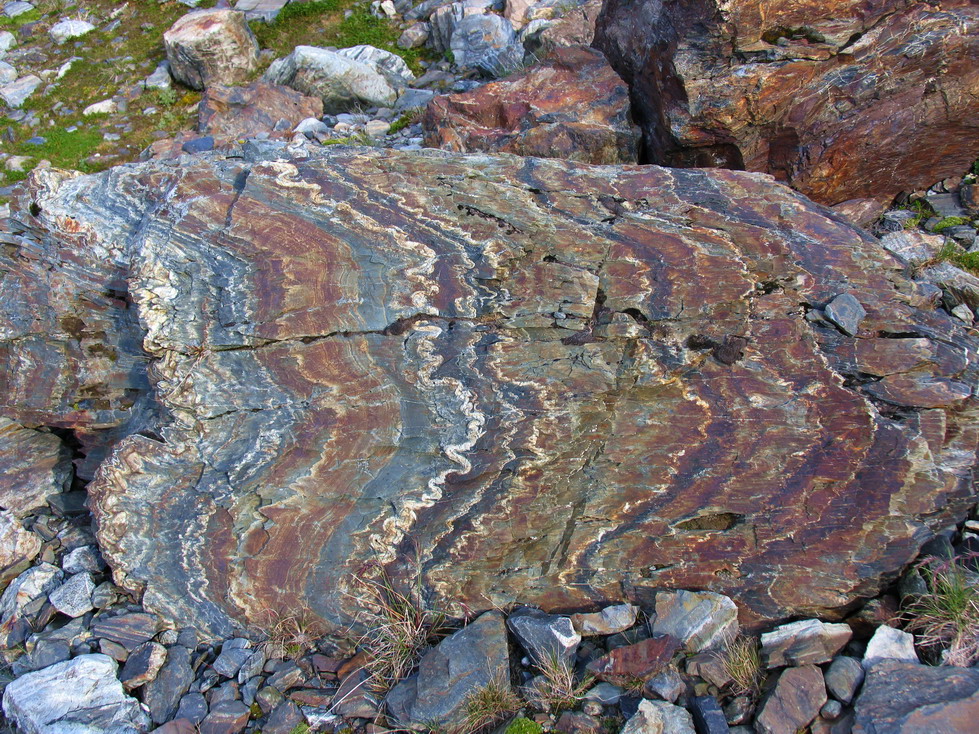
photo courtesy of a reader -- click on it for larger version
Here is what the reader says about the rock in an e-mail to me:
The rock is about 4 feet across and is near the Martial Glacier outside Ushuaia, Argentina.
Alright … have at it!
–
UPDATE (6/23/09): This update was posted after the comments below to try and capture the general consensus on this particular geopuzzle. Everyone mentioned and admired the quartz ptygmatic folds (the white squiggly layer). Kim pointed out the parasitic folding — which, correct me if I’m wrong, is the term for the self-similarity of fold geometries of different wavelengths (note how the thinner layers are folded tightly within a longer-wavelength fold). In terms of what kind of rock this is, looks like most would agree that these were sedimentary rocks (evidenced by the layering) that were deformed (evidenced by the folding) and likely metamorphosed somewhat.
I have done some work in this general region and there are extensive outcrops along the Andean orogen composed of Paleozoic (~250-550 million yrs ago) meta-sedimentary rocks. While we can’t be absolutely certain that’s what this rock is just from this one photo … if I had to make the call, that’s what it would be. Or, another way to look at it … now we have a solid hypothesis to test. We just need to get down to Tierra del Fuego and sample this thing. Field trip!
 This week’s Sea-Floor Sunday is an image from a recent paper from Flood et al. about channel networks on the floor of the Black Sea (you can see the entire paper here).
What I find interesting about this system is that it forms from saline density flows that come from the Bosphorus (the strait that separates the Black Sea from the Sea of Marmara and the rest of the Aegean Sea in the Mediterranean region):
This channel network accommodates the saline density current formed by the Mediterranean inflow. The density contrast between the density underflow and the ambient water mass is … similar to the density contrast ascribed to low-concentration turbidity currents in the deep sea.
This density current is dense because the bottom waters are saltier — so when flows come through the strait into the Black Sea, they flow across the shelf into deeper water. The development of a network of channels and associated landforms are the result.
The bathymetric map below (about 15 km across) nicely images the main channel near the bottom of the image bifurcating towards the north (towards the top of the image).
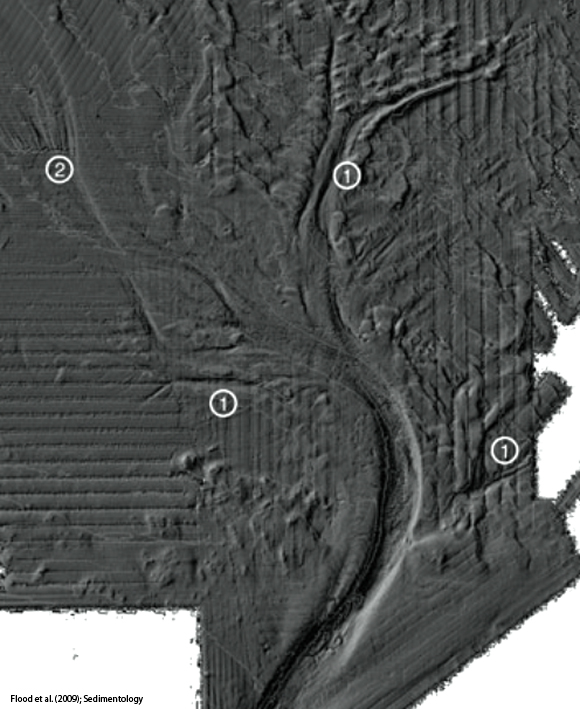
Channel network, southwestern Black Sea - image ~15 km across (credit: Flood et al. paper in journal Sedimentology; © 2009 International Association of Sedimentologists)
Turbidity currents are also density currents but get the excess density necessary to create an underflow from sediment. Experimentalists often use salt to create density underflows in the lab. This system is essentially a full-scale laboratory for studying the processes and landforms related to channelization of density flows. Although one big difference is that the saline density flows are eroding and redistributing sediment but not delivering additional sediment to the system.
If you are interested in river or deltaic channel patterns you might find this paper interesting.
–
FLOOD, R., HISCOTT, R., & AKSU, A. (2009). Morphology and evolution of an anastomosed channel network where saline underflow enters the Black Sea Sedimentology, 56 (3), 807-839 DOI: 10.1111/j.1365-3091.2008.00998.x
Friday Field Foto #87: Cobble beach on Patagonian lake
This week’s Friday Field Foto is from a cobble beach along the shores of Lago Nordenskjold in Parque Nacional Torres del Paine in Chilean Patagonia. I was in this area earlier this year to run a field conference and do some field work and spent a few days to do a little hiking in the national park.

Lago Nordenskjold cobble beach, Chile (© 2009 clastic detritus)
By the way, the beach is at the foot of this:

Los Cuernos del Paine, Chile, in the early morning light (© 2009 clastic detritus)
Ah hah! That’s where the comparable proportions of light and dark cobbles come from.
Happy Friday!
Friday Field Foto #86: Ocotillo in New Mexico
It’s been pretty hectic the last couple weeks, I just haven’t had much time for blogging … this week’s Friday Field Foto barely shows any geology. It’s just a photograph I like.

Ocotillo plant near Carlsbad, New Mexico (© 2009 clastic detritus)
Happy Friday!
Summer reading list
A post over at Reporting on a Revolution earlier today reminded me that there was a summer reading list meme started — maybe last week (?) … I forget where now.
At this point in my life, I know myself pretty well. I know how long it takes me to get through books. So … this list contains both books I have already started and hope to finish as well as ones I’d like to start (and not finish until next year sometime):
- Sand: The Neverending Story — Michael Welland (check out his blog Through the Sandglass)
- Out of Control — Kevin Kelly (have been reading this for a while, it is thick and quite dense)
- Plows, Plagues, and Petroleum: How Humans Took Control of Climate — William Ruddiman
- Thinking in Jazz: The Infinite Art of Improvisation — Paul Berliner (this is also very thick, might be studying it for years to come)
- Stories in Stone — David Williams (check out his blog Stories in Stone)
- The Shock Doctrine: The Rise of Disaster Capitalism — Naomi Klein
- Flowers for Algernon — Daniel Keyes (this in the read-in-high-school-but-need-to-reread category)
- BLDGBLOG — Geoff Manaugh (I haven’t picked this up yet, but I like his blog of the same name a lot)
- Idiot America: How Stupidity Became a Virtue in the Land of the Free — Charles Pierce
Feel free to leave a link to your list in the comment thread below.
–
UPDATE (6/10/2009): See a much longer list of popular science books on ScienceFriday’s website here. They asked for suggestions with Twitter and got a lot of great suggestions.
Wednesday potpourri
Here is a rather random list of links of cool stuff I found on the internets:
- Collection of time-lapse videos from NASA’s Earth Observatory images showing land use and other anthropogenic changes to the Earth’s surface over time (via Wired Science blog).
- Seismograms of North Korea’s nuclear tests (via Shaking Earth).
- Online books of carbonate geology (via Reporting on a Revolution).
- Online diary of a BBC correspondent aboard the Chikyu drillship doing its thing in the Nankai Trough (via BBC).
- Beautiful fan delta in Lake Eyre, Australia (via Riparian Rap; originally from NASA EO).
- Go solve Where on (Google)Earth? #167 (via Ron Schott’s Geology Home Companion)
- Finally … things that sound like Chewbacca (via urlesque).
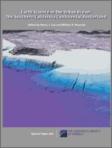 A special volume from GSA (Geological Society of America) titled Earth Science in the Urban Ocean is now available. This is a 480-page book with six thematic sections and a total of 26 papers. The ‘urban ocean’ of interest is the coastal and offshore areas of southern California. This special volume summarizes a research done by the USGS and collaborators over the past couple of decades.
–
–
The six sections include:
- Surficial Seafloor Mapping and Characterization
- Source-to-Sink Sedimentation
- Southern California Physical Oceanography and Sediment Transport
- Regional Tectonic Structure: Earthquake and Tsunami Hazards
- Coastal Aquifers of Southern California
- Contaminant and Biological Implications of Earth Science Studies in the Southern California Bight
(see table of contents listing every paper here)
–
I am a co-author on a paper in Section 2 titled Submarine canyon and fan systems of the California Continental Borderland. This is a nice review paper of the several deep-marine sedimentary systems in this area and their (geologically) recent history. My contribution is some work I did on the Holocene history of the Hueneme submarine fan system in Santa Monica Basin for my dissertation (the details of which are currently in press and should be out later this summer).
–
I am very excited to see this publication come out. I think it will be a great resource for those interested in this specific region as well as those interested in the intersection of geoscience and human activity in general. I also think it is a nice example of how to package multi-/inter-disciplinary geoscience research — that is, there is a general theme that ties the papers together but they are also useful as stand-alone papers.
Here is part of the description of the book from the GSA bookstore website:
The Southern California Continental Borderland and the associated Western Transverse Ranges constitute one of the most distinctive environments on the west coast of North America. During the past 20 years, the U.S. Geological Survey, along with many Southern California scientific partners, has conducted extensive research on geologic and oceanographic processes in the urban ocean off Southern California. The overall goal of this research has been to explore the impact that natural processes of the Borderland have on human population, and vice versa.
This week’s Sea-Floor Sunday is an image from the continental slope in the northern Gulf of Mexico.
The image is from a short article on USGS’s website called Mapping Turbidite System Pathways on the Louisiana Continental Slope with GLORIA and Multibeam Bathymetry. The GLORIA (Geological LOng-Range Inclined Asdic) tool is a side-scan sonar tool that produces images showing varying intensity or ‘backscatter’ that represent textural characteristics of the seafloor (read more about the GLORIA tool here).
The image below is the multibeam bathymetry showing the seafloor topography. The length of this map (from top to bottom) is approximately 100 miles (for regional context, see this map). The circular to oval features are called salt-withdrawal minibasins. Jurassic salt deep in the subsurface has ‘flowed’ upwards over geologic time creating domes, diapirs, ridges, and so on. Sedimentation has occurred and interacted with this process.

Turbidite system pathways on Gulf of Mexico continental slope (credit: http://coastalmap.marine.usgs.gov/regional/contusa/gomex/centgulf/lcs/aapg97/index.html)
The colored lines denote the pathways for turbidite systems that have developed across this complex topography. An interesting feedback has developed such that the low spots (the minibasins) trap sediment, which increases subsidence, which in turn promotes further salt withdrawal underneath the basin, which in turn creates a low spot on the seafloor. Some of these minibasins have several thousands of feet of structural relief along their flanks. Check out the original USGS article for more information.
–
Also check out this post from Nov 2007 for more images of the Gulf of Mexico continental slope.


 Clastic Detritus


