Geological Society of America 2012 — Call for Abstracts
This year’s annual GSA conference is November 4-7, in Charlotte, North Carolina. I am chairing two sessions at the meeting and encourage you to submit an abstract.
- T169. Cyclicity and Hierarchy in the Clastic Stratigraphic Record
Brian W. Romans, Jacob A. Covault, Stephen M. Hubbard - The documentation of cyclical and hierarchical patterns in the stratigraphic record has led to interpretations of systematic forcings and apparently improved predictability. This session will explore these themes at a range of scales. Submit an abstract.
- ~
- T181. Integrated Detrital Records of Orogenic Systems
Brian W. Romans, Amy L. Weislogel, Julie C. Fosdick - The record of orogenesis is contained within detritus deposited in sedimentary basins. This interdisciplinary session will highlight innovations in using detrital geo-/thermo-chronology and other geochemical provenance methods to better understand relationships of tectonics and sedimentation. Submit an abstract.
- ~
- Another session of interest, and one that I’ll likely submit an abstract to:
- ~
- T165. Preservation of Environmental Signals in Deep-Water Depositional Systems
Jacob A. Covault, John Snedden - This session aims to evaluate preservation of environmental signals in the deep-water stratigraphic record. Studies of Quaternary sedimentary systems on the seafloor, successions of outcropping and subsurface sedimentary rocks, and numerical models are welcome contributions.
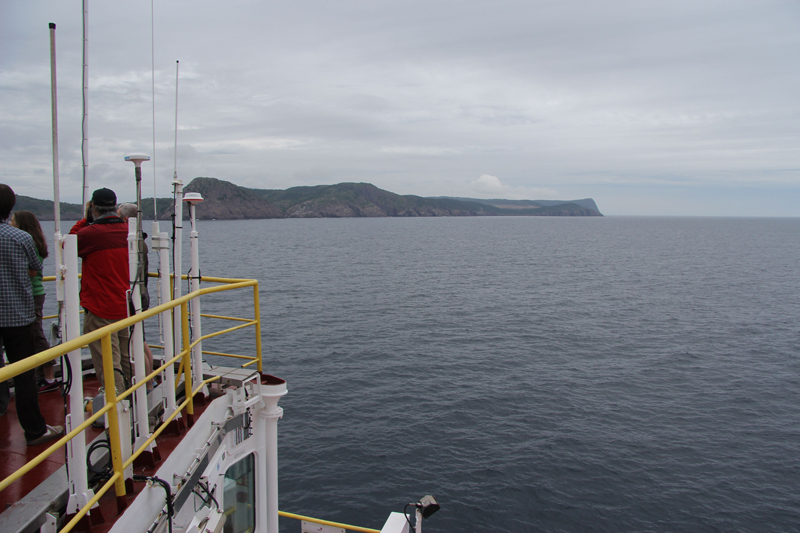
Gathering on the upper deck as we come into port at St. Johns, Newfoundland after two months at sea
IODP Expedition 342 is over and I’m back on land. The expedition was a huge success in terms of meeting the scientific objectives. The main goal was to recover expanded sedimentary records of oceanographic/climatic conditions and events during the Paleogene (~65-23 million years ago). This time in Earth history contains several global warming events, or ‘hyperthermals,’ and the transition from an ice-free (or nearly so) world to a world with ice sheets at the poles. In addition to plenty of Paleogene sections, we ended up with some fantastic records of Earth history before (Cretaceous) and after (Miocene) the Paleogene. In total, the expedition recovered 5.4 km of sediment cores.
Sedimentary records of these past climatic conditions have been recovered already — so what more is there to learn? The strategy for this expedition was to target piles of sediment that accumulated at relatively high rates, thus providing the ability to investigate the dynamics of events that occurred 10s of millions of years ago at similar resolution for events that occurred 100s of thousands of years ago. In about six months we’ll all gather at the Bremen, Germany core repository to take samples of these sediments that will be used for numerous analytical techniques aimed at reconstructing ocean conditions in the past. More about that, including what me and my students will be working on, in the coming months.
What I loved most about being on this expedition was being part of integrated science in action. Watching the micropaleontologists and paleomagnetists — the ‘keepers of time’ as they became known among the science party — figure out where we were in Earth history was incredible. Knowing what age sediment we were drilling as accurately as possible is obviously important for the science that will be conducted for years to come, but it was also crucial for operational decisions. Should we keep drilling deeper? Do we need to drill a second, or third, hole to make sure we captured the critical intervals? These questions had to be answered in real time. It was quite exciting.
With excitement comes intensity. Make no mistake, sailing on one of these expeditions is a lot of work. We worked 12-hours shifts every day for nearly 60 days. This particular expedition had very high recovery and minimal transit time between sites, which led to essentially no break in the processing of core — they just kept coming up on deck, all day, all night, the entire time. I’m still hearing the ‘core on deck’ announcement in my head.
The Integrated Ocean Drilling Program is big science. The contributions from IODP and its legacy programs over the past 45 years to the understanding of how Earth works is significant. I’ve used data from this program for some of my previous research (and will for future research) and I’m thrilled to now contribute to the collection and documentation of new data that will hopefully be used to do science for decades to come.
In case you missed them when they went live, here are the video episodes (each ~10 minutes long) that chronicled the expedition as we went.
Episode One: ‘Departure’ — http://www.youtube.com/watch?v=jWO6LnsGj1s&hd=1
Episode Two: ‘Core on Deck’ — http://www.youtube.com/watch?v=IgouMVdqLDI&hd=1
Episode Three: ‘Time Machine’ — http://www.youtube.com/watch?v=_qtvK35YhNE&hd=1
Episode Four: ‘Stormy Science’ — http://www.youtube.com/watch?v=dp8pez3PLQ4&hd=1
Episode Five: ‘Back to the Future’ — http://www.youtube.com/watch?v=eudbroUnSPs&hd=1
The sixth and final episode was shot during the final few days of the expedition and will be produced and uploaded by next week sometime. Later this fall, the film maker will produce a ~20 minute-long documentary that summarizes the entire expedition.
IODP Exp 342: Core on the Floor!
Nearly all of the geological field work I’ve done up to now has been on outcrops, rocks exposed at the surface. I’ve also done quite a bit of work on cores taken from the subsurface, which are stored in a repository and then laid out for geologists to view, describe, and sample. Working on the JOIDES Resolution is like being in the field and the core lab at the same time. Every hour or so during coring operations there’s an announcement that goes out across the ship saying ‘Core on deck’ or ‘Core on the floor.’ What I love about this is that it’s all about the core. Getting the material that holds clues to events and conditions of an ancient Earth is the primary objective.
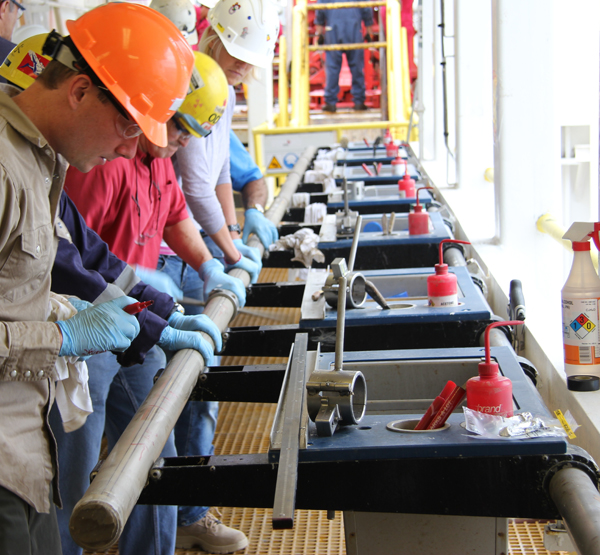
The core techs processing a core that just came on deck.
The science party starts analyzing the cores the instant they are transferred from the drilling floor to the catwalk. Samples are immediately taken from the core catcher, the very bottom of the ~9.5 m (~30 ft) long core, by the paleontologists who begin the work of figuring out where the core is in geologic time. Not all sediments contain the microscopic fossils that are useful for age determination, but they are all checked.
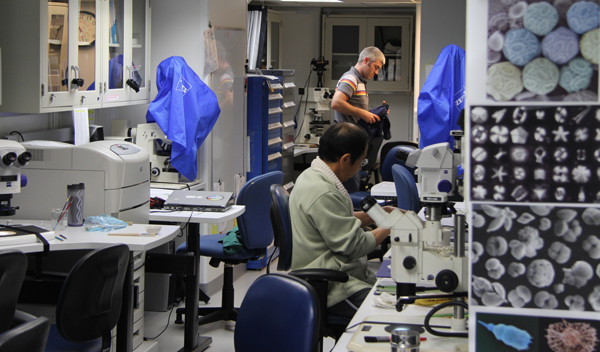
The paleontology lab aboard the JOIDES Resolution
The full core is cut into 1.5 m (~5 ft) long sections that are brought into the lab and run through a series of machines that measure physical properties of the sediments or rock. The core sections then rest a while – typically, a couple hours – to get to room temperature. The sections are then split lengthwise into two halves, either using a cheese cutter-like device for soft sediments or various saws for hard rock. One half is called the ‘working’ half and is the one sampled for geochemistry, paleomagnetics, and additional paleontology. The other half, called the ‘archive’ half, goes to a separate table to be described in detail. I’m part of the core description team and will go into more detail about that process in a future post.
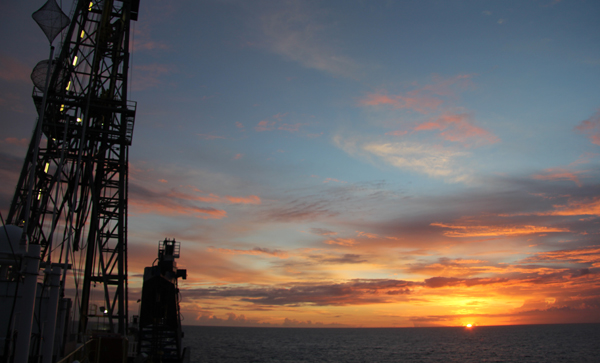
I’m on the noon-midnight shift, which means I get to see some fantastic sunsets :)
Finally, as you may know, we have a videographer and documentary film maker on board for the two-month expedition. He’s making episodes as we go and putting them up on Ocean Leandership Consortium’s YouTube channel. There will likely be about five total episodes with a synthesis film produced after the cruise. Here’s the first episode, it’s about 10 minutes long, enjoy!
Expedition 342 has begun!
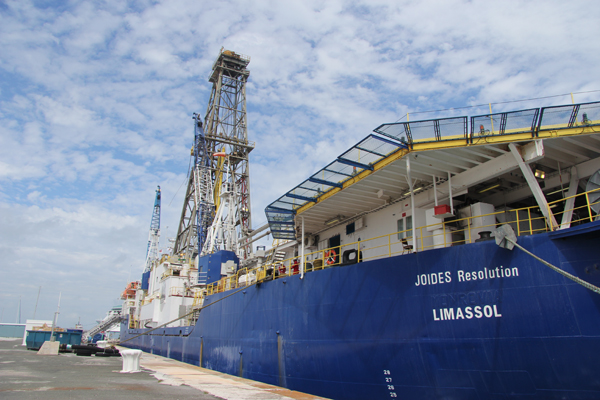
The JR docked at the Royal Navy Dockyard in Bermuda
Greetings from the JOIDES Resolution drillship (known as ‘The JR’ for short)! We left the Royal Navy Dockyard in Bermuda around dawn on Monday (June 4). Our first objective, which we are on our way to now, is an engineering test along the New Jersey continental margin. You can read more about the details of this test here, but the basic idea is to obtain some information about pore pressures directly in the borehole using a penetrometer. Such a tool has been used for a long time in the geotechnical industry, but doing it at sea from a floating drilling vessel has proven difficult. A group of scientists and engineers have worked on a new design over the past five years to eliminate (or, at least minimize ship movement effects) and are going to test it during real drilling operations.
Although this test is unrelated to the scientific objectives of Expedition 342 (it’s merely an add-on that is logistically convenient), we are using the opportunity of core coming on deck to learn the workflow in a hands-on way. There are 30 scientists on board, split into two shifts (noon-midnight and midnight-noon), with each shift further split into lab teams (core description, paleontology/biostratigraphy, physical properties, stratigraphic correlation, and chemistry). Each lab team has a series of tasks to do with each core as they are brought up out of the seafloor. As someone on board who has been on one of these cruises said, ‘It’s a well choreographed dance when it’s working well.’ The short cores associated with the engineering test will essentially be our dress rehearsal for this dance.
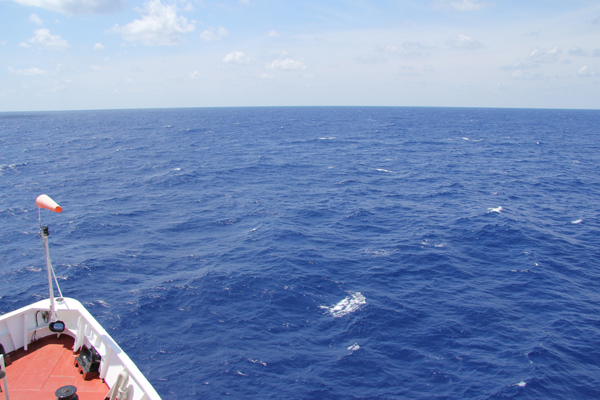
My view for the next two months
We’ve been in transit for ~35 hours and the seas have been quite rough. Perhaps not rough for the seasoned crew on the vessel, but pretty rough for first-timers like me. I was feeling a bit seasick yesterday evening but am starting to get used to it, I hope. I think it’s a bit too early for me to say too much about life on a ship, I’ll blog about that at a later date.
It’s been great to start to get to know people better during these first few days. There are 11 nations represented in the science party and a huge diversity of scientific backgrounds – paleoceanographers, paleobiologists, tectonicists, geophysicists, sedimentologists, climate scientists, and more. The technician crew is top-notch, these are people that have been on multiple cruises and know the ins and outs of the software and workflows related to processing the cores. I haven’t yet had a chance to interact with the drilling crew too much, but there is plenty of time. What I have noticed is that all the crew love doing this job. It’s impossible not to sense the excitement and comradery on the JR
Friday Field Photo #170: Bermudan eolianites
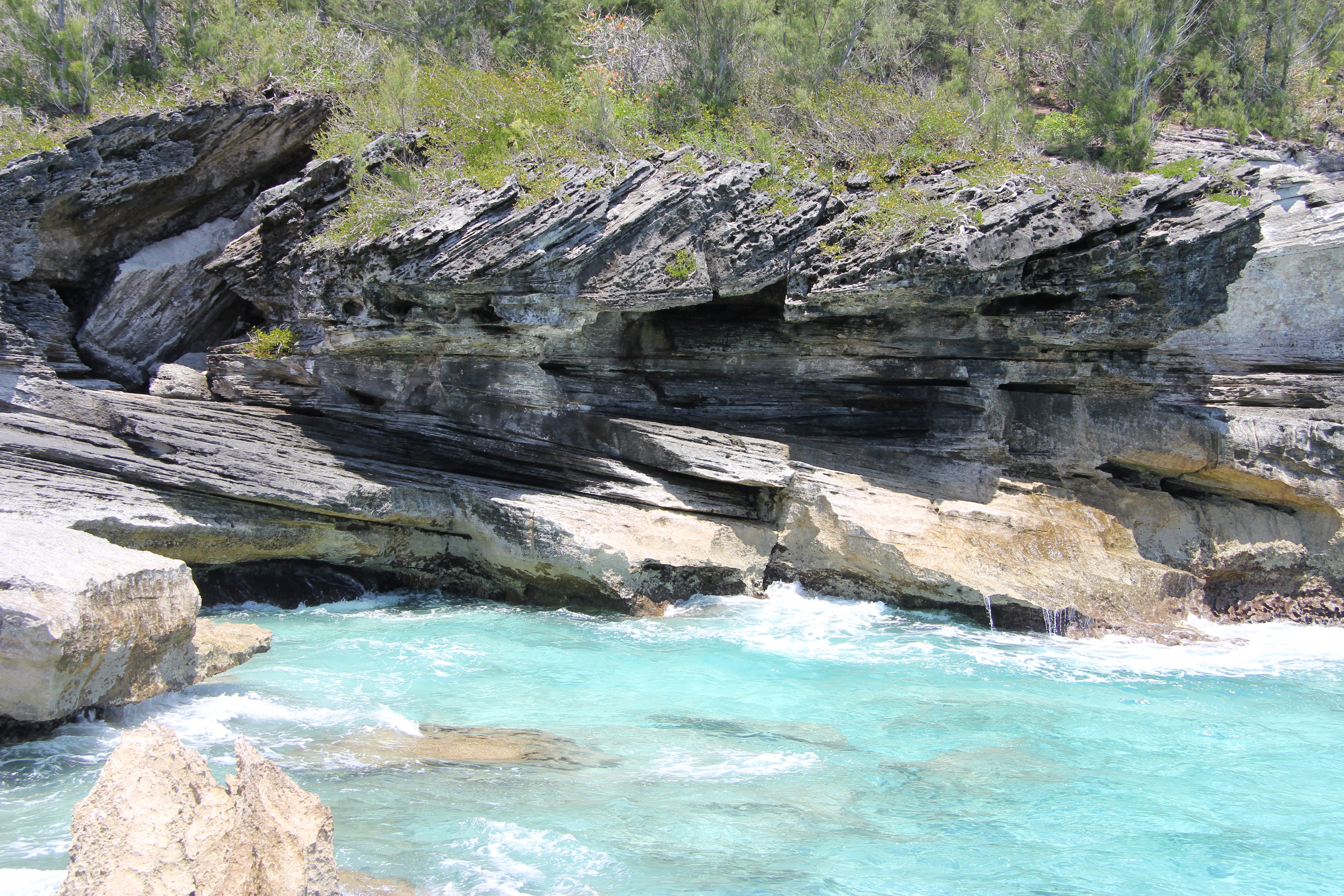
I’m in Bermuda right now waiting to board the JOIDES Resolution drilling vessel (known as the JR) for IODP Expedition 342 (see this post for background on that). I arrived yesterday and we board the JR tomorrow, so I had today to myself to do whatever. There’s an extra day just in case of travel difficulties — spending an extra day here is not a big deal compared to literally missing the boat.
I spent a couple hours this afternoon at the Spittal Nature Preserve on the southeast shore of Bermuda. It’s a lovely little place with both coastal views and a trail through some woods near a brackish pond. It was peaceful and serene, just what I was looking for today.
The photo above nicely shows the Pleistocene wind-blown dune deposits exposed along the coast. The material for these ancient dunes is all bioclastic (shelly material and pieces of coral reef) that was able to cement up quickly to become rock. Now this rock is weathering away and forming outcrops all over the island. You can see it in the building stone all over the place too.
See this and a bunch of other photos from today in this Flickr set. My next post will be from the JR itself sometime in the next few days.
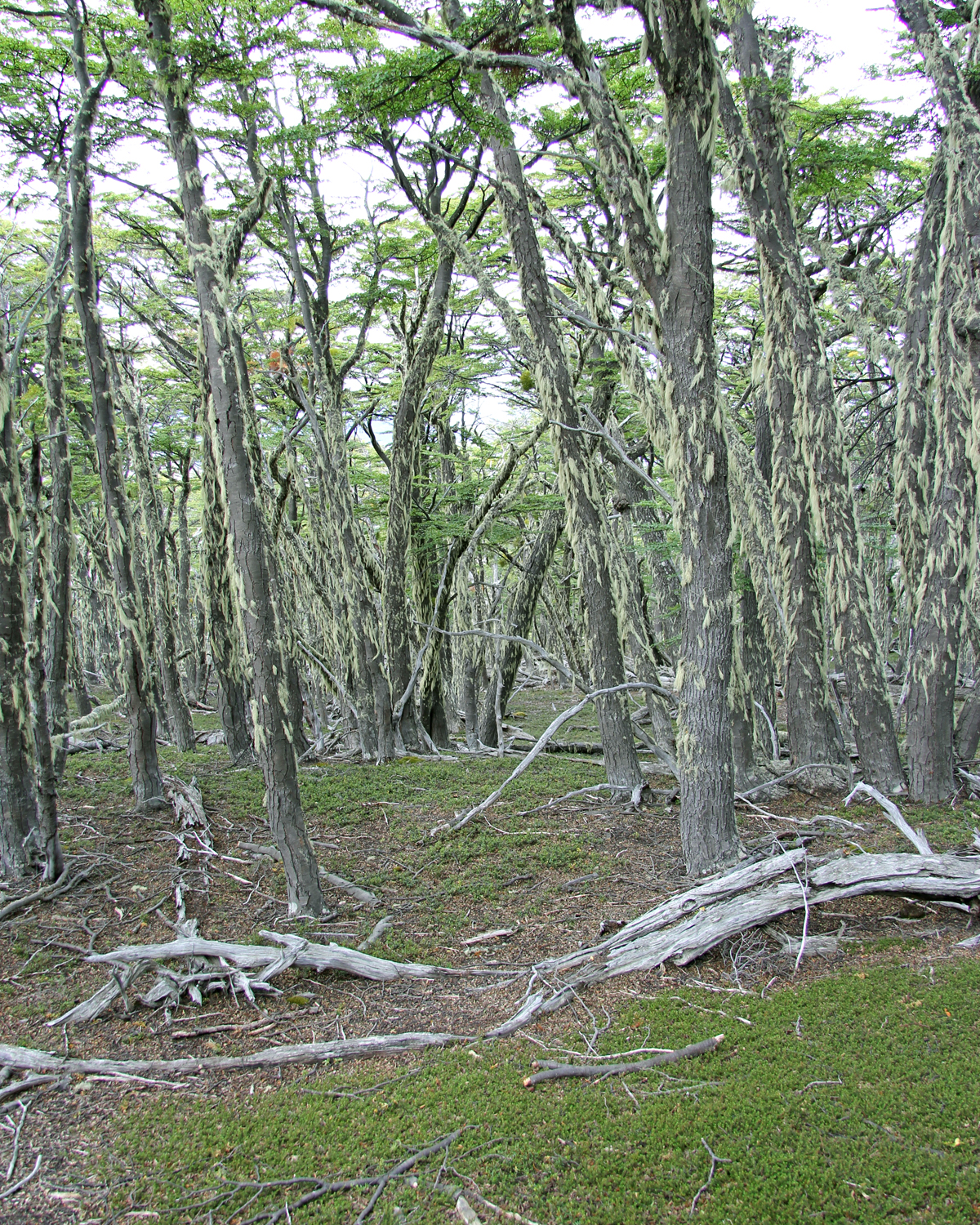
As a field geologist, you sometimes have to hike through areas of no exposed rock to get to the good stuff. In Patagonia, like many places, most of the really good outcrops are along ridge lines or at the tops of hills/mountains. Today’s photo is from a hike my field partner and I did through these enchanting woods on our way up one of these mountains. We sat here and had some lunch and it was as comfortable and serene as it looks in this photo.
Happy Friday!
UPDATE [later the same day]: I totally forgot that I shot a quick video with my camera in these woods right after snapping some photos.
Things you should know about doing a PhD in science
Chris Chambers over at the blog NeuroChambers has a great post up with some advice about doing a PhD in science. It’s a long post with a long list of tips/advice, but well worth reading in my opinion. First, a reality based statement about getting a PhD:
… a PhD is hard. It’s meant to be hard, not because inflicting pain is necessarily fun, nor because some scientists are ‘dementors’, and not because your PhD is expected to solve the mysteries of the universe. It’s hard because it is an apprenticeship in science: a frustrating, triumphant, exhausting, and ultimately Darwinian career that will require everything you can muster.
I think those words — frustrating, triumphant, and exhausting — are well chosen, but I would also add ‘rewarding’. And doing science after a PhD, regardless of the path of one’s career, is challenging. The endeavor of science is inherently challenging. This is what makes it awesome and useful.
The list of advice in Chris’ post has tons of practical stuff that I would’ve liked to have read when I started graduate school. Here’s one piece of advice that I think is very important:
Don’t expect every experiment to work, and don’t persecute yourself or others if your experiment fails. In short, figure out why, suck it up, and move forward. Nature does not reveal her secrets easily.
Very few research projects turn out exactly as they were conceived. Failures of various degrees of significance are part of the process. Finding out what doesn’t work is finding out something valuable! Over time, I’ve become more accustomed to sometimes stumbling my way through a problem. In some cases, it’s that stumbling that reveals something important. The key is to learn from the things that don’t work.
Discussions about doing a graduate degree in science inevitably lead to commentary on the ills, inequities, and absurdities of academia. And it’s healthy to continue to have that discussion, in an effort to hopefully improve things over time. The fact that I think a post like this is worthwhile information should not be confused with a blanket endorsement of the current state of academia. I simply think that having commentary out there about how things are, in addition to how things should be (or how screwed up things are), is valuable.
Lastly, there are petulant and petty people everywhere. There are nonsensical, even detrimental, processes and bureaucracy in all venues of research. Contrary to what some academics think, academia is not the only place where one has to run through a gauntlet of idiocy impeding your progress. I’ve worked for a mega-corporation and I can assure you it exists there, and I had a taste of doing research in government and, why yes, it’s there as well. Scientists in these various institutions might say ‘But where I am is the most ridiculous and the most broken!’. Okay, fine.
Again, pointing out reality isn’t an endorsement of it. If you’re a grad student, think about the battles you want to expend the effort and time fighting. Some may be important and worthy, others may not be.
In just 17 days I’ll be heading to Bermuda to board the JOIDES Resolution drill ship for IODP Expedition 342 to acquire cores of deep ocean sediment offshore the Grand Banks, northeastern Canada. I’ll be at sea for a full two months and see land again when we dock in St. John’s, Newfoundland in early August.
The scientific objectives are explained in detail on this site, but, in short, the goal is to acquire a series of cores of deep-sea sediment that have been accumulating since as far back as the Late Cretaceous (~70 million years ago). The primary goal is to obtain a record of climatic and oceanographic conditions during the Paleogene (65-23 million years ago), including important climatic events such as the Paleocene-Eocene Thermal Maximum. Deep-sea sediments can be treasure troves of information, containing microfossils from which ocean chemistry can be reconstructed over time.
Why target this particular area for this record of Earth history? The deep-sea sediments in this location aren’t the typical sediments that accumulate very slowly, known as pelagic oozes. While oozes can be great recorders of environmental conditions, they accumulate so slowly that shorter-duration episodes in Earth history aren’t captured as well. There are other areas of the deep sea, adjacent to continental margins, that accumulate sediment much faster. But, many of these submarine fan systems, fascinating and important themselves, are essentially too active and too dynamic.
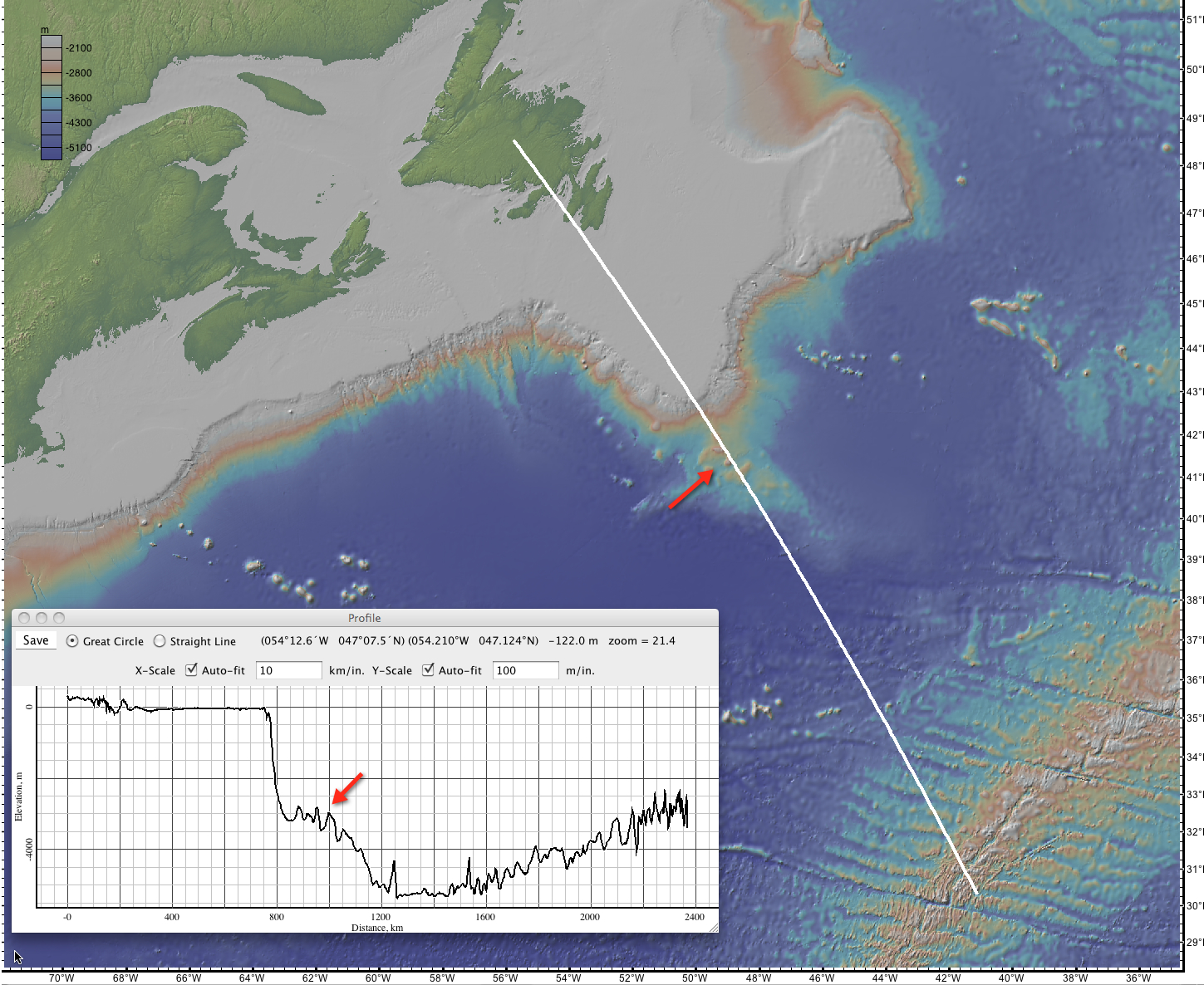
Map and accompanying topographic/bathymetric profile showing general location of Exp 342 coring sites. Basemap created in GeoMapApp.org. Click on image to see larger version.
The deep-sea drift deposits that have accumulated on the submarine ridges offshore Newfoundland might be the perfect type of deposits to obtain a high-resolution record of these climatic events. Other deposits like them accumulated faster than typical deep-sea oozes and, thus, have a thicker interval of sediment for the same duration of time. (Drift deposits are also commonly referred to as contourites because the sediment is moved by currents that follow the contours of the continental slope.)
My job as a participant on this expedition, along with several other sedimentologists on board, is to describe the cores as they come on deck. The measurements and sampling for fossils and chemistry need to be placed within a description of the sediment itself — grain size, sedimentary structures, bed thickness, composition, and so on. The sediments that accumulate on the Earth’s surface aren’t perfect tape recorders of conditions and events. Although these deposits might be the best choice to go after this record, there will still very likely be some surprises related to dynamics of the deposition that could influence how the archive is used to interpret past climate. Most of the detailed investigation into the processes and dynamics of these deposits will be done after the cruise by a graduate student of mine as part of his master’s thesis.
I really have no idea how much I’ll be able to post during the cruise, I don’t have a good feel for how much down time there will be. The priority for me as a participating scientist is to do my job characterizing the cores and summarizing results into technical reports. I will try my best to write some posts, not only about the science as it happens, but about life on an extended marine expedition.
I’m so busy getting other things done before being away, I’m not sure if I’ll get another post up or not before boarding the JR. Stay tuned.
Here are some web resources if you want to follow the expedition:
- IODP Expedition 342 Scientific Prospectus — This document has all the scientific and technical information about the objectives of this expedition, including many maps and figures.
- JOIDES Resolution Blog — This blog, which is named after the vessel we’ll be living and working on, will be updated by Caitlin Scully throughout the expedition.
- Expedition 342 page on JOIDES Resolution website — This page will be updated with various news and drilling updates.
- OceanLeadership YouTube Channel — Expedition 342 is going to have a talented videographer on board to document the expedition.
- Twitter feeds — @TheJR is the main feed for the vessel, but also check out @SeafloorSci and @BoreholeGroup
I feel like I’m missing some sites in this list, I’ll make sure to update as we go.
IODP Expedition 342 — A sneak preview
In the spirit of a trailer for a summer blockbuster, here’s a short (2 minute) and fun video about Integrated Ocean Drilling Program (IODP) Expedition 342 to the Grand Banks this June-July. I will be participating on this cruise as part of the science staff. I leave for this expedition in a few weeks and hope to get a more detailed post up before then. (I also hope to post during the expedition, which IODP encourages, but we’ll see how much time I have to do that.) In the meantime, if you’re interested in the scientific objectives of this expedition, check out the prospectus written by the chief scientists.
Friday Field Photo #168: Scorched Earth
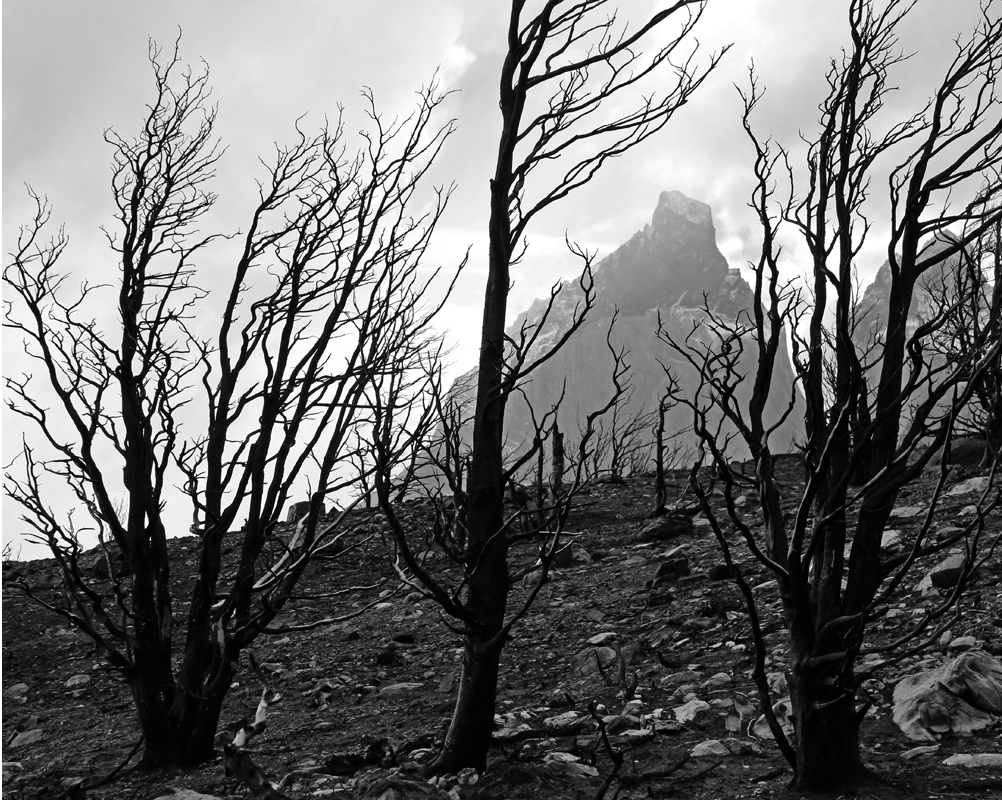
During my last trip down to Chilean Patagonia we spent a day in nearby Parque Nacional Torres del Paine, which had experienced a devastating wildfire some weeks earlier. The fire burned more than 31,000 acres and is thought to have been started by a careless tourist.
By the time we went to the park the fire had been put out for several weeks, but the evidence was obvious. It was a surreal experience to walk around on a landscape that was very recently covered in a mix of low, dense (and sometimes prickly) vegetation and dense woods. With the exception of some charred roots, most of the ground cover bushes were completely gone. Many of the trees were still standing but were blackened and crisp, their leaves stripped.
The photo above is looking north toward the iconic Cuernos del Paine through what was a dense stand of trees. Here is a collection of photos from BBC of the wildfire itself.


 Clastic Detritus