Where on (Google)Earth #45 at T. Rex Eats Fish
just in case you don’t know where it is currently….go check it out here
~~~~~~~~~~~~~~~~~~~~~~~~~~~~~~~~~~~~~~~~~~~~~~~~~~~~~~~~~~~
Chicken. No head. Running.

It’s been one of those days. I’m leaving for a trip tomorrow and needed to get a bunch of things done before stepping on the plane. Of course, I waited until the last minute to do some most of it. Hmmm…I did get the first The Accretionary Wedge out though.
I’m trying to get a draft of a paper to my co-authors…it’s finally almost there. I’m pretty excited, it’s the work related to this email. I blogged about this research a long time ago (back in February for Just Science Week), but it as gotten a lot more exciting since then. Hopefully I’ll have some time when I return from this trip to write a post about it. It involves El Niño’s, earthquakes, beach erosion, radiocarbon ages, and…everybody’s favorite…turbidites!
After this trip, I come back for a few days and then go out of town again…so September might be a slow month for Clastic Detritus.
~
image above from here
if you don’t know about Mike the headless chicken, go here
~~~~~~~~~~~~~~~~~~~~~~~~~~~~~~~~~~~~~~~~~~~~~~~~~~~~~~~~~
Mapping science
Like many geologists, my understanding (or lack of understanding) of complex phenomena is rooted in the ability to visualize the process or system in question. When pondering the fundamental workings of a river system, for example, I don’t see equations…I see patterns. I try and visualize spatial patterns as well as temporal patterns (i.e., the history of the system). Take a look at the papers geologists write…they are chock full of maps, cross sections, diagrams, geophantasmograms, etc. Complex information is best represented visually…at least, when one wants to express a general message succinctly.
One of my very favorite sites on the web is called Visual Complexity. I blogged (briefly) about this site once before, but VC recently posted an interesting visualization on the site that shows a map of science.
How was this done? Here’s a blurb from VC about the project, which is called Eigenfactor:
Eigenfactor.org is a non-commercial academic research project sponsored by the Bergstrom lab in the Department of Biology at the University of Washington. Eigenfactor ranks journals much as Google ranks websites. Scholarly references join journals together in a vast network of citations. Eigenfactor uses the structure of the entire network (instead of purely local citation information) to evaluate the importance of each journal.
A more detailed description of how this is done, high-quality images, and an explanation of what you’re looking at can be found on VC’s site here.
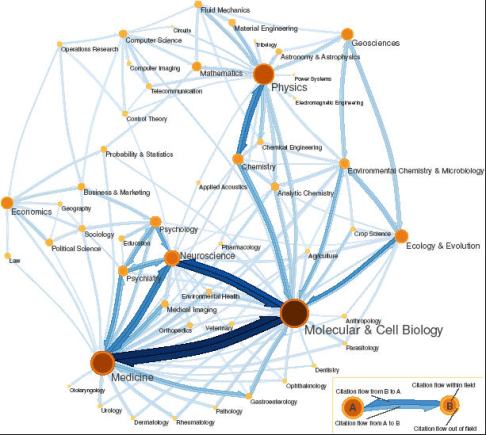
Very cool. The next image (below) is zoomed in on the northeastern outskirts of this ‘map’…where all the hippest geoscience hang-outs are.
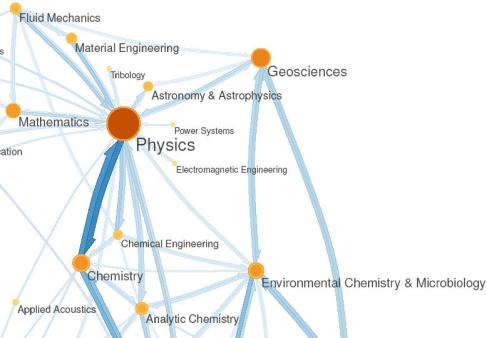
The Eigenfactor project website is here. It’s pretty dang cool.
~
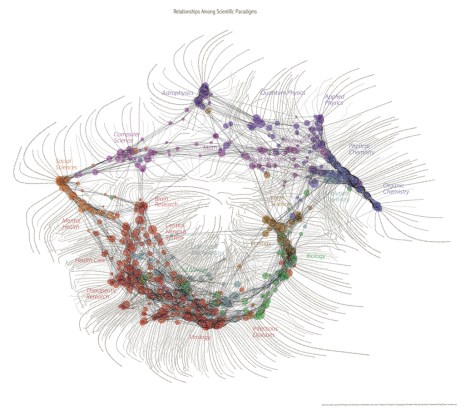
UPDATE: Kate clued me in to a similar project and visualization (below); read about it at SEED here and go then go here to see in more detail. As with the above images, you really have to check out the sites and see them in that full resolution to appreciate.
~~~~~~~~~~~~~~~~~~~~~~~~~~~~~~~~~~~~~~~~~~~~~~~~~~~~~~~~~~
The Accretionary Wedge #1: Why I Study Geology
Welcome to the 1st edition of the geology blog carnival The Accretionary Wedge.
For this inaugural edition we decided that it might be interesting for all of us to write a bit about why we became geologists/geophysicists.
As the host I get to compile (and read) all the submissions as they come in. I was so preoccupied (in a good way) by all these great essays that my own fell through the cracks resulting in a later publishing time than I originally planned! Sorry about that.
I definitely urge everyone to read all of these…it is a great collection of stories. And there is definitely a common theme regarding how many of us ended up where we are. It seems geology is not often a first-choice when students are choosing majors. It might be interesting to delve into why this is in future editions.
So…here we go…they are in alphabetical order by blog name:
~~~~~~~~~~~~~~~~~~~~~~~~~
(1) Of Lakes and Rocks (or why I do what I do)
by Kim at All of My Faults Are Stress Related
A desire to solve pollution and water quality problems at a young age motivates Kim to study environmental chemistry. However, something happened her very first semester at college: she took a geology class because chemistry wasn’t offered until the next term.
But the rocks kept calling. Not just any rocks. Rocks that had been through a lot and had stories to tell.
~~~~~~~~~~~~~~~~~~~~~~~~~
(2) Becoming Thermochronic
by Thermochronic at Apparent Dip
Thermochronic wanted to be an environmental biologist. However, something happened when he had to fulfill a requirement for the major: he took a geology class and went to the field. The realization that geology incorporated aspects of chemistry, biology, physics, statistics, etc. soon followed. Plus, any field that is both beard and flannel friendly has to be good.
If I am stuck at a boring party with no one interesting to talk to, I can entertain myself for hours with a stone fireplace.
~~~~~~~~~~~~~~~~~~~~~~~~~
(3) Playing in the Sandbox
by Chris at Brilliant Mediocrity
It all started by not only wondering why the world looked the way it did, but attempting to reconstruct it with physical experiments. Chris was 7 at the time.
So I would find an interesting location I had never been in my life on a map and try to use the information I had available to make it in my sand box
~~~~~~~~~~~~~~~~~~~~~~~~~
(4) This place used to be under water? Are you serious!?
by Brian at Clastic Detritus
It feels silly to introduce my own post…you can just read it.
~~~~~~~~~~~~~~~~~~~~~~~~~
(5) Why I’m a Geophysicist
by Yami at Green Gabbro
Yami needed to fulfill a science requirement, took intro geology, and got hooked addicted immediately. Wait, that sounds familiar.
When forced to choose between geology and astronomy for my breadth course, I took geology, because I heard there was a field trip…
~~~~~~~~~~~~~~~~~~~~~~~~~
(6) The Accidental Geologist
by Chris at Highly Allochthonous
Chris started university with aspirations of becoming a physicist. To fill out some requirements he thought that gaining some knowledge about earthquakes, volcanoes, and the like would be cool, so he took a geology class. And then…well, you probably see what’s going on by now.
…the end result of your intellectual struggle is usually a story: how that mountain range was built, how that dinosaur lived, how that ice sheet has waxed and waned. I like teasing out those stories, and I like telling them
~~~~~~~~~~~~~~~~~~~~~~~~~
(7) Geology and Me – The Earth as I See It
by Chris at goodSchist
Chris (our third one of this edition) gained actual marketable skills in computer sciences and had a real honest-to-goodness job. But wait…he was bored as schist and headed back to school. Mineralogy and petrology skills are now helping him unlock the secrets of the oldest solid materials in the solar system. (Oh, and by the way, Chris is planning on doing some geology podclasts in the future…you read that right…podclasts).
Geology is where the natural sciences meet time. Physics, chemistry and biology, wrapped up in a enormous temporal package spanning billions of years.
~~~~~~~~~~~~~~~~~~~~~~~~~
(8) Las Piedras de mi Niñez / My Childhood Rocks
by Miguel at MiGeo
As a child, Miguel picked up and admired rocks from the beaches of his hometown in Peru. He didn’t really think that picking up rocks could lead to a career in science. He thought about journalism, computers, information science, and related fields as a career. Circumstances led him to take a geology class and he’s made the most of it.
Thinking about it, I’m actually doing, one way or another, all the things I wanted: working with computers, being a journalist and more recently becoming a geologist.
p.s. Miguel’s post is in English at the bottom…but, give the Spanish version a try
~~~~~~~~~~~~~~~~~~~~~~~~~
(9) How and Why I Became a Geologist
by Mel at Ripples in Sand
In our final post, Mel shares her circuitous journey starting at wanting to be a paleontologist (at the age of 7), ending up studying biochemistry as an undergrad, realizing that wasn’t the right path, and then ending up in a graduate program studying sedimentary geology.
As a child, we had a long dirt driveway with lots of different kinds of rocks. So on my way to school or waiting at the bus stop at the top of my driveway, I remember looking at them.
~~~~~~~~~~~~~~~~~~~~~~~~~
UPDATE! Here is a post from a new geo-blogger…better late than never!! Check it out.
(10) Why I’m a Geologist
by Jessica at Inorganics
Another story about discovering the rewards and importance of geoscience.
These people were using science to solve problems faced by people in my state every day. They were using every branch of science I learned in school, but applying it toward something real. And they were educating others.
~~~~~~~~~~~~~~~~~~~~~~~~~
UPDATE! UPDATE!! Another late arrival…
(11) Why I’m a Geologist
by Neil at Microecos
This one is a photo-essay…pretty clever.
~~~~~~~~~~~~~~~~~~~~~~~~~
UPDATE! UPDATE!! UPDATE!!!
(12) My Path to Geology
by Ron at Ron Schott’s Geology Home Companion Blog
Better late than never! Ron was out in the field when this post was first published. Be sure to check out his entry.
Although I outgrew the rock collecting phase as a kid, I continued to develop a strong affinity for nature and travel. Family vacations eventually took me to many of America’s National Parks as well as many state parks and other natural attractions – many with interesting geologic origins.
~~~~~~~~~~~~~~~~~~~~~~~~~
This place used to be under water? Are you serious!?
This post is my own post about why I study geology, which is part of the 1st edition of the geology blog carnival called The Accretionary Wedge. I am the host for this inaugural edition…the link above will be your gateway to getting to know some geology blogs and the bloggers behind them.
— — — — — — — — — — — —
Why I Study Geology
Geology is the study of the whole Earth, its composition and structure, its performance as a dynamic organism, and, above all, its history
E. Spieker, 1965
Prior to becoming a geology major during my undergraduate years, I was an engineering major (that lasted one semester) and then a cultural anthropology major (that lasted about a year). Engineering was too rigid…and ethnology didn’t quite float my boat either. As interesting and important these fields are, they simply didn’t suit me. I took a geology class to fulfill a science requirement and that’s all it took. I guess it’s one of those things that when I look back now, I was interested in Earth science as a kid, but it never seemed like something to “be when you grow up”.
Before I started focusing on geology as an undergrad, I regarded the science of geology as the study of what the ancient Earth looked like. That is, if I were to be transported back X million years and stand in, say Central Park in New York City…what would it look like? To me, the word ‘geology’ was synonymous with Earth surface conditions at particular locations at particular times. Was it under water? Was it on a mountain range? Was it tropical or arid? Was it under a kilometer of ice? As I learned the fundamentals about the data and evidence that is the basis for reconstructing the ancient Earth (i.e., rocks!), I became even more enthralled. This isn’t just (pure) fantasy…we actually have evidence.
Of course, geology is much, much more than just the surface of the Earth. In fact, the Earth’s crust is only 1% of its total volume (think egg shell). And the surface of that crust is a minuscule percentage of that! But, in my head I still regard geology as the study of what is happening and what has happened on the surface of the Earth. That mindset led me to the discipline of sedimentary geology (or, when I’m feeling pedantic, the discipline of paleomorphodynamics). I’ll save the full essay about why sed geology is the coolest for a future post.
Another aspect of geology that got me (and many others) hooked at an early point in my studies was the field. The field is where we get to observe products of geologic processes firsthand. The field is where the spatial and temporal complexity of geology is laid out in its glory. The field is where we realize and reflect on the vastness of geologic time. The field is where we get away from the office and drink beer with our friends! I grew up in the eastern United States, but our field camp was on the Colorado Plateau. That was over 10 years ago now (wow)…but I still remember the experience vividly. At that point, I was just entering the stage where I decided that being a complete geo-nerd was kind of fun. A few years later, it became more than just fun…it was rewarding.
Now, it is very difficult to imagine doing anything else. To this day, when I drive through or fly over the middle of the United States, I still say to myself: “This used to be under water? Are you serious?!”
~~~~~~~~~~~~~~~~~~~~~~~~~~~~~~~~~~~~~~~~~~~~~~~~~~~~~~~~~
What’s the purpose of auditing surface temperature data?
Like many, I try and follow the latest in the global warming discussion. I’m not a climate scientist…I don’t pretend to be. When it comes to the general conclusions regarding the measurements and attribution of global warming, I accept the IPCC’s statements (more or less). Do we know everything about how the climate system works? Of course not. But, we have to try and pull all the available information together and make reasonable interpretations. That being said, I don’t necessarily and wholeheartedly agree with all the policy recommendations. I’m not sure what the best course of action is…but the policy discussion is the discussion to be having now.
Once in a while I head over to Climate Audit just to see what they are up to. Essentially it is a group of statisticians, engineers, and computer scientists…from what I can gather. If you’ve never been there, it is difficult to get a good overview of what they are doing. The FAQ is rather narrow and requires some digging into the history of why the site was started. I once asked if they could produce a high-level ‘executive summary’ and was quickly scolded and chased away. And it seems someone else in recent days inquired about a similar thing…and they told that person to get lost. So, it seems the blog is more of a forum for those involved in the data-mining and statistical analyses…it’s not for the outside reader. It’s not meant for general consumption. That’s fine, I have no problem with that. Maybe they should put that in the FAQ.
In the last few weeks, these ‘auditors’ have been painstakingly sifting through surface temperature data used by NASA GISS to calculate and report longer-term trends. Firstly, I’m not a statistician and can’t evaluate what they are doing in any technical way and, secondly, I do not have the time to try and figure it out. So, as an outsider, I try and get an idea from the post and the associated comments. A good portion of the comments are very celebratory in tone, as if they have torn down the very foundation of our understanding of global temperature trends. Indeed, they may be finding actual errors, and they may be rightly confused about NASA’s methods for adjusting surface temperature data. Most of the general comments regarding what they think of climate scientists in general, and Hansen and Mann of NASA specifically, have a tone similar to this:
I’m beginning to think that one of the main divides is that climate scientists have no idea what an engineering study looks like. They are only familiar with little articles in journals (or literature reviews.) This thing cries out for an engineering study.
I really hope that they work on communicating what it is they are doing, and why it is so important to a general audience. If their work has the implications they all think it does, it behooves them to communicate it effectively. For all their criticism of the RealClimate blog (NASA’s team), which is quite harsh, RealClimate at least has a very thorough index and ‘start here’ page communicating what they are doing. Actual audits typically create a short (1-2 page) summary of their findings…should CA do the same?
So, to sum it up…I’m not against what they are doing in principal. I say go for it. More scrutiny is always good in science. But, is this really for the benefit of our understanding of climate science?
Oh, and by the way…remember they are now claiming that the surface temperature data is, at best flawed and, at worst, completely unreliable as an indicator of global trends. Below is a plot (from Open Mind) showing the relationship of surface temperature data and satellite data. I suppose they’ll have to audit the satellite data now too.

This is being discussed in much more detail here.
~~~~~~~~~~~~~~~~~~~~~~~~~~~~~~~~~~~~~~~~~~~~~~~~~~~~~~~
Reminder: Posts for 1st edition of The Accretionary Wedge geology blog carnival due tomorrow
Most of you know what I’m talking about.
If not…we are starting a geology blog carnival called The Accretionary Wedge. The first edition, hosted here at Clastic Detritus, will be published tomorrow night.
The topic is wide open…why do you study geology?
Please e-mail me links to your post by 6pm (Pacific time) this Sunday (9/2), which is 0100 03/09 UTC/GMT. I will then put them together and release later that evening (with short blurbs introducing each submission). Please put the word “wedge” somewhere in the subject of your e-mail so I can filter it. My e-mail is romansbrian [at] gmail [dot] com.
Read all the details from this previous post.
Thanks!
~~~~~~~~~~~~~~~~~~~~~~~~~~~~~~~~~~~~~~~~~~~~~~~~~~~~~~~~~~~
Another geology-rich blog to check out
The growth rate of the geology blogosphere is increasing every week. Very likely in a nonlinear fashion….and this new geoblogger (i.e., “new” to my blogroll, not the blogosphere) could likely calculate the relationship.
Go have a look at Hindered Settling, a fantastic blog (a large portion of which is in Romanian, I believe) that discusses topics on statistics in geology, skepticism, historical geology, for example, and also has tons of beautiful photographs.
To whet your appetite a little more…check out Hindered Settling’s most recent posts about a glacial outwash river, its delta, and the glacial lake it is filling.


~~~~~~~~~~~~~~~~~~~~~~~~~~~~~~~~~~~~~~~~~~~~~~~~~~~~~~~~~~~
Listening to your own paper
I’m sure many of you already know about the ‘Read Out Loud’ capability of Adobe Acrobat. I’ve been doing so much writing lately (a dissertation chapter) that I end up reading the same passages over and over again and can’t think of ways to fix problem areas or, worse, I miss glaring errors staring me right in the face.
So, i’ve started copying/pasting specific passages of text into a new document, converting it to a PDF, and then listening to it. Sometimes I think of new (once in a while, better) ways to say what I want to say. Other times, it’s not so fruitful. But….it’s another little tip that seems to help me produce better technical writing. The key is to only do a couple paragraphs at a time….the computer-guy voice (like from that Radiohead album) gets a little hard to listen to after a couple minutes.
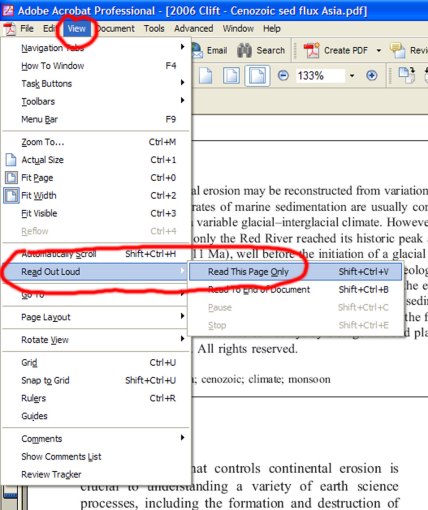
The screenshot above simply shows where this functionality is in Acrobat.
If the voice was more realistic and easier to listen to, I would love to be able to download a paper as an mp3 and then listen to it on the train ride. Is anybody doing such a thing out there?
UPDATE: I found this ultra-easy web application that converts any text to mp3, which you can listen to right away or download to listen later. It’s called vozMe. I tested it, the voice is pretty similar to one I discuss above. Okay…but still not sounding very human…yet.
~~~~~~~~~~~~~~~~~~~~~~~~~~~~~~~~~~~~~~~~~~~~~~~~~~~~~~~~~~
Five blogs I’ve been reading lately
Apparently it’s Blog Day, a day where you link to and write about five new blogs you’ve been reading. Who decides this stuff? Anyway, since the 1st edition of The Accretionary Wedge is later this weekend, I’ll put down five blogs that aren’t specifically geology blogs. These aren’t necessarily new to my feedreader…but ones that I may not have discussed explicitly before.
~
Laelaps
I found this blog earlier this summer and have been enjoying it since. The author, Brian, is a prolific writer and a modern-day naturalist, posting about numerous natural science topics with a heavy focus on paleontology, evolutionary biology, zoology, and anthropology. Laelaps also has many posts mixing in history and philosophy of science. I still haven’t fully digested his essay, Homo Sapiens: The Evolution of What We Think About Who We Are.
~
Sum 1 to N
This is the blog of a mathematician who spends a lot of his blogging time fighting the good fight against the anti-science movement and their spurious arguments. In fact, I found the blog reading a comment thread when the anti-evolutionists were celebrating what they perceived as a ‘hit’ against evolution when new data refined our understanding of hominid evolution. Check out his recent post discussing the different types of anti-science activists.
~
Deep Sea News
I’ve been reading DSN for a long time. The authors have a great mix of science, information, humor, and commentary about oceanographic topics in general, with a focus on deep sea biology. My PhD research involves understanding sedimentary processes in the deep sea, so I find it a great complement to my own ponderings of what goes on down there. They even have their own theme song! [link to mp3]
~
Trinifar
This is a semi-regular blog about sustainability. How 6 billion+ people can survive and flourish on this planet is a topic that, for good reason, is getting more and more coverage. Many blogs are popping up that deal with different aspects of sustainability. Trinifar is great because the author produces wonderfully informative (and beautiful) graphics and charts that bring together the numerous factors involved. The best place to start for this blog is a post titled visualizing sustainability.
~
Cleantech Blog
This is another blog within the broader topic of sustainability. This is a group blog that focuses on new and emerging energy technologies. Have you ever wondered about biofuels, electricity deregulation, solar technology, the economics of diversified energy, etc.? This is the place. This blog emphasizes solutions and practicality and keeps the complaining and blaming to a minimum (not that that doesn’t have its place).
~
~~~~~~~~~~~~~~~~~~~~~~~~~~~~~~~~~~~~~~~~~~~~~~~~~~~~


 Clastic Detritus