Friday Field Foto #31: Deltaic channel-fill deposits
This week, a photograph from southern Chile.
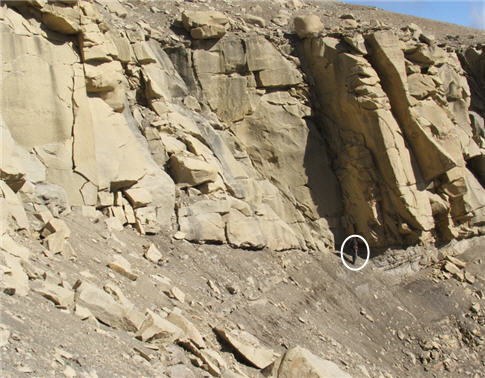
Although we’ve been focusing on the turbidite deposits in Patagonia, we also have a project investigating the shallow-marine and deltaic deposits that overlie them. Put simply, the turbidite formation was fed by a delta system that was advancing basinward and essentially filling in the basin with sediment during the Late Cretaceous (~70-80 million years ago). So, overlying the turbidites for hundreds of kilometers are younger deltaic deposits.
The below is a nice shot of sandstone-rich distributary channel-fill deposits that are encased in fine-grained carbonaceous mudstone, which is interpreted as interdistributary bay fill. The white circle is a person for scale. Note the basal erosional surface of the sandstone body, cutting down into the fine-grained strata from left to right.
Happy Friday!
Browse all Friday Field Fotos here.
~~~~~~~~~~~~~~~~~~~~~~~~~~~~~~~~~~~~~~~~~~~~~~~~~~~~~~~~~~~~
Just in case you missed it…
…Where on (Google)Earth #57 is up over at Hindered Settling.
Find the mystery location and you get to host the next installment.
~~~~~~~~~~~~~~~~~~~~~~~~~~~~~~~~~~~~~~~~~~~~~~~~~~~~~~~~~~~~
Visualizing 3.7 million tons of sediment
For one of my Ph.D projects I’ve been investigating the flux of terrigenous sediment into a deep marine basin over the last 7,000 years. I ended up calculating the volume of sediment that has accumulated over this time using high-resolution seismic-reflection data that is tied to radiocarbon-dated cores.
The variability and controls of sediment flux to the basin is an interesting story that I will save for a future post (I want to get the paper submitted first). For this post, I will talk about some absolute numbers that came out of the analysis that are kind of interesting as factoids. The average sediment accumulation in the basin over the 7 kyr when converted to mass is 3.7 million tons of sediment per year. This made me wonder…how much sediment is that?

The standard ‘gondola’ style freight train boxcar…the kind that are open on the top and carry gravel, coal, steel, and similar cargo…is 16 m long and has a 77 ton capacity (give or take). A train that carried all 3.7 million tons of sediment would have over 48,000 cars and be nearly 770 km long. This train would stretch from San Francisco to San Diego (or New York City to Cleveland; or London to Dundee, Scotland, etc.).
So, that was the amount of sediment delivered per year…what about the total for the 7,000 years. The total accumulated sediment is 26 billion tons. This cargo train would have over 337 million cars and be 5.4 million km long stretching around the Earth 135 times. That’s a lot of sediment.
As an aside, a 2003 study by Syvitski et al. calculated the total sediment flux from rivers to the ocean for the entire globe at ~20 billion tons/year. A nice number to keep in your back pocket and pull out at cocktail parties.
Syvitski, Peckham, Hilberman, and Mulder, 2003, Predicting the terrestrial flux of sediment to the global ocean: A planetary perspective: Sedimentary Geology, v. 162, p. 5-24.
~~~~~~~~~~~~~~~~~~~~~~~~~~~~~~~~~~~~~~~~~~~~~~~~~~~~~~~~~~~
Another GoogleEarth data portal
It seems each week, another online database provides a way to find their information spatially via GoogleEarth. Earlier today, I posted about a new ocean drilling vessel for the IODP (Integrated Ocean Drilling Program). I found myself surfing around their website and found that IODP now offers a GoogleEarth link for a comprehensive map of all boreholes.
Check this out…here are a couple global-scale views of the database.


And, similar to other GoogleEarth data portals, when you zoom in and click on a certain location, you get a dialog box that will link you to the online database.
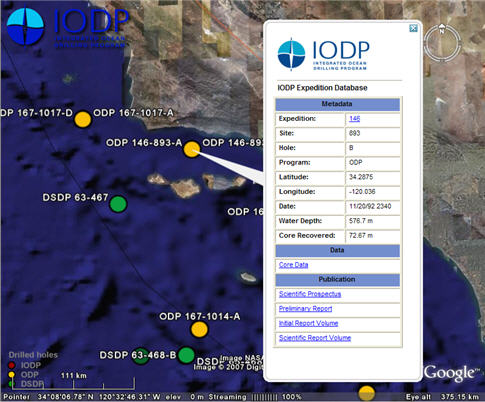
Here’s the link again…and note that this is a .kml file (not a .kmz). Go to “Add > Network Link…” in GoogleEarth and paste the link into the appropriate field.
Awesome! If I didn’t have a dissertation to finish, I would start planning a new research project tonight!!
Does anyone out there know of a website/blog that has a list of geoscience-related GoogleEarth data portals? If one doesn’t exist, we should make one.
~~~~~~~~~~~~~~~~~~~~~~~~~~~~~~~~~~~~~~~~~~~~~~~~~~~~~~~~~~~
Drill it!
The Integrated Ocean Drilling Program (IODP), formerly known as Ocean Drilling Program (ODP), and before that Deep Sea Drilling Project (DSDP), has a brand new drilling vessel. The Japanese-built Chikyu (which means ‘Planet Earth’ in Japanese) is gigantic. The new vessel is leaps and bounds better than previous scientific drill ships largely because of a system commonly used in oil drilling called a ‘riser’ system. Essentially, this is a huge pipe that surrounds the drill string enabling Chikyu to drill much deeper.
The first project for Chikyu is to drill into the Nankai subduction zone offshore of Japan. Subduction zone earthquakes can have very high magnitudes (and sometimes generate tsunamis). The overarching scientific goal of this project, called NanTroSEIZE, is to drill into the subduction zone in various locations and depths and set up a borehole monitoring system. You can find this explanatory illustration on the NanTroSEIZE website (click on image to see larger version).
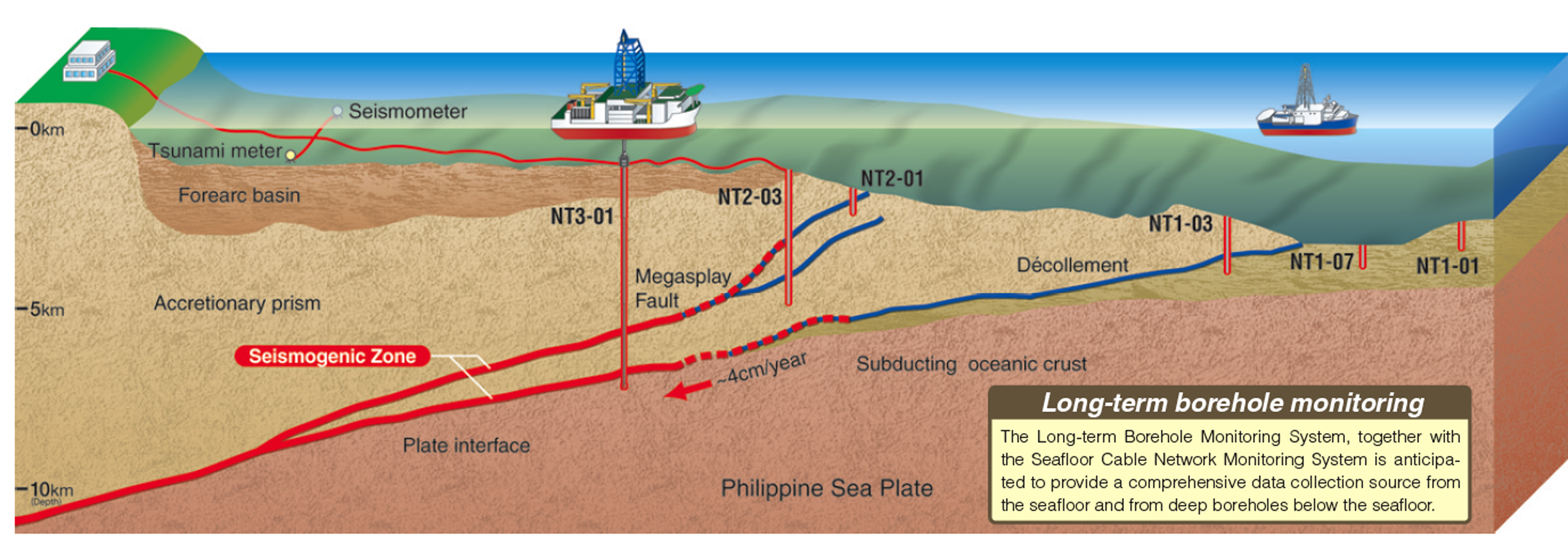
Here’s their blurb:
The Nankai Trough Seismogenic Zone Experiment (NanTroSEIZE) is a complex ocean drilling project that will be conducted over several years with multiple expedition teams of scientists from all around the world. NanTroSEIZE attempts for the first time to drill, sample, and instrument the earthquake-causing, or seismogenic portion of Earth’s crust, where violent, large-scale earthquakes have occurred repeatedly throughout history.
This is very exciting. There is already a project drilling into the San Andreas transform margin, called SAFOD, but this will be the first earthquake-monitoring system in a subduction zone. This is going to take several years, but is something to watch. And, although the hazard aspect is the main motivation for this project, our understanding of subduction zone dynamics and plate tectonics, in general, will benefit greatly from such a subsurface database.
And, although it is still a few decades away, those involved with Chikyu are talking about the day when we finally attain one of geology’s ultimate goals — to drill the mantle.
Read more here, here, and here.
~~~~~~~~~~~~~~~~~~~~~~~~~~~~~~~~~~~~~~~~~~~~~~~~~~~~~~~~~~~~~~~~
A little relaxation this weekend
For the first time in several months, I spent the weekend barely working on my dissertation and I wasn’t traveling. This meant running some annoying errands (man, I had to go to Target today…I hate that), but I also actually took some time to relax at home and do nothing. Doing nothing was everything I thought it would be.
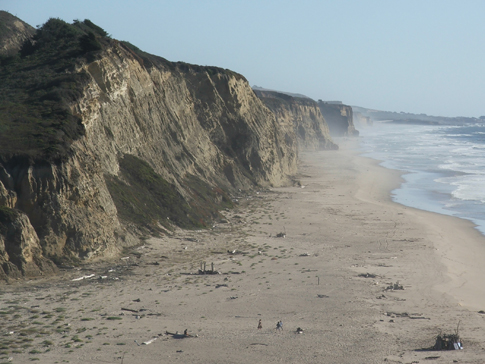
And yesterday, we spent the afternoon hangin’ out on the coast. September is summertime around these parts (after the fog, before the rain), and it was beautiful.
Below is a shot of San Gregorio beach.
This next shot is sunset at Bean Hollow beach. Glorious.
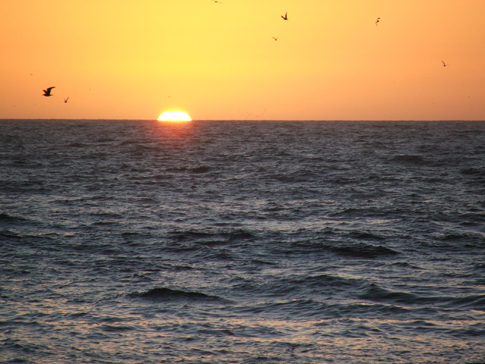
And, finally…here’s a little movie I shot on my digital camera. That vertical purplish line coming from the sun is kind of annoying…but, turn up your volume to get the sound of the waves…ahhhhh, relaxing.
If the video is not embedded above, click here.
~~~~~~~~~~~~~~~~~~~~~~~~~~~~~~~~~~~~~~~~~~~~~~~~~~~~~~~~~~~~
Call for submissions for The Accretionary Wedge #2
Head on over to All of My Faults Are Stress Related to read the details about the second edition of the geology/geoscience carnival. It will be hosted there and the theme is how the Earth could (or will) lead to your demise. This should be good.
Submissions are due to Kim Oct 15th.
~~~~~~~~~~~~~~~~~~~~~~~~~~~~~~~~~~~~~~~~~~~~~~~~~~~~~~~~~~~~~~~
Where on (Google)Earth? #53
Although Kent won #52, due to his lacking of a blog in order to host his own Wo(G)E status, he has passed the honors on to me for Where on (Google)Earth #53.
Alright…I get the feeling that some of my choices for this game are too easy for some (i.e., Ron). No more Mr. Nice Guy. This one has no clues…in fact, I know very little about the geology displayed here. I did the equivalent of throwing a dart at a map to choose this one.
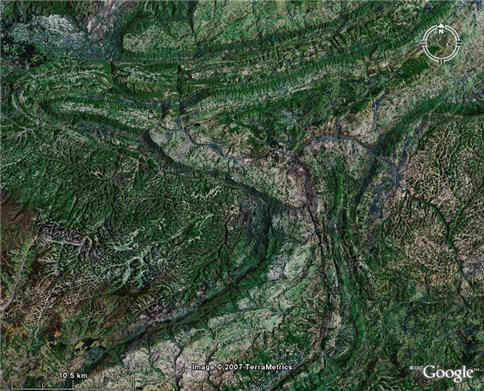
For this one, ya gotta include some geologic info…even if it’s very basic. And, as always, the Schott Rule is in effect.
Good luck!
~~~~~~~~~~~~~~~~~~~~~~~~~~~~~~~~~~~~~~~~~~~~~~~~~~~~~~~~~~~~~
How to make specious claims that research is drawing specious conclusions
UPDATE: The author of post I discuss below let me know that my comments were not blocked (i’m glad). The essence of this post, however, is more about what they say about the scientific study in question and not about my comment being blocked.
Like many science bloggers, I don’t like it when people use their blogs to try and shoot down scientific studies for unfounded reasons.
Let me give you an example.
Yesterday, I came across a blog on the WordPress home page, which highlights various categories of other WordPress blogs. Under the “science” category was this post: How to Draw Specious Conclusions From Research. How could I not click on that?!
You might remember a few weeks back, the media outlets and bloggers picked up on a study published in Nature Neuroscience titled “Neurocognitive correlates of liberalism and conservatism” (if you have access, you can see full-text of the paper here). There was some discussion of the study over at ScienceBlogs (see here and here). But, I don’t want to talk about the study in detail…i’m not a neuroscientist and will let others deal with the nitty gritty…what I do want to talk about is sloppy or, worse, purposefully misleading commentary about the study by bloggers.
One of the great things about being a scientist is that you learn how to read in detail and appreciate minutia. Remember, the whole point of their post is to claim that this particular study makes specious conclusions. So, I commented on the blog that perhaps it was the media’s interpretation and reporting of the study that is specious (since they link to an LA Times story and not the paper). My comment is paraphrased here:
Typically, the media report will try and make the big claims (i.e., headlines) to attract readers, whereas the study may offer some speculations, but the actual conclusions will be not that exciting.
The blog author immediately replied to my comment:
Trust me, I checked the paper. The authors are the ones who draw the specious conclusions, not the media. If you’d like to check the paper out, here is the Bibliography:
DM Amodio, JT Jost, SL Master, CM Yee, “Neurocognitive correlates of liberalism and conservatism” Nat Neurosci, 2007
Fair enough. I took a little time to read the actual paper. The first thing I wanted to do was check and see if what the blog author claims are their conclusions actually are. They start off their post with this:
Among their list of conclusions were:
- “conservatives tend to be more structured and persistent in their judgments”
- conservatives tend to ignore information
- “liberals are more open to new experiences”
- liberals can be expected to accept new scientific and social ideals faster
- the results “provided an elegant demonstration that individual differences on a conservative-liberal dimension are strongly related to brain activity.”
Firstly, only three of these bullet points even appear in the paper at all. Secondly, and much more importantly, the conclusions listed above aren’t Amodio et al’s conclusions. They address these attributes as hypotheses to test and cite the previous work that made the conclusions. This is very clearly stated in the abstract and the first paragraph of the paper! The point of their study (i.e., the point of a lot of scientific studies) was to take previous work and results and test them in a very specific way. So, the blog author is simply wrong when stating that “the authors are the ones who draw the specious conclusions”. The blog author asked me to check the real paper…I did. Amodio et al.’s actual conclusions go like this:
Taken together, our results are consistent with the view that political orientation, in part, reflects individual differences in the functioning of a general mechanism related to cognitive control and self-regulation.
Like most conclusions from very specific studies, what they actually say is worded carefully and within the specific context of the previous work they were addressing.
So, I submitted a comment to the post similar to what I just said above to point this out. Apparently my comment was thrown into the spam filter and never appeared (it happens). Nevertheless, my statements in this post about their deceitful (or simply sloppy) reporting of the study in question stand.
I’m not gonna take the time to try and comment again on their thread and deal with the spam issue. They can respond to what I say about their post on this thread if they like.
~~~~~~~~~~~~~~~~~~~~~~~~~~~~~~~~~~~~~~~~~~~~~~~~~~~~~~~~~~~~~
Where on (Google)Earth? #52
It’s been a while…Where on (Google)Earth is back home for a visit.
Ron included a quote from Conrad’s book ‘The Heart of Darkness’ as a clue for Wo(G)E #51. A brief period of procrastination provided enough time for me to do a little research, which narrowed down my search, and then I found it (it was the Niger River delta). I couldn’t think of any interesting clues for #52, so I’m just gonna show it straight up.
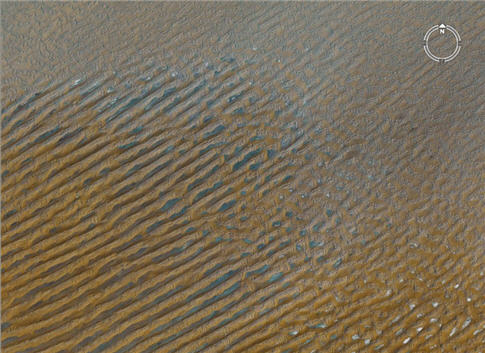
I’ll think of some clues if need be. But I don’t think this one will be too difficult. It’s an old-school map view (about 60 km across the entire image).
~~~~~~~~~~~~~~~~~~~~~~~~~~~~~~~~~~~~~~~~~~~~~~~~~~~~~~~~~~~~~~~


 Clastic Detritus
