Sessions and Activities at GSA 2012

The 2012 Geological Society of America (GSA) annual meeting, in Charlotte, North Carolina, is a busy one for me. I’m chairing three sessions and giving a talk.
On Tuesday afternoon I’m giving a talk titled “Influence of Sediment Routing Morphology and Grain-Size Partitioning on Deep-Marine Stratigraphic Records: Insights from Quaternary Systems of Southern California” in the session Preservation of Environmental Signals in Deep-Water Depositional Systems (Session T165). My talk is the first one in the session after the introductory remarks (session starts at 1:30pm in room 203A), so make sure to come by after lunch.
Sessions I’m chairing:
- T181 — Integrated Detrital Records of Orogenic Systems I: Sunday, November 4th (8:00am-12:00pm), Charlotte Convention Center 208A
- T181 — Integrated Detrital Records of Orogenic Systems II: Sunday, November 4th (1:30pm-5:30pm), Charlotte Convention Center 208A
- T169A — Cyclicity and Hierarchy in the Clastic Stratigraphic Record: Wednesday, November 7th (1:30pm-5:30pm), Charlotte Convention Center 203A
In addition to these technical session activities, I’m attending the council meeting for Society of Sedimentary Geology (SEPM) on Saturday to discuss ideas for improving their web presence. I’d love to hear ideas from members and non-members alike, so please comment below.
If you’re on Twitter follow #GEO2012 for the latest.
Friday Field Photo #175: Patagonian Sunset

Not much time for blogging these days — incredibly busy with teaching, writing proposals and papers, getting my lab set up, and all that stuff. But having fun doing it! Here’s a photo from last February of one of the more spectacular sunsets I’ve seen in Patagonia … or anywhere for that matter. I’m getting excited to head down there again in the coming months for a new phase of field research.
Happy Friday!
New Paper: Deep-Time Perspective of Land-Ocean Linkages

I have a new paper out in the Annual Reviews of Marine Science titled ‘A Deep-Time Perspective of Land-Ocean Linkages in the Sedimentary Record’ that is now available ahead-of-print here. It will come out in print in Volume 5 of this annual series in 2013.
It is becoming increasingly important to understand and predict how marine environments respond to changes in climate, sea level, and other factors such as sediment flux from rivers. The sedimentary record along continental margins is an archive of such changes from the Earth’s past. Thus, the aim of our review paper is to provide the general marine science community a broad review of the methods, approaches, and ideas related to using the sedimentary record to reconstruct land-ocean linkages, especially along continental margins.
To that end, this paper combines fundamental concepts and ideas — things you might find in a textbook — with information and discussion about the state-of-the-art and the current outstanding questions/issues in the science. If you are a sedimentary geologist already studying continental-margin stratigraphy you probably won’t learn anything new. But, if you are a marine scientist or other Earth scientist generally interested in how the linkages and interactions between continental and marine environments can be recorded at longer time scales, and thus used to reconstruct that environmental change, then I hope our review will provide insight.
Writing a review of such a broad scope was more difficult than I imagined. We certainly hope that our perspective is valuable, especially to marine scientists who don’t spend their time thinking about deep time (>millions of years); however, we also acknowledge that we couldn’t cover everything and undoubtedly overlooked great studies on this subject.
I’m always happy to discuss more!
Friday Field Photo #174: Core on the Table
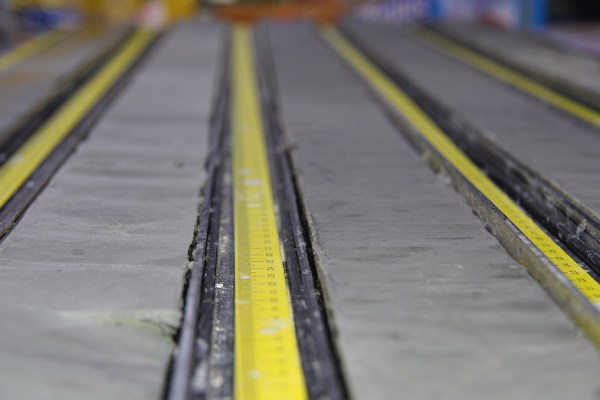
As you might surmise from my lack of posts recently things are incredibly busy. Good and exciting busy, but busy nonetheless. As a result, I give you this photo of deep-sea core on the JOIDES Resolution from a couple months ago without commentary. Many more photos of the expedition here.
Happy Friday!
Friday Field Photo #173: Snowed Out in Svalbard
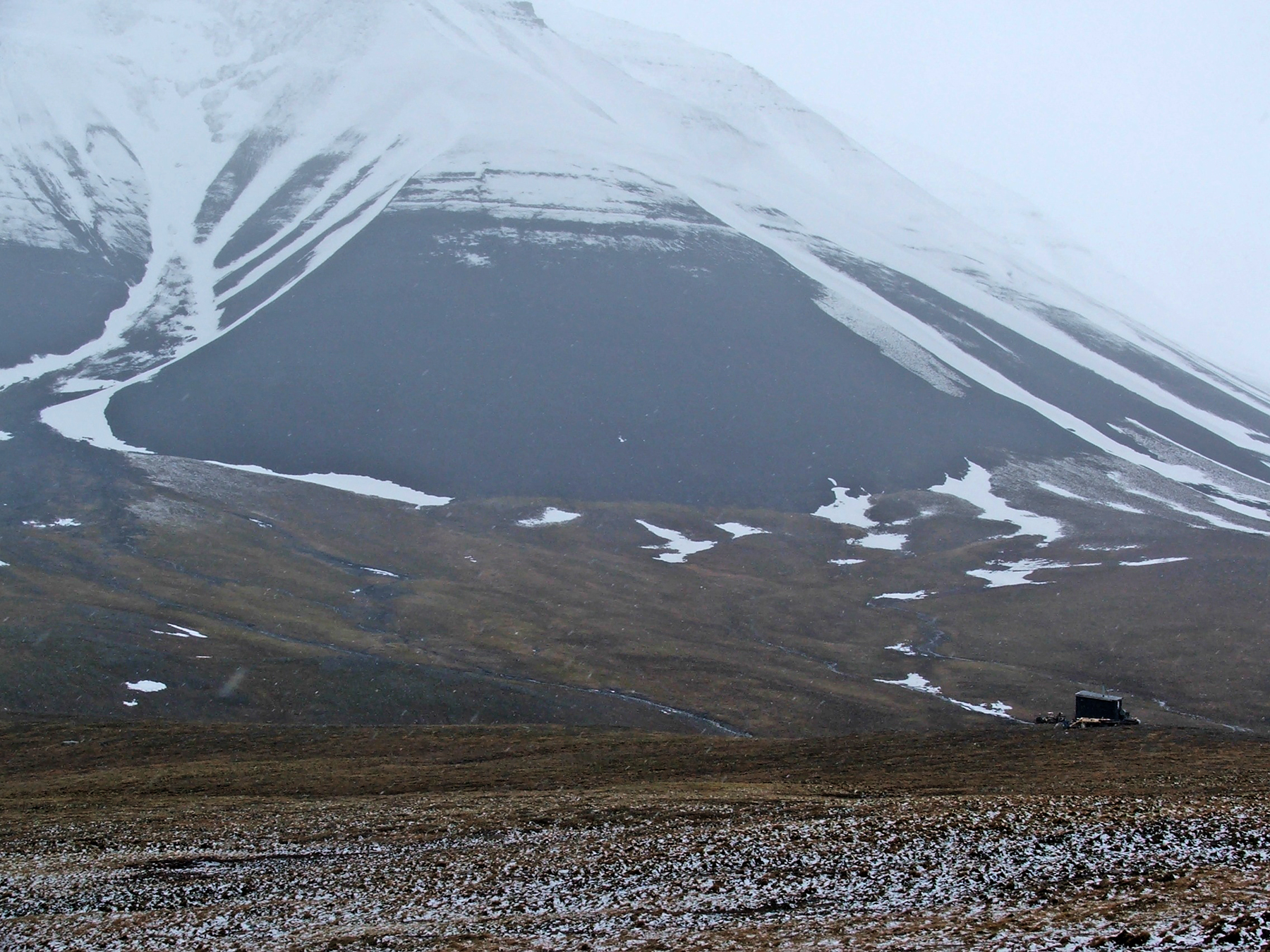
In June 2009 I took a trip to the Arctic archipelago of Svalbard to help teach a sedimentary geology field course and do a little bit of reconnaissance field work. As part of the field course we wanted to climb up some hills to do some work on the Eocene shallow-marine and deltaic strata, but we were snowed out. The weather turned bad and snow quickly covered the rocks, forcing us to head back to lower elevations. That’s the way it goes sometimes when dealing with Mother Nature. More photos from this trip here.
Happy Friday!
Friday Field Photo # 172: Pot of Scientific Gold
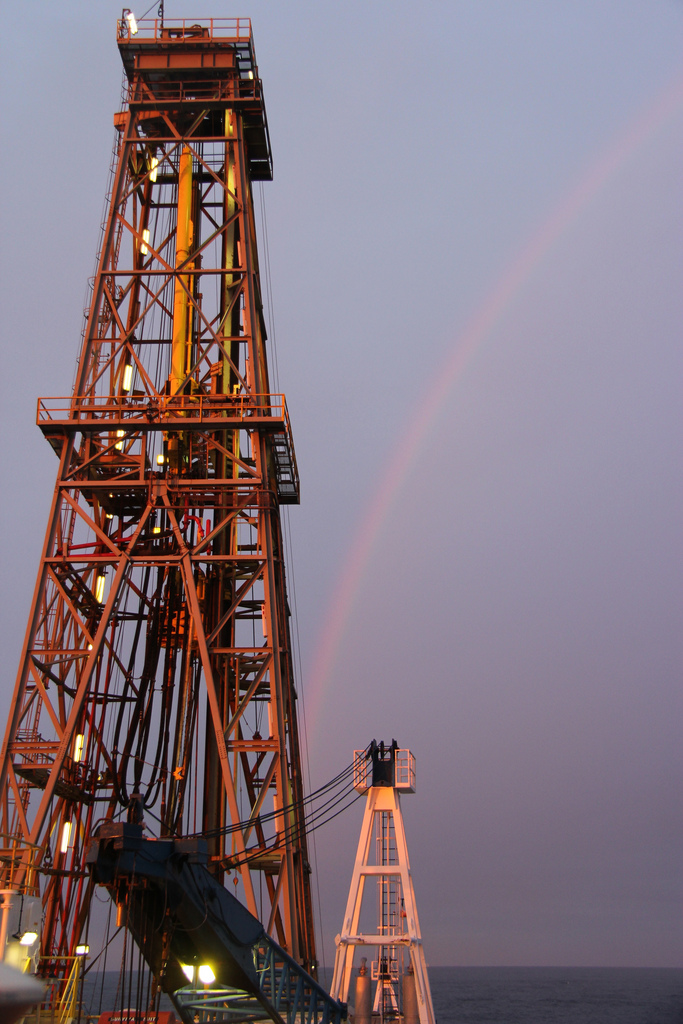
This week’s Friday Field Photo is from the North Atlantic Ocean, offshore of the Grand Banks of Newfoundland. Here, the derrick of the JOIDES Resolution drill ship is found at the end of this rainbow — a scientific pot of gold. Me and the rest of the science party from this expedition are busy preparing are post-cruise research and sampling plans. I look forward to sharing the progress of the work in the coming months.
Happy Friday!
Pediment Surface on Mars?
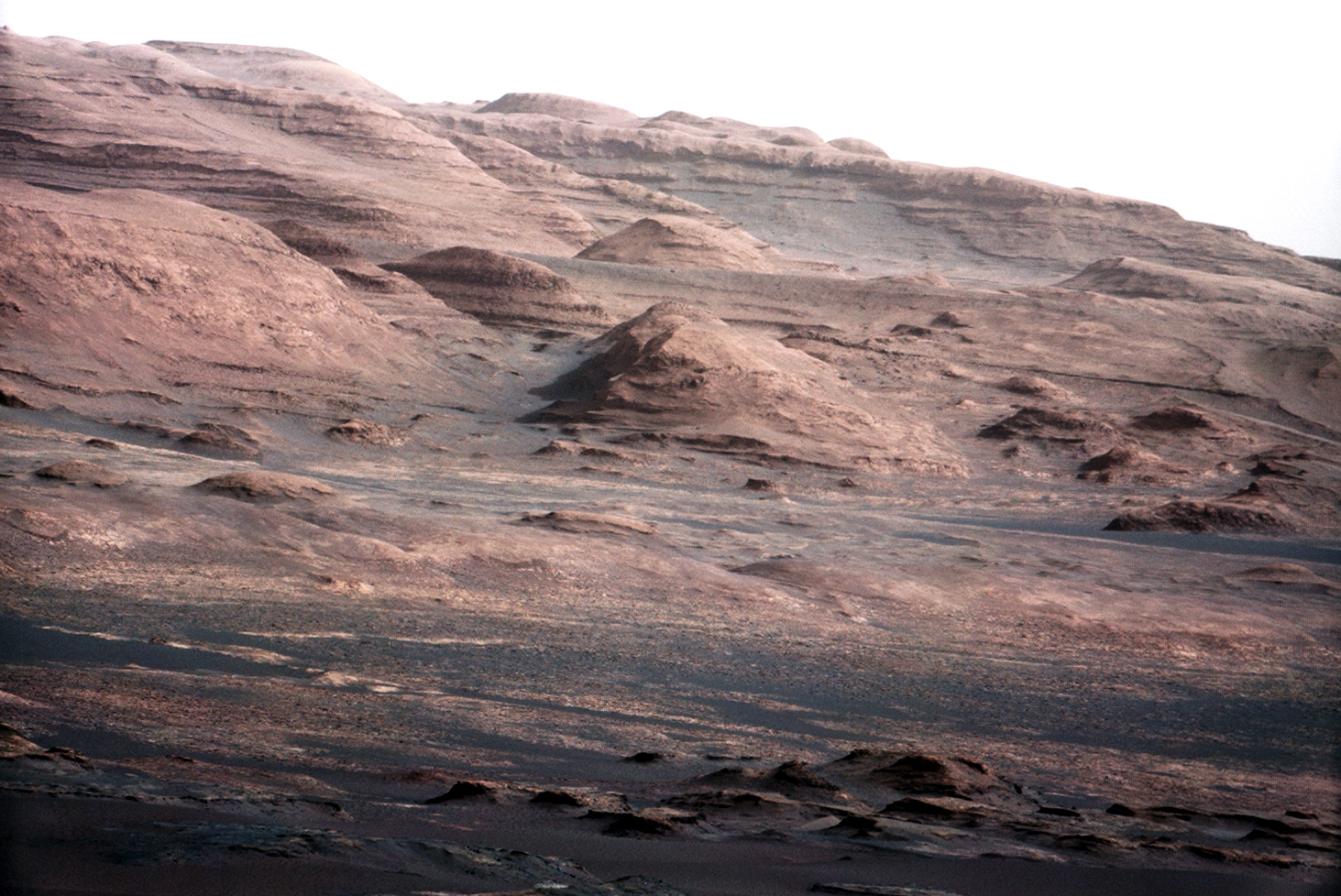
Layers at the base of Mount Sharp (photo taken by Curiosity Rover); http://www.nasa.gov/mission_pages/msl/multimedia/pia16105.html
And now for some armchair speculation of Martian geomorphology based on two minutes of looking at a photo. Why not, right? The photo above was taken by the Curiosity rover and nicely shows the stratigraphy at the base of Mount Sharp. Very nice.
Upon closer examination it appears some layers are truncated by an erosional surface that parallels the sloping mountain front. The photos below are zoomed in and cropped to highlight one such area. The lower photo includes some simple annotation showing that truncation relationship (yellow line).
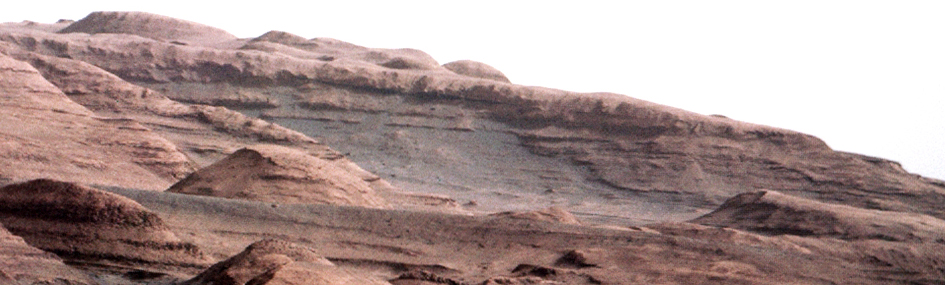
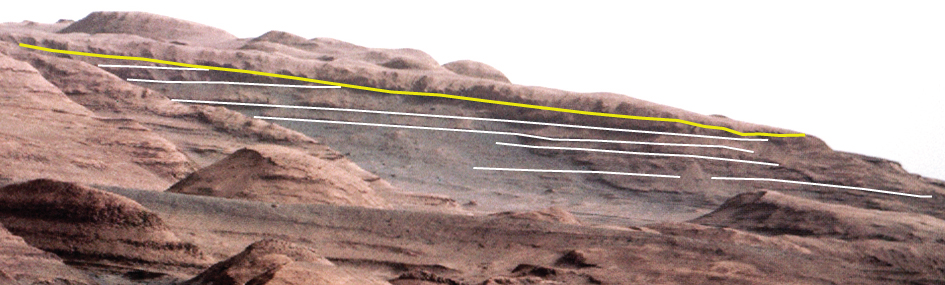
I didn’t have time to find a good Earth analog, but I’ve definitely seen erosional features like this, termed pediments, out in the deserts of Utah. Perhaps this is old news for those who study Mars, I don’t know. I just thought it was interesting. Besides, Mars!!
Those who know much more about Mars and/or desert landforms, please feel free to add info in the comments below.
MYRES 2012 — The Best Conference I’ve Ever Attended
A couple of weeks ago I attended the Meeting of Young Researchers in Earth Science (MYRES) 2012 meeting The Sedimentary Record of Landscape Dynamics in Salt Lake City, Utah. The three-day meeting/workshop had ~50 participants designed to bring multiple sub-disciplines under the umbrella of Earth surface processes together to discuss overarching scientific questions. For example, to what extent are the signals of tectonics and climate, which drive erosion (and sediment production), recorded in the down-system depositional segments? This systems view, also referred to as source-to-sink or ‘landscapes into rock’, has been talked about a lot over the past decade. I’ve been to a few meetings devoted to this topic and this was, by far, the best conference. Perhaps the approach is maturing, but there was a lot of great work (modeling, modern systems, ancient record) presented that is addressing the questions more directly. A website with a summary of the conference, including links to abstracts, talks, and posters, is being put together by the organizers and should be up this fall. I’ll make sure to post about it when it’s up.
The meeting concluded with a two-day field trip to nearby wave-cut terraces of Pleistocene Lake Bonneville, the Thistle landslide deposit, and the Cretaceous to modern landscapes in the Book Cliffs and San Rafael Swell areas. I’m a big fan of attaching time in the field, even if it’s short, to meetings like this. I think it’s important to go out and view nature in all it’s complex glory after discussing insightful, yet simplified, models of landscape process-response. Plus, it gives the participants another venue to continue discussions that might lead to interesting collaborations.

If you’ve never heard of MYRES, you’re probably not alone. It is a true grass roots organization (i.e., there is no staff) of early career geoscientists. The organization is relatively new, the first conference was in 2004 and biannually since. If this sounds like an interesting format for the kind of work you do, you should contact those on the website about what it takes to get a conference planned. The organizers for the 2012 meeting worked very hard for several months planning and to obtain funding (from NSF and SEPM in this case). But the end result was amazing, kudos to the conveners for a great event.
Final Episode of IODP Newfoundland Expedition
–
Here’s the sixth, and final, installment of the video series filmed on the JOIDES Resolution drillship during IODP Expedition 342. (Use this link if it’s not showing up for you above.) This final episode was filmed during the final few days of the two-month-long expedition as we came into port at St. Johns, Newfoundland and then edited/produced onshore in the past couple weeks. As you can tell we were quite excited — all taking photos of land since we hadn’t seen any for two months.
The film maker, Dan Brinkhuis of ScienceMediaNL, also captured the feeling of exhaustion many of us felt towards the end, which features yours truly getting excited about our first day off following eight straight weeks of 12-hour-per-day shifts. Check out my previous post reflecting on this incredible experience. But, as the expedition project manager says in the film, we are just getting started with the science. Obtaining the cores is really just the first step. In the coming months I’ll be posting more about the science plans and results.
–
Here are all six episodes:
Episode One: ‘Departure’ — http://www.youtube.com/watch?v=jWO6LnsGj1s&hd=1
Episode Two: ‘Core on Deck’ — http://www.youtube.com/watch?v=IgouMVdqLDI&hd=1
Episode Three: ‘Time Machine’ — http://www.youtube.com/watch?v=_qtvK35YhNE&hd=1
Episode Four: ‘Stormy Science’ — http://www.youtube.com/watch?v=dp8pez3PLQ4&hd=1
Episode Five: ‘Back to the Future’ — http://www.youtube.com/watch?v=eudbroUnSPs&hd=1
Episode Six: ‘Newfoundland’ — http://youtu.be/bWOOoqN0Ec8
ScienceMediaNL is also working on a single, 20-minute-long documentary about the entire expedition, which will be out later this fall.
Friday Field Photo #171: 75 Million Year-Old Plant Debris
Okay, back to posting some field photos after a >two-month long hiatus.
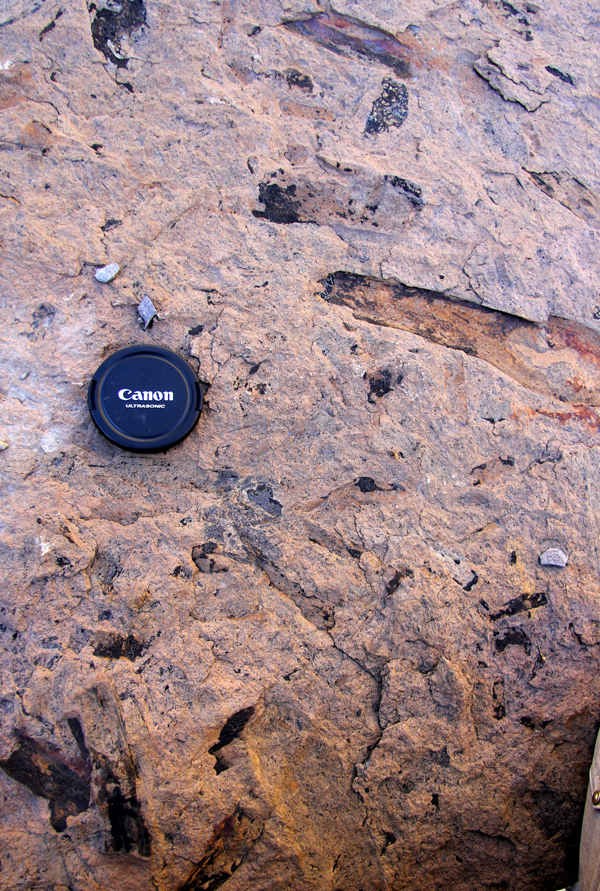
Today’s photo is from the Upper Cretaceous Tres Pasos Formation of the Magallanes foreland basin in Chilean Patagonia. The Tres Pasos is characterized by mudstone and sandstone that was deposited in relatively deep water (~700-1000 meters paleo water depth) through a variety of sediment gravity flow processes (e.g., turbidites, debris flow deposits, mass wasting deposits, etc.).
This deep-marine slope system was fed sediment by an evolving delta system, which, in addition to mud and sand, contained vast amounts of plant and other organic matter. Some of this material was transported by the same processes that moved the sediment, making its way down to the deeper water out in front of the delta. The photo above shows some of the larger chunks of woody material concentrated on the top of a turbidite bed.
Happy Friday!


 Clastic Detritus