Electoral and Geologic Boundaries
I’m slowly transitioning out of election mode and back into geoscience mode. To help this transition, this post combines both!
The map below (from this NY Times page) shows the counties that voted more Republican (in shades of red) and the counties that voted more Democratic (in shades of blue) as compared to 2004. There is a very distinct belt of deep red extending from the Appalachians to the Ouachitas in Arkansas and Oklahoma.
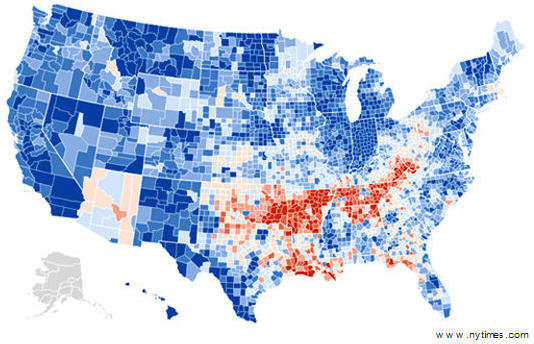
Map showing change in vote relative to 2004 (credit: http://www.nytimes.com)
Now compare that belt of red to the map below that shows the Appalachian-Ouachita orogenic belt, which reflects the suturing of Gondwana and Laurasia to form Pangea in the mid to late Paleozoic.
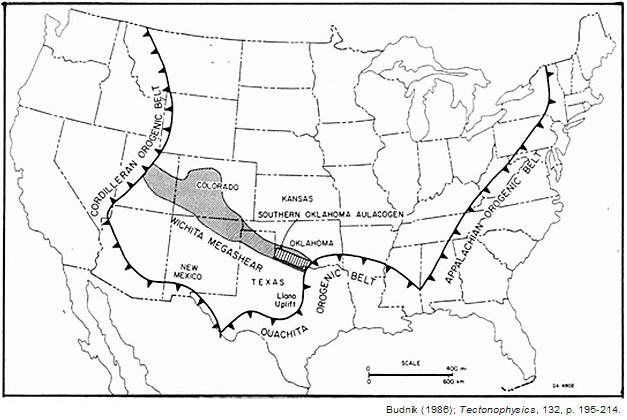
Map of the lower 48 of the United States showing continental-scale orogenic belts (credit: Budnik, 1986; Tectonophysics, 132)
Okay, I guess the western Cordilleran belt doesn’t match anything … whatever … I wrote this post in about 2 minutes!
Geology-rich posts are in the works … stay tuned.
–
UPDATE (11/16/2008): Along the lines of the some of the comments below, I came across this composite map (from the Strange Maps blog) showing the counties that voted for Obama vs. McCain (blue and red colors, respectively) with the dots represent where cotton was produced in 1860 (each dot representing 2,000 bales).

~~~~~~~~~~~~~~~~~~~~~~~~~~~~~~~~~~~~~~~~~~~~~~~~~~
Papers I’m Reading – November 2008
I didn’t get a list out for last month (October) for many reasons … there was a lot going on both personally and nationally … so here’s a list of papers I am reading or hope to read this month.
This month is a mix of brand new papers with a slightly older one.
Here’s the list for November:
Check out all the lists with the ‘papers i’m reading’ category.
~~~~~~~~~~~~~~~~~~~~~~~~~~~~~~~~~~~~~~~~~~~~~~~~~~
Why I’m worried
I really wish I could have confidence in our electoral system.
As I write this (11:20am, west coast time) there are numerous reports of large-scale voting problems — problems with the rolls, problems with the machines malfunctioning, reports of voter intimidation, reports of voters being turned away illegally, and so on and so forth.
And, of course, long lines … which isn’t really a problem that’s fixable when voter turnout is this HUGE.
Here is a quick rundown from OurVoteLive.org
Michigan
- Some voters being asked to visit other polling stations as a result of disorganization and malfunctioning machines;
- Some voters are being asked to vote on paper with magic markers.
- Many voters are angry and unaware of the legality of the recourse being offered by poll workers (in many cases, poll workers are asking voters to cast their ballot on paper saying they will count them later)
Georgia
Election Protection is working in Bleckley County, Georgia to ensure that students at Middle Georgia College are able to vote today after voting officials apparently extended, then suddenly withdrew, a deadline that would have ensured students were registered in time to use a regular ballot.
Virginia and Pennsylvania
Virginia and Pennsylvania voters are reporting major obstacles to casting their ballot, potentially disenfranchising thousands of voters. Long lines, broken voting machines, ballot shortages and misused absentee ballots are just some of the problems that threaten to rob thousands of eligible voters of their right to vote.
In Virginia:
- Dozens of polling places are experiencing varying degrees of machine malfunction. Some polling places are either completely closed or have been closed for hours.
- Thousands of voters may have been turned away illegally by polling workers.
- Voters have illegally been issued with provisional ballots where machines have been broken.
- Students at Virginia Tech, previously the victims of misinformation, have seen their polling place suddenly and unexpectedly moved six miles to a location with little parking.
In Pennsylvania:
- Voting machine malfunctions are widespread and at least a dozen locations, mainly focused on Pittsburgh and Philadelphia.
- We have received reports of campaign materials are being illegally distributed at polling locations in Pittsburgh.
- Voters across the state are reporting that they never received their absentee ballots, which is creating additional chaos at the polls.
Missouri
From Kansas City, Missouri, we’re getting multiple reports of swapped poll books — meaning polling places do not have the proper lists of registered voters. Election Protection experts are working to resolve the problem. If your polling place is experiencing problems, please don’t give up.
Florida
Voters in the Tampa-St. Petersburg area have experienced numerous problems trying to cast ballots this morning. We have preliminary reports of voters being turned away from the polls for incomplete registrations and instances of the statewide problem of broken optical scan machines in some two dozen polling locations all across the state.
Colorado
Numerous reports that voters were unable to obtain absentee ballots in time to cast their votes;
Reports of voters being asked to fill out provisional ballots if they are in the wrong precinct instead of being redirected to the appropriate location.
Reports of poll workers requiring additional and unnecessary identification from voters in Denver;
Incidents of untrained poll workers and faulty voting machines in Jefferson County; and,
Reports of voters being asked to fill out provisional ballots if they are in the wrong precinct instead of being redirected to the appropriate location.
–
Here’s a particularly sketchy one — according to RockTheVote, young voters are getting this text message:
Due to long lines today, all Obama voters are asked to vote on Wednesday. Thank you for your cooperation.
What a bunch of a%#holes! They know they don’t even have a chance of winning unless they supress as many votes as they possibly can. Disgraceful.
There’s much more …
I really hope that people stay in line and let their voice be heard. Be patient … yes, there are millions of people that don’t want you to vote — prove them wrong! If you have problems call 1-866-OUR-VOTE and report it. They’ve gotten over 50,000 calls already!
~~~~~~~~~~~~~~~~~~~~~~~~~~~~~~~~~~~~~~~~~~~~~~~~~~
Books I’m reading
I’m not sure if you any of you are like this — but I have a tendency to try and read many books at once. What happens, of course, is it takes forever to finish one of them. I think I need to focus on one and try to actually finish it!
At any rate, I don’t have time for a good geology post right now, so here’s a list of some books I’m currently trying to read:
–
 The Fourth Turning by Strauss and Howe — I started this one recently and like it so much so far that I might finish it relatively soon. The Fourth Turning discusses cycles in history and how they are tied to social generations. It focuses on 20th century American history and speculates about the future, but there is also quite a bit on ancient civilizations and mythology in the beginning of the book. The other cool thing is that this book was written in 1997 — it’s always interesting to read about prediction for time periods that have already happened or are occurring. I’ll write more about it when I finish it.
–
 Out of Control by Kevin Kelly — This 1994 book is awesome, but extremely dense. Kevin Kelly packs so many ideas into a single paragraph that if I re-read it the next day I learn something new. The subtitle for this book is ‘The New Biology of Machines’ and discusses (so far … I’m only partway through) the concept of evolving and adaptive systems, especially with respect to collective entities (e.g., the good ol’ ant colony example). Although I’m only in the first third of this book, Kelly discusses these concepts within the context of human-made machines, systems, or other technology. It’s very interesting so far.
–
 Year Million edited by Damien Broderick — This book is a collection of essays from various scholars, scientists, authors, and journalists looking forward one million years and speculating about what will become of us. I’ve read about half of the essays so far and they’ve covered topics such as biological (and specifically human) evolution, environmental/climate change, ecosystem change and variability, geological change, and social/technological trends. As with many compilation books, each essay stands on its own — some I like way better than others. This format also goes well with my can’t-finish-a-book-in-a-reasonable-amount-of-time problem.
This last book makes me want to ponder a million years out in a blog post — in fact, I just made it an Accretionary Wedge theme.
~~~~~~~~~~~~~~~~~~~~~~~~~~~~~~~~~~~~~~~~~~~~~~~~~~
Friday Field Foto #70: Permian carbonate slope system
Earlier this week I posted about some research I did on a siliciclastic depositional slope system and mentioned how different carbonate depositional slope systems can be.
This week’s Friday Field Foto is from the Guadalupe Mts of west Texas and New Mexico. The southern rim of this mountain range is essentially an ancient carbonate shelf margin (~250 million years old). Canyons cutting back into the mountains expose fantastic cross sections of this preserved depositional system.
The photo below is taken from the fantastic Permian Reef Trail in McKittrick Canyon in the park looking across the canyon to the southwest. Click on it for a bigger version.

Permian strata in McKittrick Canyon, Guadalupe Mtns Nat'l Park (© 2008 clasticdetritus.com)
This next photo (below) is the same with some simple annotation highlighting the sloping stratal surfaces within the carbonate sedimentary rock. These surfaces are not structural but represent the stacking of the actual depositional surface going from shallower waters of the platform (to the right) to deeper waters (to the left).

Permian strata in McKittrick Canyon, Guadalupe Mtns Nat'l Park - with annotation showing reef foreslope surfaces (© 2008 clasticdetritus.com)
The steepness of these slopes are such that you can see them and map them in mountainside outcrops! This is very cool. Siliciclastic slopes, on the other hand, have at most a few degrees of relief and can be very difficult to characterize in a single outcrop.
I know Suvrat is a carbonate sedimentologist, perhaps he can add some more info and/or correct me with regards to carbonate slopes.
–
I’ve posted about this region several times before – see the west Texas tag.
~~~~~~~~~~~~~~~~~~~~~~~~~~~~~~~~~~~~~~~~~~~~~~~~~~
Another field photo meme – Rainbows!
Silver Fox started it … Eric followed … here’s mine.
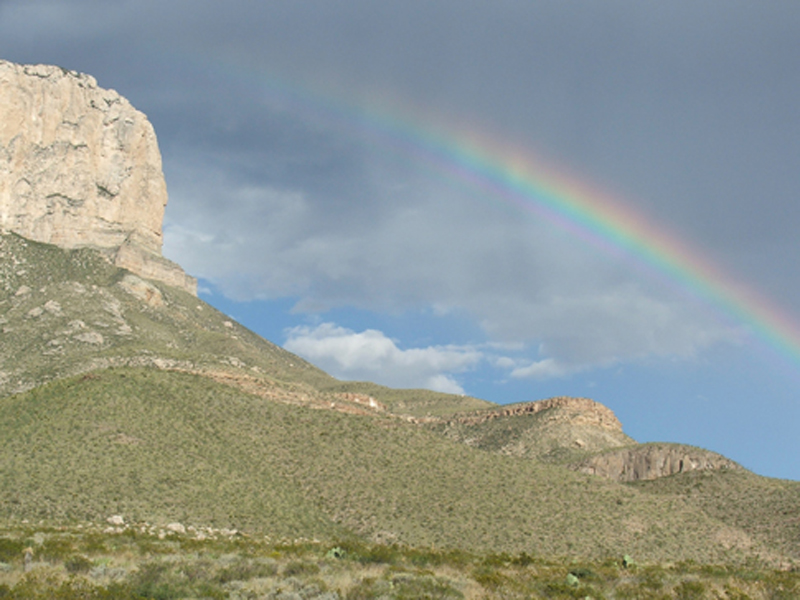
That’s the Permian Capitan Formation in Guadalupe Mountains National Park in west Texas and New Mexico. See this and other photos from this region here.
~~~~~~~~~~~~~~~~~~~~~~~~~~~~~~~~~~~~~~~~~~~~~~~~~~
Tuesday potpourri
Here’s a completely random smattering of stuff I’m reading on the internets the last few days:
(1) Hitchens unloads on Sarah Palin for her ridiculous fruit fly comment:
With Palin, however, the contempt for science may be something a little more sinister than the bluff, empty-headed plain-man’s philistinism of McCain. We never get a chance to ask her in detail about these things, but she is known to favor the teaching of creationism in schools (smuggling this crazy idea through customs in the innocent disguise of “teaching the argument,” as if there was an argument), and so it is at least probable that she believes all creatures from humans to fruit flies were created just as they are now. This would make DNA or any other kind of research pointless, whether conducted in Paris or not. Projects such as sequencing the DNA of the flu virus, the better to inoculate against it, would not need to be funded. We could all expire happily in the name of God. Gov. Palin also says that she doesn’t think humans are responsible for global warming; again, one would like to ask her whether, like some of her co-religionists, she is a “premillenial dispensationalist”—in other words, someone who believes that there is no point in protecting and preserving the natural world, since the end of days will soon be upon us.
–
(2) This site allows you to choose up to 10 colors from a standard color chart and then it searches Flickr for photos with those colors. What? … Awesome!

–
(3) If you don’t have the Boston Globe’s The Big Picture photo-blog in your reader … well, get with it. Each and every one of these simply blow me away. Recent posts have highlighted Encaledus and (shown below) World Animal Day.

–
(4) Why the heck is an 8-year old firing a machine gun?! The boy accidentally shot himself in the head and died. It’s interesting that some mainstream media articles include commenting like blogs now. Since these articles get huge numbers, the comment thread typically becomes a shouting match. This particular thread, perhaps predictably, started discussing gun control issues. I didn’t read all the comments, but skimming through I found this one from a vet that struck a chord:
As a US Army Infantry Vet, I can tell you, automatic weapons are tricky and have no place in the hands of an eight-year old– nor even in the hands of the general population. I own two guns, but– listen– if you’re such a lousy shot that you can’t defend your home with a pistol or semi-auto rifle, then go practice. Even the Army A-4 (m16) rifle is usually fired on semi-auto, and hasn’t had a fully auto setting for years. And don’t give me any nonsense about your “2nd amendment rights.” The 2nd amendment is the right to form “a well-regulated militia.” Well guess what, we have a well-regulated militia. It’s called the National Guard, and you’re welcome to go join it. They’ll give you a rifle and let you go learn how to use it in Iraq and Afghanistan, instead of playing soldier at gunshows and backwoods america.
–
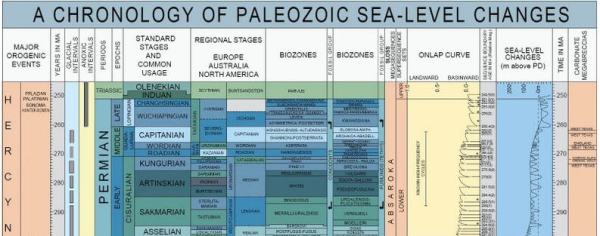
(5) Check out this post from The Dynamic Earth about the recent Haq & Schutter paper in Science presenting a sea level curve for the Paleozoic. A very good summary complete with historical context and witty banter about Exxonian sequence strat … you won’t find that in a ScienceDaily press release (this is what the science blogosphere is all about!).
–
(6) From GraphJam … this is really dumb, but made me laugh.
–
(7) Finally … if you check out some of my past posts it’s no secret I’m supporting Obama. I think almost everybody has made up their mind at this point … a lot of people, including myself, are feeling fatigue over thinking and talking about this election.
I’ve always despised the use of false dichotomies and false choices in complex and nuanced issues. I was pleased to hear Obama address this directly in a speech yesterday. Here are a few snippets that introduce full paragraphs about the particular issue:
We don’t have to choose between allowing our financial system to collapse and spending billions of taxpayer dollars to bail out Wall Street banks.
The choice in this election isn’t between tax cuts and no tax cuts.
When it comes to jobs, the choice in this election is not between putting up a wall around America or allowing every job to disappear overseas.
When it comes to health care, we don’t have to choose between a government-run health care system and the unaffordable one we have now.
And when it comes to keeping this country safe, we don’t have to choose between retreating from the world and fighting a war without end in Iraq.
This doesn’t mean that tough choices won’t have to be made … they do. Whoever gets elected will have very tough choices to make and probably end up scaling back some of their proposals (even though neither would ever admit that during a campaign). But, I am eager to listen to a leader who appreciates a complex world – who doesn’t make rash decisions from their “gut”. Someone who doesn’t boil everything down to absolutes, false dichotomies, and an us-vs-them mentality.
Finally … I was especially pleased to hear this statement from Obama:
We don’t need bigger government or smaller government. We need a better government – a more competent government.
Exactly! The debate of big vs. small government misses the point … NEWS FLASH: We have a big government. I want it to be effective. There was a time that true, old-school conservatism made a lot of sense to me … it was about effective and responsible government. This doesn’t seem to be the case anymore. Perhaps conservatism can reinvent itself in the coming years. But for right now, I simply don’t want those that despise the very notion of government in charge of mine.
~~~~~~~~~~~~~~~~~~~~~~~~~~~~~~~~~~~~~~~~~~~~~~~~~~
Stratigraphic evolution of an ancient depositional slope system

A large chunk of my Ph.D. research is now out in the journal Sedimentology (you can find it here). The following post is meant to be a general summary of this work for a broader audience and will skip over many details and try not to use too much jargon (if you are interested in the nitty-gritty please see the paper or inquire below).
–
What is a Depositional Slope?
From the title of this post you might be wondering what I mean by the term depositional slope. All this means is that there is a sloping surface that is net-depositional over time … that is, sediment is accumulating on a slope such that the system builds out over time. This doesn’t meant that there is absolutely no erosion of the slope or no bypass of sediment down the slope, but over long time scales (>thousands to tens of thousands of years) there is net accumulation.
One might argue that every depositional surface on the Earth is a slope – that there are few truly flat surfaces. This is true. However, the term ‘depositional slope’ generally refers to relatively steep slopes – about 2 to 4 degrees. That’s right … 2 to 4 degrees is steep! I know it doesn’t sound steep, but remember we are talking about slopes where sediment accumulates. Most depositional surfaces are fractions of a degree*. Steeper slopes on the Earth surface are typically net-erosional over time (e.g., mountainsides). Additionally, what I’m referring to is a large-scale depositional system (several to 10s of km in length). At a bedform- or sometimes delta front-scale, depositional slopes can be as steep as the angle of repose (30-35 degrees).
Depositional slope systems develop in various tectonic environments and under various conditions. For this post, I will focus on a large delta-fed slope system that developed in a deep-marine basin in the latest Cretaceous (~75 million yrs ago).
–
The Magallanes Basin and Cerro Divisadero, southern Chile
The study area for this research is a district in southernmost Chile called Ultima Esperanza. For a summary of this part of Patagonia read this post first and then come back here. It outlines the regional geography, the tectonic context, and discusses the specific mountain where we did this work, which is called Cerro Divisadero. It should be at least skimmed before going further.
Okay … done? Good.
The important contextual geological aspects to remember about the Magallanes Basin from that post is that: (1) it was a relatively narrow (10s to 100 km) foreland basin associated with an active volcanic arc and adjacent to an active fold-thrust belt, and (2) a large-scale delta system filled in this elongate basin over ~20 million year period.
–
What is So Special About These Rocks?
Why go to the “end of the Earth” to study some sedimentary rocks? What is unique about the geology in this location? First, and perhaps simplest to explain, is that there had been only a few sedimentary studies published on this formation, called the Tres Pasos Formation, before my work. The work that did precede us was very good and provided an important framework on which to build. From a sedimentological point of view, research conducted by the Univ. of Wisconsin-Madison faculty and students in the 1970s is notable. I’ve since corresponded with a person who did some of that work and it’s been a joy to hear the field stories from that time. Additionally, a colleague from my alma mater who preceded me by a few years did the first investigation of the Tres Pasos on this particular mountain.
Foreland fold-thrust belts and their adjacent foreland sedimentary basins typically evolve in such a way that basinal deposits end up being incorporated into the orogenic belt as the system migrates. That is, the sedimentary deposits are eventually uplifted into mountains and thus exposed at the surface as outcrops. As a result, outcrops of foreland basin deposits are relatively common compared to other tectonic settings (e.g., passive margins).
But, what makes the Magallanes Basin unique is its heritage before it was a foreland basin. Prior to this phase, the basin was an extensional (back-arc) basin — with oceanic crust and everything. That extensional basin then evolved into a compressional (foreland) basin. This basin opened up and deepened to the south. Retro-arc foreland basins (or, basins ‘behind’ an active continental arc) generally do not develop long-lived deep-marine sedimentation. You should read the paper for more of the context, but to make a long story short: outcrops of the Magallanes Basin beautifully display a thick succession (>4,000 m thick) of deep-marine deposits across a large area. The Tres Pasos Formation represents the upper 1,000-1,500 m of that deep-marine fill.
–
What Was the Objective and What Kind of Data Was Collected?
One of the primary objectives of this research was to characterize this stratigraphic succession in great detail. The data from this characterization, which I’ll outline below, is then used to “read” the history of sedimentation. The sedimentary record is a book – the strata represent conditions on the Earth’s surface through time. Observations and measurements of the rocks lead to interpretations of processes of deposition, which help reconstruct ancient Earth conditions.
Sedimentologic and stratigraphic analysis of natural systems requires abundant observation. Unlike experimental approaches that aim to control or isolate conditions and answer very specific questions regarding process (e.g., flume or tank experiments), characterizing the products of nature requires assigning relative significance to myriad observable features and then interpreting them.
The photos below (part of a figure in the paper) will hopefully give you a general sense of the rocks. The exposure is spectacular! The strata on this mountain, called Cerro Divisadero, is dipping to the east (to the left on the photo) about 20-30 degrees on average. There are some localized small-scale faults and associated drag folds and there are also some Miocene igneous intrusions (related to the magmatic event that created this nearby feature) to be aware of, but all-in-all the Cretaceous sedimentary rocks are beautifully preserved and on display.

Overview of Upper Cretaceous outcrops at Cerro Divisadero, southern Chile (© 2009 International Assoc. of Sedimentologists; photo in (b) taken by me; photo in (c) modified from Shultz et al. (2005); click on it for a higher-resolution view)
In a very general sense, there are two basic rock types here – sandstone and siltstone. In the photos above the sandstone-rich sections are lighter in color and more resistant whereas the siltstone intervals are darker and more commonly covered in talus. Note that the sandstone-rich packages, which range from 20-70 m in thickness, are labeled Units 1-4. I will come back to these later.
These two general groupings of rock types are then further subdivided into more specific groupings (termed ‘facies’) based on observable characteristics. I won’t go into all of this here, you can read the paper, but determining the breakdown of facies in sedimentary analysis is not trivial. During data collection this process is typically iterative and can change as new information is gathered.
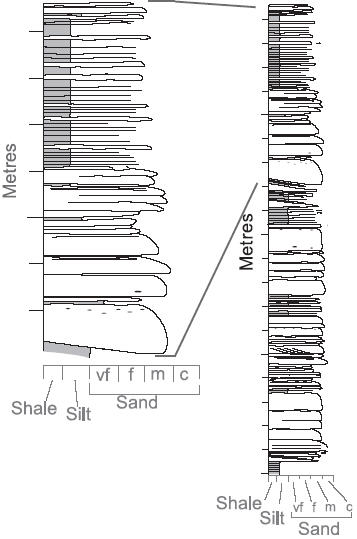
Example of measured section from Tres Pasos Formation, southern Chile (Part of Fig. 5; © 2009 International Assoc. of Sedimentologists; figure drawn by me)
One of the fundamental (and classic) methods for capturing information from a sedimentary succession is to simply measure a vertical section. Measured sections come in all types, styles, and scales – they should suit the objectives of the study.
In this case, we described the strata on sections capturing centimeter- to decimeter-scale features (depending on the rocks and your goal you may go for higher or lower resolution). The vertical axis is thickness and the horizontal axis is grain size (see example at left; click on for larger view). For these strata, grain size captures the general rock types.
Superimposed on this framework is additional information, such as bedding contacts, sedimentary structures (e.g., cross-bedding), occurrence of biogenic features, paleocurrent indicators, and so on. The result is a profile that nicely documents the vertical changes in the succession.
I measured a total of ~1,800 m of rock from numerous sections across the study area (>600 m thick by 2.5 km across). I did this over two separate field seasons (2005 and 2006) with the help of four hard-working colleagues.
If you’ve been reading this blog for a while, you already know where my research interests lie — turbidites. By using the term ‘turbidites’ (i.e., deposits of turbidity currents) I’m lumping together various types of sediment gravity flow deposits. If you know nothing about turbidity currents, picture a mixture of sand, silt, mud, and water flowing down a submarine slope (loosely similar to an avalanche). Check out some web resources about turbidity currents here. This entire 600 m-thick succession is dominated by various types of turbidites and other gravity flow deposits.
To capture the lateral relationships between the vertical sections, we walked out beds and mapped out the changes on photomosaics in the field. In some places we simply couldn’t get across safely (e.g., a steep cliff) so we used the photomosaics in concert with binoculars to observe and document the relationships.
To depict these relationships, I created diagrams for a couple of the sandstone-rich units that show the measured sections and how they correlate. The example below is just for Unit 2, which is about 40-50 m thick.
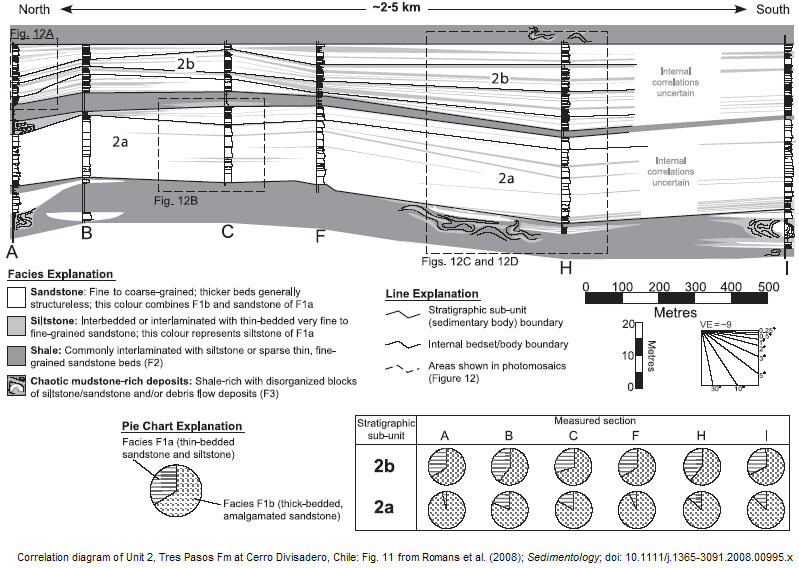
Correlation diagram of Unit 2, Tres Pasos Fm, Cerro Divisadero, southern Chile (© 2009 International Assoc. of Sedimentologists; figure drawn by me)
The studied transect (2.5 km across) is basically a 2-D slice through the stratigraphy. At smaller scales, the gully and ridge topography of the mountainside produces some three dimensionality (look at the very top photograph above). Appreciating 3-D complexity of stratigraphy from largely 2-D outcrops is always a challenge. But, on the other hand, while full 3-D imaging of the subsurface reveals larger-scale context, it cannot “see” the detail that outcrops provide.
I could go on about the data collection, methods, and process interpretation but I will spare you. Please see the paper for more details.
–
Stratigraphy of an Ancient Depositional Slope System
One of the biggest challenges in a science that describes and characterizes nature’s complexity is synthesizing all the information. Summarizing my interpretations of this 600 m-thick pile of sedimentary rock is accomplished in the text of the paper — and with a summary figure. Deciding how to depict all the relevant and significant information in one illustration is crucial (and not always easy).
The summary figure (below) shows a type measured section on the left with simplified sketch block diagrams of how I interpret the depositional environments at right. In the block diagrams the studied transect is depicted in the cut-out part of the diagram and honors the data/observations. The rest is interpretive.

Summary figure for Upper Cretaceous slope succession at Cerro Divisadero, southern Chile (© 2009 International Assoc. of Sedimentologists; figure drawn by me; click on it for a higher-resolution view)
The yellow and orange colors represent thick- and thin-bedded sandstone, respectively, and the grays are siltstone/shale. Note the four sandstone-rich units (cleverly named Units 1-4) that you can see in the overview photographs above.
The sandstone packages are exposed much better than the finer-grained intervals and were the focus of a lot of the detailed work. The overall pattern that emerges is a systematic increase in sediment bypass upwards through the four units. What I mean by ‘bypass’ is that there are features in the rocks that indicate turbidity currents passed by this area and deposited somewhere down system. Evidence for erosion is a key indicator.
If you look at the summary figure above, Unit 1 is dominated by relatively thinner-bedded and laterally continuous deposits, Unit 2 has some internal erosion but is still largely depositional, Unit 3 has a channel complex at its base (showing several meters of erosional relief), and Unit 4 has significant erosion combined with the coarsest grain size (very coarse sand with shell fragments) seen in this area. An analysis of the internal architecture of each of these units reveals a lot of interesting complexity, but when the entire succession is considered, the pattern I discuss above is robust.
So, that is the interpretation of the stratigraphic evolution — or, how the nature of the strata change upwards through a succession. What does that pattern mean? We’ve interpreted this pattern to reflect the building out of this large-scale depositional slope. As the system accreted basinward over time, the nature of the depositional slope at this one site changed. In this case, the increase in erosion/bypass reflects a steepening of the depositional slope over time (note how that’s depicted in summary figure above).
This is an interpretation and is consistent with what we know about this formation and the overlying formation in the region but is still just an interpretation. I’d be happy to entertain additional ideas on what this pattern represents, but I would ask that you first review the paper as there is a lot more data presented in there than what I’ve discussed in this blog post.
–
So What?
You might be sitting there and saying to yourself: “Gee, that’s interesting and all, but who cares … what are the broader implications?”
This is a fair question and something all researchers need to ask themselves constantly throughout the course of a research project. The answer falls under two general categories, one that is scientific and one that is applied.
As I laid out in the beginning of the post, the Magallanes retroarc foreland basin is unique in that it has such a thick (>4,000 m) deep-marine/turbidite fill^. The Tres Pasos Formation represents the upper part of that fill and is overlain by a deltaic formation. Other outcrops of delta-fed depositional slopes discussed in the literature (e.g., Eocene of Spitsbergen, Cretaceous of Wyoming, Permian of South Africa) are smaller systems that developed in basins on continental crust. The back-arc basin heritage of the Magallanes Basin permitted enhanced subsidence and a larger-relief system from delta to basin (at least 1,000 m water depth).
This is important because conceptual models of depositional slope systems are significantly influenced by outcrop characterization studies. Although the research I’ve summarized here is from one system, I would argue that it is an important system to consider because of its scale. Passive continental margins (e.g., Atlantic United States, west Africa) very rarely get uplifted and preserved in outcrops — and when they do they can be severely deformed (since they were involved in the closure of an oceanic basin). While the Magallanes Basin is certainly not analogous to a passive margin, the scale of the slope system is significant and may share characteristics with continental margins.
In terms of application, conceptual models of stratigraphic evolution are used in oil exploration and development. Sandstone packages similar to the ones on display at Cerro Divisadero are important reservoirs around the world. Outcrop studies like this are used as analogs for better understanding the complexity of these types of deposits.
Feel free to ask questions or comment below.
–
–
* An important caveat here is that I’m talking about siliciclastic slopes – depositional slopes in carbonate systems are a completely different story. Some carbonate platforms can have essentially vertical slopes.
^ Pro- or peripheral foreland basins typically have thick deep-marine sedimentary fills but can also be quite structurally deformed and thus difficult to reconstruct in detail over large areas.
ROMANS, B., HUBBARD, S., & GRAHAM, S. (2009). Stratigraphic evolution of an outcropping continental slope system, Tres Pasos Formation at Cerro Divisadero, Chile Sedimentology, 56 (3), 737-764 DOI: 10.1111/j.1365-3091.2008.00995.x
Sea-Floor Sunday #33: Uppermost Monterey submarine canyon
This week’s Sea-Floor Sunday highlights the very upper reaches of Monterey submarine canyon (central California coast). Monterey Canyon might be the world’s best-mapped submarine canyon. If you google it, you’ll find plenty of information about it.
This particular image is from a 2005 GSA Bulletin paper by Smith et al. (2005) from Cal State Monterey Bay called “Semiannual patterns of erosion and deposition in upper Monterey Canyon from serial multibeam bathymetry” [link].

Uppermost Monterey submarine canyon - Fig. 2 from Smith et al. (2005); GSA Bulletin; doi: 10.1130/B25510.1
What they did in this study was analyze a series of sea-floor images over time to investigate changes. It’s a cool paper, I recommend taking a look at it if you’re interested in this stuff.
The cool thing about this image is how high-resolution it is — this particular multibeam system achieved 3 m resolution. This is awesome!
In terms of sedimentation (deposition and erosion) all the action is taking place on the canyon floor. Note the arcuate sand wave-like features. There is another paper coming out soon about these features that I’ll post about in the future – very interesting stuff.
Douglas P. Smith, Genoveva Ruiz, Rikk Kvitek, Pat J. Iampietro (2005). Semiannual patterns of erosion and deposition in upper Monterey Canyon from serial multibeam bathymetry Geological Society of America Bulletin, 117 (9) DOI: 10.1130/B25510.1
~~~~~~~~~~~~~~~~~~~~~~~~~~~~~~~~~~~~~~~~~~~~~~~~~~
Some photographs of trees
Geotripper has a post discussing trees — and asking if others have a favorite tree. I’m not sure if I have one favorite tree, but this made me look through my field photograph collection (I love any excuse to do this) to find photos of trees.
My master’s work was in the Delaware Mts of west Texas (I’ve blogged about this area before here, here, here, here, and here). Although madrones are common in parts of California, they are very rare in the Delaware Mountains (more common in higher elevations of the region). This single madrone captured our awe and must’ve been a special place for native Americans as we came across some pottery shards and grinding pits in the rock (what are those called again?) nearby.
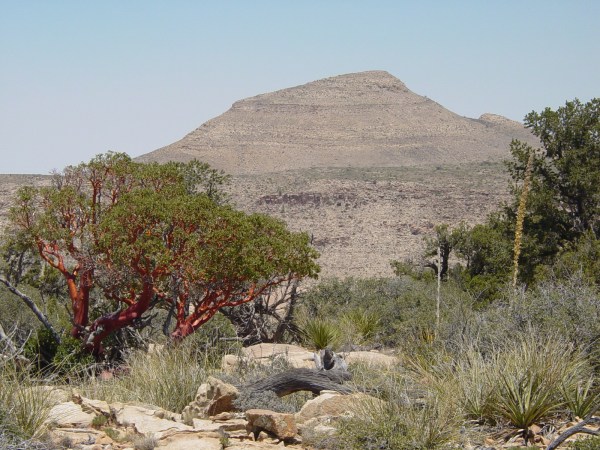

Madrone in Delaware Mountains, west Texas (© 2008 clasticdetritus.com)
The brilliant orange-red bark of the madrone stands out amongst the relatively drab sandstone cliffs and other green plants.
This next one (below) is not really an in situ tree but part of one that was buried in the beach sand. This is along the California coast just south of Eureka.
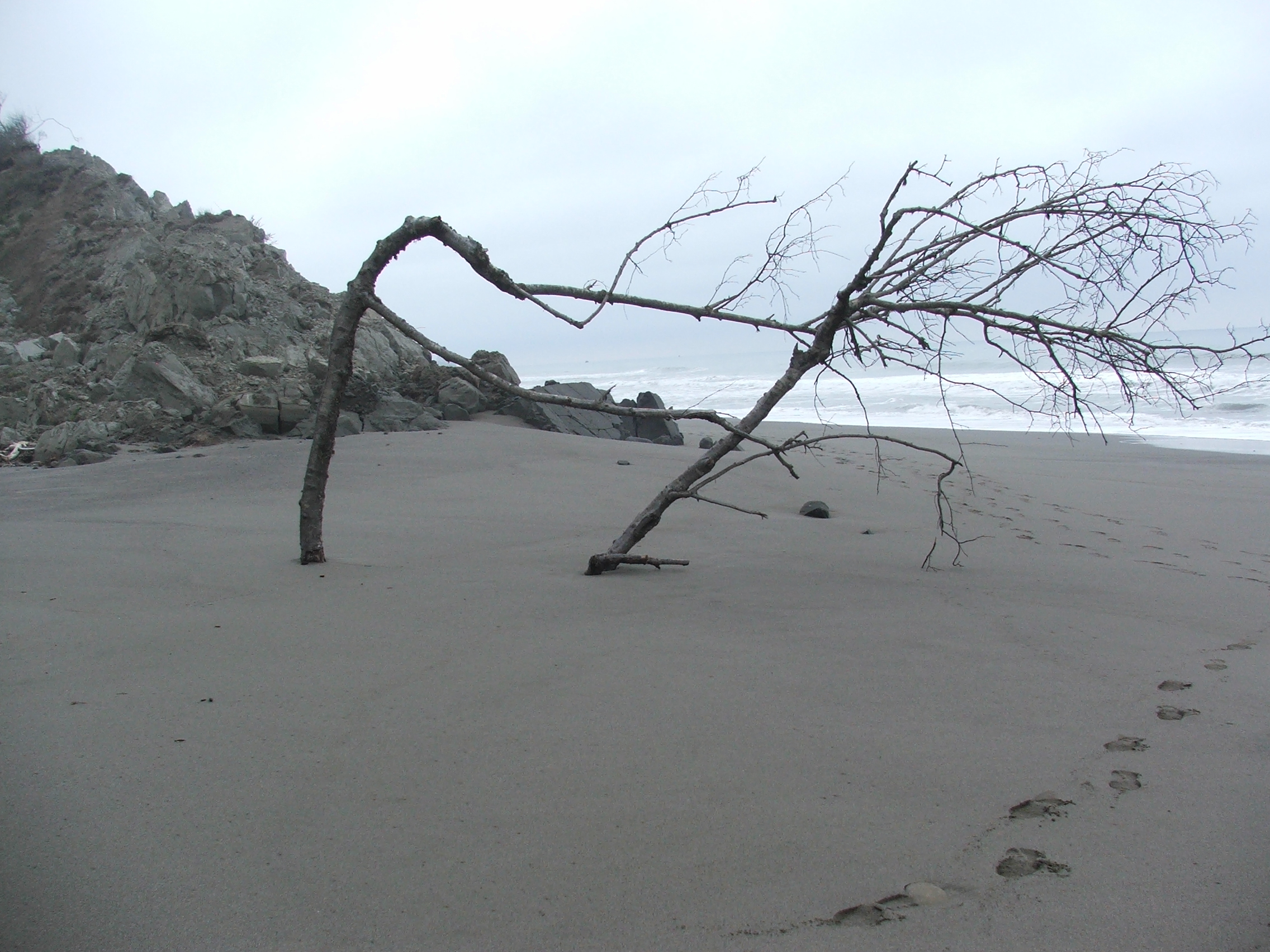
Buried tree near Eureka, California (© 2008 clasticdetritus.com)
The next one (below) shows some trees populating a sandy ridge we were hiking down in Patagonia a couple years ago.
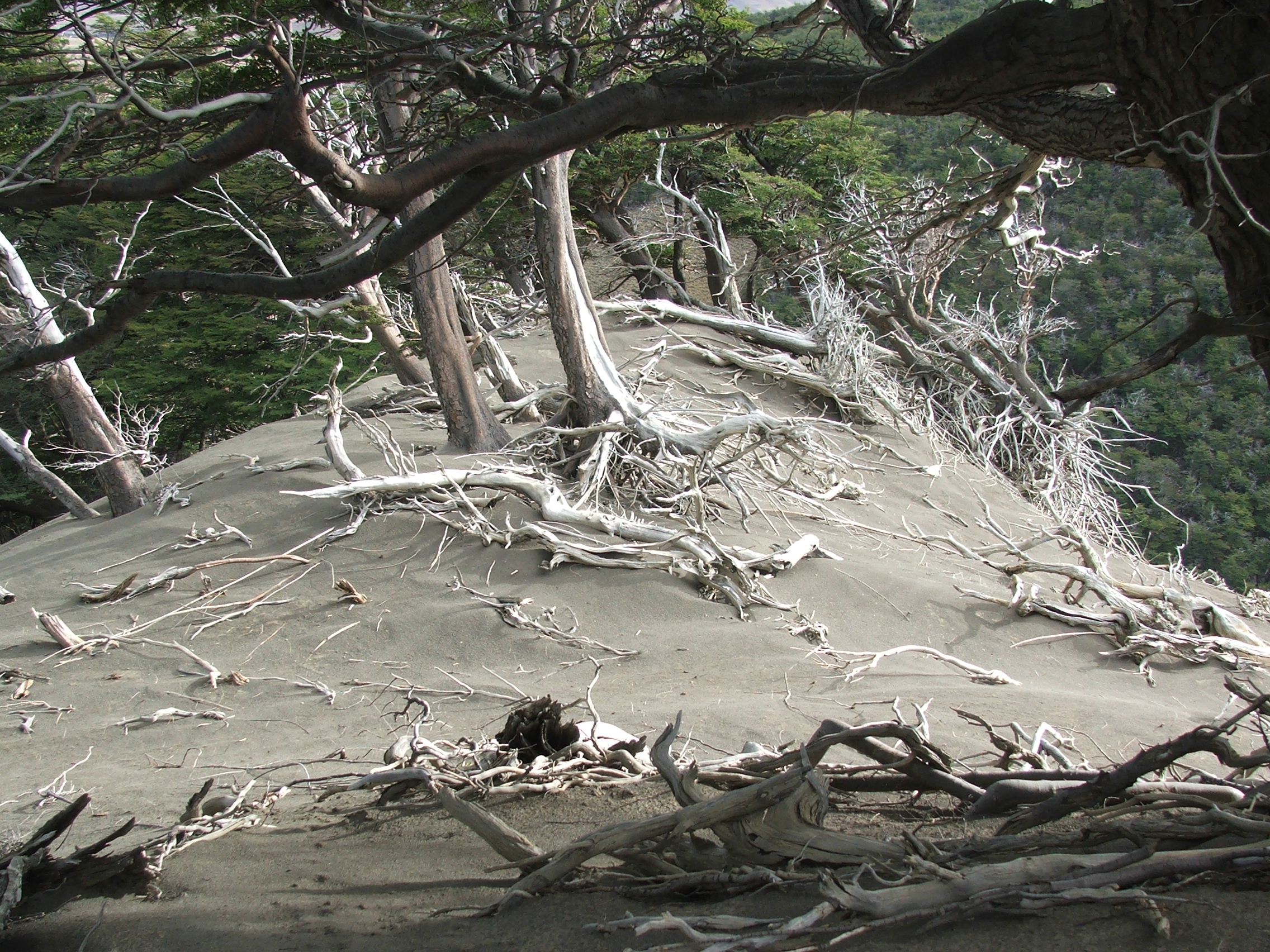
Trees along ridge, southern Chile (© 2008 clasticdetritus.com)
What this little exercise revealed is that I need to take more photographs of trees!
~~~~~~~~~~~~~~~~~~~~~~~~~~~~~~~~~~~~~~~~~~~~~~~~~~


 Clastic Detritus
