Friday Field Foto #96: A view of Aconcagua from the air
This week’s Friday Field Foto is one I snapped as the flight from North America I was on was starting it’s decent into Santiago, Chile. It was about an hour or so after sunrise and when I opened the window shade I saw this:
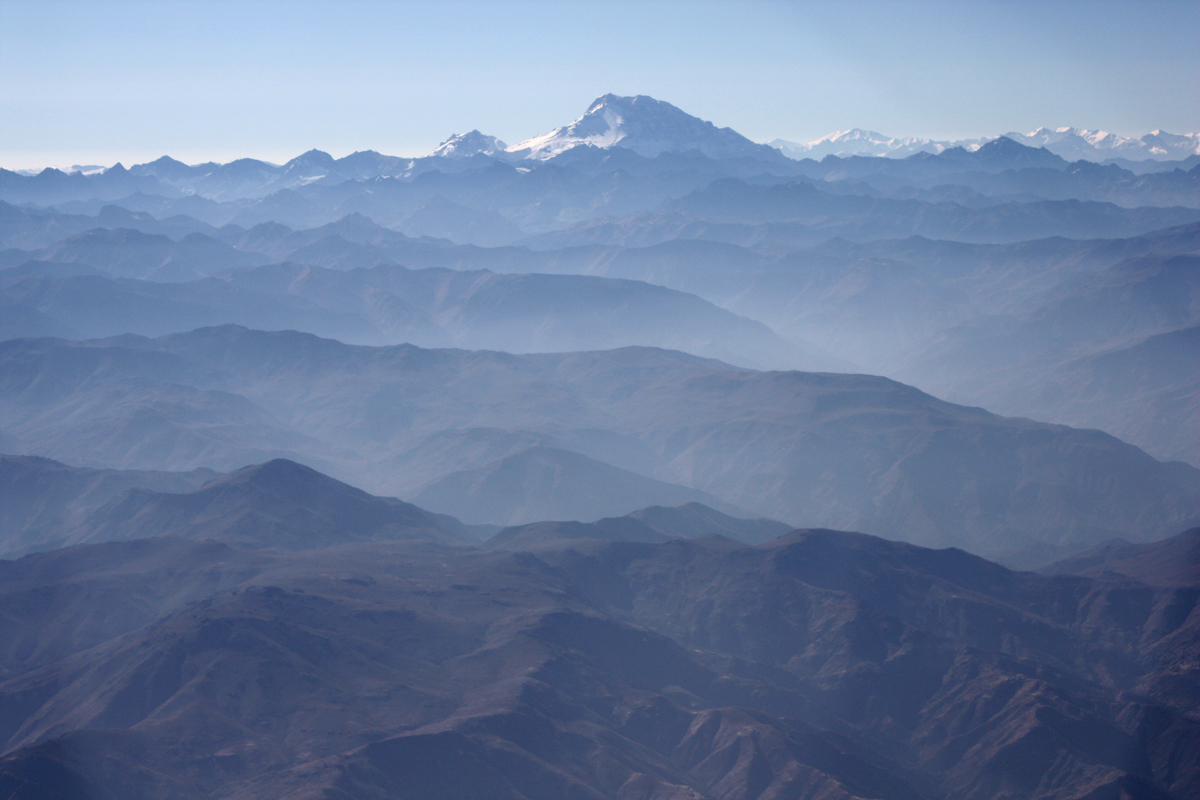
Cerro Aconcagua (© 2009 clasticdetritus.com)
Cerro Aconcongua (6,962 m/22,841 ft) is in the Andes Mountain range between Mendoza, Argentina and Santiago, Chile and is the highest peak in the western hemisphere. A very nice view to wake up to after a long flight.
Below I try to recreate the view in GoogleEarth … close enough.

credit: GoogleEarth
Happy Friday!
GSA in Portland: Wrap-up
I meant to blog about the 2009 GSA meeting in Portland each day but … well, I didn’t. This is mainly due to the fact that I spent each evening with friends I haven’t seen in a long time (or with friends I’ve never met in person) combined with a lack of internet access in my hotel room. And, even though, there was free and abundant internet access at the convention center I found it very difficult to find the time to sit down and collect my thoughts. The fact that conferences are so whirlwind and busy is why I like them — but, is not the best for blogging.
Anyway, with all those excuses aside, here is a summary of how I spent my time at the meeting:
Sunday, October 18th: Arrival
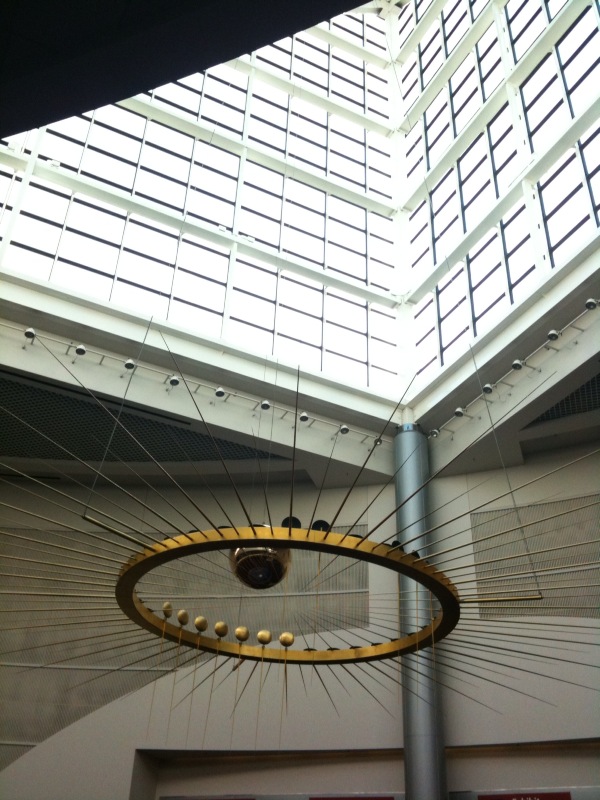 I arrived in Portland late afternoon on Sunday. A friend and colleague of mine with whom I traveled checked into our hotel and then made our way over to the convention center to pick up our badges and program guides. I haven’t been to a GSA meeting since 2004 and was unaware that Sunday was like any other conference day — full of technical sessions. I need to remember this for next time.
My friend and I then made our way downtown via the light rail system (which other Portland-sized cities should study for how to create a nice public transportation system). We were meeting our former adviser and a whole bunch of other current and former students of his for a big reunion dinner. There were about 15-20 people and we had a blast eating, drinking, sharing geologic stories, and generally being merry. Catching up with people I rarely see is one of the best parts of conferences.
–
Monday, October 19th: Ramping up during the day and meeting other bloggers at night
 Monday was the only day I actually did manage to get an afternoon blog post up (which is here). I’ve learned over the years that if I don’t pace myself regarding technical sessions at conferences I burn out fast. My talk was Tuesday afternoon so I spent Monday slowly ramping myself up such that my ‘peak’ of science focus would generally coincide with the delivery of my talk. In the past I’ve gone science crazy at first and by the time my talk/poster came around I was spent. But this is just me … many other people have seemingly limitless energy and focus at meetings.
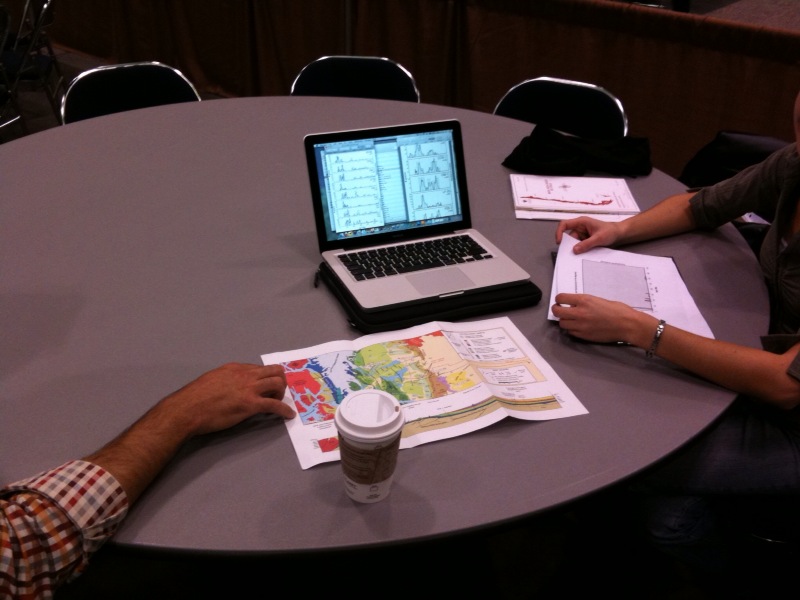
In the morning I spent a good hour or more with two colleagues about our recent and ongoing research in Patagonia. This was the topic of my talk and the topic of a related poster presented by a colleague. Sending messages back and forth via e-mail is great but nothing beats the ability to sit down at the same table and look over data together. We pulled out some hard-copy maps and figures and other information on my laptop and had a great time discussing the projects.
Later that afternoon I attended a few talks, browsed some posters, checked out the exhibit hall, and then took an hour to put the finishing touches on my own talk for the next day. The system for uploading your talk file was great (at least for me) — it was very easy to understand and worked without complication. In fact, GSA may have the smoothest and easiest system I’ve seen yet. I got my talk on there by 4pm and felt relieved to stop tinkering and just have it finalized. I’m one of these people that tweaks minor things forever such that as the talk nears I’m constantly about 5-10 minutes of work away from being done yet I still work on it. I know, it’s a problem I have — at least I’m not in denial — that’s the first step right?
Monday evening was eventful. I first attended an alumni reception for my PhD alma mater. Almost all my grad student peers are now done and have moved on to something else. Many are in academia, some in government entities like the USGS, and still others in industry. The dean for the school was not able to attend so, in her place, an emeritus faculty member who was once department chair dean long ago gave a hilarious speech chock full of inside jokes that had the crowd in stitches.
 Before that reception ended I snuck out and jumped on the light rail to make my way downtown for the geosocial networking meet-up at the Tugboat. Luckily, I ran into Kim and Silver Fox on the train and the three of us were able to combine our map-reading skills to successfully locate the bar. The photo to the left is difficult to see but paints a nice picture of what the bar was like. We had great discussions over candlelight and microbrews ranging from where we were from, where we went (or are going) to school, what kind of research or work each other is in to, and so on. A memorable highlight for me was Kyle showing off and explaining the Livescribe smartpen system — he got me sufficiently intrigued to look into it.
It is really cool to be able to associate faces and personalities with all these people whom I’ve grown to “know” over the internet now. I was telling some of my friends the next day that one of the coolest aspects of it is that the blogging/tweeting community is incredibily diverse. The other groups of people I spend time with at geoscience conferences are mostly based on research specialties and/or people I’ve gone to school with or worked with. The blogger group, however, cuts across that — it includes a wide age range, people of wildly different expertise, different jobs (students, profs, industry, etc.), and so on. Very cool.
Callan of NOVA Geoblog did a great job of organizing the event and even herding the big group for a nice photo, which he posted on his blog earlier today (he also has the full list of those who attended).
–
Tuesday, October 20th: My presentation
Tuesday turned out to be the best day of talks for me. I went to some of the talks in the general clastic sediments session in the morning. While there were a few gems in there (e.g., an interesting talk on the sediment budget of Nile River dispersal system) I tend not to like the general sessions that lack a theme. I understand that not all talks may fit a theme but these potpourri sessions never seem to be that well-attended. I’m not sure what the solution is.
I went to lunch with a colleague and a peer (who happened to review a recent paper of mine and is also doing tectonics research in Patagonia). We went far enough away from the conference and found a great little Thai restuarant and talked geology for over an hour.
My talk was in an afternoon session about sedimentary basins related to convergent tectonic margins. Originally there were two sessions, one dealing with forearc basins and another about general tectonic signatures as reflected in sedimentary successions — these ended up getting merged into this one session. I thought it was a great session. This is probably because I have great interest in the topic and know many of the speakers’ research pretty well, but I also thought the talks were generally well done.
I gave my talk right after the mid-afternoon break and it went okay. I always find it difficult to gauge my own “performance”. I received good feedback afterwards from people saying they got the main points and it all made sense to them so that’s good! The paper on which this talk was based is in press now — I’ll blog about it once it’s out (early 2010 probably).
–
Wednesday, October 21st: Posters in the morning and heading home
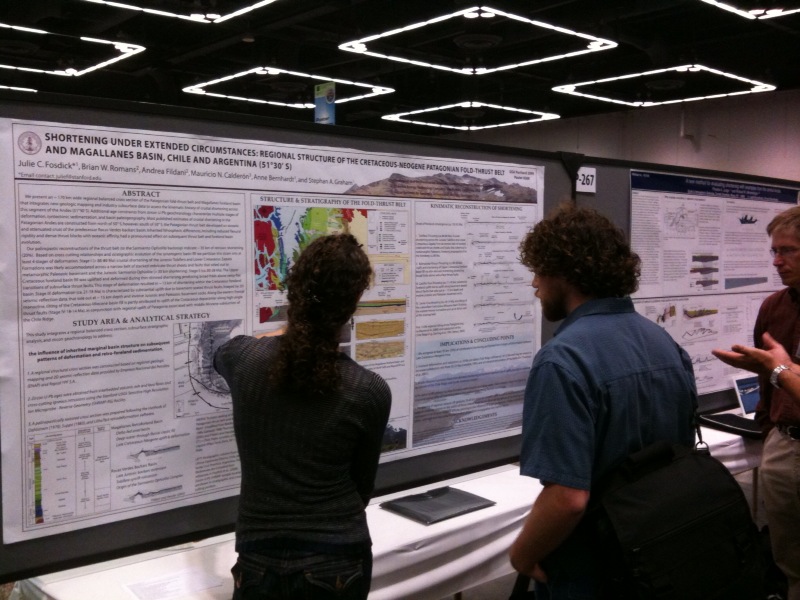 I spent most of Wednesday morning at a poster session that was the companion session for the one my talk was in. Although the active poster time each day was later in the afternoon there were a lot of folks around in the morning. The poster my colleague presented, which went into a lot more detail about the structural history of the foreland basin I talked about on Tuesday, had a nice little crowd around it for about an hour. Many of the same people who attended and presented in the oral session were around checking out the posters. I really like the combination of an oral session followed by a poster session — provides a chance for follow-up conversations.
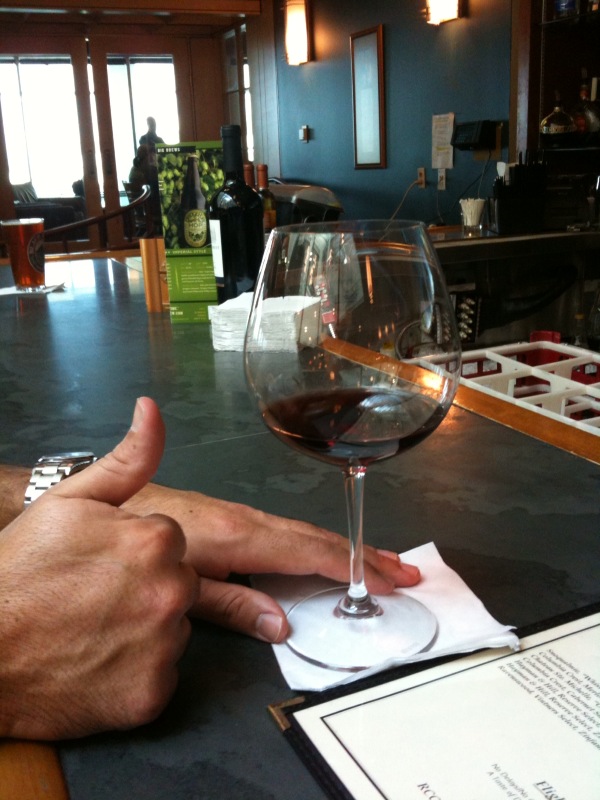 Unfortunately we had to head out around midday to get some lunch and then make our way to the airport. It’s always a bit sad leaving a conference.We got to the airport early enough to enjoy one more glass of some great Willamette Valley Pinot Noir.
It was a great conference. I had a fantastic time scientifically and socially. I am especially thrilled that the blogger/tweeter meet-up was so well attended. I’m looking forward to these events for years to come.
GSA in Portland: Monday
Today was my first day at the 2009 GSA conference in Portland. I arrived yesterday (Sunday) afternoon and didn’t do much at all in terms of technical sessions. My PhD adviser invited a bunch of his former and current students all out to dinner — ended up being about 20 of us. It was a lot of fun — a diverse group of people spanning a couple of decades.
This morning I woke up early-ish and worked on my talk (which is Tues at 3:30pm) for about an hour in my hotel room. I then headed over to the convention center and met with a couple of fellow Patagonian researcher colleagues for about an hour about the various projects going on. I love the big round tables GSA set up between the posters and exhibit hall — they are perfect for sitting around data and talking about it.
After that it was already lunch! A couple of friends and I headed downtown and found a nice Italian restaurant, got some pizzas, and chatted about our careers in science at this point. It’s always nice to learn about what other people are doing.
I then went to a few talks in the Linking Shallow to Deep Crustal Processes in Arc and Collisional Orogens afternoon session. I only stayed for a few talks and then spent time finishing up my talk and got it uploaded to their servers. I still have time to change it I suppose but it’s nice to have it there ready to go.
It’s now nearly 5:30pm and after I finish this free beer I scored I’m going to head back to my hotel to drop my stuff off and then go to an alumni event, which is conveniently in my hotel. Finally, later on I will head downtown to meet up with a bunch of other folks from the geosocialnetworkosphere (see Callan’s post here for the details).
So, that’s the rundown for me so far. More socializing than science at this point. But, hey, that’s what conferences are all about — interacting. Plus, over the years I’ve learned to better pace myself and not go too science-crazy on the first day — sitting in dark rooms thinking can be exhausting. I don’t wanna burn out before I even present my own stuff.
GSA conference in Portland
 As many of you know the 2009 Geological Society of America (GSA) conference is in Portland, Oregon from this Sunday (Oct 18) through Wednesday (Oct 21).
I will be heading up to give a talk about some work I did for my Ph.D. about the provenance and tectonics of the Cretaceous Magallanes foreland basin in Patagonia. I’ve posted before about the studies in Patagonia that focused on the sedimentology and stratigraphic architecture of a particular formation (see here), but the research I will talk about at GSA summarizes more regional and longer-term patterns related to how the basin evolved.
The title of the talk is:
Importance of predecessor basin history on provenance of the Magallanes retroarc foreland basin, Chile
This talk will be Tuesday afternoon at 3:30pm in the Tectonics and Basins of Convergent Margins session. The link to the full abstract is here and you can see the list of all presentations in this session here. This session also has a companion poster session on Wednesday. I’m a co-author on a poster that focuses on the structural styles and history of deformation in the Magallanes fold-thrust belt. This is going to be an awesome poster — the first author has done a fantastic job of unraveling the complex structural history of this area (read the full abstract here).
The last couple of weeks have been intensely busy for me so I haven’t had a chance to look at the rest of the technical program for the meeting — but I’m sure there will be tons of great stuff as always. I encourage readers to add information about their own talks/posters to the comment thread below.
In addition to all the great science, a whole host of blogging/tweeting Earth scientists (geosocial networking?) will be meeting up on Monday night. See Callan’s post here for all the details. GSA has been extremely good this year about embracing geosocial networking — they’ve set up a dynamic blogroll here and I remember hearing about a list of Twitterers too (I can’t seem to find that, please comment below if you know it), which is here.
See you in Portland!
–
UPDATE: GSA will be keeping track of blog posts about the conference on this site — bookmark it and check back over the next several days for posts from many different bloggers.
Sea-Floor Sunday #57: Ocean Observatories Initiative
This week’s Sea-Floor Sunday is from a press release from the National Science Foundation (NSF) and Consortium for Ocean Leadership (COL) earlier this month about the launch of the Ocean Observatories Initiative.
Ocean Observatories Initiative (OOI) will provide a network of undersea sensors for observing complex ocean processes such as climate variability, ocean circulation, and ocean acidification at several coastal, open-ocean and seafloor locations. Continuous data flow from hundreds of OOI sensors will be integrated by a sophisticated computing network, and will be openly available to scientists, policy makers, students and the public.
To illustrate this they put together this nice diagram of the bathymetry of the Cascadia continental margin, the Juan de Fuca plate, and associated spreading center and transform zones.
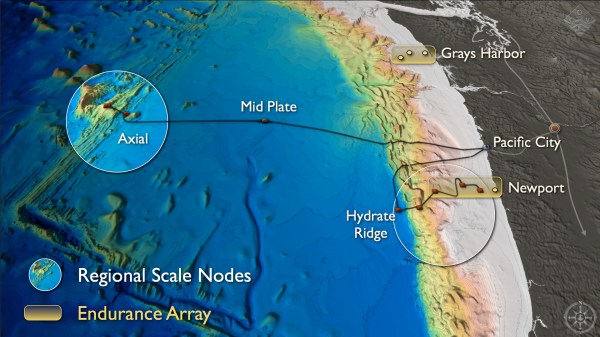
credit: NSF
Click on the image to go to the OOI site to learn more about what kind of sensors will be deployed and the overall program.
The Cascadia margin is one of my favorite continental margins — I’ve shown similar images before (here) and it was the focus of the third part of the subduction denialism series (here).
Friday Field Foto #95: Turbidites onlapping a basin margin
This week’s Friday Field Foto is from the French Alps and shows a very cool stratigraphic relationship that is commonly observed in regional-scale seismic-reflection data but not as commonly recognized in outcrops.
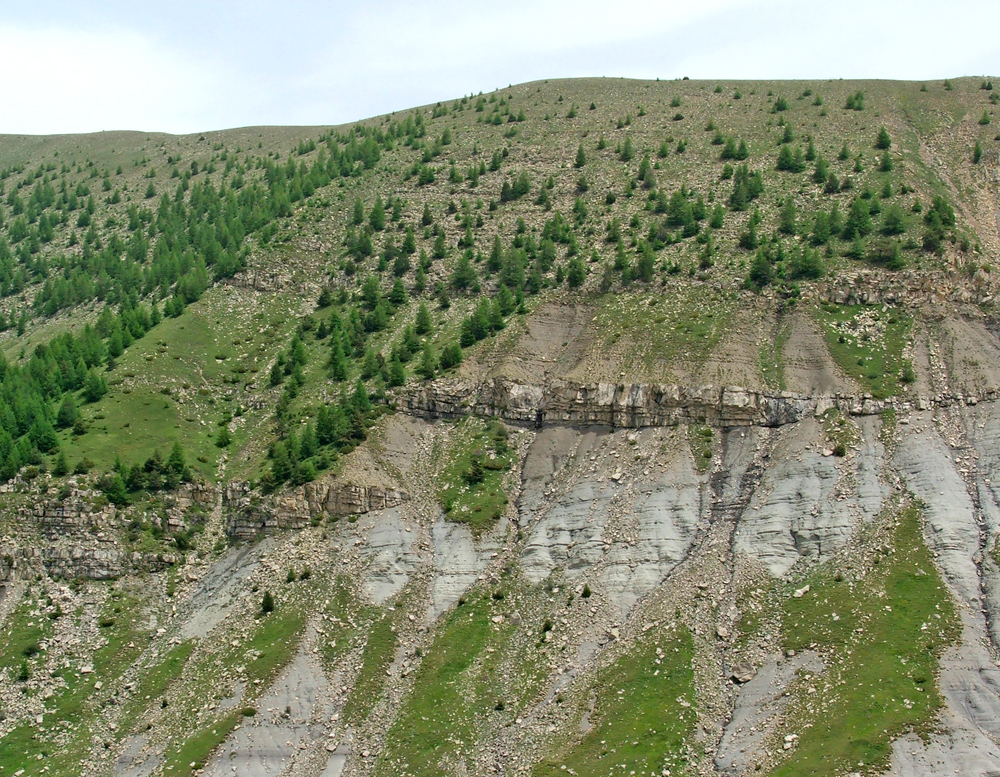
Strata onlapping a basin margin, Eocene of the French Alps (© 2009 clasticdetritus.com)
Note the two sandstone bodies in the photo above — they are the resistant cliff-forming rocks that are wedge-shaped and pinch out from left to right. The upper one appears to pinch out to the left but I am told by those who have climbed around on there that that is a function of it getting covered. The other thing to note is the fine-grained strata in the lower part has a slightly blueish to gray-blue color.
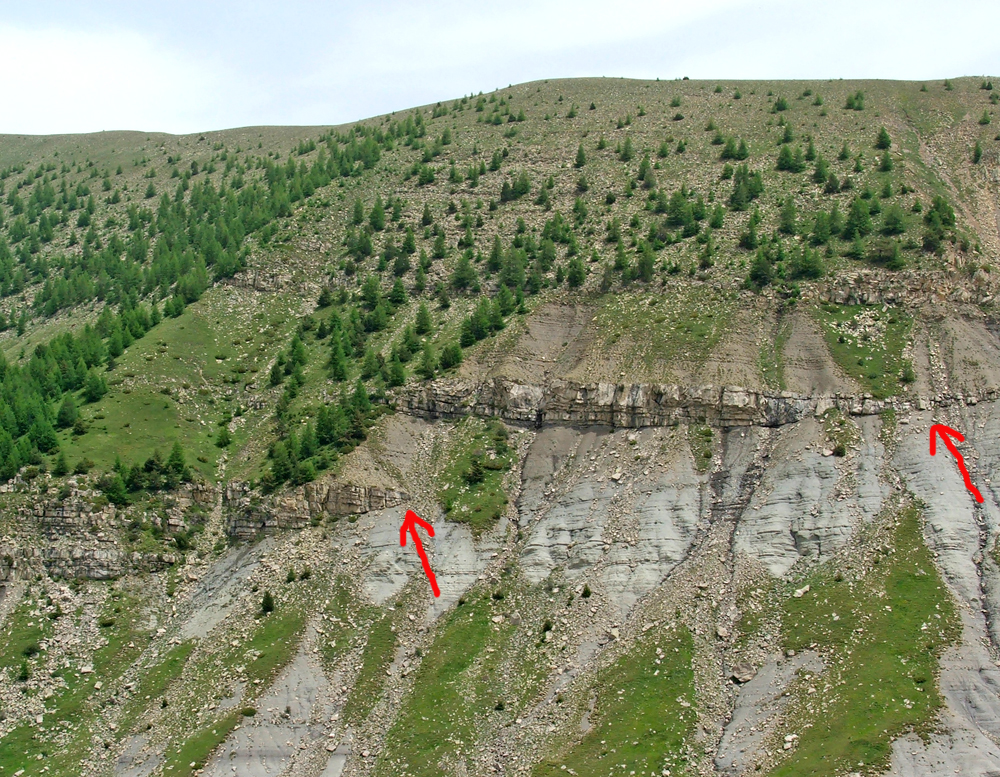
Strata onlapping basin margin; red arrows denote pinchout of sandstone bodies (© 2009 clasticdetritus.com)
This next photo (above) is the same photo with some quick (and sloppy) annotation pointing out where those sandstone bodies pinch out.
The interpretation here is that the older blue marl strata was uplifted and tilted and the subsequent turbidite deposits (both the sandstone bodies and the brownish fine-grained strata they are encased in) filled in that basin — and what you are seeing here is the margin of that basin.
Happy Friday!
USGS director nominee McNutt’s statement before Congress
Below is Marcia McNutt’s statement to the Congressional committee that is responsible for evaluating her as the nominee for USGS director — many thanks to Arizona Geology blog for obtaining and posting here.
–
Statement Of Marcia K. McNutt As nominee for the position of Director of the U.S. Geological Survey Before the Committee on Energy and Natural Resources Of the United States Senate, October 8, 2009
Chairman Bingaman, Senator Murkowski, distinguished members of the Energy and Natural Resources Committee, I am honored to come before you as President Obama’s nominee for Director of the US Geological Survey. I am excited about this opportunity to join Secretary Salazar’s team at the Department of the Interior, especially now, when the nation’s need for timely information on natural hazards, environmental and climate change, and water, energy, biological, and other natural resources has never been greater.
My inspiration for dedicating my life to the Earth sciences comes from having lived in some of the most beautiful landscapes that America has to offer: the 10,000 lakes of Minnesota, the Rocky Mountains of Colorado, the sandy beaches of La Jolla and Cape Cod, and now John Steinbeck’s Pastures of Heaven above Monterey Bay. I always knew I wanted to be a scientist, but even when I was young I could never picture myself in a lab coat with a test tube.
I majored in Physics at Colorado College, but my favorite college course was Introduction to Geology, taught by Professor John Lewis. Colorado College uses the block plan in which students only take one course at a time for a month. Introduction to Geology is two blocks long. So my first two months at college were spent with Doc Lewis and about 19 other students scrambling around the Front Range with our back packs and sleeping bags trying to piece together the geologic history of the Southern Rockies from first principles. We never cracked a book the entire time. I was drawn to the grandeur of the Earth sciences and awed by the time and space scales upon which Earth processes played out. No lab coat. No test tube. Science outside!
Once I arrived at graduate school at Scripps Institution of Oceanography, I switched fields from Physical Oceanography to Marine Geophysics because plate tectonics was revolutionizing the geosciences. With the vast majority of plate boundaries under the ocean, marine geophysicists would be the ones to put the pieces of the theory together. Entering the field at that time was like becoming a biologist right after Darwin wrote Origin of the Species or becoming a physicist right after Einstein wrote the Special Theory of Relativity. Old papers, textbooks, and theories were suddenly rendered irrelevant, such that there was no large body of prior knowledge to be absorbed. Observations had to be reinterpreted within the context of the new framework. Major marine expeditions were led, and often staffed entirely, by my fellow graduate students and myself, because many of the more senior practitioners in the field were too slow to embrace the new paradigm. It was a heady time filled with the excitement of scientific discovery. Science at sea!
I credit the US Geological Survey for giving me my first “real” job after receiving my PhD. I spent three wonderful years in the Office of Earthquake Studies in Menlo Park, California, calibrating the strength of plates on time scales relevant to the earthquake generation process. Working on the earthquake problem, in California, gave me my first taste of what it was like to be involved in research of interest to the general public, not just my fellow scientists. This was science people use! I also benefitted from this time at the GS in that I can still appreciate the culture of the organization from the viewpoint of someone who has spent time “down in the trenches,” and yet the intervening years away allow me to bring a fresh perspective to the organization.
The majority of my career has been spent at the Massachusetts Institute of Technology, where I served on the faculty in the Department of Earth, Atmospheric, and Planetary Sciences for 15 years, and was eventually awarded an endowed chair. I enjoyed being surrounded every day by some of the brightest young minds in the country, engaging them in forefront research problems, and watching them grow intellectually each day. My favorite part about MIT was serving as a freshman advisor and hearing the personal stories of the students each September. Many represented the first generation in their families to attend college. Whether they had come from the barrios of San Antonio or the plains of North Dakota, the one thing they shared was the fact that they had earned their place in the MIT freshman class by their own effort. And back home, an entire community was cheering them on.
My research took me and my students all over the planet: to the islands of French Polynesia, the Tibet Plateau, Iceland, Siberia, and Antarctica. At MIT I learned how to do what really counts, how to find, measure, and nurture excellence, and to become ridiculously efficient at multi-tasking. Equally importantly, I developed a complete intolerance for sloppy science and anything but the highest ethical standards.
My most recent posting for the last 12 years has been as the President and CEO of the Monterey Bay Aquarium Research Institute, better known as MBARI. MBARI is an oceanographic research institution founded by David Packard and privately funded by the David and Lucile Packard Foundation. With its emphasis on peer relationships between scientists and engineers and encouragement of high-risk research and technology development, MBARI is best described as a “NASA for the oceans,” albeit at a smaller budget scale. This latest position has given me ample experience in leadership, management, and administration, as well as considerable opportunity to familiarize myself with issues and opportunities in environmental chemistry and biology.
In looking back at my time at MBARI, I believe I have left a mark on several aspects of institute operations. First, teamwork. Across science, engineering, marine operations, outreach programs, and administrative areas, everyone functions as a well-oiled team. To a person, everyone understands that the reason we exist is to support the research mission and to make it progress smoothly and flawlessly. Second, our mission. I helped redirect MBARI from a broadly constituted portfolio in basic research to a more targeted set of socially relevant topics such as ocean acidification, eutrophication, methane hydrates, and harmful algal blooms, nearly a decade before they became common buzzwords. Finally, the staff. I am proud of the people I have hired, their work ethic, and their commitment to Packard’s founding vision of how a different kind of institution can truly make a difference.
You may all be wondering why I would consider leaving such a scientific paradise and relocating from my beloved Pastures of Heaven at this time. This nation is facing important decisions concerning future uses of its precious resources: water, energy, and environment. We are increasingly at economic risk from natural hazards. The challenges associated with climate change must be better understood. Submarine areas under US control out to the 200 mile limit are equal to the subaerial land area of this great nation, and yet the seabed resources have yet to be explored and inventoried. In deciding how best to move forward, our leaders, including members of Congress, the President, and the Secretary of the Interior, need sound, unbiased, scientific advice. Science is not the only factor in decision making, but it needs to be one of the factors. The USGS has long-term records and scientific expertise that can be used for making good choices based on solid data, and can look into the geologic record to determine whether recent conditions are likely to be representative of the future. Now, more than ever before, the nation needs the USGS, and I would be proud, if confirmed, to lead this effort.
So, in summary, these are the skills and qualities I would hope to bring to the leadership of the US Geological Survey, if confirmed:
– The capacity to be inspired by the natural world
– A love for science outside
– An appreciation for the culture of the US Geological Survey
– A history of association with some of the finest research institutions in the nation
– The ability to recognize and nurture excellence
– High ethical standards
– An aptitude for leadership
– Experience in team building
– A track record for asking the right scientific questions
Thank you for the opportunity to come before you, and I look forward to this challenge, should you confirm me for this position.
–
All in all, I’d say this is a strong opening. The USGS is going to become increasingly important as an independent evaluator of information pertaining to the United States’ resources, among other issues. A strong and robust USGS needs to be there to objectively study and report the science that will lead to important policy decisions.
Papers I’m Reading — October 2009
I haven’t posted one of these papers I’m reading posts in several months … I will attempt to revive the series with the following list for this month:
- Schumer, R., and Jerolmack, D.J., 2009, Real and apparent changes in sediment deposition rates through time: JGR Earth Surface, v. 114, F00A06, doi: 10.1029/2009JF001266. [link] — note: this topic is related to the ‘Sadler Effect’, which I’ve written about here
- Dickinson, W.R., and Gehrels, G.E., in press, Use of U-Pb ages of detrital zircons to infer maximum depositional ages of strata: A test against a Colorado Plateau Mesozoic database: Earth and Planetary Science Letters. [link]
- Martin, J., Sheets, B., Paola, C., and Hoyal, D., 2009, Influence of steady base-level rise on channel mobility, shoreline migration, and scaling properties of a cohesive experimental delta: JGR Earth Surface, v. 114, F03017, doi: 10.1029/2008JF001142 [link]
- Kender, S., Peck, V.L., Jones, R.W., and Kaminski, M.A., 2009, Middle Miocene oxygen minimum zone expansion offshore west Africa: Evidence for global cooling precursor events: Geology, v. 37, p. 699-702. [link]
- Ryan, M.C., Helland-Hansen, W., Johannessen, E.P., and Steel, R.J., 2009, Erosional vs. accretionary shelf margins: the influence of margin type on deepwater sedimentation: an example from the Porcupine Basin, offshore western Ireland: Basin Research, v. 21, p. 676-703. doi: 10.1111/j.1365-2117.2009.00424.x. [link]
- Allen, P.A., 2008, Time scales of tectonic landscapes and their sediment routing systems: Gallagher et al. (eds) Landscape Evolution: Denudation, Climate, and Tectonics Over Different Time and Space Scales, Geological Society London Spec. Pub. 296, p. 7-28, doi: 10.1144/SP296.2. [link]
–
Note: the links above may take you to a subscription-only page; as a policy I do not e-mail PDF copies of papers to people (sorry).
Sea-Floor Sunday #56: Samoa region in the South Pacific
This week’s Sea-Floor Sunday image is of the Samoa region in the South Pacific. Earlier this week (Sept 29, 2009) an 8.0 earthquake struck a couple hundred km south of the volcanic island chain.
See Chris Rowan’s post explaining this earthquake (and the nearly coincident, but unrelated, quake offshore Indonesia) here. Chris already showed some nice GoogleEarth images, so this one was made with the GeoMapApp tool.

map of Samoa region (made in GeoMapApp) showing epicenter of Sept 29, 2009 8.0 earthquake
Note the bathymetry color scale in upper left corner. The Samoan volcanic chain is related to large-scale lithospheric fractures in the Pacific Plate likely caused by interaction with the Tonga subduction zone.
Also check out this animation from NOAA showing the propagation of the tsunami triggered by this earthquake across the Pacific Ocean basin.
Finally, here’s a list of the coverage of the 2009 Samoan quake in the geoblogosphere:
- About.com — 8.0 Earthquake in Samoa
- Geotripper — Magnitude 8.0 Earthquake in Samoa
- NOVA Geoblog — Awesome: Samoa subduction cross-section
- Adventures in the World of Geology — Samoa Earthquake
- Highly Allochthonous — Two large earthquakes, two unusual focal mechanisms (linked to above)
- Chris Rowan of Highly Allochthonous also participated in an internet radio program on BBC — you can get the link to the audio here
Dear readers … sorry that the posting has gotten so infrequent lately … but I’ve got a couple of things in the pipeline that I hope to finish up very soon. One is a couple of posts about some of my own research (this has taken a lot longer than planned to prepare). Another is a similar ‘event’ to my participation in the Stories in Stone virtual book tour, but with a different geology-related popular science book that came out in 2009 … stay tuned!
–
This week’s Friday Field Foto doesn’t highlight any specific sedimentary structure or relationship … I just think it’s pretty :)

Pine Spring Canyon, Guadalupe Mountains, west Texas (© 2009 clasticdetritus.com)
This is from the main campground in Pine Spring Canyon in Guadalupe Mountains National Park (west Texas and New Mexico). These rocks are part of the fabulous shelf and slope carbonate sequences of the Permian Delaware Basin.
See this post for the same strata in a nearby location that better shows the original depositional topography (preserved after ~250 million years!). Want more photos of these rocks? — Check out this, this, and this.
Happy Friday!


 Clastic Detritus