Friday Field Foto #104: Waimea Canyon, Hawai’i
I recently took a trip (a significantly delayed honeymoon, actually) to Hawai’i, which was the first time for me — wow, what an incredible place. I snapped tons of photos of the beautiful landscapes and geologic features, which you all will be seeing in future installments of the Friday Field Foto series no doubt.
Waimea Canyon is on the island of Kaua’i and is sometimes referred to as the ‘Grand Canyon of Hawai’i’. Kaua’i is one of the oldest islands (old around these parts is 5 million years) and, as a result, the shield volcano complex is now dissected by rivers and streams.

Waimea Canyon -- island of Kauai'i (© 2010 clastic detritus)
I just love the combination of red and green colors from the weathering basalt and patches of lush rainforest — absolutely spectacular.
–
Happy Friday!
Papers I’m Reading — February 2010
I’m still in post-vacation catch-up mode so blogging is pretty light right now. I hope to get back to it relatively soon.
In the meantime, here is this month’s installment in the papers I’m reading series:
- Barnard, P.L. and Warrick, J.A., in press, Dramatic beach and nearshore morphological changes due to extreme flooding at a wave-dominated river mouth: Marine Geology, doi: 10.1016/j.margeo.2010.01.018. [link]
- Liu, J.T., et al., in press, Quantifying tidal signatures of the benthic nepheloid layer in Gaoping submarine canyon in southern Taiwan: Marine Geology, doi: 10.1016.j.margeo.2010.01.016. [link]
- Bache, F., et al., in press, Evolution of rifted continental margins: The case of the Gulf of Lions (Western Mediterranean Basin): EPSL, doi: 10.1016/j.epsl.2010.02.001. [link]
- Twichell, D.C., et al., in press, Partitioning of sediment on the shelf offshore of the Columbia River littoral cell: Marine Geology, doi: 10.1016/j.margeo.2010.02.001. [link]
The following two publications are part of a recent Discussion and Reply — if turbidites are your thing, these are a must-read:
- Shanmugam, G., 2010, Discussion: “Turbidites and turbidity currents from Alpine flysch to the exploration of continental margin” by Mutti et al., (2009), Sedimentology, 56, 267-318: Sedimentology, doi: 10.1111/j.1365-3091.2009.01132.x. [link]
- Mutti, E., et al., 2010, Reply to Discussion by G. Shanmugam on “Turbidites and turbidity currents from Alpine flysch to the exploration of continental margin” by Mutti et al., (2009), Sedimentology, 56, 267-318: Sedimentology, doi: 10.1111/j.1365-3091.2009.01131.x [link]
–
Note: the links above may take you to a subscription-only page; as a policy I do not e-mail PDF copies of papers to people (sorry).
Sea-Floor Sunday #60: Hawaiian Archipelago
This installment of Sea-Floor Sunday highlights a place I’ve never been. But, that’s about to change — my wife and I are headed to Hawai’i next week for an actual vacation. I can’t even remember when I’ve had one of those! The images below are from this beautiful bathymetric map from the U.S. Geological Survey, which can be found here (or by clicking on images below).
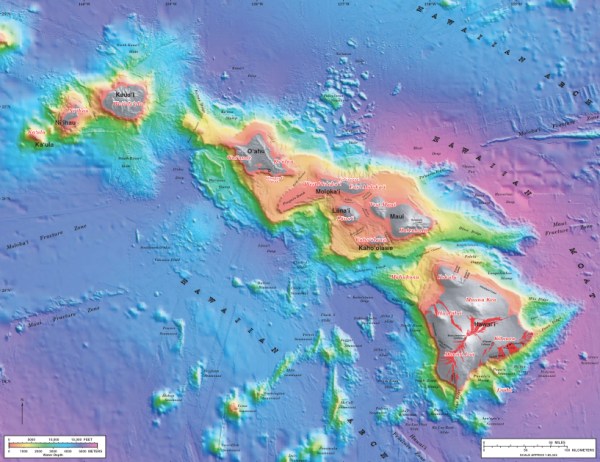
image credit: http://geopubs.wr.usgs.gov/i-map/i2809/
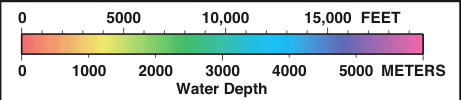
This is some serious relief — nearly 10,000 m (32,000 ft) from the highest peak on the Big Island to the deep sea floor off to the southeast. As a result of that relief, immense submarine landslide/slump deposits make up much of the flanks of these islands.
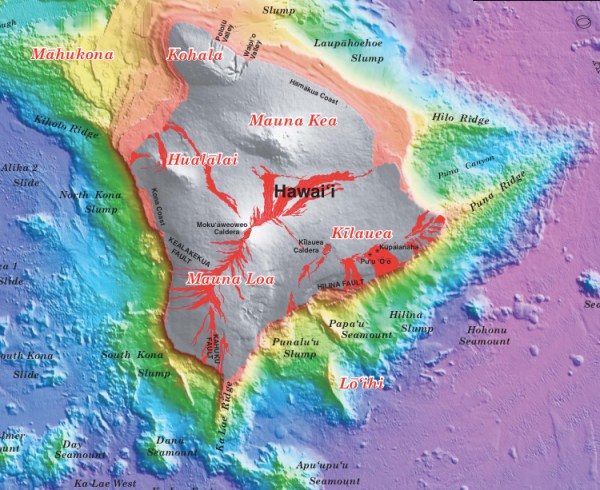
image credit: http://geopubs.wr.usgs.gov/i-map/i2809/
For the first part of our trip we are going to spend a few days on the Big Island touring Hawai’i Volcanoes National Park.
For the remainder of the vacation we will be relaxing on Kaua’i, which is one of the oldest volcanic peaks currently emergent (note that “old” here is ~5 million years). I’m pretty excited to do some hiking up in beautiful Waimea Canyon.
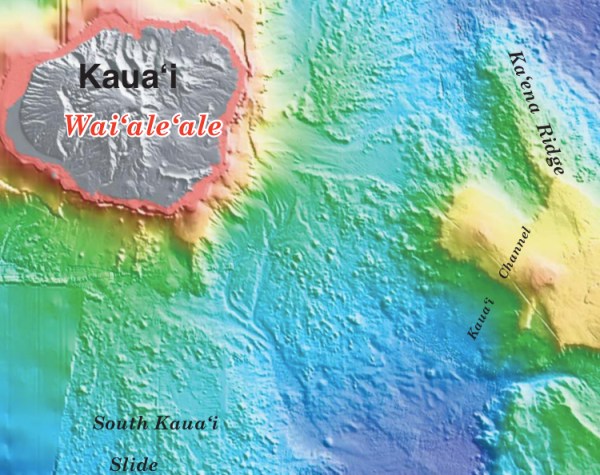
image credit: http://geopubs.wr.usgs.gov/i-map/i2809/
We already have the Roadside Geology of Hawaii book, but if anybody has any other tips for geo-attractions on the Big Island and/or Kaua’i feel free to leave in comments.
This week’s Friday Field Foto is a trace fossil called Diplocraterion from some Upper Cretaceous strata in Utah. Unfortunately, this photo is from my collection from several years ago (ca. 2002) when I wasn’t as diligent as I am now regarding keeping track of exactly where, both geographically and geologically, my photos are.
Diplocraterion is a vertical, U-shaped burrow with markings between the the main ‘limbs’ of the U. It is within the Skolithos ichnofacies, which are a group of trace fossil types that are generally vertical and found within sandy sediment and relatively high energy environments. It is thought to be a dwelling and feeding trace.

Diplocraterion trace fossil, Cretaceous strata of Utah (© 2010 clastic detritus)
To learn more about some common trace fossils, check out this set of slides I found (note: link will open a Powerpoint file).
–
Happy Friday!
Geopuzzle: What is this rock?
I received an e-mail from a reader asking my opinion about a rock they found and, as in previous occasions (e.g., here and here), I figured it would make a good Geopuzzle. I also recommend checking out Andrew Alden’s resources for identifying rocks over at About.com.
This one was found near Brandenburg, Kentucky. To be perfectly honest, this one is pretty difficult … I’d like to take a hammer to it to see if most of what’s highlighted in these photos is just surficial.
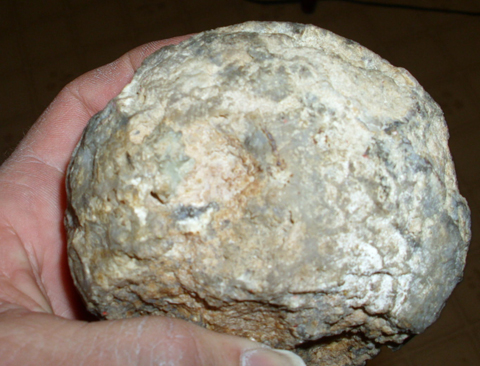

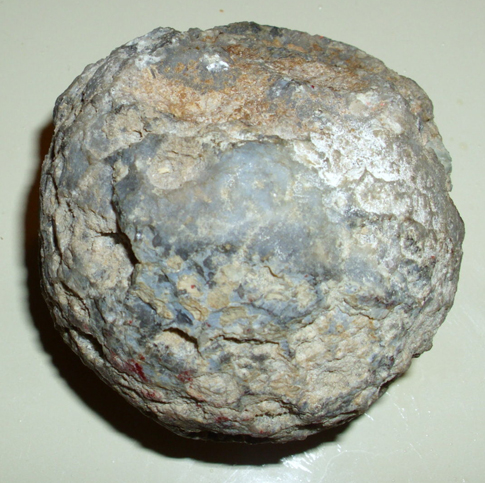
What do you think? Share your guesses in the comments below.
As Lee Allison over at Arizona Geology blog pointed out earlier today, here is the American Geological Institute’s (AGI) summary of geoscience-related aspects in the federal budget request for fiscal year 2011. I’m going to repost it here just in case people don’t see it at Lee’s blog:
President Obama released the Administration’s budget request for fiscal year 2011 (FY11) on February 1, 2010. Of the $3.8 trillion requested for the U.S. government, here are some highlights of what is being requested for geosciences. The American Geological Institute’s Government Affairs Program will be preparing more detailed summaries and tables of requested geoscience funding in the near future through special email updates and our appropriation web pages.
The National Science Foundation (NSF) is requested to receive $7.4 billion, an increase of 8 percent (+$550 million) over FY10. Much of the increase would be for research with some emphasis on energy and sustainability. A smaller 2 percent increase is requested for NSF’s education and training programs. A major new NSF-wide initiative is called Science, Engineering and Education for Sustainability (SEES) which is budgeted at $766 million. The funds will be pulled from across the different directorates and the Geosciences will contribute $231 million for the initiative.
The Geosciences Directorate would receive an increase of 7.4 percent (+$65.6 million) for a total budget of $955.3 million. Atmospheric and Geospace Sciences would receive $281 million (+8.1 percent), Ocean Sciences would receive $378 million (+8.3 percent) and Earth Sciences would receive $199 million (+8.7 percent). EarthScope would receive $26 million (+3.8 percent) and the Ocean Observatories Initiative would receive $27.5 million (+66.7 percent).
The U.S. Geological Survey is requested to receive $1.1 billion, an increase of $21.6 million over FY10. Major increases would include +$3 million for the New Energy Frontier Initiative, +$11 million for the Climate Change Adaptation Initiative, +9 million for the WaterSMART Program, +$3.6 million for work in Chesapeake Bay as part of the Treasured Landscape Initiative, +$13.4 million for the Landsat Data Continuity Mission, +$4.7 million for hazards, +$13.9 million for the Global Change Program and +$4 million for marine spatial planning through a partnership with the Minerals Management Service.
The National Aeronautics and Space Administration (NASA) is requested to receive $19 billion, a increase of 4 percent (+$700 million) over FY10. The Constellation program, to build the Orion spacecraft and Ares rocket, and manned lunar missions would be eliminated. The termination of Constellation leaves the U.S. with a likely multi-year gap in human spaceflight capabilities. The three space shuttles will be retired at the end of this year and the U.S. will depend on Russian spaceflights to support the International Space Station. NASA would like to transition to commercially operated spaceflights.
NASA’s Science Directorate would receive $5 billion, an increase of 8 percent ($540 million). Earth Science would receive $1,420.7 million (+$44 million). NASA would also focus on building Earth-observing satellites. About $170 million would be for replacing the failed Orbiting Carbon Observatory (OCO). About $150 million would be used to accelerate the development of new satellites for Earth Science priorities.
The Department of Energy is requested to receive $28.4 billion, an increase of 1.4 percent (+$406 million) compared to FY10. The Office of Science would receive $5.1 billion for an increase of $218 million. The Advanced Research Projects in Energy (ARPA-E) would receive $300 million, an additional $40 million would go to existing Energy Frontier Research Centers, an additional $107 million would go to Energy Innovation Hubs and RE-ENERGYSE would get $74 million. The Office of Energy Efficiency and Renewable Energy would receive $2.4 billion (+$113 million), Fossil Energy Programs would receive $586 million (-$86 million) and Nuclear Energy would receive $824 million (+$37 million).
The National Institute of Standards and Technology is requested to receive $919 million, an increase of 7.3 percent over FY10. Scientific and Technical Research and Services would receive $585 million (+$54 million).
The U.S. Department of Agriculture is requested to receive a huge increase of $164 million for competitively awarded research programs for a total research budget of $429 million for FY11.
See this page on USGS.gov if you want to see more details related to their programs. There has also been a lot of discussion in the blogosphere related to the NASA part of this, including, but not limited to: Bad Astronomy, The Martian Chronicles, and Highly Allochthonous.
Anthropogenic avulsion in the Huang He (Yellow River) delta
The term ‘avulsion’ describes the process of natural channels abruptly changing course. This process is typical in sedimentary systems in which the dispersal pattern is distributive, or spreading out — as in deltas, alluvial fans, and submarine fans. To put it another way, avulsion is one of the processes that is responsible for creating these morphologies — channels switch back and forth over time distributing the sediment into a ‘fan’ shape. There is, of course, a lot more going on (e.g., bifurcation of channels), but I’m just going to keep it simple for this post.
What causes avulsion? This is a fundamental question — I have many colleagues and peers conducting research that address this question. In a simplified sense, if the downstream segment of a channel begins to back-fill with sediment (and, thus, reduce gradient along the reach), the upstream segment will respond by ‘seeking’ a new course to a lower site. Now, exactly where along the channel that happens, and when it occurs is what researchers would like to figure out. Another idea is that during a particularly large flood, or particularly large turbidity current, the flow simply breaches its natural levee, thus, creating a new course.
The example of avulsion I’m showing in this post, however, is the product of human engineering. The two images below are from a recent post on Earth Observatory that shows a series of images of the Huang He (Yellow River) delta in China. I’m really loving NASA’s Earth Observatory site lately — it seems to be getting better and better.
Here’s an excerpt from the explanation of the series of images that show recent change in the delta morphology:
Between 1989 and 1995, the delta became longer and narrower along a southeast-bending arc. In 1996, however, Chinese engineers blocked the main channel and forced the river to veer northeast. By 1999, erosion and settling along the old channel caused the tip of the delta to retreat, while a new peninsula had formed to the north.
The two images below are from 1995 and 1999, respectively, and show this anthropogenic avulsion nicely.
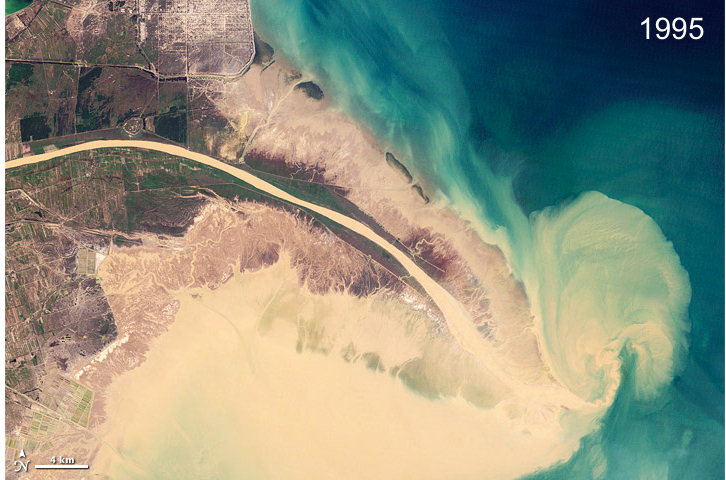
Delta of the Yellow River in 1995 (credit: NASA Earth Observatory)
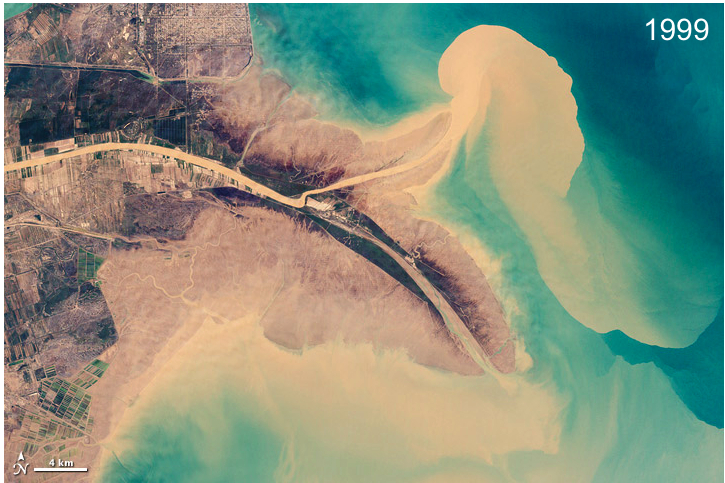
Delta of the Yellow River in 1999 (credit: NASA Earth Observatory)
Compare those two images and note the changes in the abandoned part of the delta after the avulsion. As the excerpt above mentions, the coastline of the abandoned part of the delta is receding. The supply of sediment, which is what constructs and builds the delta seaward, has been cut off. A combination of natural subsidence — a slow sinking as the underlying sediment compacts — with rising sea level is now eating away at that part of the delta. Also notice how the new channel is contributing to net-construction of the delta to the north.
About a year ago I posted similar images of the Huange He, also from Earth Observatory, that showed changes in the delta over a bit longer time scale and, more importantly, comparing before major human influence to after.
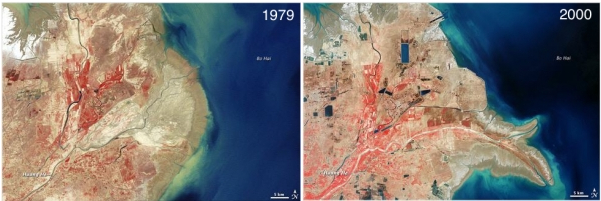
Note how significant the delta morphology is in the 1979 image — showing a much more rounded delta front, whereas the more recent morphology protrudes into Bohai Bay creating what delta researchers call a “bird’s foot” morphology. While the Chinese have been constructing levees along this river for a very long time I wonder if natural avulsions were able to occur at the lowermost reaches — the river mouth — until more recently. [note: this paragraph edited from original version; see comments]
Management of delta regions is an increasingly important area of research, especially as we deal with rising sea levels. The example of the anthropogenic avulsion shown here will certainly be something to watch. A significant proportion of the Earth’s population lives on delta and coastal plain environments, so we will undoubtedly continue to geo-engineer these sedimentary environments. The more effort we put into researching their dynamics and processes, the better our strategies will be for doing smart engineering that takes advantage of the natural processes that shape and maintain the health of a delta.
–
The other reason I love these images is because of the beautiful sediment plumes — I’m a sucker for sediment plume images (e.g., here, here, and here).
Geologic Art Exhibit: Geo Sapiens
Last week I received an e-mail about a recent exhibit showcasing art inspired by Earth science. It was at the Two Wall Gallery in Washington state in November 2009 and called “Geo Sapiens”. You can read all about the event on this website and view the art as well as photos from the opening. Here are just a few of the many in the online gallery that popped out to me (descriptions beneath image from their website).

Road Cutting at Charlwood by John Jackson (© John Jackson)
Road Cutting at Charlwood by John Jackson — A petroleum industry professional with over 39 years experience in most all aspects of the industry worldwide, John is also a well-known geological artist who uses his artistic skills to promote earth science education and geotourism. A prolific painter since 1995, John’s original concept was to use his paintings to educate people on specific topics. Since then, his concept has evolved and expanded to the point that his works have been used to educate private and public groups around the world, including such groups as tourists in southeast Queensland, seminar attendees in Africa, and a collection of diverse tribal interests in Uganda. Also known as “The Rock Doctor”, John is first a geologist and second an educator who uses his art to convey his message.
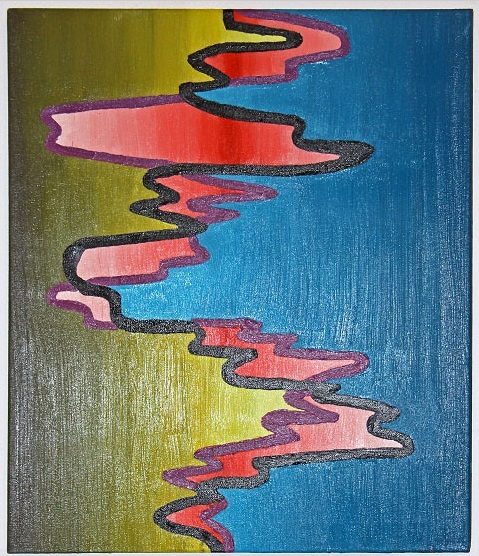
Net Pay No. 1 by C. Mark Wallis (© Mark Wallis)
Net Pay No. 1 by C. Mark Wallis — Originally from the heart of Arizona and educated as a geologist, Mark now resides in New Zealand. It is here that he is inspired by the natural beauty and native culture to create vivid images that speak out to each observer. Using his experience as a geoscientist, Mark is able to blend natural geologic features into his art.
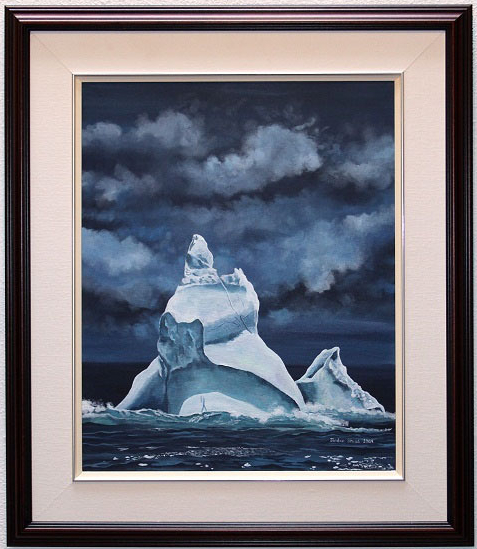
Anxious Times by Jordan Stead (© Jordan Stead)
Anxious Times by Jordan Stead — Jordan is a native of St. John’s, where she is a geophysicist with the Canada-Newfoundland and Labrador Petroleum Board. Jordan began painting five years ago under the guidance of Canadian artist Ed Roche, and has participated in several local exhibitions hosted by his art school. Her artistic talent was recognized by the Ed Roche School of Art in 2005 when she received the Best New Artist Award, and again in 2008 with the Best in Show Award.
The curator mentioned in his e-mail that they are working on another exhibit like this — and he’s looking for others to participate and/or contribute their time to making it happen:
We plan to host another exhibit of work done by geoscientists, Geo sapiens II, later this year. In addition, we hope to coordinate similar shows at other sites across the country and possibly overseas at about the same time, and so we invite you to help with that effort and assist with the advertising and organization of geo-art shows in your neighborhood. If you are interested in participating and helping with an exhibit in your neighborhood, let me know and we’ll share ideas. I can say from personal experience that it’s a LOT of fun and not nearly as much work as it seems. And you get to meet a mess of people in your profession and have a few beers with them! What could be better than that?
If you are interested in getting in touch with them, they have a ‘contact us’ page on their website here.
–
note: Rebecca over at Dinochick Blogs must have received the same e-mail I did about this exhibit.
Friday Field Foto #102: Cross-bedded pebbly sandstone in Patagonia
This week’s Friday Field Foto is from the Magallanes Basin in Patagonia — an area from which I’ve shown lots of photos. However, this is not from the turbidite strata that I focused my work on; rather it is from the overlying shallow-marine and deltaic units.
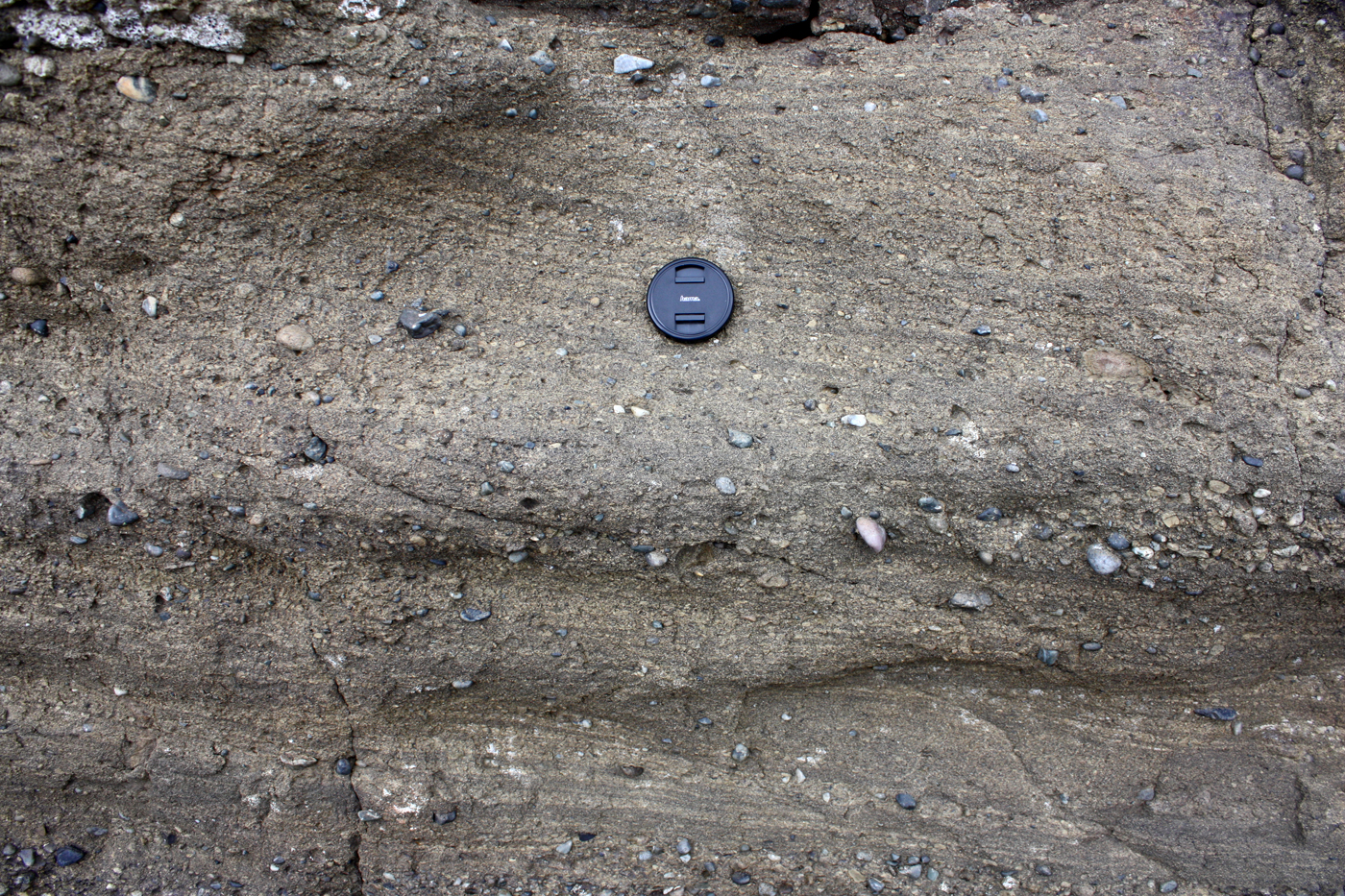
Cross-bedded pebbly sandstone, Dorotea Formation, southern Chile (© 2010 clasticdetritus.com)
I’ll post more about these rocks in the coming weeks — for now, just a taste.
Happy Friday!
Sand: The Neverending Story — Q&A with author Michael Welland
This post is the second of two posts devoted to the book ‘Sand: The Neverending Story’ by Michael Welland (check out the first post, my review of ‘Sand’ from yesterday). Below is a Q&A with author Michael Welland and then additional Q&A in the comment thread between Michael and my readers. Make sure to check out his blog Through the Sandglass for additional information.
–
Brian Romans (BR): How did the idea for ‘Sand’ develop? Is this something you’ve wanted to write for a long time or did it come to you in an “ah ha!” moment?
Michael Welland (MW): Several years ago (I just realized that, astonishingly, it was 2004), I had an idea for a book that would be a guide to looking at landscapes. Working on bits and pieces of that, I started writing the story of a sand grain’s journey down a river, and, the more I worked on it, the more the idea struck me that here was the basis for a different book in its own right – and the rest, as they say, is history. So it was a kind of “ah ha!” moment, and the “ah has” rapidly escalated as I thought through the scope of topics that a book on sand needed to cover – all the journeys that a sand grain could take us on.
–
BR: My favorite chapters were the ones that tracked the journey a grain of sand might take in a sedimentary system. These pages artfully discussed what I think is a fascinating area of research in sedimentary geology that attempts to integrate observations and measurements from an entire sediment-routing system — that is, from source areas to terminal depositional basins and everywhere in between. How did you come to use the Susquehanna River and associated offshore areas of eastern North America as the setting for telling that story?
MW: I wanted to use an essentially wild river, one as close to its natural state as possible, free from dams and other manmade influences that would impede the sand grain’s journey. Since I had been writing about a sand grain’s birth in the tepuis, the incredible flat-topped mountains of Venezuela’s Canaima National Park, I assumed that I could just continue from there – about as remote a place as you can get, home of Conan Doyle’s The Lost World, wild and romantic landscapes. It turned out that this was a very naive assumption – the rivers flowing out of the park and, ultimately, into the Orinoco, are, today, some of the most disrupted in the world – gold mining and gigantic hydroelectric power projects the culprits.
So I embarked on a review of the literature of the world’s rivers and our influence on them. What emerged was the startling fact that, in order to find a truly wild river, you have to go to the Arctic of Canada and Russia. But what I wanted was a river that would be familiar to the reader, a setting that would resonate – and lead the narrative on to a coast that would do the same. It turns out that, relatively speaking, the Susquehanna is as close to a wild river in a familiar setting as you can get. It also had the advantage of linking strands on the Appalachians, the ice ages, and the importance of rivers in culture and history – plus it leads to the Chesapeake Bay, the Outer Banks, barrier islands, and a dramatic coastal system, all wonderful grist for my mill, so to speak.
I agree that the whole topic of sediment-routing systems is fascinating – as much for what we don’t know as what we do. Measurements are not only tricky, but generic, different instantaneous cargoes of dissolved, suspended, and bed load sediment measured at particular times in particular places. Individual frames in a movie much of which we can’t watch, characters on journeys that we can’t follow. I found the reports of the Grand Canyon sediment flushing experiments fascinating since this is one of the few examples of tracking a specific cargo in real time.
–
BR: Which part of the book turned out to be the most challenging to research and/or write? Why?
MW: Without doubt, the section on the strange behaviors of granular materials – I had no idea what I was getting into! But I found it absolutely fascinating and compelling, a dramatic example of the apparently simple presenting physicists with something complex and baffling. I knew about Per Bak’s work on sand piles, self-organizing criticality, and so on, but that was only the beginning. The first challenge was understanding some of these phenomena myself and the second finding a way of explaining them clearly (I hope), and communicating the excitement of the science. I was fortunate in that many of the researchers not only happily provided me with permission to use the images, but gave me a lot of help with understanding what was going on – together with the mysteries. And this topic I continue to find fascinating – it continues to crop up in science news and, as I’m sure you’ve noticed, I blog about the wonders of granular materials quite frequently. I recently had great fun giving a talk where there was no provision for the crutch of powerpoint illustrations, so I spent the whole time doing table-top experiments – “magic tricks” – with sand.
–
BR: What was the most surprising bit of scientific or historical information you came across during your research for ‘Sand’?
MW: I was astonished to discover the microscopic ecological diversity of life between grains of sand – Rachel Carson’s “Underground City.” I’m no biologist, and so the world of meiofauna and extremophiles was a revelation.
And, in a completely different way, the sand bottles of Andrew Clemens (first encountered by my wife, my trusty research assistant) were a complete surprise, an awe-inspiring example of human creativity and tenacity.
–
BR: A book like this requires a lot of research and I’m sure a great deal of interesting material ended up being trimmed or even completely cut out of the final version. Could you share a few facts or anecdotes you uncovered during your research that didn’t make it into the book?
MW: It’s still surprising, for a book about such an apparently mundane material as sand, how much stuff I had to leave out. This was one of the motivations for starting the blog – which I’ll return to in a later response.
There were a lot more examples of sand in art and literature that I would have liked to include, but permissions costs as well as space sent them to the cutting room floor. Bob Dylan, Salvador Dali, Andy Goldsworthy….
One noticeable omission, that I’m very conscious of and resulted from the fact that I used a river that ends in an estuary, is anything much about deltas which are, after all, some of the planet’s greatest piles of sand. And there are, of course, endless great tales from Earth’s history that sand can tell and I didn’t have the space to.
One of the fascinating and fertile areas of research was the imagery of sand in myths and sayings, cross-culturally and around the world. The stories of ropes of sand, for example, or sayings such as the definition of a one-horse town, “just a spit in the sand in the middle of nowhere,” or, from Japan, “Getting money is like digging with a needle. Spending it is like water soaking into the sand.” The Danes observe that “Many grains of sand will sink a ship” and, from India, the highly dubious and politically incorrect observation that “A woman without a man is like a spit in the sand – she dries up.” I think I’ll leave it at that……
A somewhat related point of interest is the challenge of the infamous Chapter 9 – sand in our daily lives. People either love it or hate it and I know that you’ve commented on it in your review as coming over too much like an encyclopedia. Fair enough – it does, but I have to admit that I was at a complete loss as to how to spin a story, a narrative through the staggering diversity of topics – any alternatives that I came up with seemed contrived. Hafnium and Fred Astaire? Aerogels and golf courses? Vines and quicksand? I’ll come up with something better for the movie!
–
BR: What’s next for you as an author? Was ‘Sand’ the one-off book you’ve always wanted to write or do you have plans to write another popular book about Earth science? What other scientific (or non-scientific) topics are you interested in enough to learn about and maybe write about someday?
MW: No, it’s certainly not a one-off (I hope). I enjoyed the process (well, most of it) so much that I intend to continue (the blog is a great outlet). Of course one of the challenges is that writing a book does not generate proper income (unless it’s Harry Potter) and certainly no-one should embark on the process with that as an aspiration. What I enjoy, and which is evident, I hope, in Sand, are connections and the inter-relationships between science, particularly geology, and our daily lives, global issues, art and literature; I have in mind a couple of topics for another book that would continue this kind of exploration, but I’d prefer to keep them to myself for the moment – sorry!
–
BR: Since this is a blog, I’ve got a few blog-related questions for you. I’ve noticed that your blog, Through the Sandglass, contains some material that is in ‘Sand’, but it also has some other material that I don’t remember being in the book. Have some of the topics that didn’t make it into ‘Sand’ found a home on your blog? Do you consider the primary purpose of your blog as a way to promote the book? Do you use it as a way to brainstorm topics you want to write about? Many of my readers are also science bloggers and would be interested to hear your thoughts on the connection of blog writing with book writing.
MW: I started the blog at the encouragement of the University of California Press as support and continuation of the book. I’d had nothing to do with the blogosphere before that, and I’ll readily admit that I suffered from sone of the common prejudices (“the self-absorbed ramblings and rants of adolescents of all ages. Political and social tirades from grinders of the well-honed axes of zealotry. Mindless and breathless accounts of minor celebrities and nonentities” etc.). But I rapidly came to appreciate how wrong I was and how powerful the blogosphere can be as a communication tool. I’m now, obviously I hope, a dedicated and enthusiastic member of the community and have derived immense pleasure from all the contacts that I would never otherwise have made, and all the stuff I’ve learned.
So yes, the blog started out as a way of writing about the book material that ended up on the cutting room floor, and as a means of publicizing the book (this “virtual book tour” is an example) but it’s become much more than that. By far the majority of the material in the blog is new (not from the book) and it seems that every day the backlog of topics I want to write about grows longer. I continue to be amazed at how the theme crops up on a daily basis in such a variety of contexts – I write about what intrigues and surprises me and I’m never at a loss. I often think that now, after fourteen months of blogging, I’ve actually written another book; but I haven’t – what I’ve done is write a series of articles, connected by a theme, yes, but it’s as much as anything a form of journalism. So yes, there can be a connection between blog-writing and book-writing, but I suspect that a blog emerges more naturally from a book than the other way round. I found the results of the recent geoblogosphere survey by Lutz Geissler, Robert Huber, and Callan Bentley really resonated with me. The equally top-ranked responses to the question “why do you blog?” were “to inform”, “to share knowledge”, and “to popularise the geosciences” – followed closely by “to have fun”. Absolutely!
–
Note: the comment thread is still open but Michael is no longer standing by to answer immediately. But please free to leave a question if you’d like, he’ll be checking back over the next few days.
–
UPDATE (2/3/2010): Michael Welland has been awarded The John Burroughs Medal for excellence in natural history writing. This is very well-deserved.


 Clastic Detritus