Friday Field Foto #118: Mt. St. Helens from the air
Okay, so maybe sitting on a commercial airplane isn’t technically “the field”, but, then again, geology is everywhere!

Mt. St. Helens from the air (© 2010 clasticdetritus.com)
This week’s Friday Field Foto is a shot of Mt. St. Helens volcano in Washington State taken from the window seat of a plane flying from Vancouver to Oakland. Click on it for a bigger version.
Happy Friday!
Geoblogosphere week in review (July 12-July 18, 2010)
Here are several posts from the geoscience blogosphere last week highlighting some interesting writing:
- Ole Nielsen from olelog reviews global oceanic circulation within the context of a new study that addresses what might have happened to this system at the end of the Last Glacial Maximum some 15,000 years ago.
- Erik Klemetti of Eruptions is out in the field, but keeps the excellent volcanology related posts going with guest blogger Ed Kohut who writes two great posts about the Mariana Islands (part 1 and part 2).
- Kyle House of Geologic Froth writes about some recent mapping of the Bill Williams River in Arizona with a series of spectacular maps showing off how dynamic this river system is.
- Michael Welland of Through the Sandglass continues his great writing about the Gulf of Mexico oil disaster with a post about the possibility of oil-consuming microbes that live in the sand onshore.
- David Bressan of History of Geology posts about some of the first documented uses of forensic geology in the investigations of crimes.
Last, but certainly not least, is the past week’s events on the California serpentinite issue. If you’ve been living under a rock and don’t know what I’m talking about — the California state legislature has decided to spend their time and taxpayer resources on whether or not to remove serpentinite as the official state rock.
- Garry Hayes of Geotripper has been leading the charge on this issue. In one post this week he provides some personal context about his grandfather with a plea for a more civil discussion. In another post, Garry extends an invitation to the the author of the bill, Gloria Romero, to join him and other California scientists and historians in the field to have this discussion.
- Andrew Alden of About.com discusses asbestos fundamentals.
- James Repka of Active Margin, another California geoscience educator, adds his two cents with his own eloquently written letter to state officials.
- Chris Rowan of Highly Allocthonous adds his perspective on the tectonic value of serpentinite.
- Julian of Harmonic Tremors posts a self-described rant about the issue (well worth the read!).
- To keep updated on the latest, search the hashtag #CAserpentine on Twitter.
–
~~~~
–
Week-in-review posts from past month:
If you want to subscribe to the week-in-review posts (but not the entire blog feed) use this link: https://clasticdetritus.com/category/week-in-review/feed/
Sea-Floor Sunday #67: Hudson submarine canyon
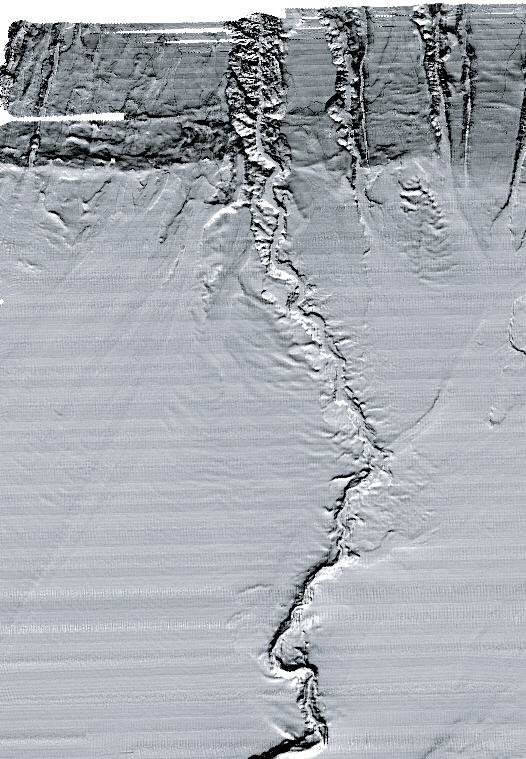
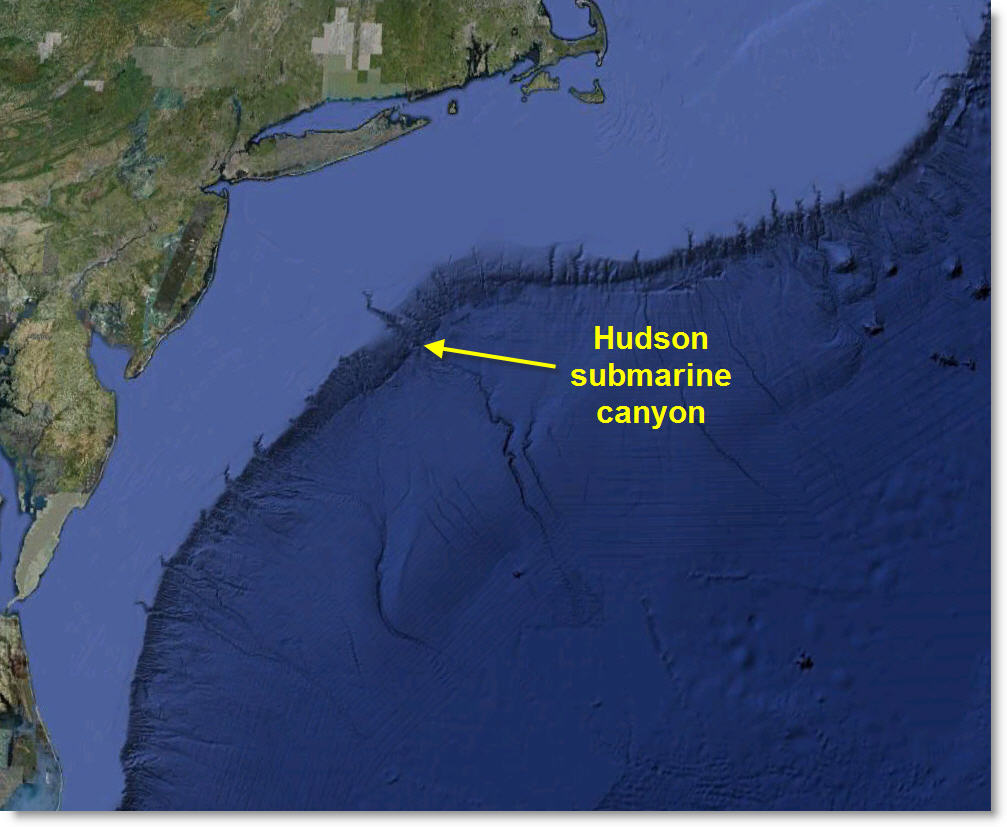
This week’s Sea-Floor Sunday is a nice shaded relief bathymetric image* of the Hudson submarine canyon region offshore of New York and New Jersey (see map at bottom of post for regional context). The image is courtesy of this 2006 U.S. Geological Survey Open File Report where you can learn much more and see other images.
I’ve rotated these images such that north is to the upper right corner. In this first image the width is approximately 100 km (60 miles). The top of the image is more-or-less the edge of the continental shelf, which is about 400 m (1,300 ft) deep. The bottom of the image is well onto the continental slope and greater than 3,000 m (9,800 ft) of water depth. Note how the Hudson canyon (and other smaller canyons) incise across the steepest section of the shelf edge and uppermost slope.
Shaded relief bathymetry, Hudson submarine canyon (credit: USGS Open File Report 2004-1441; http://pubs.usgs.gov/of/2004/1441/html/figures.html)
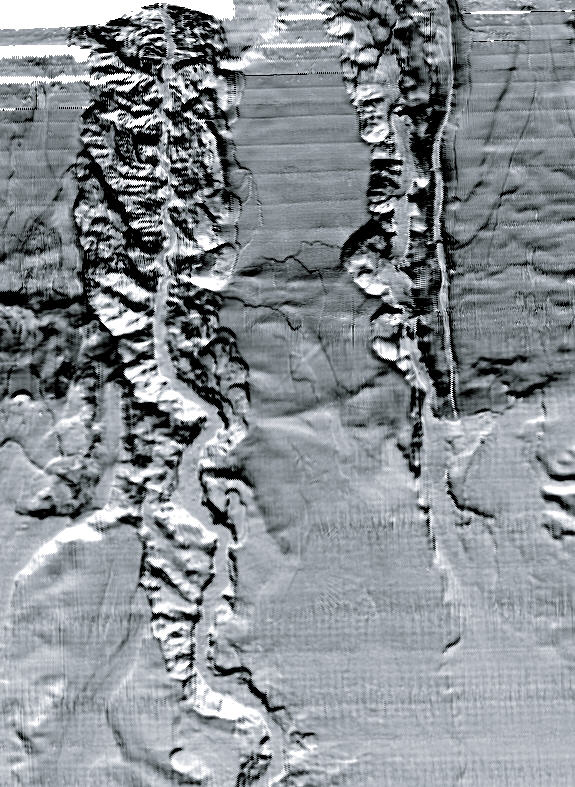
The image below zooms in on the upper reaches of the canyon. The relatively flat floor of the canyon near the bottom of the image is about a kilometer wide to give you a sense of scale.
Shaded relief bathymetry, Hudson submarine canyon (credit: USGS Open File Report 2004-1441; http://pubs.usgs.gov/of/2004/1441/html/figures.html)
Here’s a snapshot from Google Earth for regional context.
– Also see this post from 2007 about the Hudson Shelf Valley.
–
* FYI: I opened the PDF file in Illustrator and deleted all the linework and annotation to highlight just the shaded relief
This week’s Friday Field Foto is from a hike my wife and I took on the last day of a trip we took to Hawai’i earlier this year. If you take the coast trail from Ke’e Beach on the northwest shore of Kaua’i south for a couple of hours you reach this basalt boulder beach.

If you want to see more of my photographs from this trip, check out my Flickr collection.
–
Happy Friday!
Modern agriculture a major control of increased rates of dust flux from continent to ocean

Dust blowing from west Africa into the Atlantic Ocean (credit: NASA Earth Observatory)
 Strong winds can pick up dust particles* from continents and carry them thousands of kilometers where they are deposited on the ocean floor. Deserts are especially important contributors of dust with the Sahara Desert of northern Africa being the single largest source of mineral dust in the world. The occurrence of this process has been observed and deposits of dust have been documented in marine sediment cores for a long time, but what has been more difficult to determine is how this process changes over time.
Very recent changes in dust flux (since the 1970s) are well known and relatively well understood to be the result of recent drought conditions in the Sahel region. However, longer-term trends, at the scale of centuries and millennia, are not as well understood. A new paper by Mulitza et al., published in Nature last week, provides a robust record of dust deposition for the past 3,200 years. The sedimentary archive is from a marine site offshore northwest Africa, located in a prime position under one of the most active dust plumes.
 The top three curves on the diagram at left are the dust fraction, terrigenous (i.e., continent-derived) fraction of a certain grain size, and dust flux, respectively (click on it for a bigger version). The curve at the bottom of the diagram is a δ18O record, which the authors use as a proxy for precipitation. Also note the arrows near the top of diagram denoting when various forms of agriculture became dominant in the region.
Essentially, the authors of this study are arguing that the dust deposition generally corresponds to the paleo-precipitation record until very recently. When the climate was drier, more dust was picked up from the continent and deposited in the ocean. The curves don’t match exactly, but I wouldn’t expect them to — there are numerous other factors at play here. But the general correspondence is compelling. The departure of the dust fraction and flux curves from the paleo-precipitation curve starts a few hundred years ago.
From the abstract, Mulitza et al. explain this departure:
With the help of our dust record and a proxy record for West African precipitation we find that, on the century scale, dust deposition is related to precipitation in tropical West Africa until the 17th century. At the beginning of the 19th century, a sharp increase in dust deposition parallels the advent of commercial agriculture in the Sahel region.
I find these millennial-scale records fascinating because they highlight the complex interaction of multiple controls on Earth surface processes and commonly, although not always, reveal the significant impact that human civilization has on these processes.
–
* according to authors, ‘dust’ refers to airborne particles mostly within the very fine silt range (<10 microns) with some as coarse as fine sand (~200 microns)
–
Mulitza, S., Heslop, D., Pittauerova, D., Fischer, H., Meyer, I., Stuut, J., Zabel, M., Mollenhauer, G., Collins, J., Kuhnert, H., & Schulz, M. (2010). Increase in African dust flux at the onset of commercial agriculture in the Sahel region Nature, 466 (7303), 226-228 DOI: 10.1038/nature09213
image from NASA’s Earth Observatory website [link]
Geoblogosphere week in review (July 5-July 11, 2010)
Here are several posts from the geoscience blogosphere last week highlighting some interesting writing:
- Daniel from sandbian explains the tricky situation within which a geologist who wants to study the mineralogy/petrology of archeological artifacts may find themselves — convincing the archeologist that it is worth cutting open (and “destroying”) the artifact for further study.
- Silver Fox from Looking For Detachment muses about how her upbringing and built-in sense of direction might have a lot to do with her becoming a geologist. This is a great read with some great discussion in the comment thread too.
- Zoltan Sylvester from Hindered Settling shares a story (and many superb photographs) about a hike in the Romanian Carpathians, including encounters with the Cretaceous Bucegi Conglomerate.
- You may have heard rumblings from the science blogosphere at large last week when bloggers from the SEED Media-hosted site ScienceBlogs erupted in furor (justifiably, in my opinion) at their host’s decision to allow a corporate “advertorial” blog run by Pepsico into the ranks of their independent science blogs. Read reaction from geology blog Highly Allochthonous and the paleontology/paleobiology blog Laelaps regarding their decisions of whether or not to continue working with the site. [UPDATE: Chris and Anne have moved Highly Allochthonous to a new location, make sure to update your feeds!]
- Finally, the brouhaha out here in California regarding the bill in the state legislature to remove serpentinite as the state rock continues. Garry Hayes from Geotripper has been on top of this issue from the beginning and has written a powerful and succinct letter to the governor that artfully combines explanation and formal objection to the bill. Andrew Alden has also been quite active on this front — see his latest post on the issue on his Oakland Geology blog. To keep updated on the latest, search the hashtag #CAserpentine on Twitter.
–
~~~~
~~~~
–
Week-in-review posts from past month:
If you want to subscribe to the week-in-review posts (but not the entire blog feed) use this link: https://clasticdetritus.com/category/week-in-review/feed/
This week’s Friday Field Foto is from a trip I took to the Arctic archipelago of Svalbard in June 2009.

Glacial outwash braidplain delta, Svalbard (© 2010 clasticdetritus.com)
(Click on the image to see a bigger and less fuzzy version)
There are virtually no roads on this group of islands, which means you need to hop on a small plane to get to other areas. This is a dream come true for those fascinated by this landscape. The photo above shows a beautiful braidplain delta building out into a fjord. Note how wave action has sculpted the tip of the delta. Also note the accumulation of sea ice to the left.
Happy Friday!
Geoblogosphere week in review (June 28-July 4, 2010)
Here are several posts from the geoscience blogosphere last week highlighting some interesting writing:
- Chris Rowan from Highly Allochthonous explains new results from the San Andreas Fault Observatory at Depth (SAFOD) project that were published in Geology this month. Clay minerals were found on the fault surface and may have a lot to do with the ‘creeping’ behavior along this segment of the fault.
- Michael Welland from Through the Sandglass shares his thoughts about a shape-shifting island of sand called Sylt (including some absolutely spectacular images of the barrier island system).
- A Life Long Scholar from the blog of the same name muses about being a Marie Curie Fellow within the context of attending a conference for other fellows.
- Another post from Chris Rowan of Highly Allochthonous provides important geologic and geochronologic context for the Nature paper that came out last week documenting fossils found in Gabon that are being interpreted as the oldest multicellular life on Earth (at 2.1 billion years).
- David Petley from Dave’s Landslide Blog continues his excellent blogging about a lake that has formed as a result of a landslide and the potential hazards that could occur. This week, David plots some of the available data himself and shares his thoughts on the state of the spillway.
- Daniel from the blog sandbian writes about eerie Bronze Age mounds that can still be found in parts of Sweden.
- The Volcanism Blog reviews a new textbook called Volcanoes: Global Perspectives that sounds great for both students of volcanology as well as amateur enthusiasts.
- Finally, you may have heard about the bill going through the California state legislature to remove serpentinite as the official state rock. The geoscience blogosphere has been all over this story. Silver Fox at Looking For Detachment posted a great review of the ongoing debacle with links to other posts, including some reporting from Andrew Alden at About.com.
–
~~~~~~~~~~~~~~~~~~~~~~~~~~~~~~
–
Week-in-review posts from past few weeks:
If you want to subscribe to the week-in-review posts (but not the entire blog feed) use this link: https://clasticdetritus.com/category/week-in-review/feed/
Sea-Floor Sunday #66: Mississippi submarine fan
The website for the Center for Coastal & Ocean Mapping – Joint Hydrologic Center (CCOM-JHC), a University of New Hampshire and NOAA research center, is a treasure trove of information and images of modern seafloor mapping technology.
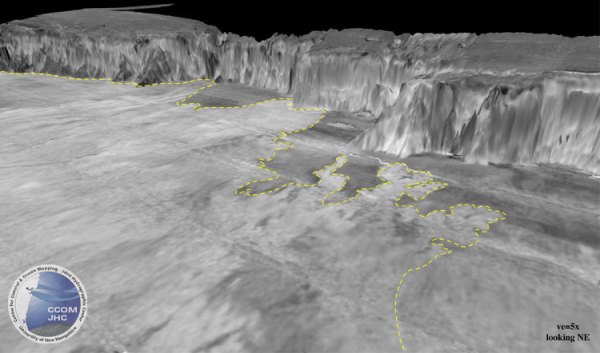
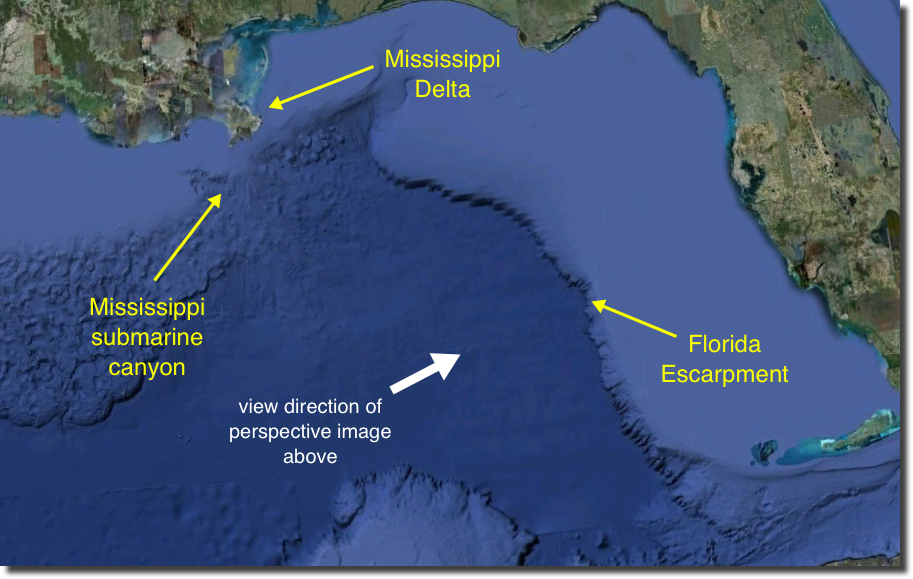
I came across this fantastic perspective image of the Florida Escarpment and deep basin floor of the Gulf of Mexico (see the regional map at the bottom of the post for context). What you’re looking at is a backscatter image, which relates to the intensity of the returned signal (read more about seafloor mapping technologies here).
Backscatter perspective image of Mississippi Fan lobes (credit: Center for Coastal and Ocean Mapping, http://ccom.unh.edu)
If you look at the flat basin floor you’ll notice a dashed yellow line drawn in — this separates the the light-colored, or high backscatter, regions from the dark-colored, or low backscatter, regions. The lighter colored regions are interpreted to represent sandier sediment and the dark is muddier.
The finger-like, lobate shape of the boundary of those sandier sediments are submarine fan lobes that are constructing the Mississippi submarine fan over time. The next image below shows the same area but now in a regular map view.
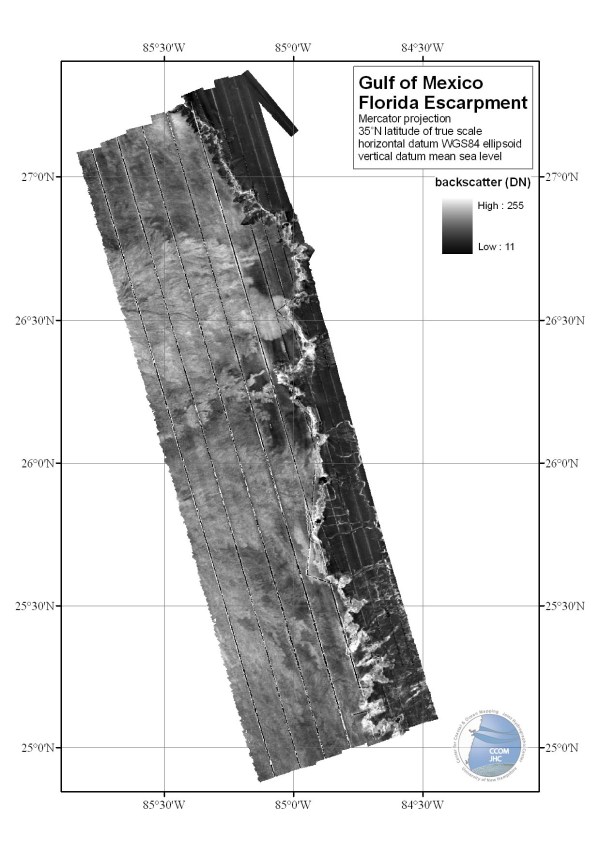
Backscatter image of Mississippi Fan lobes (credit: Center for Coastal and Ocean Mapping, http://ccom.unh.edu)
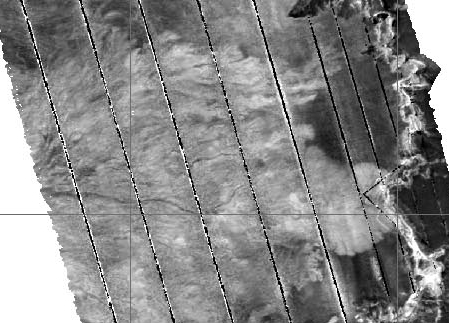
The backscatter image on the submarine lobes reveals a complex texture of small channels traversing the seafloor. I’ve zoomed in a bit more in the image below. This rich geomorphology is created by many thousands of years of turbidity currents delivering sand and mud from the Mississippi delta front to the deep sea.
–
This map below shows the regional context for the images above.


 Clastic Detritus