Patagonia field work — Update #2
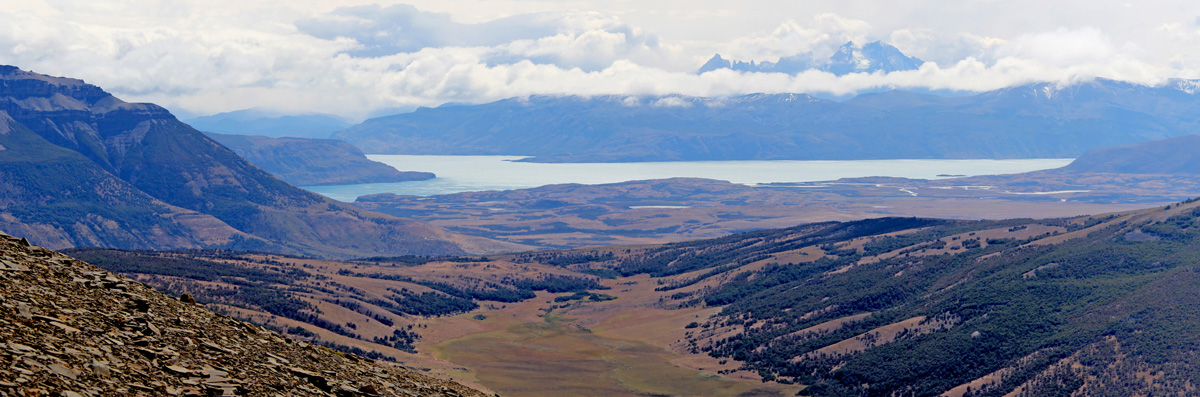 Field work is going well. Weather doing what it does down here, mostly a mix of clouds and sun, very windy, with occasional periods of rain. Typical Patagonia.
Yesterday, we made our way up a mountain to check out the strata exposed there and to get a view of regional relationships. One of the objectives of the work we are doing down here is to link very detailed sedimentological information (bed-scale sedimentary structures and ‘architectural’ scale stratigraphy) with basin-scale patterns (changes across several to many tens of kilometers). The patterns that fill a sedimentary basin span many orders of magnitude spatially and temporally.
To get a good sense of these larger-scale patterns we need to get up on top of mountains to get a vantage not available in the valleys. A result of doing these hikes — in addition to me feeling very sore and tired afterwards — is the opportunity for spectacular views of the landscape. The photo at the top is a view of the famous Paine Massif (a Miocene laccolith intruding into the Cretaceous turbidites we are studying) taken from such a vantage. And below is a short video from the ‘hiker’s perspective’ I took as we approached the top of this mountain.
Patagonia Field Work — Week 1
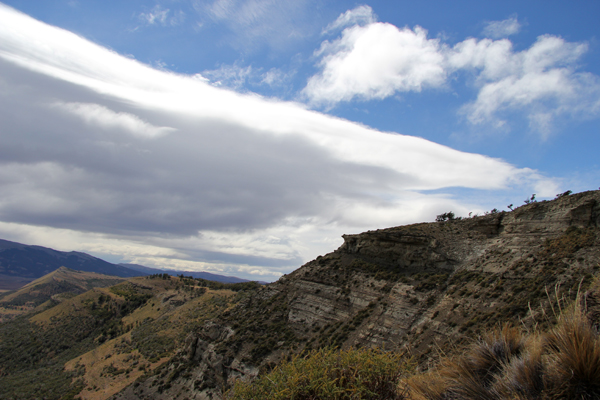 Quick update from Chilean Patagonia where I’m doing some geological field work for a total of five weeks. We arrived in Punta Areans last Sunday and then spent Monday afternoon at Instituto Antartico Chileno, where a colleague and I gave a talk and chatted with the scientists there. They do a lot of work on the Antarctic Peninsula, but also some paleobiological studies in the same region we are doing sedimentological research. It was great to meet and interact with the Chilean scientists.
We then headed north up to the town of Puerto Natales along Seno Ultimo Esperanza, which is the jumping off point for a lot of tourists heading to Parque Nacional Torres del Paine. We’ve been coming here for several years and have made some friends over that time, so we spent a bit of time visiting with a woman whose hostel we used to stay in back when we were grad students.
We’ve spent the past few days easing into the field season with some detailed work on some turbidite channel outcrops discussed in this paper. The photo above and a bunch in this Flickr set show what the landscape is like here.
We are staying in a little farmhouse-style hosteria that has internet, but it’s intermittent and very weak. I’m really only able to provide some updates via Twitter (see sidebar at right); I tried to upload a 200 kb photo and it failed numerous times. Oh well, that’s how it is. Right now we are in town doing some errands so we stopped in a cafe that has stronger wi-fi. I’ll try to provide updates like this whenever I have a chance.
Patagonian geology from the air

I’m now down in Chilean Patagonia and will be for the next five weeks doing some geological field work. I’m going to try and post a bunch while down here — wi-fi willing — so be forewarned that these posts will be short and probably contain typos and sloppy errors. It’s either that or no posts :)
I took the above photo a few hours ago from the flight from Santiago to Punta Arenas. It’s always fun to see the geology you’ll be working on from the air before or after. We won’t be going to this particular place, well probably not, but will be going to some outcrops just outside this photo.
I forgot to mention — the outcrops in upper left of this photo, the more buff-colored stuff, is the locale from the previous Friday Field Photo: https://clasticdetritus.com/2012/02/03/friday-field-photo-166-thin-bedded-turbidites/
Friday Field Photo #166: Thin-Bedded Turbidites
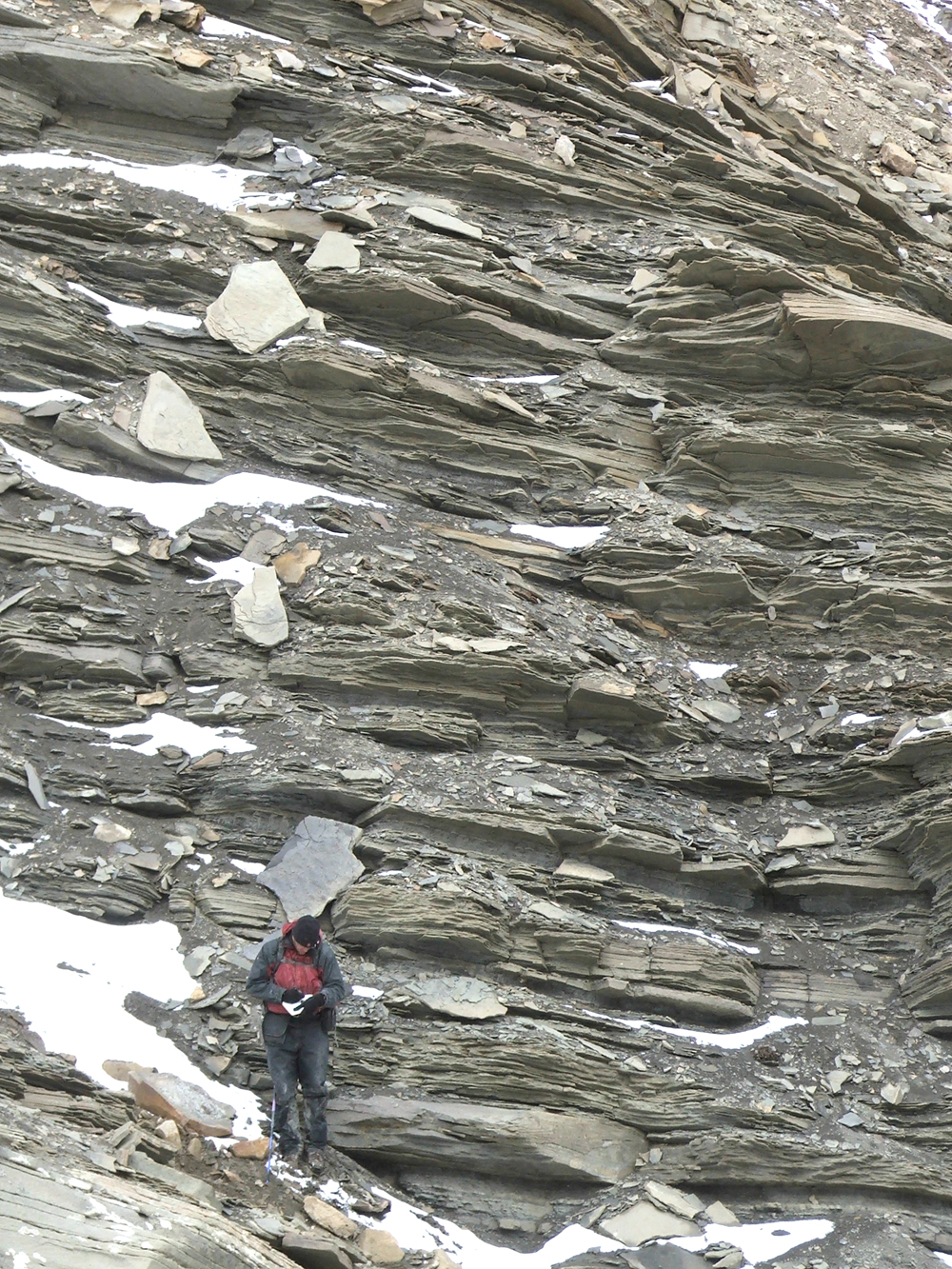
This week’s Friday Field Photo is from the Cretaceous Dorotea Formation in southern Chile. This particular outcrop includes a thick succession of thin-bedded sandstones we interpret to be sediment gravity flow deposits in a delta front environment. Check out our 2009 paper in Journal of Sedimentary Research for the details.
Measuring section (or logging core) through thin beds can be wonderful therapy or soul-crushing tedium, it really depends on your frame of mind at the moment. There are times where I absolutely love documenting sedimentary structures at the sub-centimeter level — and there are other times where I dread the task and would rather work through a stack of 2 meter-thick structureless sandstone beds.
Such is field work, and over time you learn to get yourself in the frame of mind necessary to get the work done. Tomorrow I begin the journey down to this area for several weeks of data collection and scouting/recon for future studies. We won’t be going to this particular outcrop, but we will undoubtedly come across some strata like this. I’m looking forward to it, it will be therapeutic.
I will try to post updates and photos while in the field, but it all depends on the wi-fi — sometimes it works well, sometimes it doesn’t, and sometimes there just isn’t any.
Pyroclastic density currents
Pete Rowley of the blog lithics has a great post about research he’s done on young pyroclastic density current deposits on Mount Ngauruhoe in New Zealand, a volcano used as a ‘stand in’ for Mount Doom in the Lord of the Rings series. Go read it, he’s got some great photos of the deposits and how they change along the profile.
Pete also links to this video of pyroclastic density currents in action on Mount Merapi in Indonesia. This footage shows numerous relatively small flows begin and then die out on the flank of the volcano. Also note the large boulders rolling down the mountainside and outrunning the flows.
Blogging scientific papers and copyright [UPDATED]
Go take a look at this post from Simon Wellings at the blog Metageologist about using images from journal articles for blog posts. He did some digging to find out what the actual policies are for a few different journals in geosciences. Unsurprisingly, most publishers do not allow re-posting of figures/illustrations from papers without paying a fee. The Geological Society of London (GSL), however, has a different policy:
I happen to belong to the Geological Society of London and the particular diagram I am dying to copy is in their journal. A quick and helpful twitter response from them pointed me to their publications permissions page. All is well! With acknowledgement, I can use up to three figures without permission and up to 100 words.
This seems like a decent way to go. People are permitted to use some of the content but can’t simply reproduce the entire journal article on their site. From my experience, this is aligned with the goals of blogging scientists anyway — we want to highlight one or two aspects of the paper that we find interesting and show a couple figures that best communicate that. Publishers need to know that we aren’t running these sites as some black market depot of scientific papers. We want to discuss the science! In fact, when we blog about a paper we provide a link to it, which may drive more people to download and read the whole paper.
I doubt the very large publishers would adopt a policy like GSL. But, I’d really love to see Earth science organizations like the American Geophysical Union (AGU), Geological Society of America (GSA), and Society for Sedimentary Geology (SEPM), all of which have numerous well-read and widely cited journals, have an official policy that allowed for limited reproduction of their content on personal blogs/websites.
The trend of researchers discussing and hashing out details of their science in online venues (in addition, not as a replacement, to conferences and peer review) is only going to increase in the coming years. Having your paper talked about is what we all want. It means more and different researchers might see our work and potentially cite it. These scientific organizations should get ahead of this trend. If my peers are permitted to reproduce some of my published work on their blog — whether its to prop it up or to challenge it — I’m going to be more inclined to submit my work to those journals.
UPDATE: In response to this post, GSA pointed me to their revised copyright policy. You can read the whole thing on their page, but I’ll highlight the ‘fair use’ section:
If you want to use a single figure, a brief paragraph, or a single table from a GSA publication, GSA considers this to be fair usage, and you need no formal permission and no fees are assessed unless you or your publisher require a formal permission letter. In that case, you should print a copy of this document and present it to your publisher.
An author has the right to use his or her article or a portion of the article in a thesis or dissertation without requesting permission from GSA, provided the bibliographic citation and the GSA copyright credit line are given on the appropriate pages.
This is somewhat close to GSL’s policy, although only a single figure or single table is allowed by GSA. For the shorter papers in Geology this is pretty good because there’s typically only a couple of figures in those papers anyway. Perhaps allowing 2 or 3 figures from the much longer and more data-rich papers that are published in GSA Bulletin, for example, would be a welcome revision to the policy. But, all in all, this is a good development. I’d like to thank GSA for responding so quickly (in a few hours!) and with genuine interest about how best to serve their members.
UPDATE 2: Also see the comment below from Howard Harper, the director of Society of Sedimentary Geology (SEPM), with a draft of their revised permission statement regarding usage of content on personal websites/blogs.
Austral parakeets in the early morning
[This post is primarily a test of sharing/viewing videos from Vimeo]
Here’s a very short video I took while doing field work in Patagonia in 2005. It’s early in the morning, the sun is still behind the ridge, so the lighting is poor. Make sure you have your volume up so you can hear these birds. They are Austral parakeets, which are fairly common in this part of Chilean Patagonia.


 Clastic Detritus