A geological pilgrimage to the Late Cretaceous
This month’s Accretionary Wedge asked participants to discuss a place they would go (or did go) for a geological pilgrimage:
I would like to define the pilgrimage as a single place, which is “geologically” unique, relatively remote, and requires some difficulty to get to. If you have already done your geological pilgrimage, please share with us your experience. If you are still planning your pilgrimage, then let us know where your sacred geological spot is and why.
Perhaps this is cheating, but instead of a geographic place, I’ve chosen a ‘place’ in Earth history — the Late Cretaceous (oh, let’s say the middle of the Campanian stage, about 75 million years ago). Like many sedimentary geologists I’ve spent a lot of time thinking about this 35 million year-long (100-65 Ma) epoch. Whether its related to a class project during grad school, reading about new studies, or doing their own research, most stratigraphers end up pondering the landscapes of the Late Cretaceous at some point.

North American paleogeography 75 million years ago (from Colorado Plateau Geosystems, http://cpgeosystems.com/nam.html)
Several years ago, while working on a master’s degree in Colorado, I spent a lot of time climbing around on sediments deposited during the Late Cretaceous that are now cropping out as dusty mesas and hogbacks in Utah and Colorado. The famous Book Cliffs outcrops in central Utah is one of the best places in the world to learn about and to debate the concepts of stratigraphy.
More recently, I’ve researched and published about sedimentary deposits in the far south of Chile, also deposited during the Late Cretaceous. We can use sedimentary rocks to reconstruct ancient environments — and we can do it pretty well — but there is obviously uncertainty in these reconstructions. With this pilgrimage I’d love to fly over some of my favorite Late Cretaceous landscapes in a helicopter, just so I could see what it was really like — to see all the wonderful detail and nuance that ends up simplified and generalized.
Why are there so many studies on outcrops of Cretaceous rocks in the stratigraphic literature? Why do sedimentary geologists focus so much on rocks from this time period? The simplest answer is because there is a lot of preserved sedimentary material from the Cretaceous. The diagram below, from Peters (2008) [PDF], reproduced from Ronov and others (1982), shows the global volume of preserved marine sediments (the solid line) through time. As you can see, the Cretaceous, denoted by the ‘K’ along the horizontal axis, is the big winner.

The Cretaceous was the most recent time when the continents were flooded by the global ocean. Take another look at the paleogeographic map above, note the shallow sea connecting the Arctic Ocean to the Gulf of Mexico. In general, marine environments are great places for deposited sediment to be preserved. Combine a place to put sediment with an ample supply (from eroding mountain belts nearby) and the result is a thick pile of strata. These strata up on the continental crust can be relatively well preserved and accessible as outcrops.
As the diagram indicates, there are older time periods that had more significant continental flooding (the dashed line) than the Cretaceous. However, because they are from an even more distant geologic past, many of these areas have been subjected to tectonic reorganization. The Cretaceous is recent enough such that these longer-term cycles of super-continent construction and breakup haven’t sliced, diced, cooked, recycled, or otherwise consumed the strata. In other words, several aspects of geology have conspired to produce one the best preserved periods of Earth history.
And it’s not just stratigraphers who love the Late Cretaceous — all that preserved sedimentary rock hosts the fossils that paleobiologists use to address questions about the evolution of life. You can’t have the fossils without the rocks. I wonder how much less we would know about dinosaurs if not for the level of preservation of Cretaceous strata.
Even if we can’t literally travel back in time to visit the Late Cretaceous, we can continue to learn more about it and improve our reconstructions of this unique and remote place in Earth history.
Fluid injection and seismicity
I don’t use this blog much anymore to link to an article or post I find interesting — I mostly do that with Twitter these days — but I wanted to make sure this one gets wide distribution.
Mark Zoback, an earthquake expert at Stanford University, published a piece in EARTH Magazine yesterday (April 17, 2012) titled Managing the seismic risk posed by wastewater disposal. This article is a breath of fresh air. Just go read it now, it will only take a few minutes.
There has been quite a bit of kvetching the past few months regarding whether or not operations related to natural gas exploration and production, and specifically hydraulic fracturing (referred to as ‘fracking’), have caused earthquakes. There are numerous articles on the topic — many asking the question and others making proclamations.
Zoback’s article is certainly not the end-all-be-all on this issue, but it stands out for being rich in facts and technical details that are skillfully communicated. The bottom line is that these operations can and do induce seismicity. But, it’s not the hydraulic fracturing that’s doing it. Rather, it’s the injection of fluid into the subsurface:
[W]e have known for more than 40 years that earthquakes can be triggered by fluid injection. The first well-studied cases were earthquakes triggered by waste disposal at the Rocky Mountain arsenal near Denver, Colo., in the early 1960s, and by water injection at the Rangely oilfield in western Colorado in the late ‘60s and early ‘70s.
Such quakes occur when increasing pore pressure at depth caused by fluid injection reduces the effective normal stress acting perpendicular to pre-existing faults. The effective normal stress on a fault can be thought of as a force that resists shear movement — much as how putting a weight on a box makes it more difficult to slide along the floor. Increasing pore pressure reduces the effective normal stress, allowing elastic energy already stored in brittle rock formations to be released in earthquakes. These earthquakes would someday have occurred anyway as a result of slowly accumulating forces in the earth resulting from natural geologic processes — injection just speeds up the process.
And it’s not just the injection of fluid into the subsurface through a well that can increase pore pressure enough to induce seismicity. Geologists and engineers have known for decades that the accumulation of large volumes of water at the surface, behind newly constructed dams, can also create earthquakes. (Here are the results of searching ‘induced seismicity reservoir’ on GoogleScholar just to give you a flavor of that literature.)
The important conclusion at this point is that fracking is not triggering seismicity:
The concern about triggered seismicity associated with shale gas development arises after hydraulic fracturing, when wastewater that flows back out of the wells is disposed of at dedicated injection wells.
Emphasis mine. So, some might say: ‘Injection, fracking, whatever … the point is that these activities are causing earthquakes!’. Yes, these activities can and do cause earthquakes. But details matter, and here’s why: If we want to establish/improve regulations for these operations in the name of public safety we need to understand the mechanism. We need to do the basic science to address the problem. (This is an issue in geothermal and CO2 projects as well.) And I don’t care if it’s advocacy for or against natural gas extraction, either loses credibility if specifics about the science are distorted, cherry-picked, or omitted. Details matter.
I realize there’s a bigger-picture debate about whether or not to extract natural gas at all. This is a good debate to have no doubt. But, let’s make sure the current state of knowledge and understanding informs that debate.
El Niño and sediment flux to the deep sea
Last week the Dept of Geography here at Virginia Tech invited me to give a talk about some of my research on controls on sedimentary system evolution. A major component of my PhD research (2003-2008) was investigating the influences on sediment delivery from land to the deep sea over the past ~10,000 years. Our ‘natural laboratory’ for this work was the Santa Clara River and offshore Santa Monica Basin, southern California. This work was published in 2009 in GSA Bulletin (link or pdf).
Please note that these slides were designed for a projected screen in a relatively small room; I did not take the time to modify the design to look good on small screens or mobile devices. I also did not take the time to add additional text/annotation related to what I said during the presentation.
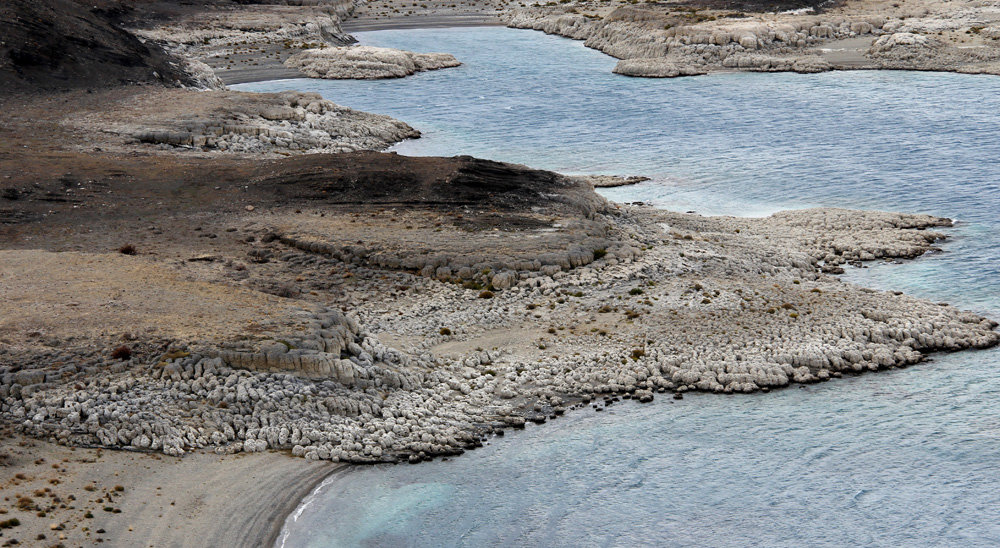
If you’ve ever been to Torres del Paine National Park in Chilean Patagonia you’ve probably seen the curious white ‘bathtub ring’ of rock rimming Lago Sarmiento. These rocks are made of calcium carbonate (limestone) that formed as a result of microbial activity. Such deposits, called microbialites (or stromatolites, thrombolites, etc. depending on their character), develop when a microbial community on the bottom of a body of water traps and binds detrital sediment, some of which becomes the nucleus for sediment that precipitates out of solution. Over time, the precipitated carbonate and trapped sediment grow into a complex of layered mats or, in this case, bulbous ‘lumps’.
The microbialites that you can see exposed around the edge of the lake are fossils, they were formed when the lake level was higher several thousand years ago. There is still microbial activity in the lake at present forming similar features on the lake bottom several meters below the water surface. Modern microbialites such as these at Lago Sarmiento are important analogs for better understanding early Earth history and for addressing questions about life in general.

There is, obviously, a lot more to know about the Lago Sarmiento microbialites. If you want to learn more about the chemistry, biology, and history of these features, check out this paper from the journal Paleogeography, Paleoclimatolgy, Paleoecology.
“All I have to do is write it up”
The scenario: Student A sees Student B in the hallway and asks “Hey, I haven’t seen you in a while, how’s your thesis going?” — Student B answers gleefully “Really good, I’ve completed all the data collection and analysis, all I have to do now is write it up!”
Over the years I’ve heard a lot of students that are doing research, whether they are undergraduate or graduate, utter these words. I can’t recall with absolute certainty, but I seem to remember saying this phrase myself several years ago during my master’s thesis work.
A few years ago the University of California Museum of Paleontology and its collaborators developed a fantastic flowchart simply called Understanding Science. Compare this updated diagram of the scientific method (at right) with the traditional version I learned in grade school (at left).
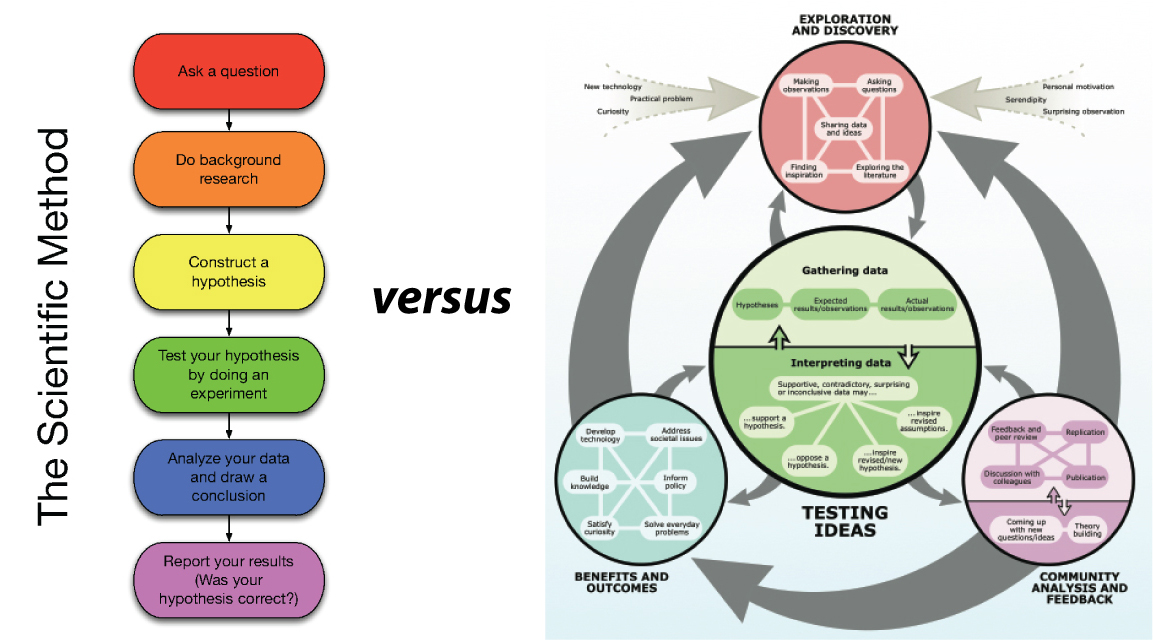
The key difference, of course, is the iterative nature of the diagram at the right. Anyone who has been involved in doing science knows that it almost never happens in the straightforward linear way depicted in the classic diagram. A researcher (or team of researchers) will constantly circle back to the motivating questions as they acquire information from the literature, conduct experiments/collect field data, and think about how their results fit into the bigger picture.
Writing is a key part of this iterative process. Assuming you can simply ‘write it up’ at the very end may end up being a disastrous assumption. The act of writing is doing science. When you have to formalize the ideas into words it forces you to really think about what you’re doing. If you wait until the end to attempt to articulate this you may find that your analysis and data could be flawed.
Most research projects involve a document in the beginning stages — a proposal of some kind, for funding and/or required as part of the degree program. This is great, but don’t leave it at that. Force yourself to put your research into words during the process, not just at the beginning and at the end. The best-case scenario is that these words will fold right into the final document, thus saving you time and effort at the end. The more typical scenario, however, is that the act of writing during the entire process leads to breakthroughs and epiphanies you might not have had otherwise. There may be milestones along the way that encourage writing — an abstract for a conference, an annual review required by the department, or from your adviser. These are fantastic motivators to get some words down on paper, but take the initiative and write without these more formal deadlines.
When you get a draft back from your adviser or collaborator that appears ‘ripped to shreds’ it’s because they are using your words to do science. It’s part of the process. It’s not simply editing, this process is as important as designing an experiment or designing a field sampling campaign. The document becomes a living entity in a way — constantly changing and giving birth to offspring documents through ‘Save As.’ (You should keep all these iterations, by the way, they may come in handy later on.)
So, my advice — and this comes from learning the hard way — is to write early and often because writing is doing science.
–
Images: Understanding Science flowchart from the University of California Museum of Paleontology
Window-seat views of the Andes
Callan Bentley’s post earlier today of some photos he took from the window seat on a flight from California to D.C. motivated me to take a few minutes to post some of my own window-seat photos. These are from a flight from Punta Arenas, Chile (southernmost city in Chile) to Santiago. I don’t have the time to try and figure out exactly where all these places are, but they are roughly in order from south to north. Brief captions are above each photo.
This is a few minutes after departing Punta Arenas; that body of water is Estrecho de Magallanes (Straight of Magellan).

–
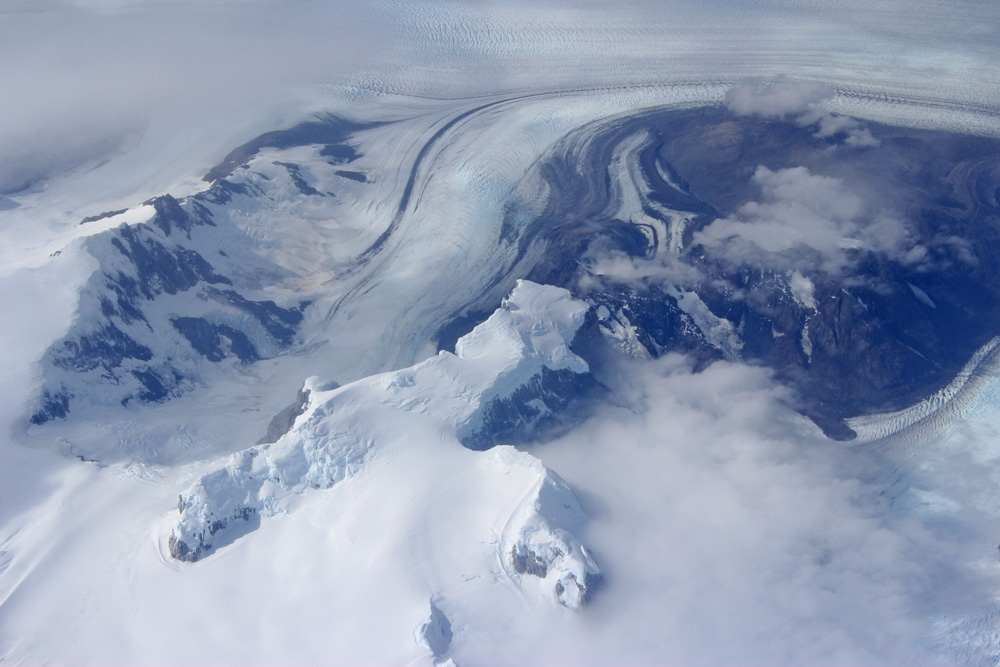
I was really hoping to get lucky and have a clear view of the Patagonian Ice Sheet but, alas, it was shrouded in clouds, which is typical. But … there was one small clearing in the clouds that provided a spectacular, if fleeting, glimpse of the ice cap and its glaciers.
–
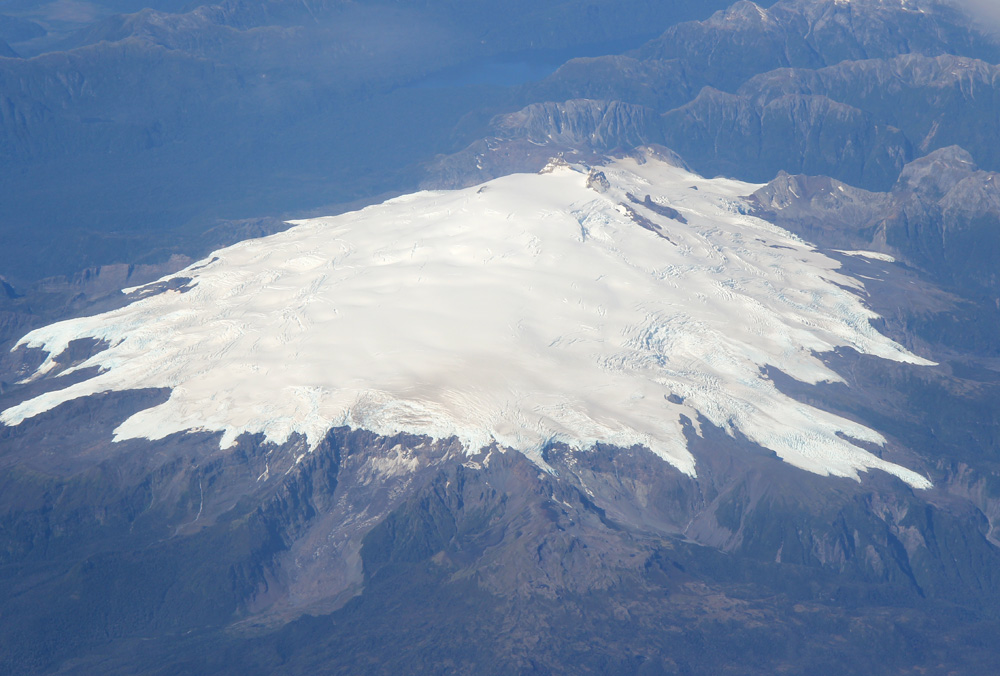
Further north (somewhere a bit north of Puerto Montt is my guess) I spotted this nice snow field-capped mountain.
–
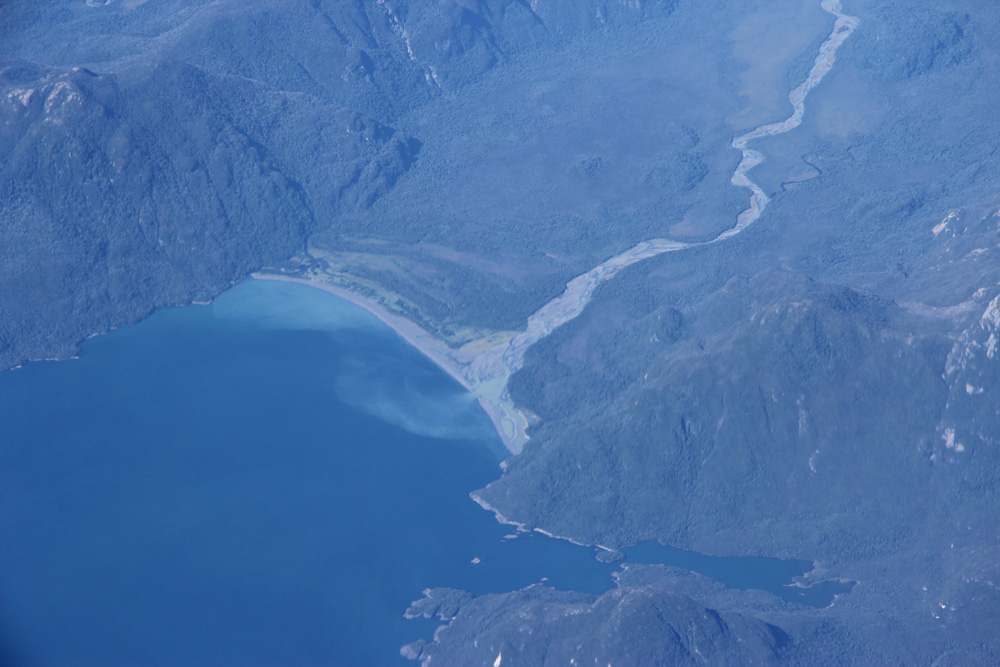
I’m a huge fan of river mouths, but then again, who isn’t?
–
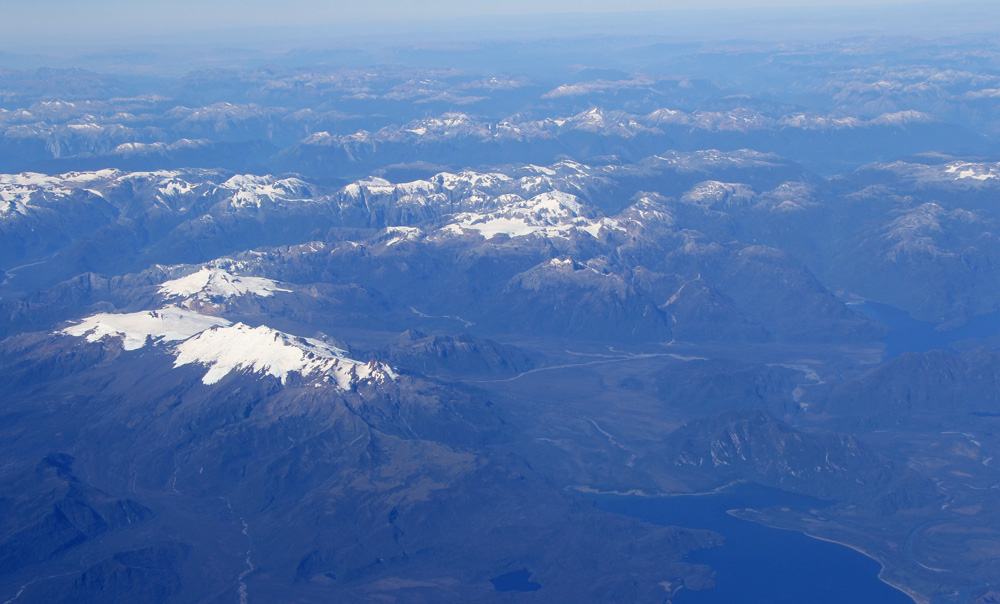
The beautiful Andes.
–
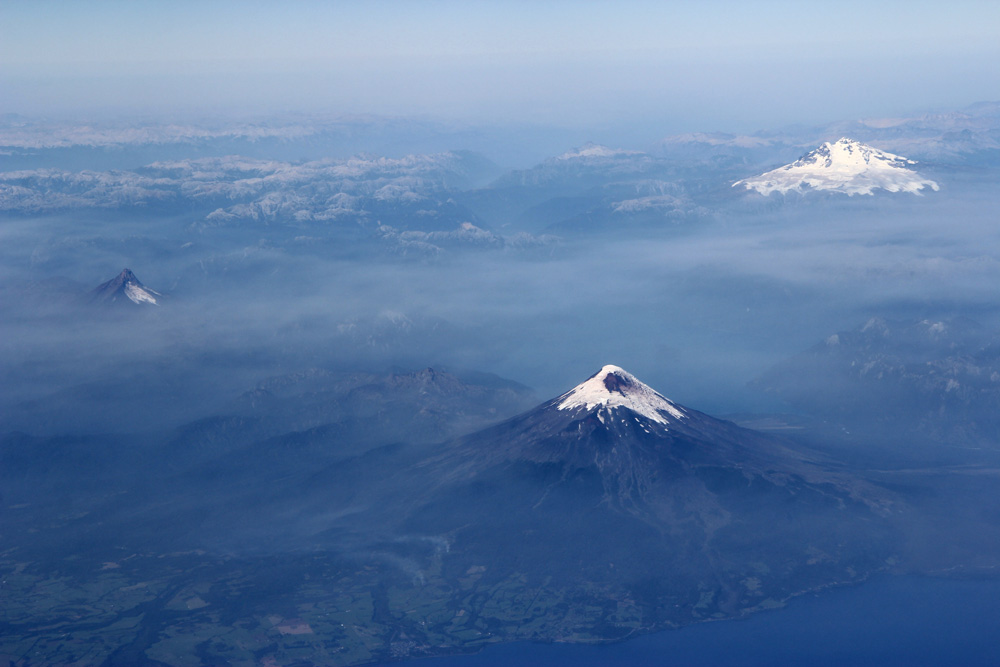
The Andes has its fair share of volcanoes too — Puntiagudo at left, Osorno in the center-foreground, and Calbuco at right in the background. Many thanks to @robbstoner on Twitter for identifying these for me.
–
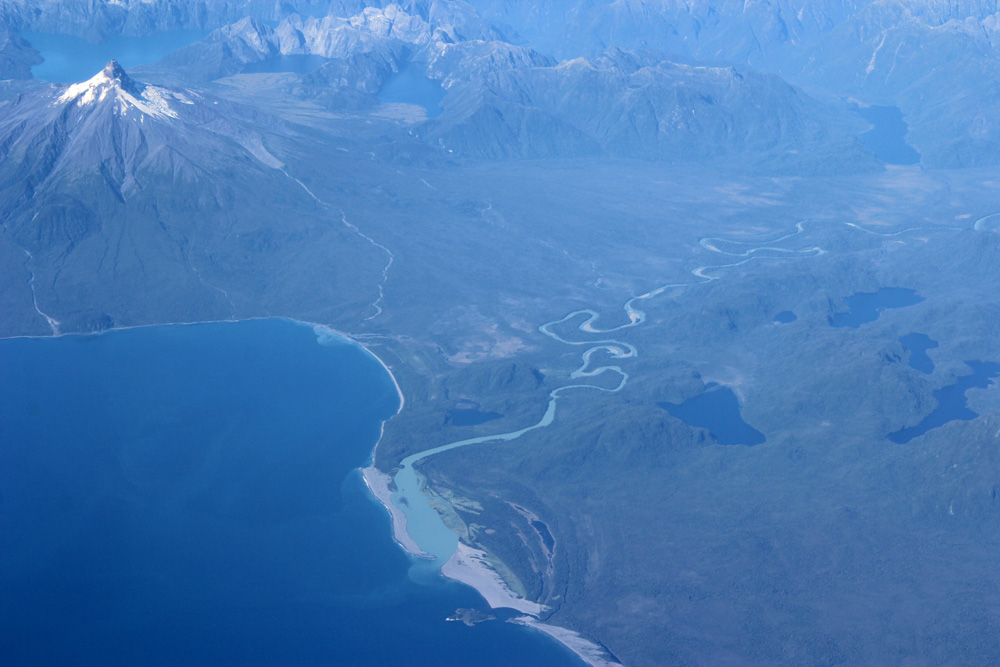
This might be my favorite of this set of photos — the sinuous river, a beautiful river mouth, and nearby mountains. Gorgeous!
–
As we started the descent into Santiago we got great views of river systems draining the Andes and making their way west across the forearc basin.
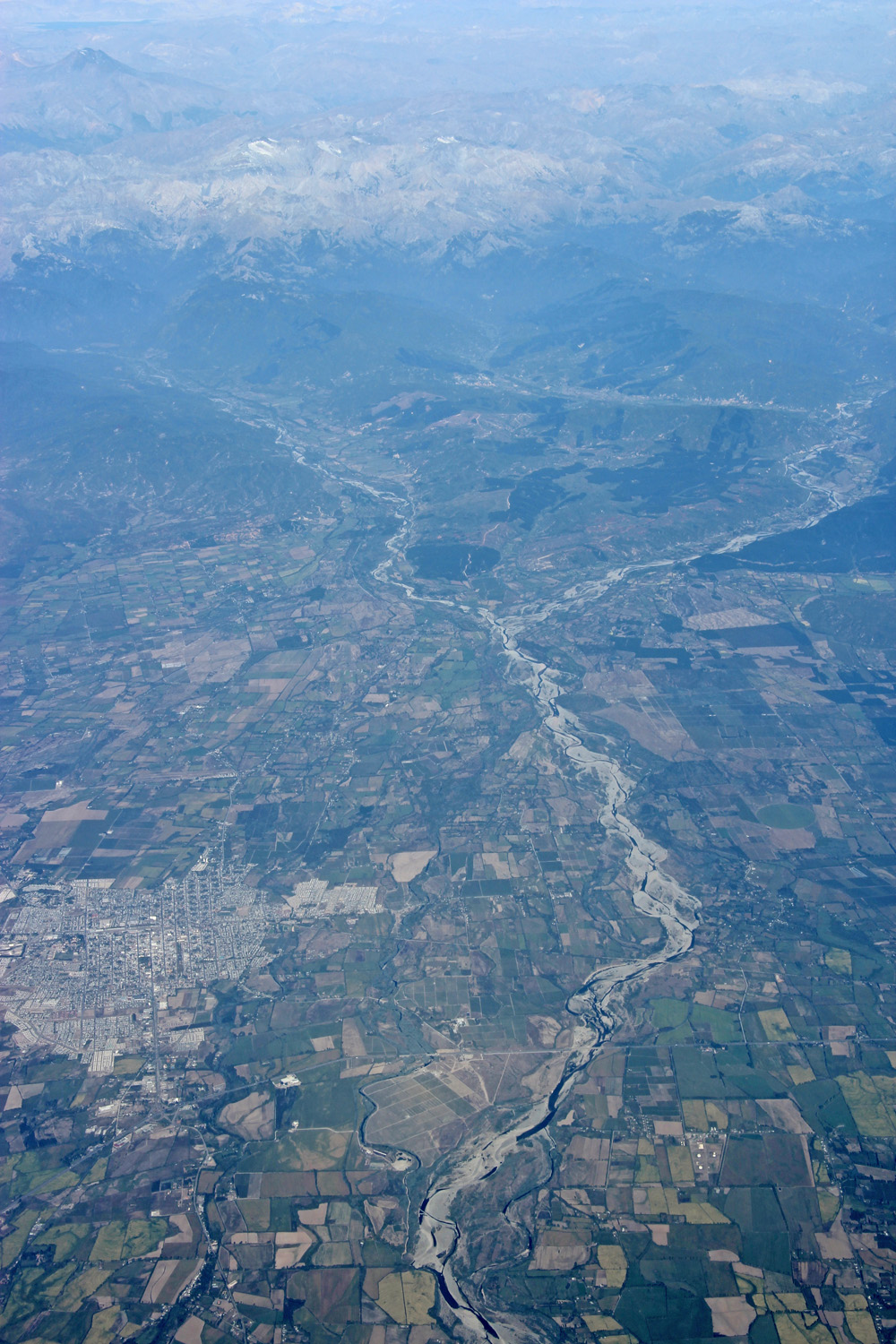
–
Here’s a view a bit more zoomed in on one of these river systems.
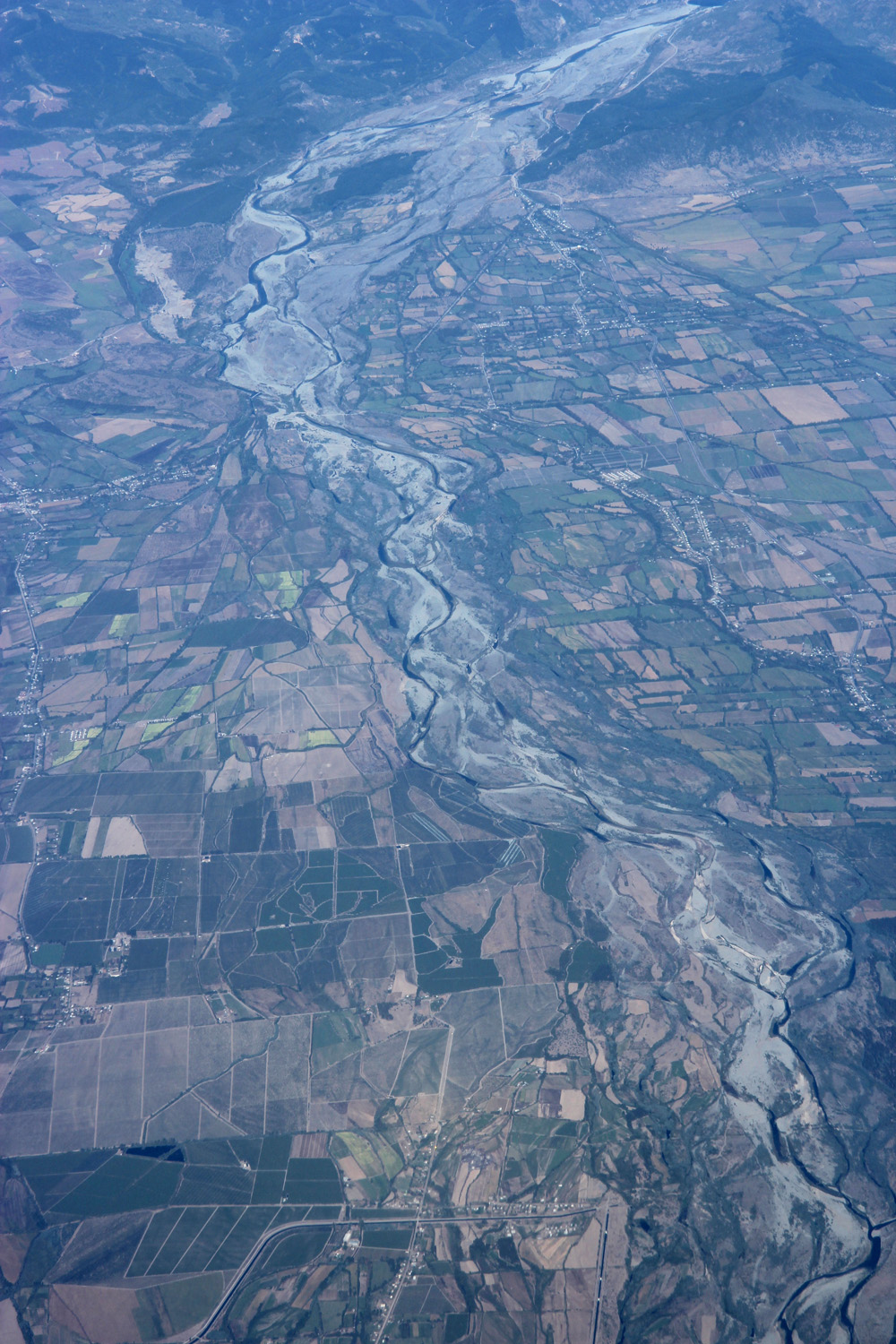
If anyone happens to know the specific locations, names, etc. of anything shown above don’t hesitate to comment below.
Patagonia field work — wrap-up

having some lunch along a mountain stream
Just a quick post to wrap up this series. I’m back in the office and digging my way out of the accumulated administrative detritus after five weeks in the field. Overall, a successful field season — spent a lot of time scouting out areas we’ve seen from afar for several years but hadn’t actually hiked on. We took a lot of photographs. Photos of well-exposed cliff faces and other outcrops are important data for a major component of the work we are doing, which could best be described as high-resolution 3D stratigraphic mapping. Before leaving the field we had a photo back-up/sharing session — making sure that all these photos were on at least three or four hard drives. Losing these data to a hard drive crash would not be good thing.
This Flickr set has 130 of the 3,000 photos I took during the field season; a combination of landscape, scenery, wildlife, and geology images. I haven’t included titles, descriptions, or tags for all of them. I’ll do that at some point. I hope you enjoy them.
As always, the Chilean people were friendly and helpful. We’ve made some good friends over the years and look forward to continuing that in the years to come. It was especially fun to meet and interact with Chilean geologists doing paleontological studies in the same general area.
My next major field expedition is going to be very different. Instead of walking on mountains made of deep-sea sedimentary rocks I’ll be on a boat acquiring sediment cores from the deep sea in the North Atlantic. More about that in the coming weeks.
Patagonia field work — Update #5

An update from down south. Field work is going well, the weather has actually been quite wonderful. We’ve had multiple days in a row of near-perfect field weather. Weather can make this type of work glorious or full of misery, and we’re getting lucky the past couple weeks.
I figured I’d take the time to explain in a bit more detail about the work we are doing down here. The overarching goal of our research is to understand the stratigraphic patterns and evolution of deep-marine sedimentation. The deep-sea environment is inherently difficult to study — it costs a lot to deploy ROVs and other instrumentation on the seafloor to make basic observations and measurements of physical processes. One of the dominant processes that transfer sediment from continents to the deep sea, called a turbidity current (picture a submarine avalanche of mud, silt, and sand), can end up destroying any instrumentation. Additionally, these events occur infrequently at the timescale of human observation — once every few hundred to thousands of years — which makes it impossible to directly study a sequence of events.
So, we look to the evidence left in the geologic record. The transfer of sediment from land to the deep sea can, under certain circumstances, get preserved in the stratigraphic record. We are investigating such deep-sea deposits that were buried and then at some later point uplifted into a mountain belt. Weathering and erosion of those mountains reveals exposures of the sedimentary rock that we can study in detail.
But, why do we travel all the way to Patagonia to look at deep-sea sedimentary rocks? This particular sedimentary basin, the Cretaceous Magallanes Basin, is a foreland basin. Many outcrops of sedimentary successions come from foreland basins because they end up getting uplifted into the evolving fold-thrust belt. Compared to most foreland basins of this type, the Magallanes Basin had a unique tectonic history that resulted in a basin that was deep enough for long enough time to accumulate approximately 4,000 m of deep-sea sediments. If you’re interested in the details, my colleagues and I discuss this tectonic history at length in this paper.
This geologic history provides a situation to study a thick succession of deep-sea stratigraphy that evolved over 20 million years and resulted in a diverse assemblage of turbidite (the deposits of turbidity currents) architectures. Check out this paper that my colleagues and I published last year for the best ‘start here’ review of the Magallanes Basin.
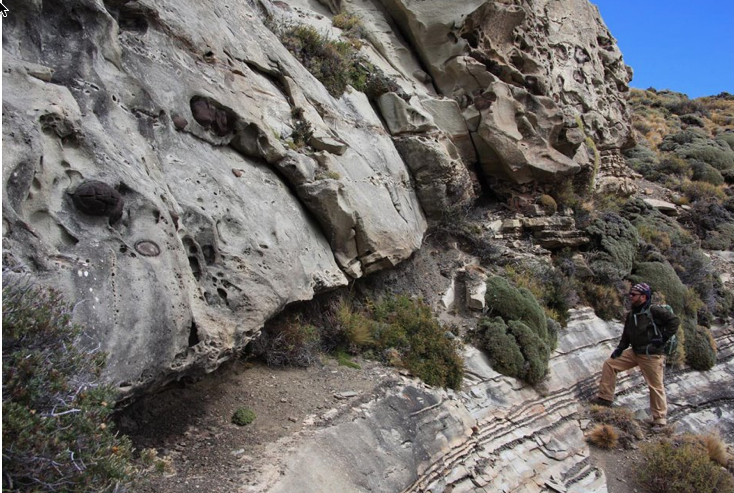
Photo of me checking out one of the beautiful submarine channel margin exposures.
There are numerous scientific questions about how these sedimentary systems work and how they relate to the evolution of the Andes in this region. But, how are the results of this kind of work actually used in applied Earth science? The deposits of deep-sea sedimentary systems that are still buried in the subsurface are important reservoirs that we extract fluids from (oil, gas, water) and that we inject fluids into (CO2). These subsurface reservoirs are not homogenous layers, rather they are heterogeneous 3D bodies. Subsurface geology is as rich and complex as geology at the surface, but we have only low-resolution remote sensing and dimensionally challenged observations to characterize it. These examples exposed at the Earth’s surface, in outcrop belts like the Magallanes Basin, provide an opportunity to characterize the complex relationships at scales we may never be able to achieve deep in the subsurface. Qualitative insights and quantitative information (e.g., sedimentary body dimensions) derived from outcrops like this are used to constrain models and, importantly, improve prediction of complex subsurface geology.
–
Image at top of post: This mountain, called Cerro Divisadero, is where I did a big chunk of my PhD research in 2004-2006. I haven’t been back since those days (it’s rather difficult to get to) but we got close enough last week to get this view. Here’s the paper that came out of that work.
Patagonia field work — Update #4
Here’s a short video clip I shot the other day of an Andean condor flying above us we hiked up on top of some sandstone cliffs. We see these magnificent birds all the time because we tend to be around cliffs that have good exposure, and they like the updrafts the cliffs provide. They are scavengers and won’t attack, but they can be a bit startling just because of their size.
Also, I keep updating this Flickr set with new photos every 4-5 days, enjoy!
Patagonia field work — Update #3

Unexpected trip to town this morning to get some new (and much beefier) tires put on our vehicle. The ones we had were okay, but it’ll be good to have some better ones for some places we want to go in the coming weeks. So … while we wait for new tires to be put on we figured we’d stop by our favorite coffee/internet cafe.
Yesterday we drove up to Estancia Cerro Guido to meet with some other scientists doing research in this region. They were giving a little talk to some locals and tourists. One of them is a plant fossil expert investigating the history of South America-Antarctica connections. Patagonia and the Antarctic Peninsula were once connected until the Drake Passage fully opened in the Oligocene. He’s studying the Upper Cretaceous through Miocene plant fossil record in both Patagonia and Antarctica to test hypotheses about the timing of the opening. Very cool.
Another scientist gave a short talk on ichthyasaur fossils they are excavating from Jurassic to Lower Cretaceous strata just west and downsection from where we are working. The fossils are extremely well preserved and found amongst deep-marine turbidite deposits. An interesting aspect of this is the mechanism for their preservation because it’s thought turbidity currents would destroy the carcass in the process of ripping it up off the seafloor. They are hypothesizing that the animals were potentially sucked down into a submarine canyon following the passage of a turbidity current. Very interesting.
It’s great to learn about what other Earth scientists are working on down here. We are focused on the sedimentology and stratigraphic architecture of these turbidite systems — mapping out bed-scale to basin-scale relationships and reconstructing the location and nature of submarine channel systems. These channels are the main conduits delivering sediment from land to the deep sea and their deposits left in the rock record help us understand their evolution.
Image: photograph taken yesterday of the famous Paine Massif near Estancia Cerro Guido


 Clastic Detritus