Friday Field Foto #28: Thin-bedded turbidites
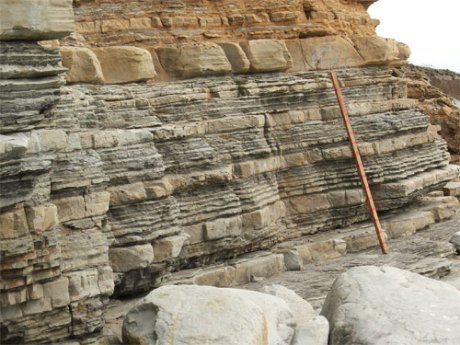
It’s not quite Friday yet, but close enough…15 minutes to go.
Check out these strikingly rhythmic turbidite beds. I’m not a fan of the term ‘rhythmites’ because that implies, to me anyway, that the deposits are the result of a rhythmic process. Just because the response appears rhythmic doesn’t mean that the process was.
Anyway, this is a pretty beautiful example of the expression of thin-bedded turbidites. This package is in between two very thick (>50 m) successions of coarse sand and some conglomerate beds (some individual beds getting up to ~8 m thick). These are so well exposed because this entire outcrop is along the coast and washed nicely by wave action.
This is up north of here near the town of Gualala (apparently Ron did some of his graduate work there…maybe we can bug him to post about that someday).
See all the Friday Field Fotos here.
The Jacob Staff (the “jake”) at right is 1.5 m tall.
~~~~~~~~~~~~~~~~~~~~~~~~~~~~~~~~~~~~~~~~~~~~~~~~~~~~~~
A couple months ago I posted about what makes summer in San Francisco unique. Fog.
Well, as the summer season winds down in late August and early September here, the fog tends to be less frequent, not as thick, not as cool, and less ‘intense’ (generally). So, the nice summertime weather is actually just getting started here. The month of September is really our ‘summer’.

Check out my thorough analysis above of the temperature record (showing averages and extremes) for San Francisco from Wunderground (link). The light green vertical line is today (Aug 30th). Note how the record and normal high temps start to trend upwards as we get into September. September also has the highest normal temps (barely).
Time to go hang out at the coast and catch a sunset or two soon.
~~~~~~~~~~~~~~~~~~~~~~~~~~~~~~~~~~~~~~~~~~~~~~~~~~~~~~
Nit-picking science reporting
Kim’s post about the misleading headline that reads “Two Years Later, New Orleans Still Sinking” was enough to pull me off of the paper I’ve been working on constantly, and actually read the DiscoveryChannel.com article.
It’s an okay article…clearly the headline was written to connect the findings of a particular study on delta subsidence to the 2nd anniversary of Hurricane Katrina.
So, I figured I would post about it…and maybe pick a few nits.
The subsidence of the Mississippi Delta has never been a surprise to most geologists. It is, in fact, the traditional way large river deltas are thought to behave all over the world.
I am glad the author states this. Given the headline (as Kim points out) you’d think Katrina caused the subsidence in the first place. For me, putting the word ‘subsidence’ and ‘delta’ in the same sentence is almost redundant. I’m being cheeky, of course….but this is another example of how disconnected the general public is from knowing about the landscape they live on. By saying that this is no surprise to geologists, they are leaving out everybody else. This should be no surprise to EVERYBODY. It is a cop-out….another way for the general public to say ‘hey, I’m no scientist…I don’t care about that’. Malarkey.
On a side note…I can’t resist…I’ve been in a world of text, grammar, and word-smithing for weeks…the last sentence should be “It is, in fact, the way large rivers are traditionally thought to behave all over the world”. Our thinking is what’s traditional, not the delta’s behavior. Like I said….there’s a nit. I picked it. No big deal.
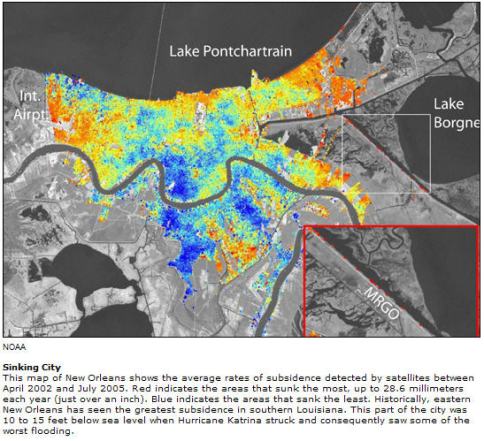
Then I thought a bit…and it seems like they are reporting about a study that was published last year. When I saw this image (above) associated with this Discovery Channel article, I knew I had seen it. Click here to go to a related abstract for a 2006 Geophysical Research Letters paper.
But, this DiscoveryChannel.com article from today states:
Dokka, along with Caltech’s Erik Ivins and Ronald Blom, published their results in the August issue of Geophysical Research Letters.
When I went to the list of papers in Geophysical Research Letters for August 2007 I could not find this paper or any paper by those authors. But you’ll notice that the quote doesn’t specify the August 2007 issue of GRL. Hmmm….and I still can’t find a paper by those three authors (if someone does, link to it in the comments). This is really not that big of a deal. The fact that they are re-reporting something that is very important is fine with me. But, I’m an anal-retentive scientist and if they are going to cite a paper in the article, I want the correct info.
Let’s move on.
Dokka and many other geologists argue…that rebuilding many parts of New Orleans is folly in light of the geologically doomed location.
The physics of the situation are a “no-brainer,” Dokka told Discovery News. The mouth of a large river is where giga-tons of muddy sediment drop to the bottom and pile up.
The pile-ups can even temporarily build land into the sea, as is the case in southern Louisiana. As this happens the river periodically switches the route of its main channel to get around the muddy dams it creates.
The southern and most seaward part of the delta, or the “birds foot”, is the most recent “pile-up” (delta lobe). This makes me want to draft a post about the fundamentals of deltas. The modern delta lobe south of New Orleans is only a part of the entire Mississippi River delta. Yes, this system is extremely muddy but the author is painting a picture that there is no sand. The distribution of sand and mud is a very important (and interesting to dorks like me) part of what makes a delta a delta.
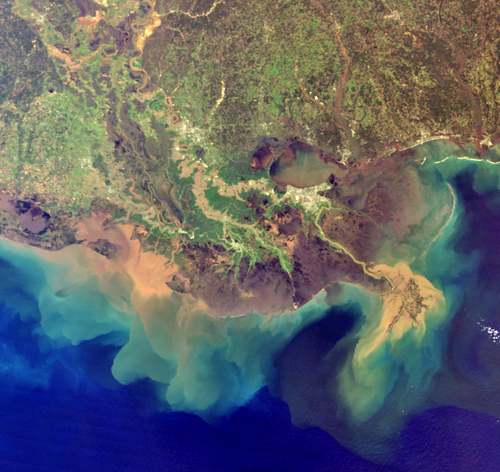
This image above is one of my favorite images of all time! I can’t believe I haven’t shown it on this blog yet. You can get it from NASA’s Earth Observatory website here. I’ve cropped it and tweaked the levels/colors a bit to bring out those gorgeous sediment plumes. Gorgeous!
Anyway, my original point (if I had one) was that although the information in this article is extremely important to report (even again and again), I don’t think it only has to be on the anniversary of Katrina. Don’t get me wrong, it’s better than nothing, but I think we can do better when it comes to informing and educating the masses about the landscapes they live on.
~~~~~~~~~~~~~~~~~~~~~~~~~~~~~~~~~~~~~~~~~~~~~~~~~~~~~~~~~
Big changes for “…Or Something”
I have done it … I made the big switch from Blogger (blogspot) to WordPress.
I took this opportunity to also rename my blog. I pondered a long time if a “rebranding” was a good idea or not. I’ve focused much of my blogging on Earth science, and sedimentary geology in particular, over the course of the life of …Or Something. That name doesn’t really represent what this blog is really about (plus, then I get to choose a geeky name).
So, the new name is …. drum roll … Clastic Detritus
The new feed is: https://clasticdetritus.com/feed
Hopefully this won’t cause too many problems. I know some of you receive my posts via feed aggregators (e.g., GoogleReader) so you will have to update that (sorry). I guess you’ll have to update your blogroll lists as well (sorry sorry).
Why the switch to WordPress?
- WordPress.com allows you to use your own domain but still host it through them. Although I had to purchase the domain ($15/yr), I feel that having my own is better in the long run.
- I’ve never been fond of how commenting is done in Blogger. It is often clunky and inefficient.
- I like the idea of having static pages associated with the blog (the tabs on the bottom of the header image).
- I like the look and feel of WordPress much better. When it comes to aesthetics everyone has their own preferences.
- The navigation for managing the posts, pages, and comments is also better (in my view).
I also felt the timing of changing the name would be better combined with the blogging software switch. The migration was relatively painless. All the posts and comments made it over, although I haven’t gone through everything yet. I will write a post about that soon.
~~~~~~~~~~~~~~~~~~~~~~~~~~~~~~~~~~~~~~~~~~~~~~~~~~
A call for posts for the inaugural edition of The Accretionary Wedge: Why do you study geology?
If you have no idea what I’m talking about, read this post and associated comments first.
We are organizing a geology blog carnival called The Accretionary Wedge.
What is it and how does it work?
- write a post related to the chosen theme
- one blogger will collect the posts and then distribute/announce
- there will be a different host each edition (me for this one)
- looks like about once a month (more-or-less) is a good frequency
Okay, so for the inaugural edition of The Accretionary Wedge we have come to a consensus that it would be a good idea to introduce ourselves to each other and the blogosphere at large by writing about why you study geology in the first place. What aspect of Earth/planetary science fascinates you the most? How or when did you decide this was the path for you? And so on.
This topic is purposefully wide open. It can be technical, it can be funny, it can be serious. As The Wedge evolves we will come up with other more focused topics. For this first one, it would be nice to just see the breadth of expertise and personalities the geoblogosphere has to offer.
Please e-mail me links to your post by 6pm (Pacific time) this Sunday (9/2), which is 0100 03/09 UTC/GMT. I will then put them together and release later that evening (with short blurbs introducing each submission). Please put the word “wedge” somewhere in the subject of your e-mail so I can filter it. My e-mail is romansbrian [at] gmail [dot] com.
If this timing is too soon, we can move it (although I will be out of town and away from computer from Wed 9/5 to Mon 9/10). If I don’t hear anything in the comments below, I’ll assume this works for everyone.
Please pass this announcement on to other geology bloggers!
Finally, although it’s not necessary a simple logo for the carnival would be cool. We can discuss that in the comments below.
~~~~~~~~~~~~~~~~~~~~~~~~~~~~~~~~~~~~~~~~~~~~~~~~~~
An e-mail I hope to get more often
In the midst of trying to write a manuscript, dealing with data glitches, and putting together the first edition of The Accretionary Wedge, I received an e-mail from the chair for a session at the upcoming American Geophysical Union (AGU) annual meeting in December.
I sent him a note, asking about the session, whether it was an oral or poster session, and so on.
And then I get this note back:
I have added you as an invited author.
Cheers
Yay!
One less thing to worry about….although I do still have to actually submit something (deadline is Sept. 6th, by the way).
~~~~~~~~~~~~~~~~~~~~~~~~~~~~~~~~~~~~~~~~~~~~~~~~~~
Calling all geology bloggers!!
Okay, I think we are getting somewhere now with getting a geology blog carnival going.
Coturnix from A Blog Around The Clock was kind enough to chime in and provide me a link to a post from last year outlining what a blog carnival is and what it should be (take a look). This is helpful…as the comments from last week revealed, many of us geo-bloggers are aware of carnivals but not quite sure what they are.
What is a blog carnival?
A blog carnival is:
– well-defined
– well-archived
– regular
– rotating
– linkfest
So far, we have agreed that the (still) unnamed geology carnival will be rotating (hosted on a different blog each issue), regular (about once a month, more-or-less), and, of course, providing the links to the posts.
We are still working on the ‘well-defined’ part of this equation. What should it be about? This is a tough question. Here’s what I gathered from the comments in the original post last week:
- we don’t want to focus on a single discipline within earth sciences (e.g., seismology, geochronology, sedimentology, etc.); the best aspect of a blogging community is the breadth
- but…we don’t want to be completely unfocused either
A couple of ways to strike the perfect balance (that we thought of so far) are to have editions of the carnival focus on:
- a geographic region — in this way, bloggers can share their expertise and knowledge but we will have a ‘theme’ within which the (hopefully) numerous posts will fit
- similarly…focus on a specific geologic time (e.g., Cretaceous, Archean, Holocene, etc.)
- share stories and photos about field work or field trips — many of us have chosen the path of geology as our scientific discipline because of field experiences
At this point, it seems there is a decent consensus to have our first edition of _________ to be about a geographic region. I think this is a great idea. I was also thinking that since plate tectonics is what ties everything together….it is our closest thing to a ‘grand unifying theory’… that for our first edition we should choose a tectonic plate to blog about (maybe one of the bigger ones to start).
In this way, we can choose a region but, at the same time, have a geological foundation from which the individual posts can start.

Any thoughts?
Does a ‘plate’ theme work for everybody? The host of each edition could be the one that gets to choose the plate (everybody has their favorite).
If everybody is on board with this, then I can go ahead and put together the first ‘call for posts’. But, please don’t hesitate to comment on potential shortcomings of this approach….I really want this to be a community decision.
One final, but very important issue: We need a name and a logo!!
I don’t know….maybe “Plates and Periods” …. or something.
Let the brainstorming begin.
image of plates from here
~~~~~~~~~~~~~~~~~~~~~~~~~~~~~~~~~~~~~~~~~~~~~~~~~~
Wilco at The Greek
“You were right about the stars
Each one is a setting sun”
 That is one of my favorite lines from Jeff Tweedy, the creative foundation for the band Wilco. We went across the Bay last night to see them at the beautiful Greek Theater on the Berkeley campus. The weather was perfect and although we got there a little later than we wanted, we didn’t miss any of Wilco’s set and got pretty good seats.
They played a lot of tunes from their newest album, Sky Blue Sky, which has seen a lot of play on my iPod in the last month or so. It’s a great record. Some of the songs are simple, even light, acoustic guitar melodies while some are more raucous rock songs. A few have a very Lennon/Beatles quality to them, especially “Hate it Here”.
 I am a huge fan of Yankee Hotel Foxtrot (2002)…I think that’ll always be their best, it is their Sgt. Peppers in my eyes. But this newest album might be my second favorite. The show last night was fantastic….a good mix of new and old. Jeff Tweedy is a great performer and the rest of the band members are all excellent musicians. I’m no Wilco historian but I think Tweedy and the bassist John Stirratt are the only members left from the original line-up back in the mid ’90s. Guitarist Nels Cline is a maniac!
It was a beautiful night and a great time. If Wilco comes to your town I highly recommend you shell out the cash to see them.
photo of Wilco from here
photo of Jeff Tweedy from here
~~~~~~~~~~~~~~~~~~~~~~~~~~~~~~~~~~~~~~~~~~~~~~~~~~
Friday Field Foto #27: Cretaceous marine shale

I was browsing my collection of photographs this morning looking for a Friday Field Foto and, as happens when you start looking at old photos, I was reminded of when we were doing this field work. Today’s photo is from the Cretaceous of central Utah (the Book Cliffs). When I was working on my master’s in Colorado we took many field trips in the western Colorado and east-central Utah. I’ve shown some photos from the Book Cliffs before (here, here, and here).
What’s obvious in the photo is the cliff-forming sandstone unit capping the mesa. These strata represent the movement of the ancient shoreline through the area. The underlying thick shale sequence (the drab, slope-forming gray ‘rocks’) are offshore marine deposits. If you look closely (click on the image to get a better view), you’ll notice a darker gray path heading up the gray slope to the base of the sandstone cliff. Me and another guy measured a stratigraphic section and took some samples up that hill. We were out here helping out another student and this was supplemental data for him….he was trying to look at the nature of the marine shale over a thick sequence.
This falls into the category of “hey, whatever happened to those data?”
~~~~~~~~~~~~~~~~~~~~~~~~~~~~~~~~~~~~~~~~~~~~~~~~~~~~~~~~~~~~~~
Scientific Integrity Editorial Cartoon Contest
Head over to Union of Concerned Scientists to see all the finalists for this contest. They are all pretty good…but this one is my favorite.

~~~~~~~~~~~~~~~~~~~~~~~~~~~~~~~~~~~~~~~~~~~~~~~~~~~~~~~~~


 Clastic Detritus