Who said mud isn’t exciting?
I’ve seen a few science news stories/blurbs about a paper that came out in Science last week making the rounds the last few days:
New York Times: A Clearer Muddy Story
ScienceDaily: As Waters Clear, Scientists Seek to End a Muddy Debate
I guess the whole “mud” play-on-words is just too dang easy.
Just when something as breathtakingly exciting as the transport and deposition of mud makes the headlines (you know you love it), I find myself lacking the requisite time to report about it any better than the stories above, or to blog about it in any great detail (see Olelog’s post here about this research). I would love to dig into this paper and compose a wonderfully concise blog post about the results and implications. Unfortunately, I have some travel approaching and am desperately trying to get a paper submitted before I leave (it’s not looking good).
The Schieber et al. paper, titled “Accretion of Mudstone Beds from Migrating Floccule Ripples”, reports results of experimental sedimentary research focused on the finest fraction (<62.5 microns or 0.0625 mm).
I have a confession to make. I am a mudist. That word is with an “m”…take another look. In other words, I discriminate against mud. I won’t lie. When looking at sedimentary rocks, I typically skip right over mudstone and shale and go right to the chunky stuff (sand and gravel). Hey, at least I look at the sedimentary rocks at all (I know some of you skip over all of them…shame on you).
But mudstone is a HUGE part of the geologic record and has long been under-appreciated, especially with respect to sedimentation mechanics. I think this is largely a result of its tendency to produce craptacular outcrops. The best mudstone deposits I’ve ever seen, by far, were from cores. Nicely cut and polished slabs or cores can reveal the beauty of muddy rocks that outcrops typically do not.
Although I haven’t actually read the Schieber et al. paper, the reports about it (including this nice review article by Macquaker and Bohacs in the same issue of Science) summarize the experimental work rather well. In a nutshell, they found that mud can accumulate at flow velocities (i.e., boundary shear stress) higher than previously thought. The fine particles aggregate into floccules, which, in essence, produces “larger” grain sizes.
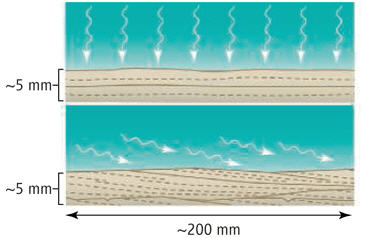 The cartoon at left (from the Macquaker and Bohacs review article) depicts differing processes of deposition (suspension fall-out vs. traction). The lab results from Schieber et al. show that traction sedimentation is possible because of flocculation. The implications of this are important because mudstone has long been thought to record “quiet” energy conditions. As usual, it looks like it might be a bit more complicated than we thought. One of my goals over my holiday break is to read this paper in some detail and re-post about it in a couple of weeks.
One thing I’m wondering is how important is combined suspension and traction deposition in mudstones? I’ve posted about climbing ripple-laminations before (here), which, in some cases, show a nice succession from dominantly traction sedimentation to dominantly suspension sedimentation within a few 10s of cm of deposits. Is this happening in mudstone deposits and we simply can’t see it? If so, are the patterns similar?
I’ll leave you with a quote from the Macquaker and Bohacs review article discussing the big-picture implications of their findings.
These results come at a time when mudstone science is poised for a paradigm shift. Observations accumulated over the past 30 years indicate that deposition and burial of mud is as dynamic and complex as that of sand or limestone–or possibly even more so, because of myriad processes–including grain-size changes due to aggregate growth and decay, presence of biofilms, reworking, and cement precipitation–that occur in mudstones to control their variability.
Aren’t you excited about mud now?
~~~~~~~~~~~~~~~~~~~~~~~~~~~~~~~~~~~~~~~~~~~~~~~~~~~~~~~~~~~~~~
Sea-Floor Sunday #7: Bathymetry of Northeastern Atlantic Ocean
I came across a beautiful map of a fairly large area of the northeastern Atlantic Ocean yesterday and wanted to share it for this week’s Sea-Floor Sunday.
I have a few snapshots of the map in this post, but to really appreciate the map you should go to this site and download the high-resolution version (~9 MB). That page is part of the website for IFREMER, or the French Research Institute for Exploration of the Sea.
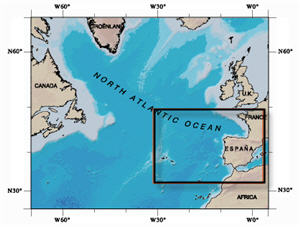 The map at left is for context and shows the area of interest. We will be looking at the area from offshore of France, the Iberian Peninsula, and parts of northernmost Africa to the Mid-Atlantic Ridge.
The map below is a snapshot of the entire map area. As noted above, scroll to the bottom of this site to download the 9 MB jpeg. I especially like their use of oranges and reds for the shallowest depths in the bathymetry scale.
Note the cluster of seamounts just west of the Strait of Gibraltar. These are a northern extension of the Canary Islands volcanic chain (that are just off the map to the south). The origin of the volcanic chain is debated (hotspot/plume volcanism, zone of extensional deformation, etc.). This paper (1), which favors a hotspot interpretation, focuses on the Canary Islands themselves but also discusses the implications for the chain.
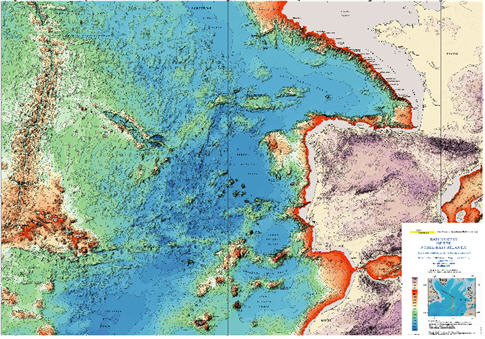
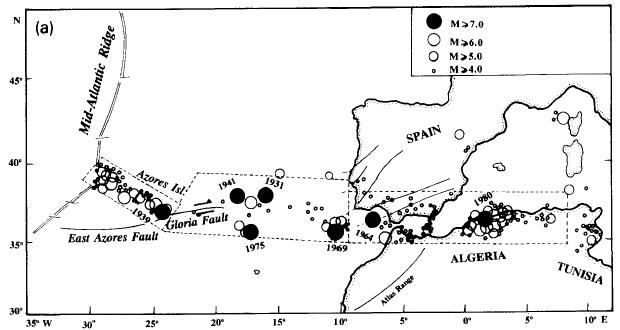
The other noticeable cluster of red colors just east and off-axis of the Mid-Atlantic Ridge in the map above are the Azores. This triangular volcanic plateau connects the Mid-Atlantic Ridge with the East Azores Fracture Zone, which runs west-to-east ultimately separating Africa and Iberia. In other words, it’s a triple junction. There are numerous papers out there about the Azores; here are just a couple I found while researching this post (2 and 3). The image below (from 3) shows the seismicity along this plate boundary. Click on it for a slightly larger image.
The series of images below are zoomed-in snapshots of the map. Note the broad continental shelf offshore of France in contrast to the much narrower shelf north of the Pyrenees

The image below is zoomed in to the northern part of the Azores triple junction.
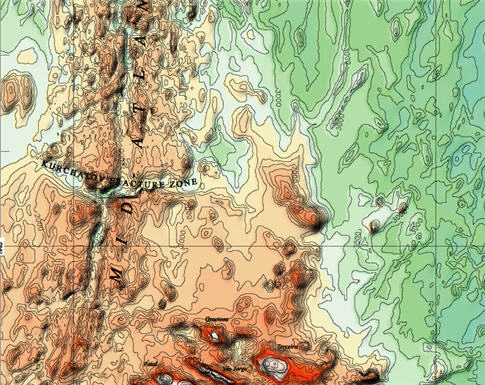
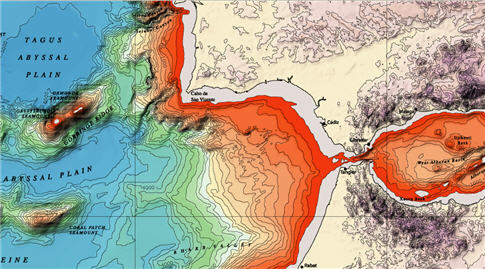
The final image below shows the Strait of Gibraltar. Oooh…looks like a nice submarine fan building out into the Atlantic right out of the strait.
See all Sea-Floor Sunday posts here.
–
References
(1) Geological Magazine (1998), 135: 591-604 Cambridge University Press doi:10.1017/S0016756898001447
(2) 1998, Lourenco et al., Morpho-tectonic analysis of the Azores Volcanic Plateau from a new bathymetric compilation of the area: Marine Geophysical Researches. 10.1023/A:1004505401547
(3) Kiratzi and Papazachos, 1995, Active crustal deformation from the Azores triple junction to the Middle East: Tectonophysics Volume 243, Issues 1-2, 15, Pages 1-24 10.1016/0040-1951(94)00188-F
~~~~~~~~~~~~~~~~~~~~~~~~~~~~~~~~~~~~~~~~~~~~~~~~~~~~~~~~~~~~~~~
A few of my favorite pet rocks
For the 4th edition of The Accretionary Wedge blog carnival, which is hosted over at goodSchist, we are showing off our favorite pet rocks (or “deskcrops” as coined by Thermochronic).
–
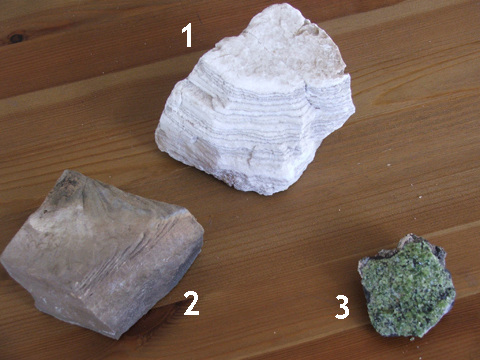
The first shot below is an “overview” shot of three of my favorite deskcrops (or, more correctly in this case, bookcasecrops).
–
1. Permian Evaporites of the Castile Formation
Stopping along Highway 62/180 in between Guadalupe Mtns National Park and Carlsbad Caverns is a favorite for geology field trips of any kind. At this location, you are not in any national park and can smash and grab as much of this rock as you want. The photo below is a close-up of these beautifully-varved evaporites (alternating calcite and anhydrite, and some halite in there too).

–
2. Permian Turbidite
Also from the Permian Delaware Basin of west Texas and New Mexico, this sample was given to me by my master’s advisor. It is from the Cherry Canyon Formation and nicely shows the “a”, “b” and “c” divisions of a Bouma turbidite sequence. The “a” division is a the base and is normally-graded and structureless (just the very bottom of this particular deskcrop). This grades upwards into the plane-laminated “b” division. And, finally, the top of the deskcrop is the ripple-laminated “c” division. What’s particularly nice about this sample is how exquisite the ripple forms are preserved. One of my favorites!

–
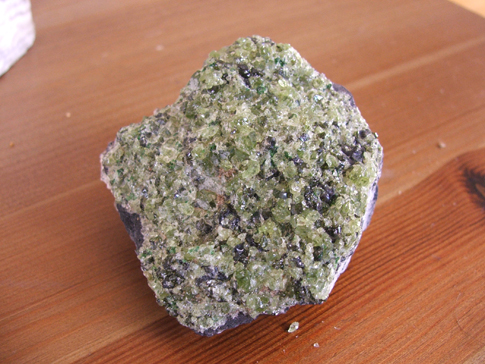
3. Xenoliths from Kilbourne Hole
I didn’t even realize until now that all of these deskcrops are from the same region. I picked up some beautiful xenoliths from this maar volcano just last September. The locale is a little tricky to find (it’s a hole in the desert), but there are still lots of beautiful olivine/pyroxene xenoliths like this one to find if you can find it.
–
Thanks to Chris over at goodSchist for hosting…go check it out.
~~~~~~~~~~~~~~~~~~~~~~~~~~~~~~~~~~~~~~~~~~~~~~~~~~~~~~~~~~~~~
AGU blogging #3: Friday and conference wrap-up
I did not make it to the conference on Thursday, but I was there yesterday (Friday) from 8:00 am until 5:30 (with a nice long lunch in there).
There were several posters I wanted to check out yesterday morning, but I went early to catch a few of the talks in the “climate sensitivity” session. Jim Hansen was supposed to be first, but they had a technical issue so they bumped James Annan up. That name seemed familiar to me and, lo and behold, it is the same James of James’ Empty Blog. The topic is not in my field so I cannot comment on the nitty-gritty, but James delivered a great talk about our assumptions that are built into calculating various probabilities of climate scenarios. Jim Hansen spoke next and discussed the paleoclimate record a little deeper than people usually do (the Cenozoic record) within the context of evaluating sensitivity. He had to rush at the end of the talk to finish in time…this was a pattern I saw many times at this meeting that I will rant about below.
I then checked out some posters about river bifurcation and avulsion. Specifically was Doug Jerolmack‘s poster discussing some observations and modeling of how avulsion leads to bifurcation patterns and the time scales in which this happens. Doug is a very enthusiastic scientist and does a great job of explaining his work. If you ever have a chance to check out a talk/poster by him, do it.
I checked out several posters in the hydrology/sediment transport session. As a sedimentary geologist, I’m mostly concerned with long-term preservation (stratigraphy) but always learn something from those looking at the mechanics of sediment transport.
I then went to check out a talk by a former student at my institution that is now at NASA’s Jet Propulsion Laboratory (JPL). He did his work on the habitability of Europa. He is essentially a combination of a physicist, astrobiologist, planetary geologist, and engineer. His talk discussed some aspects of calculating the thickness of the ice shell on Europa that were way over my head. The point of the talk was to try and calculate the thickness based on physics alone (especially the tidal interactions with Jupiter) and not so much by looking at the ice surface.
Later in the afternoon, the last slot of the whole conference, I went to a “depositional landforms” session. The aim was to bring together observation of modern and ancient systems with modeling studies. It was a good session, I enjoyed it. It’s tough to be on Friday afternoon like that, but there was a decent-sized audience. Sessions that aim to integrate disciplines are a double-edged sword in some senses. I love the concept, I am very much a fan of integration…but, sometimes I feel like the session needs a wrap-up of some kind. Either a really good talk at the end that actually brings things together, or a discussion panel. I’m not sure what the answer is. Again, I enjoyed the session and don’t mean to sound nit-picky, but I’m always trying to think of ways to make it better.
On to one of my biggest pet peeves. Several times during AGU this week I was annoyed at talks that ran out of time and had to rush through about 4-5 slides in the last 30 seconds. I understand that 13-15 minutes is a short time to give a talk, but everyone knows what the length is and should be prepared. I get way more out of a talk that gives a nice “take-home” message at the end. A good punctuation mark, so to speak. The talks that started off great and were clearly not practiced for timing, trailed off with a lot of details and essentially had to blow off the conclusions (and no time for questions). The whole point of a giving a talk, to me, is to give the audience something to take away. What is the point of the study? Did some unexpected questions arise from doing it? Is there a problem with our conceptual understanding at some fundamental level? Did it quantitatively address some issue that previously wasn’t? And so on, and so on. The bottom line: PRACTICE YOUR TALKS! Maybe I’m being nit-picky, but I’ve seen this pattern in a lot of conferences. It can make a talk that starts out fantastic end with a whimper.
Overall, I had a great time at AGU this year. It is a hugemongous conference and can be a little overwhelming. I don’t even attempt to catch all the “big” events and typically stick to sessions in my field. Those of you who go to conferences know how tiring it can be. The location is, of course, one of the best parts. Not only because it is a 15-minute street car ride for me, but San Francisco is also one of the greatest cities in the world. We had a great weather this week too…sometimes it can be dreary and gloomy this time of year, but it was sunny and crisp all week.
I have a good idea for a session next year…I might work on getting that down on paper now.
About.com has a nice Friday wrap-up as well here.
~~~~~~~~~~~~~~~~~~~~~~~~~~~~~~~~~~~~~~~~~~~~~~~~~~~~~~~~~~~~~~~
REMINDER: The Accretionary Wedge #4 posts are due on Saturday
REMINDER!!
This post copied directly from goodSchist.com — go here to see the post and make any comments to Chris.
~
goodSchist is hosting AW episode 4. This month’s theme is “My Pet Rock”.
As was decided by no majority at all on the discussion thread, the 4th installment of The Accretionary Wedge geology blog carnival will be “My Pet Rock”. As Ron Schott put it;
I think Thermochronic hit on a really interesting theme in writing about rocks in your home/office collection, or Deskcrops as he coined it (http://apparentdip.blogspot.com/search/label/Deskcrops). Others might prefer to call these pet rocks, but in any case they usually will have interesting stories and many folks have them.
Could be very interesting.
Could be very interesting indeed. So, as geologists with large rock collections, tell us about your favourite sample. Why is it interesting? Where did it come from? What’s its history? The most difficult part maybe choosing just one, so don’t feel limited. Give us the run down on as many of your favourite deskcrops as you like.
Please email your submissions to Chris (yorrike {at} gmail {.} com – with the ” {at} ” replaced with an @, and the ” {.} ” replaced with a simple .), with the words “accretionary wedge” in the subject, before the following deadline:
01:00 December 14th EST (New York)
04:00 December 14th PST (Los Angeles)
12:00 December 14th GMT
23:00 December 14th PST (Sydney)
~~~~~~~~~~~~~~~~~~~~~~~~~~~~~~~~~~~~~~~~~~~~~~~~~~~~~~~~~~~~~~
My post-PhD plans
Those who have been following this blog for the last few months know that I am very close to wrapping up a PhD in geology. I successfully defended last Friday and, after nearly a week, it is finally sinking in that that part is over and I feel really good about it. As I mentioned, I have some revisions to work on, which I hope to accomplish by the end of January 2008.
So, what am I doing next?
I’ve taken a job as a research geologist with The Man*.
In the last year or so I have applied for some academic jobs but nothing panned out. It is very competitive out there. Additionally, I didn’t apply to any and every job…I was pretty picky about location and the description of the position. The jobs I applied for were in places others would like to live, which surely contributed to the competitiveness.
At this point in my scientific career I want to continue doing research. I might’ve been able to land a job at a smaller school where my duties would primarily be teaching. I do enjoy teaching, but am not ready for a job that is all teaching. I could see wanting that down the line, but right now I want to be doing research, writing papers, going to meetings, re-writing papers, chairing sessions, reviewing papers, and so on. Maybe that sounds crazy to some, but that’s where I am.
So, the job I have with The Man will allow me to do just that. I will definitely be utilizing the skills and expertise I’ve gained from earning a PhD for this job. The Man typically doesn’t put a lot of effort into truly basic scientific research. The position I have is pretty darn close though. I will be able to continue working on projects similar to what I just presented at AGU yesterday. I will be able to continue working on ancient turbidite systems exposed in outcrops as well. Additionally, I will be involved in developing and teaching training courses (including field courses!) for other employees of The Man. This will satisfy the teaching bug at some level.
On a more personal level, taking this job also allows us to stay in the Bay Area. My girlfriend already has a job here she really likes and we enjoy the weather and overall “vibe” of the area. In other words, we don’t want to move.
What does this mean for Clastic Detritus?
Hopefully, not much. Obviously, I won’t be blogging about life as a graduate student or writing a dissertation once it is all completely behind me (which is still a couple months away). The “academic life” tag won’t get as much use. But, my posting about sedimentary geology topics and summaries of important papers will continue. This is what this blog is really about anyway, so I see no reason why the transition out of grad school and into professional life should change that dramatically. Friday Field Fotos and Sea-Floor Sundays series won’t stop either.
Additionally, as time goes on, the work that I’ve done as part of my dissertation will start to appear in the published domain (hopefully), at which point I will post about it more detail than I have thus far.
I hope you all, the readers of Clastic Detritus, continue to visit and comment. Don’t hesitate to drop me a line about sedimentary geology-related topics or questions.
—
*I won’t talk about The Man in any detail on this blog. The Man is known to get upset if his doings and goings-on are written or talked about in detail. The Man has good lawyers and I do not want to upset him. If you ask me any detailed questions about the specific research I do for The Man, which Man it is, etc., I will not answer them. That being said, I will from time to time discuss in general terms what I do.
~~~~~~~~~~~~~~~~~~~~~~~~~~~~~~~~~~~~~~~~~~~~~~~~~~~~~~~~~~~~~
Why isn’t AGU on Scienceblogs.com’s radar?
Perusing the front page of Scienceblogs.com this morning I notice that the call for a science debate in the U.S. presidential race is the top news. I can certainly understand why that would get the most attention. It is indeed an important initiative that I hope continues to get stronger.
But, even looking down at the list of some of the individual posts of the day, there are very few (if any) posts about the American Geophysical Union fall meeting in San Francisco this week, which is the annual meeting for earth, planetary, and space science. This is a huge event.
Is it because the bloggers on scienceblogs.com don’t care about earth science? Of course they care. I think the problem is there is a serious lack of earth/planetary/space science bloggers over there. The geoblogosphere’s strongest link to that community is Chris over at Highly Allochthonous…and he’s doing a great job of blogging about geoscience-related topics. Additionally, there are other bloggers who discuss climate science as well.
I enjoy several of the bloggers over at scienceblogs, but, as time goes on, I find myself not going there as much. Firstly, I simply can’t keep up with fast blogging pace (those who do multiple posts a day). Additionally, while I understand blogging and discussing political/societal issues is extremely important, I sometimes don’t feel like sifting through it all when I’m in the mood for information about the latest science in other fields.
I’m not sure what the solution is … it’s not so much about adding more earth science bloggers to their roster. The number of blogs over there is getting so large that I find it hard to keep up with anything. Will scienceblogs be like a stock and have to split at some point? At what point does the sheer size of it start to hinder rather than help the goal of communicating science?
Anyway, back to my point … if you do want information about the AGU meeting, the folks over at RealClimate have some great real-time (or close to it) blogging of the big happenings with respect to climate science this week. Check out the latest here and here.
Andrew over at About.com is also summarizing some of the news coming out of the meeting.
~~~~~~~~~~~~~~~~~~~~~~~~~~~~~~~~~~~~~~~~~~~~~~~~~~~~~~~~~~~~~~~
AGU blogging #2: Wednesday wrap-up
Again, the title of this post is a little misleading. This post is not a wrap-up of what a happened at AGU on Wednesday as a whole, but what happened for me at AGU on Wednesday.
I gave a talk in a morning session called From Mountains to Ocean Deep: Tracking Material Fluxes. Basically, two sessions had to be combined into one session…so the first few talks focused on fluid and elemental fluxes, and the second part focused on sediment fluxes. It worked okay…but was a little to disjointed for my liking. When people are giving 12-13 minute talks, they need to get to the point, which requires some jargon and “skipping” the fundamentals. Specialists appreciate this, but others get lost quickly. This is just the nature of the beast. If I’m in a session about a certain topic, I expect everybody to be on the same page. So, when disciplines are brought together to try and bridge a gap, sometimes it doesn’t quite work out.
Anyway…my talk ended up being the last one before the lunch break (and end of the session). I received great feedback about it and had plenty of follow-up questions. I was very happy with the talk…I felt very comfortable with the timing and the “take-home” message.
The poster session component of this same session was in the afternoon. I was a co-author for a poster and ended up hanging out by the posters all afternoon. I spent some time talking to a woman doing some work on clinoforms offshore of the Fly River in the Gulf of Papua…fantastic data, fascinating stuff. Another poster summarized some physics-based models of turbidity currents flowing down Monterey Canyon. They were able to constrain some of their parameters from real measurements made in recent years from monitoring systems in the canyon. This is just the tip of the iceberg, so to speak…we are only beginning to find out about the sedimentary processes that take place in these settings.
After that, a small group of us went and got some sushi in The Mission and then a few beers. A great day at AGU!!
I’m not sure what’s going on tomorrow…I need to look at the program.
~~~~~~~~~~~~~~~~~~~~~~~~~~~~~~~~~~~~~~~~~~~~~~~~~~~~~~~~~~~~~
AGU blogging #1: Tuesday wrap-up
If you’re expecting a detailed report of exciting new geoscience research reported at AGU today, you should go somewhere else. I didn’t arrive at the meeting until lunchtime and then spent most of the afternoon browsing posters rather lazily. Luckily, I’m just a guy with a blog and not a member of the press.
I did go to a few talks in the Geomorphology of Mars session, which was pretty cool. One thing I realized watching these talks is how fundamental the geology they are doing is. I saw a talk about using HiRISE images to do some basic structural geology. They were able to generate a DEM and then make traverses and measure bedding attitudes on very well-exposed sedimentary rocks. Pretty cool. The interpretations of the geologic history are very speculative without any ground-truthing, but it’s a start. Another talk in this session discussed what they termed “rhythmic” bedding and then speculated about highly ordered cyclical forcings (e.g., Milankovitch cycles). This is a pet peeve of mine … cyclical bedding can be generated from non-cyclical forcings … there is no need to jump to conclusions about a highly ordered forcing. Especially, on Mars where we won’t be able to ground-truth for some time. But, to the presenter’s credit, he did say this interpretation was only a possibility and is impossible to confirm with the data available at this point.
I saw some nice posters this afternoon, but have to admit that I was relatively relaxed today and did not dive head first into any of the studies. I did, however, check out a poster about a thermochronology study that was pretty cool…that’s a hot field, I hear.
I’m rampin’ up. Tomorrow morning, I’m going to be checking out most of the talks in the session my talk is in. And, in the afternoon, there are tons of posters for that same session. So, hopefully, I’ll have a bunch of notes and thoughts to share tomorrow night.
~~~~~~~~~~~~~~~~~~~~~~~~~~~~~~~~~~~~~~~~~~~~~~~~~~~~~~~~~~~~~~~
Wait … I have to give a talk tomorrow
I’ve known for weeks that my AGU talk is tomorrow. Last week, I even posted the time/place and abstract. But, in all the hub-bub of the defense and post-defense relaxation/celebration, I didn’t think about what I’m actually going to say that much.
I was just about to walk out my door to take a street car down to the meeting and had one of those moments where you stand in your hallway debating with yourself. In theory, I could head down there and take breaks in between talks and posters to work on my talk. It doesn’t need that much work … all the elements are there, I just talked about this research on Friday. But, in the end, I decided I should stay home for the morning and get the talk cleaned up and all shiny for tomorrow. Unfortunately, I’m going to miss some talks I wanted to check out this morning, but that’s the way it goes. Hopefully, I’ll be able to get down there by late morning.
As Yami points out, there was a geoblogger meet-up last night. Me, Yami, Andrew, and Thermochronic had some beers, shared some California tapas, and discussed various aspects of our blogging in addition to what we’re all doing in the “real” world. I hope these meet-ups are something that happen every year … I enjoyed it.
They all heard about what my plans are after officially finishing up the dissertation (in January/February). It’s not that exciting really, but I will post about it in the next few days.
~~~~~~~~~~~~~~~~~~~~~~~~~~~~~~~~~~~~~~~~~~~~~~~~~~~~~~~~~~~~~~


 Clastic Detritus