What do you listen to while writing?
I’m sure most of you (my readers) are involved or affiliated with science (especially of the Earthly variety) in some shape or form. And many of you probably do quite a bit of writing … scholarly and/or technical writing, that is.
I enjoy listening to music when I’m writing. For me, it has to be without vocals and usually towards a more ambient style. I dislike the term ‘background’ for music because I think music is something to be experienced in its own right, but when I’m trying to focus and get in the ‘zone’ the more the music blends into the background the better.
A monthly music podcast (that I posted about a long time ago) delivers exactly what I’m looking for. It’s called Bending Corners and each month they produce an hour-long set of (usually) instrumental music. Most of it is a nice blend of jazz, electronica, and funk elements. Very interesting music (to me) yet not in your face commanding your attention. Plus, I like that each file is one long set … there’s no monkeying around with playlists and such. When trying to find a writing groove, we all know how the smallest distraction can result in yet another hour of procrastination thinking. At this point, I’ve downloaded over 10 of their sets and can just hit play and have great writing music for several hours.
If the task I’m doing is a bit more mindless (e.g., drafting figures, screwing around with spreadsheets, etc.) then I’ll sometimes choose less ambient music.
Do you listen to anything? Do you like it silent? If you do listen to music, what kind? Anyone have good recommendations?
~~~~~~~~~~~~~~~~~~~~~~~~~~~~~~~~~~~~~~~~~~~~~~~~~~~~~~~~~~~~~~~~~~~~~~
Why I rarely go to Scienceblogs.com anymore
Let me first say that Highly Allochthonous and Green Gabbro will always be in my aggregator whether they’re on Scienceblogs or not…they are fellow geoblogspherons. And there are a few other blogs on there (e.g., Laelaps, Deep Sea News) that I read semi-regularly as well.
What I’m talking about here is the front page of Scienceblogs.com … the chatter, the latest debate, the latest drama.
For example, check out this idiotic exchange on the blog The Intersection. Most of you might know what’s going on, if you don’t, it goes like this:
(1) atheist blogger gets thrown out of screening of creationist movie, (2) atheist blogger blogs about it in his usual brazen style, (3) those claiming to speak and strategize for science tell atheist blogger to shut up, he’s doing more harm than good, (4) atheist blogger tells science “framers” to ____ off (again, in his usual brazen style), and finally, (5) a different science framer tells atheist blogger to be nice.
Sigh.
Perhaps all of this is entertaining in some way. I used to spend more time reading blogs and their comments over there … not anymore. This latest brouhaha is particularly energetic and getting a bit nasty. Those advocating better science communication via “framing” (Nisbet, Mooney, et al.) have gone a bit too far. Essentially, they are telling outspoken scientists that they should keep their mouths shut and let “professional” communicators take care of it.
____ off!
I hear and appreciate their overall message … yes, scientists aren’t always the best communicators in every instance. But, c’mon … telling us that we should just shut up! They are wrong on this one.
Sean over at Cosmic Variance wrote a great, succinct post summing up exactly how I feel. You should go read it now.
So, while I have my favorite handful of science blogs that happen to be hosted at Scienceblogs.com, I can neither find the energy nor the time to wade through a sea of banter anymore. Maybe it’s my new job (I am definitely way busier), or maybe Scienceblogs has really changed since I’ve started paying attention (late 2006). Any thoughts?
~~~~~~~~~~~~~~~~~~~~~~~~~~~~~~~~~~~~~~~~~~~~~~~~~~~~~~~~~~~~~~~~~~~~~
Geology in the Movies – Coarse-grained villain
Instead of talking about geologists in the movies, my contribution to The Accretionary Wedge #7 is a real quick post about my favorite geology-related villain in a movie — Sandman from Spiderman comics.

How awesome is that? This is a villain for a sedimentologist … he’s made out of particles between 0.0625 mm and 2 mm in diameter. I’m not sure what the sorting is.
I suppose the next-favorite geology-related villain would Lex Luthor as played by Gene Hackman in the first Superman movie with Christopher Reeve. His whole plan was to jump-start the San Andreas Fault with some warheads. Yes!
–
image from here
~~~~~~~~~~~~~~~~~~~~~~~~~~~~~~~~~~~~~~~~~~~~~~~~~~~~~~~~~~~~
I usually show bathymetry images for Sea-Floor Sunday, but I saw this on Deep Sea News the other day and then spent a bunch of time checking out all the photographs on the Deepseascape.org website.
The photo below (from this archive) shows a sandy bottom with ripples and distinct animal trace (future trace fossil?). This is from the Faroe Bank Channel off the northwestern coast of the UK.
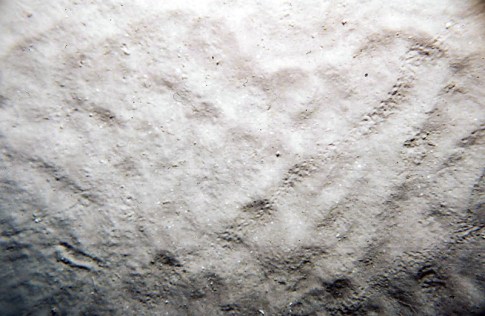
The site has an interactive map for searching for images. Some of the locations don’t have images associated just yet, but there’s plenty of deep sea floor photographs to be found.
Happy Easter.
~~~~~~~~~~~~~~~~~~~~~~~~~~~~~~~~~~~~~~~~~~~~~~~~~~~~~~~~~~~~~~
Every other Friday
One of the aspects of now having a job and not being a grad student is that I have a more set schedule. This certainly has its pros and cons … I kind of miss the freedom of being a graduate student … but, it is nice to leave work at work.
A schedule that many companies are adopting is called a 9/80, which means that you work 80 hours in 9 days. What this means is that you have every other Friday off. Each work day is a bit longer but you barely notice. Most companies will try and even it out such that about half the office is out each Friday (instead of everybody on same Friday).
I love this schedule.
The Friday that you do work is great because half the office is gone … things that waste your time (i.e., meetings) are diminished or eliminated. It’s a chance to get a lot of work done. But, today is my Friday off. What am I doing? I’m finishing revisions for a paper.
I was very happy to see ChrisR’s post the other day about his paper that came out after quite a long process. I’m in the middle of a similar stretch with one of the main papers from my Ph.D. research. His success gives me hope. I submitted it last July, got reviews back in early December (the week of my defense), and am now about to re-submit for either further review or the associate editor’s blessing (fingers crossed).
The reviewer comments were constructive and more-or-less aligned. The meat of the thing, the data presentation, was in great shape. They wanted an improved introduction section discussing the problem(s) and motivation better. They also wanted the discussion section at the end of the paper more focused and … well, just better. Oh yeah, it’s got to be ~15% shorter and get rid of at least three figures.
Essentially, shorten it and make it better.
So, on my every other Friday off I’m doing just that. I’m finally nearly done with revising this thing. I plan to submit on Monday or Tuesday after my co-author gives it one more look-see. When I compare to the original version, it is definitely improved. I’m optimistic, but we’ll see.
~~~~~~~~~~~~~~~~~~~~~~~~~~~~~~~~~~~~~~~~~~~~~~~~~~~~~~~~~~~~~
Friday Field Foto #45: Glauconitic sandstone
It’s several days late, but I wanted to get my own green rock (or, at least, photograph of a one) in for St. Patrick’s Day (see some great green rocks from earlier this week from Ron, Silver Fox, Tuff Cookie, and Harmonic Tremors)
This week’s photo is from the Cambrian Bliss Sandstone in the Franklin Mountains of westernmost Texas. The greenish material is glauconite … an authigenic mineral that typically forms in marine shelf settings, thought to reflect very slow sedimentation rates. In this example, the glauconitic sandstone is actually reworked material (note the cross stratification).
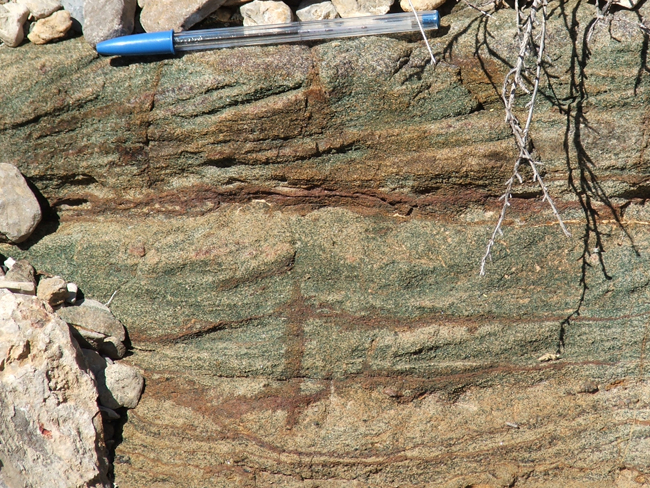
To learn more about what glauconite actually is, how it precipitates in sedimentary rocks, and what it means, check out this paper from Chavez and Reid (2000; Sedimentary Geology, v. 136)
Happy Friday!
~~~~~~~~~~~~~~~~~~~~~~~~~~~~~~~~~~~~~~~~~~~~~~~~~~~~~~~~~~~~
Geopuzzle: What’s the scale? (ANSWER)
ChrisR was the closest, and Ed wasn’t too far off either … the unknown scale bar from the photo in this post is about 36 cm, or two field notebooks long.
The reason I picked this photo is because these structures look very much like climbing ripples, except that they are climbing dunes. The lighter material is siltstone to very fine-grained sandstone and the brownish stuff is fine to lower coarse-grained sandstone. Note the consistent direction of climb (from right to left), especially in the interval just above the field notebook.
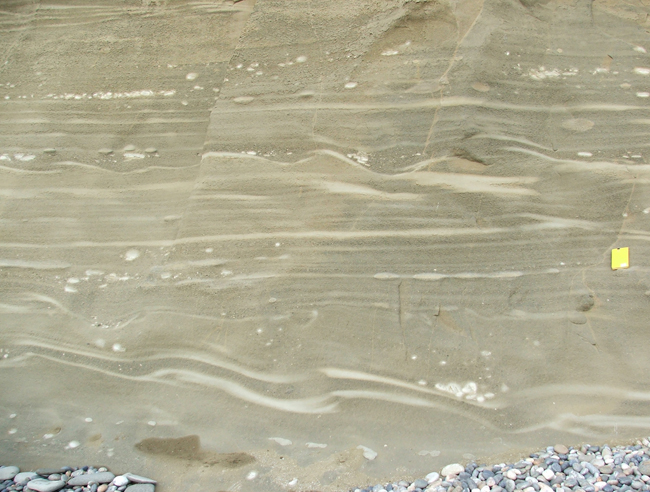
To get climbing cross-stratification you need a combination of migration and aggradation. In other words, these structures form where sediment is being transported in suspension and by bedload such that some grains fall out of suspension (aggrading the bed) while others are transported as bedload (migrating the bed).
Climbing ripples are everywhere in turbidite sequences, but climbing dunes are not nearly as common. It takes some fairly sustained sediment gravity flows to produce such structures.
Thanks for playing!
~~~~~~~~~~~~~~~~~~~~~~~~~~~~~~~~~~~~~~~~~~~~~~~~~~~~~~~~~~~~~
Geopuzzle: What’s the scale?
There have been some great geopuzzles coming out of the ever-growing geoblogosphere the last few months.
I’ve got another one.
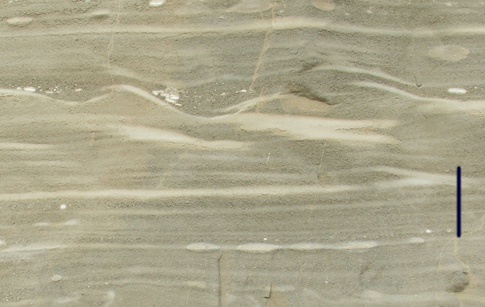
We all have hundreds or even thousands of photographs that, to the non-geologist, look like we are showing off our favorite hammer, pencil, or unidentified hand. The first thing we learned on our first field trip was to include a scale in your photograph. Nature has that pesky tendency to create self-similarity.
So … here we go … below is a photograph with scale context cropped out. While it may not be too difficult to get a general sense of scale, I’m looking for someone who can tell me precisely how tall that vertical black line is (lower right of photo). What do you win? Nothing really … I still don’t have those Clastic Detritus t-shirts made.
Good luck!
~~~~~~~~~~~~~~~~~~~~~~~~~~~~~~~~~~~~~~~~~~~~~~~~~~~~~~~~~~~~
Creation of a sustainable planet
One of my favorite blogs that I wish I had more time to read is called Trinifar and covers topics under the broad subject of sustainability, with particular focus on global consumption, growth, and population issues.
I’ve been able to catch up on a few blogs this weekend and noticed that Trinifar penned a nice series of posts titled “Creation of a different planet” recently:
Creation of a different planet: preface
Creation of a different planet: part 1
Creation of a different planet: part 2
Creation of a different planet: part 3
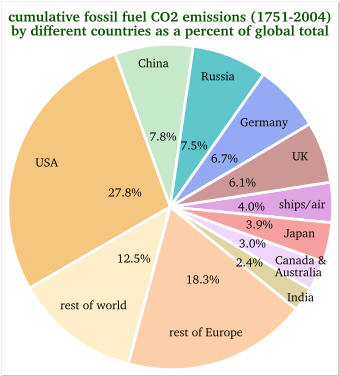
One of the aspects I like about this blog are the informative and visually-pleasing plots, charts, and graphs. Even if you don’t have the time to dive in and study the information in great detail, you can get a good sense of the information by looking at the illustrations.
~~~~~~~~~~~~~~~~~~~~~~~~~~~~~~~~~~~~~~~~~~~~~~~~~~~~~~~~~~~~~
Sea-Floor Sunday #14: Var submarine canyon
As I mentioned a few days ago, I am putting together some posts about the initiation mechanisms for submarine sediment gravity flows (e.g., turbidity currents). The first post for that topic should be done soon.
Today’s Sea-Floor Sunday images are from an active submarine sedimentary system in the Mediterranean Sea that has been characterized in great detail, mostly by French researchers. The forthcoming posts on initiation mechanisms will draw upon information from that work.
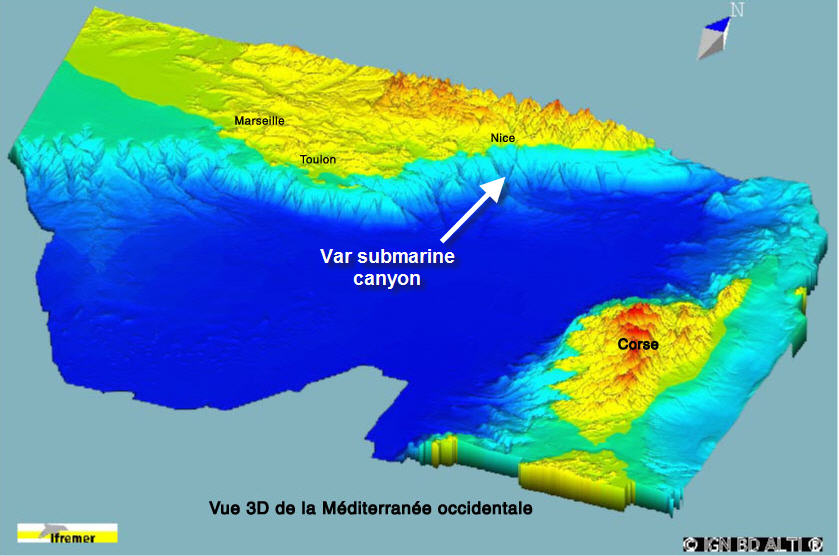
The Var River of southeastern France empties into the Mediterranean near the city of Nice. There is essentially no continental shelf at this location and the river mouth empties directly into the Var submarine canyon. This is an important system to study because the current sea-level highstand we are in today has resulted in many (but not all) river mouths far from the shelf edge. During the Last Glacial Maximum (~18,000-25,000 yrs ago), sea level was ~130 meters lower and many more river systems were positioned at the shelf edge. Thus the Var system is one example of how a “lowstand” system might behave.
The first image below (from the IFREMER marine geoscience website) is a perspective view of southeastern France, Corsica, and the sea floor in between.
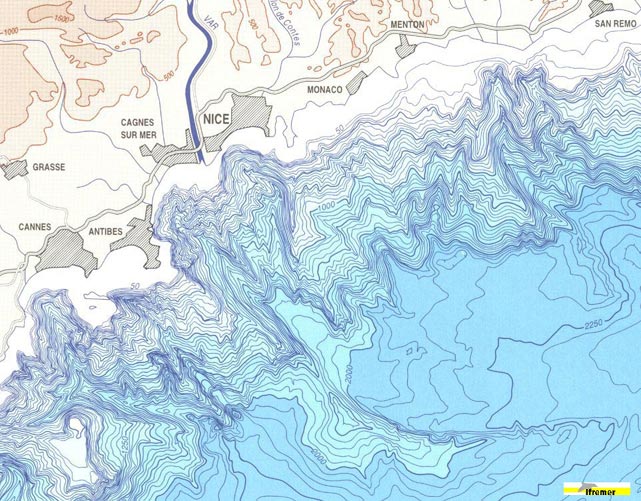
The next image (below) zooms in a bit and shows the bathymetric contours of the Var canyon and surrounding area. The Var River is the dark blue line just to the left of the label ‘NICE’. Note the submarine ridge that curves off to the east at the base of the slope. This is a depositional feature called the Var Sedimentary Ridge that is essentially a levee being formed as turbidity currents come down the canyon-channel system.
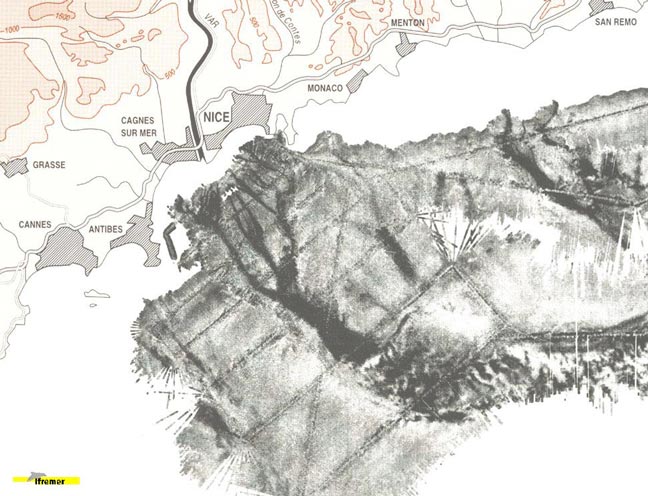
The next image (below) is the same map but now showing the ‘backscatter’ information from the sonar. These data represent the acoustic properties of the sea floor and, in this case, nicely reveal the tributary canyons coalescing into the main Var fan valley.
There are some great papers about the Var system that I will post about in the next couple weeks as I discuss initiation mechanisms. A great one that summarizes the system and very recent sedimentation events is:
Mulder et al. (1998), The Var submarine sedimentary system: understanding Holocene sediment delivery processes and their importance to the geological record: GSL Spec. Pub. #129, p. 145-166.
~
images from this page
~~~~~~~~~~~~~~~~~~~~~~~~~~~~~~~~~~~~~~~~~~~~~~~~~~~~~~~~~~~~~


 Clastic Detritus