UPDATE (July 2008): To learn more about the geology of the Bakken petroleum system, check out this study by Flannery and Kraus from 2006.
UPDATE (June 2008): I have edited the text from the original version of this post in April 2008. I incorrectly used the word “reserves” when I should’ve been using “resources”. In addition to that, I was using them inconsistently! My bad … thanks SF!
–
Reports, blurbs, and blog posts related to a USGS assessment of the petroleum resources of the Bakken Formation (Williston Basin, Montana and North Dakota) motivated me to look at the report in a little more detail.
Now, whether or not the resources should be developed is a question I’ll come to at the end of the post. I think, regardless of how you might answer that question, it is important for an entity like the USGS (as opposed to the private sector) to carry out these assessments. More knowledge is beneficial for making decisions.
The USGS puts together these great summaries, called “fact sheets”, for a lot of the work they do. Having done some work with the USGS myself, I found myself going back to their fact sheets for other topics over and over again. I’m sure one can nit-pick and find problems with them … blah blah blah … but, for a high-level overview, these are fantastic. You can find and download the PDF for the fact sheet for the Bakken resource assessment here. Much of what I outline below comes directly from that summary.
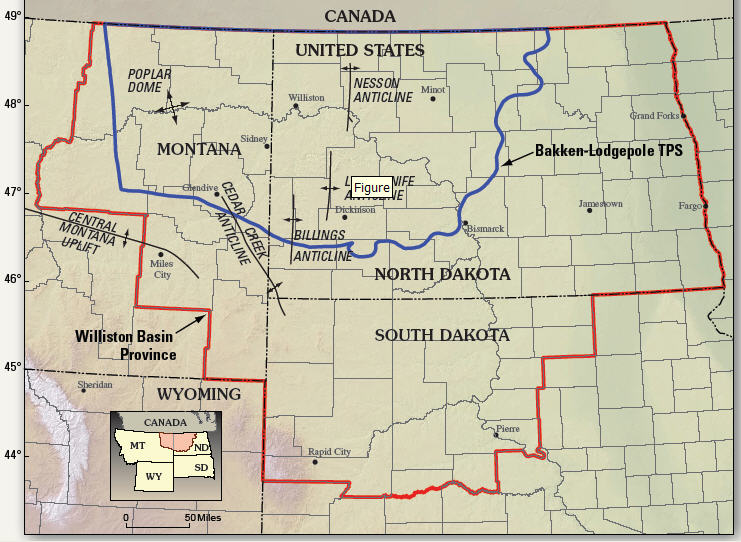
The map below shows the area of interest. The red line is the approximate boundary of the Williston Basin province, and the blue line is the boundary of the USGS’s total petroleum system (TPS) assessment.
What does total petroleum system mean? To accurately assess petroleum resources, three general aspects must be considered: (1) source rock, (2) reservoir rock, and (3) trap formation/timing.
The shales of the Bakken (Upper Devonian-Lower Mississippian) are already known to be a source rock for younger reservoir intervals in the Williston Basin. In terms of reservoir, the Bakken has a middle sandstone member that is thought to be widespread and a good candidate for a conventional reservoir unit.
Now, here is the crucial part of all this. This report concludes with some rather large numbers of recoverable resources – greater than 3.6 billion barrels of oil. Below is the summary table for these numbers. The total undiscovered resources is at the bottom right.

There are two types of resources reported here – continuous and conventional. Note that the conventional resources are a mere 4 million barrels, or 0.001% of the total reported undiscovered resources (I’ve circled it in red above).
Conventional resources are those that we can recover with existing drilling and production technologies and within the general current economic state. Continuous resources (which are sometimes grouped into the “unconventional” category by other assessments) are a different story.
So, then what exactly are “continuous” resources? This USGS site states:
The U.S. Geological Survey has defined a new type of hydrocarbon accumulation which is not trapped in the conventional sense because the accumulation is not significantly affected by the water column. These unconventional accumulations are areally large and are termed continuous because the reservoir rock is charged with oil or gas throughout. Many examples of continuous accumulations can be found in the United States. In conducting the 1995 National Assessment of Oil and Gas Resources, U.S. Geological Survey scientists included this new category of accumulation because of the large quantities of technically recoverable hydrocarbons, mostly gas.
The resources are technically recoverable in the sense that we could extract them if really wanted to. This is an extremely important distinction between what is economically recoverable. In other words, even though one could technically recover the oil, if the cost to recover it was far greater than what one could get when they sell it on the market, what’s the point. It’s uneconomic.
So, while quantifying unconventional resources is certainly important for getting a handle on what’s down there, they can be a bit misleading when reported in the mainstream media. The big wildcard in unconventional petroleum resources is, of course, the price of oil. As the price of oil goes up (increasing global demand + diminishing supply), the economics of recovering these unconventional resources starts to work out.
Personally, I think it’s important to acquire knowledge about such unconventional petroleum resources, but I don’t think we ought to focus our efforts on developing technologies that extract such resources at lower costs (thus making the economics work better).
Do we need petroleum? Yes, indeed. Are we going to need it for some time to come? Yes again. Anyone who thinks the world can operate as it is now without it is out to lunch. Of course, this doesn’t mean we don’t work hard to get ourselves off the stuff. I really despise false dichotomies in general and the one that arises in the energy debate is no oil vs. only oil. The former is unrealistic and the latter lacks vision and is typically driven by power/greed. Admittedly, the ‘we-need-to-get-off-of-all-oil-today’ argument may help to drive public opinion and attitude … I can appreciate that. But, when it comes down to actually making progress regarding energy solutions, we need practical solutions in addition to opinion and attitude. On the flip side, those who are constantly claiming how little alternative energy solutions make up our overall energy portfolio, as if that proves that it’s unimportant and we shouldn’t pursue it, are disingenuous at best.
So, should we start putting all our efforts to recover this resource? Personally, I would say no … at least, not yet. But, that’s just my own opinion. When I was doing a bit of web research for this post, I found myself on some right-wing blogs that were talking about how these resources would solve all our energy problems. This is a very weird thing to say, especially coming from people claiming to be free marketeers. Just because the petroleum is within the U.S., doesn’t mean it’s ours. We don’t have a nationalized oil company*. Companies that extract it, need to sell it on the market. It’s a commodity. The only oil that is truly nationalized is the Strategic Petroleum Reserve (SPR). All this rhetoric about “our” oil (this goes for ANWR and the OCS too) implies a completely different commercial model. Are those people advocating nationalization of America’s resource?
My main point here is to be aware of the different categories of resources that you might see reported in the media. Big numbers will be thrown around and hyped and it’s important to realize exactly where they come from and how they were determined.
–
* By the way … a little factoid for you – less than 10% of all the worlds oil production comes from the major international oil companies … the rest comes from the numerous national oil companies around the world [link].
A re-post for SF Quake Day
Today is the anniversary of the 1906 San Francisco earthquake (see other geoblogosphere coverage here and here) so I thought I’d repost something I wrote last fall after the moderate quake we experienced in the Bay Area about being mentally ready for the inevitability of the next big quake.
~
The moderate quake on Oct. 30th, 2007 (Mw 5.6) here in the San Francisco Bay Area was the highest magnitude quake since Loma Prieta in 1989. It was also the strongest earthquake I’ve personally experienced (and the first one I’ve blogged about).
I’ve only lived on a plate boundary for about 4 years now. Prior to that, I was in the interior of the North American plate, which has the potential for dangerous seismic activity in certain locations, but overall, moderate to big events are less frequent (which may be arguably even worse for what I’m going to talk about next).
A moderate earthquake is really just right. It reminds you about the fundamental hazard, freaks you (and your cat) out a bit, makes you think twice about the those bottles on the top shelf, and makes you think about your own general preparedness.
As I see it, there are two basic kinds of preparedness. The first kind is the practical kind. This includes the list of stuff you should have at the ready if the infrastructure (power, water, communications, etc.) gets knocked out in the event of a big quake. It also includes things like having a plan with your family about what to do if such an event happens while you are all separated. And there are many other aspects to practical preparedness…I won’t go into that here…that website has tons of information.
The second kind of preparedness is one that I think stems from being an Earth scientist, and a geologist in particular. This is mental preparedness. Geologists know and appreciate probably more than anyone the unstoppable force that is plate tectonics. Even some non-geologists that have lived through multiple earthquakes forget (or, maybe more likely, block out) that it will happen again. Geologists have a unique perspective of the “long view”. We throw around millions of years like its our job! Geologists appreciate that the beauty of a place like the Bay Area, with its hills and interior waterways, was (and still is being) created by plates sliding past each other.
I think the geological perspective leads to the mental preparedness. I am mentally prepared for a big earthquake. I refuse to be one of those people after the fact that say something like “I didn’t think it could happen”. Not only could it happen…it will happen. So, get mentally prepared to accept the consequences.
~~~~~~~~~~~~~~~~~~~~~~~~~~~~~~~~~~~~~~~~~~~~~~~~~~~~~~~~~~~~~~~~~~~~~~~~~~~~~~~~~~~~~
Friday Field Foto #47: Paleozoic glacial tillite
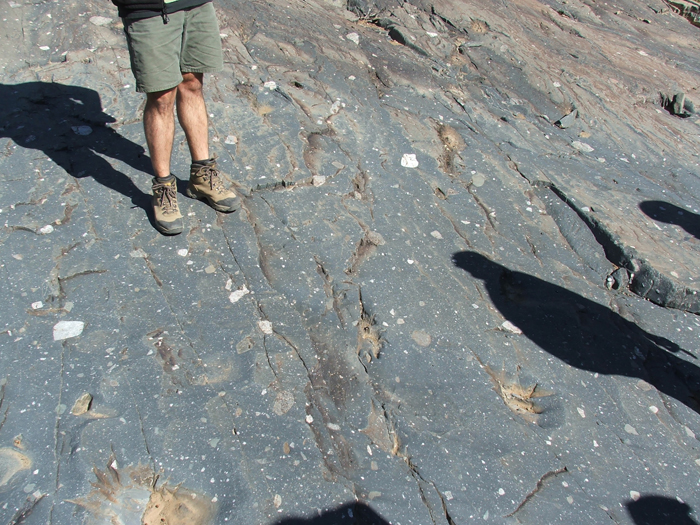
Although my recent trip to South Africa was to look at the Permian turbidites, we couldn’t resist a short stop to check out the underlying glacial tillite of the Dwyka Group.
The Dwyka is Carboniferous to Permian and was deposited during the glacial cycles that affected this part of Gondwana during that time. The well-known cyclical coal measures of the mid-continent of North America and Europe are roughly equivalent.
Tillites are readily recognizable from their very poorly sorted mixture of grains, pebbles, and boulders of various rock types in a fine matrix. The clasts are commonly angular producing a breccia-like appearance.

If you happen to know more about this particular formation or glacial deposits in general (not my specialty), please feel free to chime in below.
Happy Friday!
see all Friday Field Fotos here
~~~~~~~~~~~~~~~~~~~~~~~~~~~~~~~~~~~~~~~~~~~~~~~~~~~~~~~~~~~~~~~~~~~~~~~~~~~~~~~~~~
Anyone going to San Antonio?
Oh man … I’m finally getting over the jet lag from the last trip and have some more traveling coming up this right away. Many of you may know that the annual AAPG conference is being held in San Antonio, Texas next week.
This conference typically has a lot of sessions for sedimentary geologists, especially for those of you interested in the sedimentology and stratigraphy of ancient depositional systems.
This is a busy one for me this year — I’m chairing a session, presenting a poster, and giving a talk. Yikes. Where did the time go … I’m still compiling data for my poster!
Busy busy. I long for the days when I was “working” on my thesis and I had the time to sit and think about something, or read a paper in some detail, or interact in the blogosphere. Such is life. Enjoy it while you can!
If you are going to be in San Antonio, I’m co-chairing an SEPM-sponsored session Tuesday morning called “Process-Related Architectural Changes in Deep-Water Deposits” and then presenting a poster that afternoon. Feel free to stop by the poster.
The talk I’m giving is not too different from what I just presented at AGU in December, but this is for a special event. Every year SEPM sponsors an informal evening session about some topic in deep-marine sedimentary research. This year, the session is in honor of the late Bill Normark, a USGS marine geologist who passed away in January after a long battle with cancer. Bill pioneered work on characterizing modern submarine fans back in the 60s and 70s and continued to be at the cutting edge until his death. A component of my Ph.D. research was supervised by and in collaboration with Bill. I will be giving a short talk about that work. This special session is Monday evening in the Grand Hyatt Hotel from 7pm-10pm.
~~~~~~~~~~~~~~~~~~~~~~~~~~~~~~~~~~~~~~~~~~~~~~~~~~~~~~~~~~~~~~~~~~~~~~~~~~~~~~~
Game reserve in the Karoo
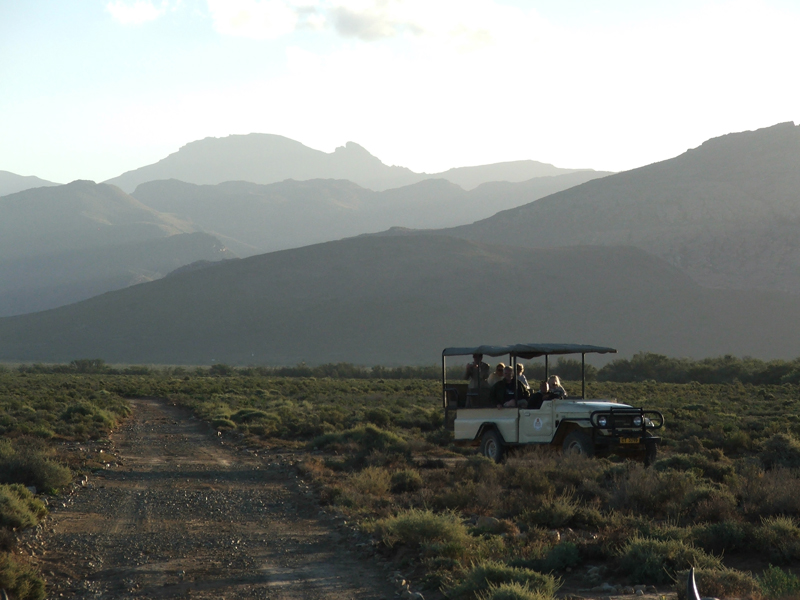
Before I post about the geology I saw in South Africa (later today or tomorrow), I’d like to share a few photographs from a small game reserve we went to one evening.
This reserve wasn’t huge, but still rather large (took about an hour to drive across). It was established to provide a place for animals that have, unfortunately, been pushed out of habitat or, worse, threatened by illegal hunting. Ideally, they aim to re-introduce some of the animals back into the wild or to much larger reserves.
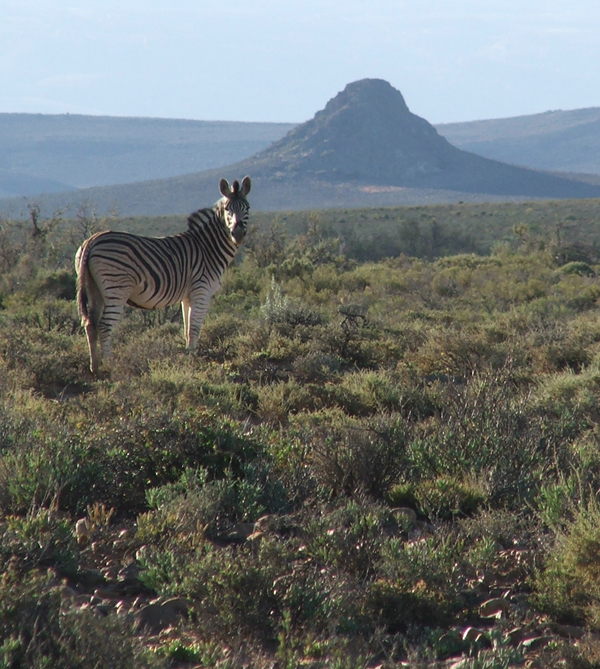
A photogenic zebra in the late afternoon sun.

At first, these two rhinos (female on left and junvenile male on right) were slightly concerned with our presence, but they eventually were more concerned with their dinner.

The highlight for me was the cheetahs. Absolutely beautiful animals. They were kept in a separate large enclosure becuase they aren’t quite ready to hunt and the reserve may not be large enough anyway. Cheetahs are typically solitary animals, but the few they have here are relatively happy hanging out together. In the next year or so, the reserve plans to try and re-train them to hunt live prey in hopes of getting them ready to back into the wild.


They also had a very rare Barbary lion. There are only a few of these animals left on the planet and none in the wild. This particular male was saved before it was killed to be a trophy. For some reason, people pay a lot of money to come shoot an animal like this WHILE IT’S IN A CAGE, just so they can get it as a trophy. So, while living on a reserve isn’t ideal, the alternative is stuffed in some a#$hole’s office.
~~~~~~~~~~~~~~~~~~~~~~~~~~~~~~~~~~~~~~~~~~~~~~~~~~~~~~~~~~~~~~~~~~~~~~~~~~~~~~~~~~~
Back from South Africa
I returned last night from a nearly two-week trip to look at Permian strata of the Laingsburg Formation in the Karoo Basin of South Africa. I haven’t downloaded any photographs just yet … I hope to get that done in the next couple of days.
This was my first time to the continent of Africa and it was, overall, a good trip. I did end up with some rather nasty food poisioning that resulted in a pretty rough night. I will spare you the details!
The purpose of this trip was to look at research that has been done over the past several years primarily by students and professors from Liverpool University. In addition, it was an in-house training course developed for those with some, by perhaps not extensive, experience investigating turbidite deposits. Part of my job description is to help with the development and teaching of such training courses. I was mostly on this trip as a student/observer (since I had never been there) but was able to contribute to the teaching of fundamental concepts throughout the course. This is a topic I’ll post about someday in the future — differences/similarities between teaching at undergrad or grad level with this, more specific and focused style of teaching. Teaching adults that have technical expertise in related fields presents unique challenges as well.
Unfortunately, I did not have much free time before or after to explore more of South Africa. I flew in and out of Cape Town and spent a day on either side of the trip seeing a bit of the city. South Africa is hosting the World Cup in 2010 and is extremely busy doing construction and various other projects in preparation.
Another interesting aspect of the trip for me was seeing, with my own eyes, the contrast of shanty towns right next to rather affluent neighborhoods on the outskirts of Cape Town. The end of Apartheid was not that long ago and the division of wealth is still very apparent. From people we talked to, things are slowly getting better but they still have a long way to go. I’m sure Chris Rowan could comment in much more detail having lived there for some time and experiencing it first hand.
I have a lot of catching up to do … looks like there are numerous great posts from the geoblogosphere over the last couple of weeks. Unfortunately, something happened with my spam filter on this blog while I was gone … I think I cleaned it all up, but if you left a comment and don’t see it, please let me know. I was rather annoyed while marking and deleting spam and could have easily made a mistake.
~~~~~~~~~~~~~~~~~~~~~~~~~~~~~~~~~~~~~~~~~~~~~~~~~~~~~~~~~~~~~~~~~~~~~~~~~~~~~~~~
Where on (Google)Earth #119
Wow, number 119! Where on (Google)Earth is still going strong … love it.
I’m going to be heading out of town in a couple of days, so if this sits around for more than a day, I’ll start giving some clues.
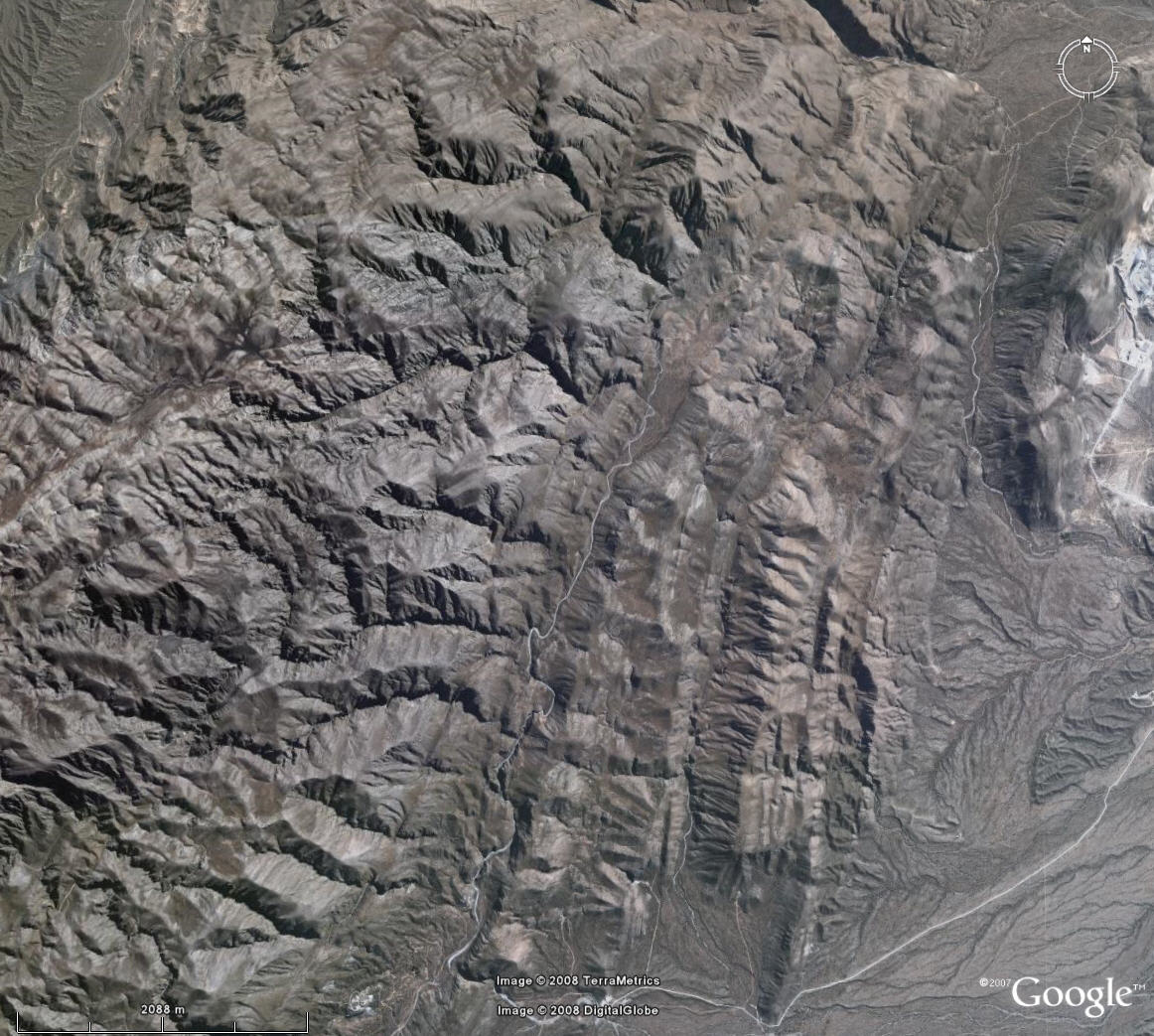
For those that have never played … simply put the latitude-longitude coordinates in the comments below and then you get to host (or pick the location if you don’t have a blog) for the next one. Typically, the winner also provides a few comments about the geological feature(s) on display.
I will invoke the Schott Rule — you have to wait one hour for each Wo(G)E win you have before you can answer.
Posted: March 31st, 2008, 10:00am Pacific Daylight Time (convert to your time zone here)
~~~~~~~~~~~~~~~~~~~~~~~~~~~~~~~~~~~~~~~~~~~~~~~~~~~~~~~~~~~~~~~~~~~
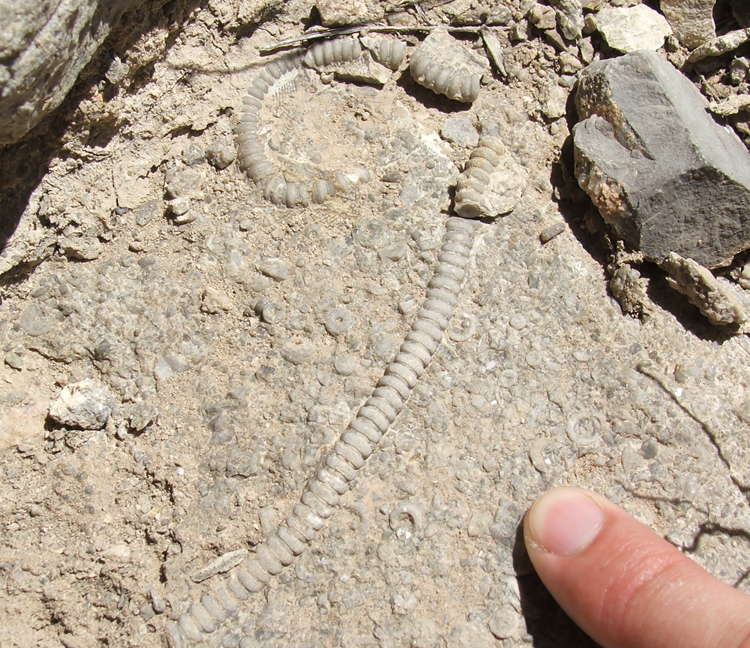
Friday Field Foto #46: Crinoid fossil
Today’s photograph is for you paleo-geeks … this nice crinoid stem is from a formation I forget the name of along the western flank of the Sacramento Mountains in New Mexico. If you have some knowledge about crinoids in general, or something specific about this one, please share in the comments. I forgot I had this photo until just now.
Click on it for a bigger version.
Happy Friday!
–
see all Friday Field Fotos here
~~~~~~~~~~~~~~~~~~~~~~~~~~~~~~~~~~~~~~~~~~~~~~~~~~~~~~~~~~~~~~~
Doing geology like it’s your job
The geoblogosphere is abuzz with posts and discussions about the current demand (and associated offers) for geologists in both the minerals and petroleum industries.
Geoscience educators and academic researchers (i.e., those that landed a job at a university doing what they love) realize this, but it’s worth repeating: The vast majority of those students who end up with a degree in geoscience do not end up doing what you are doing. If you are tenured or tenure-track, you are but a small slice of the greater community of trained geoscientists.
So, what about the rest of us?
Well, there are a few options. Firstly, one can get out of geology altogether and go sell insurance, open a restaurant, or become a shepherd. This certainly happens (maybe not the shepherd part) but let’s focus on those that can’t get or don’t want an academic job but still want to make their living doing what they love … geology.
We can break it down into two main pathways — public institutions and the private sector. Once upon a time (so I’m told) a job with the US Geological Survey was the job to have. During my PhD research, I collaborated with a marine geologist from the USGS. I had an office there (Menlo Park, CA office) and was in the system as a volunteer (i.e., not on payroll). In an ideal world, the USGS would be a perfect place for those with a hunger for doing research. Unfortunately, the budget is tight and getting tighter by the year. I don’t have the stats at my fingertips, but a long-time USGS employee said that one new position is created for every 5-7 positions left vacant due to retirement. In other words, the postings are pretty competitive … at least they were for anything to do with my field in the last few years. So, this pathway is not significantly different than academia with respect to landing a position. And then there are more local governmental entities (e.g., state geological survey). Honestly, I don’t know what the job prospects are like for those institutions. Feel free to chime in if you know anything about that.
The second major career pathway is the private sector. This could be anything from working for a gigantic corporation to being an independent consultant. It’s pretty rare for a newly-graduated geoscientists to start a successful consulting firm on their own. Consulting is mostly about experience and contacts — you know what you’re doing and you know who your clients are. There are, of course, larger firms that employ young geoscience graduates as well. Geotechnical and/or environmental engineering firms are two that pop into my head.
But, the articles that created the discussion in the first place was talking about the Earth resources industry — minerals and petroleum. Both hard and soft rocks are hot! I’ve heard Australia’s mining industry, in particular, is snatching up new graduates left and right (maybe Lab Lemming can comment on that). I’ve heard Canada’s oil patch (mostly Alberta) is hiring right out of undergraduate … no graduate degree required. Demand for those that understand the Earth is high.
All things considered, more geologists actually working as geologists is a good thing. This is good for science (more data, more information) and this is good for those who want to educate and train students to become working geologists. All these budding geologists need advisers and mentors.
Additionally, more geologists in the world is a good thing. Many may not stay in geology for their whole career, but having some experience doing geology day-in and day-out will hopefully give them a larger appreciation of how the Earth works and why it’s important to understand it.
If you are an undergraduate reading these reports about high demand and salaries, don’t get too excited. The boom-bust cycle is inherent to the way global commerce operates (at least for now). It’s certainly good to know you have options when you do graduate … the more pathways to choose from, the better … but I wouldn’t choose geology solely based upon the current high demand. By the time you are done, it may not be that way. But, if you take geology classes and really like it, stick with it. If you enjoy geology, you’ll most likely put a lot of work into it and end up doing well. If you do well, you’ll have a better chance of being employable.
~~~~~~~~~~~~~~~~~~~~~~~~~~~~~~~~~~~~~~~~~~~~~~~~~~~~~~~~~~~~~~~~~~~~~~


 Clastic Detritus