AGU 2009 blogging #3 — allogenic and autogenic forcings
Today was the last day of the AGU meeting. Unlike some other meetings, the final day at AGU isn’t nearly as depressing. I’m not sure why — maybe because it’s a Friday and attendees are staying to hang out in the Bay Area for the weekend. It’s certainly not as happenin’ as the other days but it seems that the final day for conferences that end in the middle of the week are even worse.
Anyway, I spent the morning catching up with some friends and then we all headed to the “Interpreting Allogenic and Autogenic Processes in the Stratigraphic Record” session. What the heck does ‘allogenic’ and ‘autogenic’ mean? Maybe I’ll write a whole post about that someday, but the short answer is that allogenic forcings are those that are external to the system whereas autogenic refers to processes/dynamics that arise intrinsically. Examples of allogenic forcings on sedimentary systems include climatic fluctuations, tectonism, and sea level. Autogenic processes included the formation of channel-levee systems and the avulsion of delta or fan channels/lobes.
However, it’s not so simple … which was the point of the session. It was a great session, a nice mix of outcrop data, modern systems, and experimental systems. I gave a talk on some work I did during my Ph.D. on how various factors interacted and influenced deposition in a deep marine basin offshore southern California during the last 7,000 years. I felt I was going a bit fast — maybe was trying to squeeze too much info in — but I got some good feedback afterwards, so I think it was a success.
After that, I had a nice lunch with some friends and then we headed to the companion poster session that afternoon. The posters were very well attended and I had a bunch of follow-up discussions about my talk in addition to discussions about the posters.
Although I only went to two days of AGU this year and didn’t have time to branch out of my field of expertise, it was a great meeting as always!
AGU 2009 blogging #2 — deltas and fans
I got off BART in San Francisco around 8:30 this morning, got a coffee, picked up my badge and headed right to the poster hall. Instead of diving immediately into the posters I had to find a relatively quiet corner to work on some finishing touches for my own talk. I spent about an hour getting it just how I wanted it and then spent a couple hours looking at the posters in the Deltas and Fans session. I ended up socializing with people I hadn’t seen in a while more than actually studying the posters … but, hey, that’s what conferences are all about. I caught up with friends and peers who are in both industry and in academia — and we all lamented 2009 for being a tough year in terms of convincing those who control $$$ to release some for research.
I then went and caught a couple of talks in a late morning session about computational modeling of sedimentary landscapes/seascapes. The two talks I saw were okay, but not great.
After that, lunch (pizza and beer) with a good friend of many years who I don’t get to see all that often.
I went to the entire early afternoon oral session on Deltas and Fans — the companion session to the posters in the morning. Pretty much all the talks were very good — pretty heavy on the experimental side, which isn’t really my expertise, but I always learn something and get ideas about what kinds of features to measure in natural systems and interesting patterns to keep an eye out for.
I headed back to poster hall to check out a particular poster about some modeling of hyperpycnal flows (i.e., river floods so chock full of sediment that they plunge under the water body they are entering into and create a sediment gravity flow). Very cool stuff.
Right before I headed home I uploaded my talk for tomorrow morning. I’m pretty happy with it, gave a sneak-preview to a friend and he liked it a lot. We’ll see how it goes tomorrow.
Great day!!
AGU 2009 blogging #1 — getting ready
Although AGU 2009 is already half over I’m just getting ready for it! I’ve had an incredibly busy week with non-AGU obligations so tomorrow (Thursday) will be my first day at the conference. Unfortunately I missed a luncheon held for bloggers today, I’d be interested to hear how that was from others.
Several other geo-bloggers have been covering the conference (including AGU’s “official” blog, Dave’s Landslide Blog, Harmonic Tremors, Musings of a Life-Long Scholar, Active Margin, and Andrew at geology.about.com). See the blogroll for a bunch more. And the Twitter feed (using #AGU09 tag) is extremely active and highly recommended for keeping up with it all.
I hope you’ve paced yourself and are still hungry for what I think are some great sessions. This is how I will be spending my time at the meeting:
Thursday AM
EP41A (Moscone South) — Dynamics and Processes of Deltas, Fans, and Their Distributary Channels I (Posters)
EP42A (2008 Moscone West) — Computational Modeling of Landscape and Seascapes: Models, Data Sets, and Applications I (Oral) — specifically, I’m going to try and check out the following in this session:
- EP42A-01: Modeling the complex dynamic interactions between surface processes, crustal deformation, and climate change (Braun et al.)
- EP42A-05: Reconstructing the Waipaoa sedimentary systems at the LGM (Upton et al.)
- EP42A-06: Community sediment-transport modeling system (CSTMS) (Sherwood et al.)
- EP42A-08: Computational investigation of turbidity currents and river outflows (Meiburg et al.)
Thursday PM
EP43D (Moscone South) — Computational Modeling of Landscape and Seascapes: Models, Data Sets, and Applications II (Posters) — I will check out all, but hope to get some good discussions going about this one:
- EP43D-0672: Flow dynamics and sediment entrainment in natural turbidity currents inferred from numerical modeling (Traer et al.)
EP43F (2008 Moscone West) — Dynamics and Processes of Deltas, Fans, and Their Distributary Channels I (Oral) — this whole session looks fantastic
–
Friday AM
EP52A (2002 Moscone West) — Interpreting Allogenic and Autogenic Processes in the Stratigraphic Record I (Oral) — this session explores the interactions of external (or allogenic) forcings and intrinsic dynamics (or autogenic processes) on what is preserved in the stratigraphic record. I am giving a talk in this session that starts at 11:35am titled:
- EP52A-06: High-frequency allogenic forcings on the Holocene stratigraphy of Santa Monica Basin, California
Friday PM
EP53A (Moscone South) — Interpreting Allogenic and Autogenic Processes in the Stratigraphic Record II (Posters) — this is the companion poster session to the morning oral session and has a bunch of awesome stuff. I really hope people stick around until Friday afternoon to argue about discuss what is actually being recorded in the stratigraphic record.
–
I’m excited … now I need to finish preparing my talk.
Sea-Floor Sunday #58: Northern Puerto Rican margin
One of my more popular posts, based on site stats, is this one highlighting a nice image of the seafloor in the region of the Puerto Rico trench. This week’s Sea-Floor Sunday image shows a new bathymetric image of this region that I found on the USGS Woods Hole Science Center website.
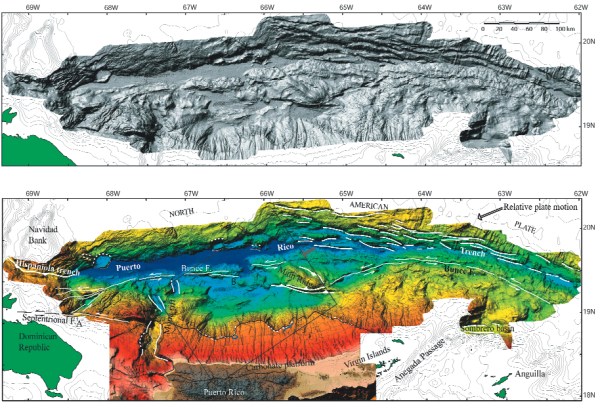
Shaded relief and colored bathymetry of the Puerto Rico Trench (credit: http://woodshole.er.usgs.gov/project-pages/caribbean/seafloor.html)
Click on the image above (or here) to read the description from the researchers who acquired the data.
Below is another image from this dataset — this one is zoomed in a bit and also reoriented (north is to the lower right).
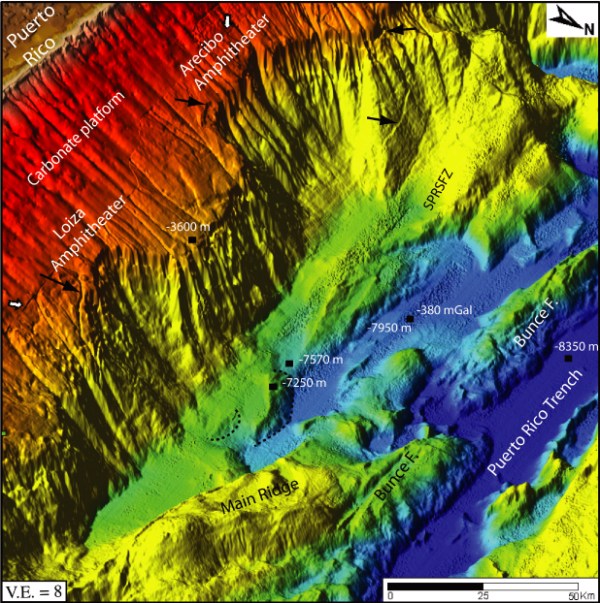
Perspective view of part of Puerto Rico Trench (credit: http://woodshole.er.usgs.gov/project-pages/caribbean/tsunamiFig.html)
Click on the image to go to the page that describes the features shown here and a key to the annotation. The ‘amphitheaters’ refer to areas of geologically recent submarine landslides (note the possible debris fans at the base of slope; one of them outlined with a black dashed line).
Friday Field Foto #98: Miniature sedimentary systems in the beach
This week’s Friday Field Foto is from along the west coast of the U.S. just south of the town of Eureka, California.
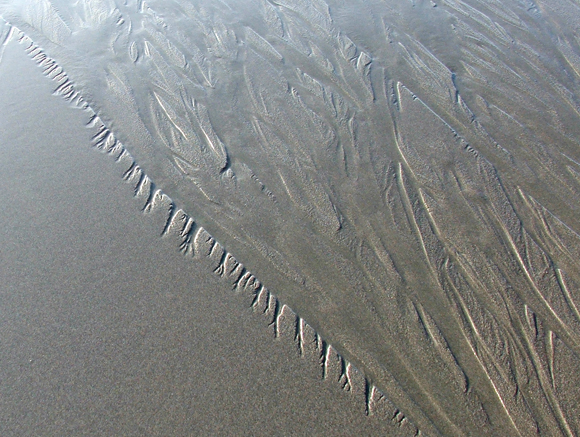
I especially like the margin of this sedimentary system, which includes intricate and beautiful mini-canyons eroding and contributing sediment. The photo below zooms in on these features.
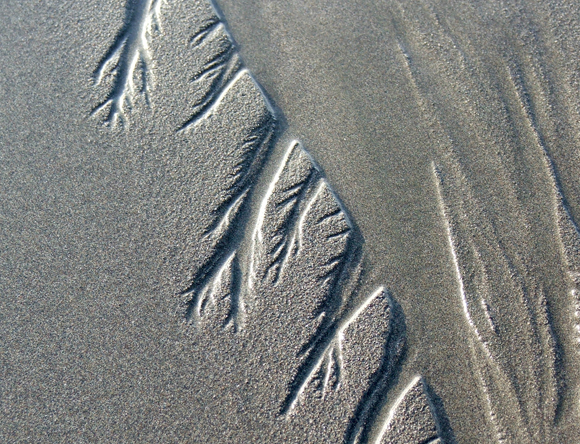
I know I’ve seen others show their photographs of features like this (e.g., Through the Sandglass blog) so feel free to include links in the comments below.
Happy Friday!
Geopuzzle: What are these things? (UPDATED)
Earlier this year a reader sent me a photograph of some rocks they had come across asking me what I thought they were or might represent. I ended up posting the photograph here as a ‘geopuzzle’ and asked all of you to comment on it with your thoughts (see that post here). It was pretty fun and worked so well that I thought I’d do it again.
A few weeks ago a reader sent me a couple photos of some interesting features in some fine-grained sedimentary rocks near her home in northeastern Oregon Washington. I replied with my own educated guess but would like to see what you all think.
The features of interest in these rocks are the numerous saucer-shaped rocks eroding out of the outcrop.
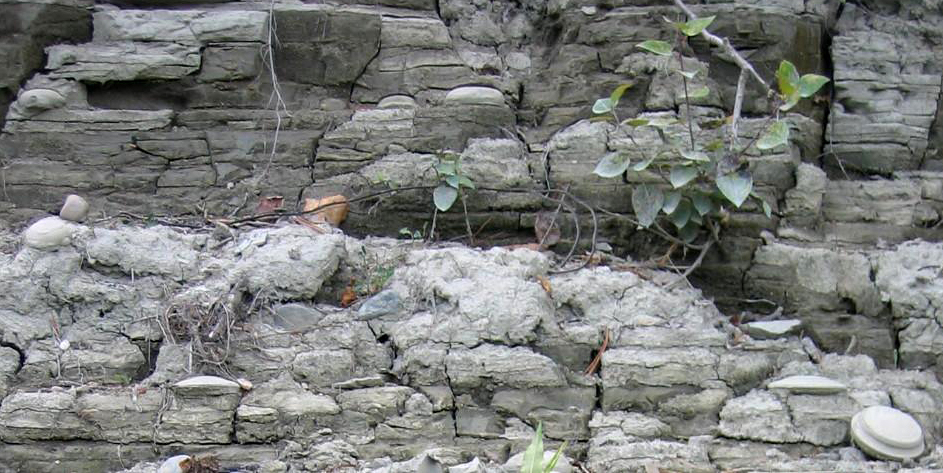
photograph from reader
In the photo above you can see these ‘saucers’ in lower right of photo as float.
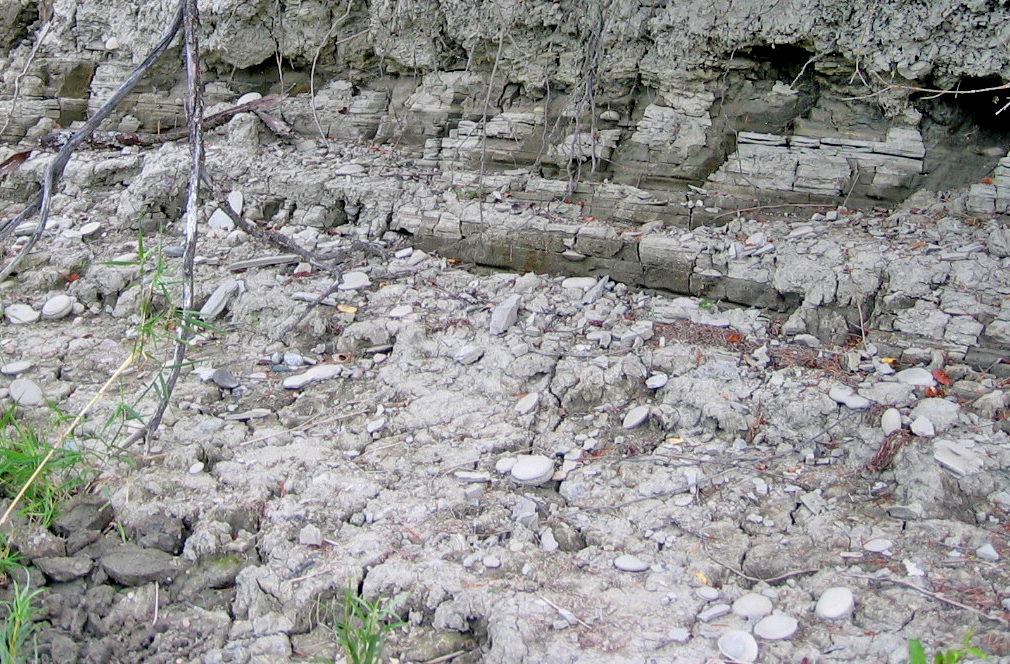
photograph from a reader
Again, look at the lower right of the photo above for another view.
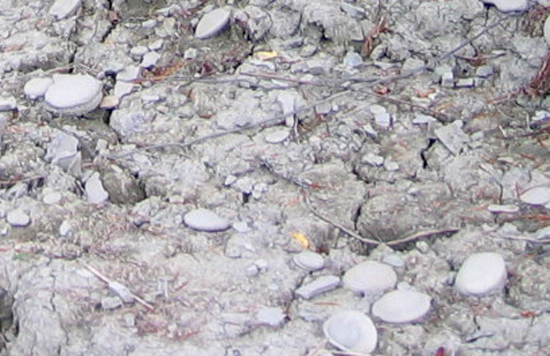
zoomed-in part of previous photo showing disc-shaped features eroding out of the outcrop (photograph from a reader)
So, add your two cents below and I’ll summarize the consensus on this geopuzzle tonight or tomorrow with an update.
–
UPDATE (12/8/2009): Well thanks to everybody for ‘playing’. Here is my initial response to the reader regarding these saucer-shaped features:
It’s difficult to tell for sure w/ that photo … but my gut instinct is that the saucer-shaped stones are “concretions”, which are features that form after deposition (sometimes millions yrs after) from differential chemical cementation. The wikipedia page is actually pretty good for this: http://en.wikipedia.org/wiki/ConcretionThat’s just my best guess from that photo and your description … I could be wrong.
Papers I’m Reading — November 2009
Here is this month’s installment in the papers I’m reading series:
- Schlager, W., 2009, Ordered hierarchy versus scale invariance in sequence stratigraphy: Int. Journal of Earth Science, doi: 10.1007/s00531-009-0491-8. [link]
- Brackley, H.L., et al., in press, Dispersal and transformation of organic carbon across an episodic, high sediment discharge contiental margin, Waipaoa sedimentary system: Marine Geology, doi: 10.1016/j.margeo.2009.11.001 [link]
- Mulder, T., et al., in press, High-resolution analysis of submarine lobe deposits: Seismic-scale outcrops of the Lauzanier area (SE Alps, France): Sedimentary Geology, doi: 10.1016/j.sedgeo.2009.11.005 [link]
- Kane, I.A., et al., in press, Submarine channel levee shape and sediment waves from physcial experiments: Sedimentary Geology, doi: 10.1016/j.sedgeo.2009.11.001. [link]
- Wittmann, H., et al., in press, From source to sink: Preservring cosmogenic 10Be-derived denudation rate signal of the Bolivian Andes in sediment of the Beni and Mamore foreland basins: EPSL, doi: 10.1016/j.epsl.2009.10.008. [link]
–
Note: the links above may take you to a subscription-only page; as a policy I do not e-mail PDF copies of papers to people (sorry).
Friday Field Foto #97: Trace fossils in Californian anthropogenite
A few weeks ago I went up to the Sierra Nevada mountains to get some fresh air and go for a bike ride with some friends. We started our ride at a trailhead parking lot near the town of South Lake Tahoe and as I walked to the restroom I noticed some nice trace fossils preserved in this sedimentary rock from the anthropocene.

I thought it might be raccoon, but they seem to elongate. Anyone have other ideas? To give you a sense of scale, the biggest tracks are about 6-8 cm long.
In case you’re wondering, yes, the other imprints in the “rock” are pine needles.
Happy Friday!
Stunning image of sediment plumes in Gulf of Mexico
This blog has moved to Wired Science (as of Sept 14, 2010)
URL: http://www.wired.com/wiredscience/clasticdetritus/
RSS: http://www.wired.com/wiredscience/category/clastic-detritus/feed
–
I was alerted to this image from a reader and also saw it linked to on geology.com/news and just had to share it.
Absolutely beautiful patterns of sediment plumes mixing with each other and surrunding water in the Gulf of Mexico from NASA’s Earth Observatory website. The image was taken last week a few hours after Tropical Storm Ida passed by to the east of here. The waves associated with the storm churned up the sediment on the shelf. The limit of sediment with the dark blue water to the south essentially marks the edge of the continental shelf. Click on the images below, or here, to read more about this image.
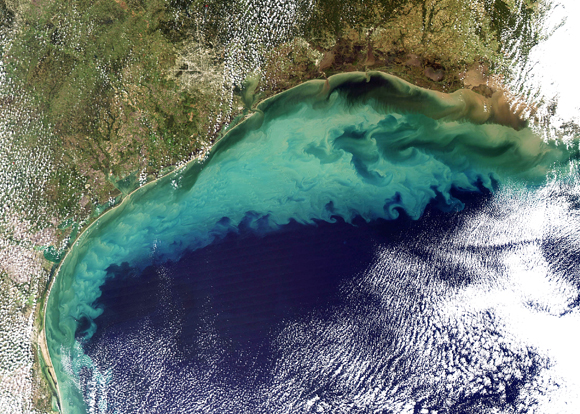
Mixing sediment plumes in Gulf of Mexico (image credit: NASA Earth Observatory - http://earthobservatory.nasa.gov)
The next image below zooms in a bit on the image showing distinctive brown plumes coming from rivers.
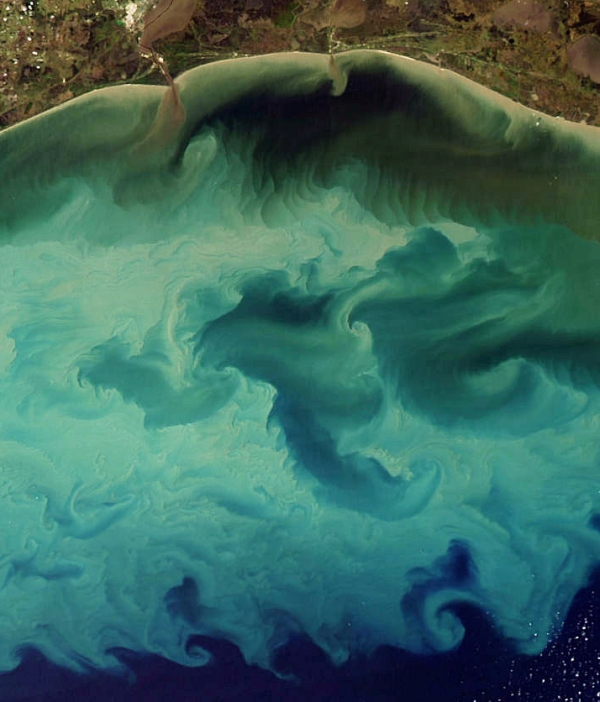
zoomed-in view of mixing sediment plumes in Gulf of Mexico (image credit: NASA Earth Observatory - http://earthobservatory.nasa.gov)
Wow.
I just love looking at the patterns nature produces.
–
(note: I slightly modified the ‘levels’ of these images in Photoshop to enhance them a bit)
Going to be quiet here for a while
Just a quick note.
Unfortunately, my lack of posting will continue for a little longer. In addition to trying to finish up a manuscript in my “free time” I will be traveling for the next couple of weeks for work (nowhere exotic, unfortunately).
If you want, you can follow me on Twitter — twitter.com/clasticdetritus — although I can’t guarantee it will be interesting in any way. These days it consists of me tweeting about working on the manuscript mentioned above and lamenting the actions of people like Joe Lieberman.
In the meantime, here are a few internet tid-bits for your enjoyment:
- Magma Cum Laude: Deadline for Accretionary Wedge (geoscience blog carnival) posts extended
- Research at a Snail’s Pace: Down the Rabbit Hole — the first in a series of posts about a GSA-related field trip led by a young-Earth creationist — I haven’t read yet, but looks like a very interesting account (also see Magma Cum Laude’s post on the same topic)
- Reporting on a Revolution: This Time It’s the Calcium That Did It — post about the Cambrian explosion/radiation
- BLDGBLOG: Fossil Reactors — haven’t read it, but I almost always enjoy the posts from that blog
- It’s alive! — Where on (Google)Earth #177 up at The Couloir Times
- Wired: The Epidemic of Fear — the BEST article I’ve read all year on the anti-vaccination movement and why it’s complete junk, a must-read
- Cosmic Variance: If Dr. Seuss Designed Produce — dragon fruit
- Interactive chart showing the frequency range of musical instruments
- Photographic documentation of a Roomba (robot vacuum cleaner) doing it’s thing — cool!


 Clastic Detritus