 Over geologic time scales, the Earth naturally captures carbon dioxide from the atmosphere through weathering of silicate rocks and sequesters it via the production of carbonate rocks. Ultimately, subduction can return these rocks to the Earth’s interior and carbon dioxide is once again emitted into the atmosphere by volcanism. Thus, understanding the history of erosion and, by association, weathering of our planet’s surface will help us understand this important geochemical cycle and its relationship to climate.
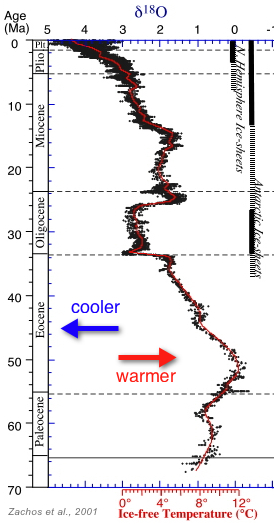
Oxygen isotope curve for Cenozoic (Zachos et al., 2001; Science)
Paleoclimate records for the past ~50 million years show overall global cooling with higher-frequency fluctuations (see plot of δ18O measurements, a proxy for temperature, at left). The annotation on the right side of the figure denotes when researchers think continental glaciation was initiated — approximately 30 million years ago for Antarctica and 5-8 million years ago for the northern hemisphere.
What caused this long-term global cooling?
Some researchers have hypothesized that increased tectonic uplift (especially the Himalayas) and the increased weathering that came with it is one of the primary causes of this long-term global cooling*. That is, as more carbon dioxide was withdrawn from the atmosphere and naturally sequestered, the Earth cooled. One line of evidence geologists have used to infer changes in rates of erosion and weathering is the depositional record.
Sediment-dispersal systems transfer eroded material from mountainous uplands to sites of sediment accumulation in alluvial lowlands, coastal deltas, the continental shelf, and the deep sea. Because erosion in one location is balanced by deposition in another location, some geologists are using changes in deposition rates to infer changes in erosion rates. This seems like an elegant solution but, as usual, it’s not quite so simple.
I was delighted to see this paper by Willenbring and von Blanckenburg about late Cenozoic erosion/weathering rates come out in Nature last month. There’s a lot to say about this paper and its implications, too much to cover in this one blog post. I recommend this great review article by Yves Godderis, which highlights the global paleoclimate implications of the study nicely. Here, I will focus on one aspect I find fascinating: how erosion and deposition is recorded in the stratigraphic record.
Willenbring and von Blanckenburg revisit an inherent measurement bias demonstrated by Peter Sadler in his 1981 seminal paper “Sediment accumulation rates and the completeness of stratigraphic sections.” I’ve written about the ‘Sadler Effect’ before on this blog (read this post from 2007) but to make a long story short — the longer the measured time interval the smaller the sedimentation rates and vice versa.
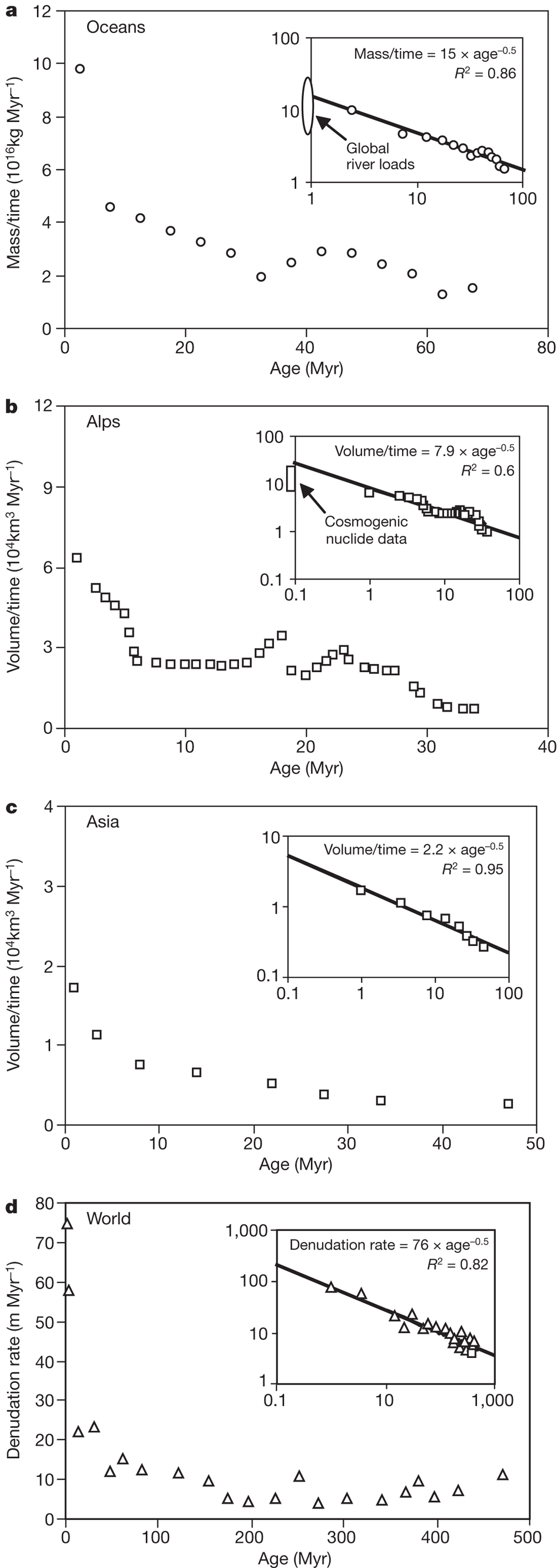
Sediment accumulation rates and erosion rates as functions of geological time (Figure 2 from Willenbring & von Blanckenburg, 2010, Nature 465; doi:10.1038/nature09044
This phenomenon arises because the accumulation of sediment is unsteady — that is, at one location it varies over time. As longer durations are measured in a succession, more hiatuses, or periods of no deposition, are captured and, thus, the rate (thickness/time) is lower. Conversely, rates measured from very short durations can be quite high. Think about it — if you go out to a river mouth when it’s flooding and measure the thickness of sediment that piled up over a day and converted it to a yearly rate by simply multiplying by 365 you’d get a huge rate that wildly overestimates the actual yearly rate (unless, of course, that river is flooding every single day of the year). This is intuitive and few would attempt to make such a conversion, but this is essentially what is happening when comparing sedimentation rates that were measured from different time scales. Similarly, geomorphologists have discussed the unsteadiness of processes such as erosion and uplift^.
Willenbring and von Blanckenburg show this by plotting various process rates against time. The plots at right show, from top to bottom, (a) ocean-basin sediment accumulation rates, (b) volumetric erosion rates, (c) sediment accumulation rates in Asian offshore basins, and (d) global denudation rates. Note how all of them show a huge uptick in rates during younger time intervals. The point here is that this apparent increase in rates is an artifact of measuring unsteady processes — it isn’t real. The inset log-log plots of the same data show the Sadler Effect clear as day.
So, does this mean we can’t use measured rates of deposition to say something about the variability of processes in Earth history? I think we can but we need to significantly increase our understanding of rates of processes at multiple time scales. Careful documentation of sediment-dispersal systems with ever-improving geochronological tools is one approach to unraveling these complex temporal relationships. Numerical/physical experimental methodologies can be designed to address process rate questions as well. Ultimately, the integration of multiple approaches will lead to a better understanding of the complex temporal relationships of sediment erosion, transfer, and deposition and how we can utilize the stratigraphic record to reconstruct Earth history.
–
–
Willenbring, J., & von Blanckenburg, F. (2010). Long-term stability of global erosion rates and weathering during late-Cenozoic cooling Nature, 465 (7295), 211-214 DOI: 10.1038/nature09044
* just one example is this Raymo and Ruddiman paper from 1992
^ Gardner et al. (1987); Geology
Geoblogosphere week in review (June 21-27, 2010)
Some posts from the geoscience blogosphere last week highlighting some interesting writing:
- Michael Welland from Through the Sandglass writes about how the amazing amoeba-like microbe Difflugia, which fashions its shell out sand, inspires sculpture artists.
- Chris Rowan from Highly Allocthonous explains the magnitude 5.0 earthquake in the middle of the North American plate (near Ottawa, Canada) last week.
- Garry Hayes from Geotripper discusses the issue of removing serpentinite as the official state rock of California because of misunderstood fears regarding the relationship of the mineral serpentine to harmful forms of asbestos.
- Suvrat Kher from Rapid Uplift asks the rest of the geoblogosphere to participate in a sedimentary basins meme — and kicks it off by writing about the Proterozoic Cuddapah Basin in India.
- Silver Fox from Looking For Detachment continues her series about traveling around the deserts and mountains of Nevada to find a thesis area.
–
~~~~~~~~~~~~~~~~~~~~~~~~~~~~~~
–
Week-in-review posts from past two weeks:
If you want to subscribe to the week-in-review posts (but not the entire blog feed) use this link: https://clasticdetritus.com/category/week-in-review/feed/
Sea-Floor Sunday #65: Makran accretionary wedge
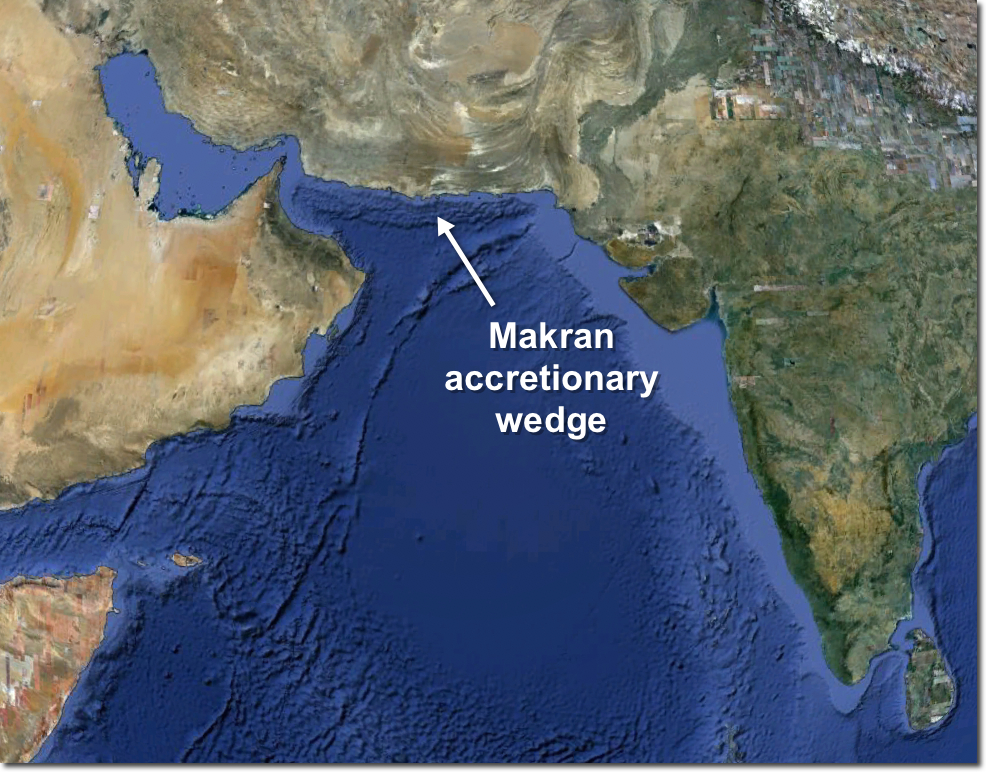
This week’s Sea-Floor Sunday image is from a recent paper in Sedimentology by Bourget et al. that investigates the deep-marine sedimentary system associated with the Makran subduction zone and accretionary wedge in the northwest Indian Ocean (offshore of Iran and Pakistan). The Arabian plate is subducting northward underneath continental blocks now part of the Eurasian plate creating a wide swath of compressional deformation.
The images below (Fig. 8 from their paper) are perspective images of seafloor topography (bathymetry) where the warm colors are shallow water and the cool colors are deeper water. The shallowest part shown is a few hundred meters below sea level and the deepest, at the deformation front, is approximately 2,500 meters below sea level.
Note the strong east-west trend in the ridges and valleys of the deformed zone. These images remind me a lot of similar perspective bathymetric images of the Cascadia accretionary wedge offshore Oregon and Washington.

In this paper, Bourget et al. investigate the character of the turbidite systems that traverse this topographically complex continental slope. Submarine canyons and channels zig-zag their way down through this maze depositing sediment in the elongate basins behind uplifted ridges, commonly referred to as “piggy-back basins”. The patterns of sedimentation differ along the margin as a function of varying tectonic styles/rates and onshore sediment-feeder systems. Check out the paper if you want to learn more.
Here’s a snapshot from Google Earth showing the regional context for this area.
The first author of this paper, Julien, has commented on this blog in the past so I’m sure he’ll be happy to share more information — feel free to ask questions in the comment thread below.
–
BOURGET, J., ZARAGOSI, S., ELLOUZ-ZIMMERMANN, N., MOUCHOT, N., GARLAN, T., SCHNEIDER, J., LANFUMEY, V., & LALLEMANT, S. (2010). Turbidite system architecture and sedimentary processes along topographically complex slopes: the Makran convergent margin Sedimentology DOI: 10.1111/j.1365-3091.2010.01168.x
Friday Field Foto #115: Mountains in the French Alps
This week’s Friday Field Foto doesn’t really show any geology — it’s just a nice shot of some beautiful mountains in the French Alps.

French Alps (© 2010 clasticdetritus.com)
I need to get out to some mountains soon.
Happy Friday!
Why I Blog
Like Callan and Jessica before me I participated in the “Why I Blog” series at the American Geophysical Union’s (AGU) blog The Plainspoken Scientist: Communicating Science.
If you want to know why I blog check out my post.


–
Rapid canyon formation and uniformitarianism

Canyon Lake Gorge (credit: http://www.canyongorge.org/about-the-canyon-gorge)
In 2002, flood waters from Canyon Lake dam reservoir in central Texas were diverted into an emergency spillway at nearly 200 times the normal flow rate. The resulting flood event, which lasted for six weeks, removed trees and sediment and excavated a 7 m deep and >1 km long canyon into the limestone bedrock.
A paper by Lamb & Fonstad called Rapid formation of a modern bedrock canyon by a single flood event published in Nature Geoscience this week documents the patterns left in the landscape and reconstructs the hydraulics involved in this catastrophic flood.
I encourage those interested in the details of sediment transport and bedrock incision to read the paper. But what I want to discuss in this post is an issue that will come up as a result of this study — an issue that I can almost feel bubbling up as I write this. In fact, I’m certain that someone, somewhere is abusing the results of this study in an attempt to claim that because significant change to the Earth’s surface can occur abruptly then it follows that all geologic change must be the result of abrupt and cataclysmic events. This is a false dichotomy pushed by neocatastrophists that are typically, but not always, associated with the viewpoint that the Earth is ~6,000 years old.
When the history of the science of geology is taught it commonly includes the classic uniformitarianism vs. catastrophism debates of the late 1700s-early 1800s. The uniformitarianists, so the story goes, argued that the changes we see in the geologic record were the result of minor and gradual processes that accumulated over time — from processes that we can see working on the landscape today. Catastrophists believed the same geologic products were the result of cataclysmic events that reshaped the land abruptly.
Studying this historical debate is thought-provoking and provides context for a novice geoscientist but the science has largely moved on from this false dichotomy. Geologists in the 1800s and early 1900s documented features that could only be explained by large-magnitude events*. Geologists realized that, of course, both gradual and catastrophic processes helped shape the landscape. The great paleontologist Stephen Jay Gould wrote a paper in the American Journal of Science in 1965 (he was 24 years old) called “Is Uniformitarianism Necessary?” that succinctly summed up where the science was regarding the concept of uniformitarianism. The incredible clarity of Gould’s writing forces me to quote the entire abstract:
Uniformitarianism is a dual concept. Substantive uniformitarianism (a testable theory of geologic change postulating uniformity of rates or material conditions) is false and stifling to hypothesis formation. Methodological uniformitarianism (a procedural principle asserting spatial and temporal invariance of natural laws) belongs to the definition of science and is not unique to geology. Methodological uniformitarianism enabled Lyell to exclude the miraculous from geologic explanation; its invocation today is anachronistic since the question of divine intervention is no longer and issue in science. Substantive uniformitarianism, and incorrect theory, should be abandoned. Methodological uniformitarianism, now a superfluous term, is best confined to the past history of geology.
In other words, the original notion of uniformitarianism — that there is uniformity in rates — is false. Although the science has discarded this erroneous concept, it is what modern catastrophists use as a straw man in their arguments. And, unfortunately, we see glimpses of it in mainstream science writing and reporting of geologic processes. The nuance of Gould’s paper from nearly 50 years ago is lost within the compelling story of pitting one absolute versus another.
I would argue that rapid and significant processes are included within our current understanding of processes. For example, I study the processes and deposits of turbidity currents, which are essentially submarine avalanches of sediment. The recurrence of such events varies but is typically on the order of hundreds to thousands of years. Moderate to large turbidity current events would surely be labeled “catastrophic” from our point of view. Yet, entire sedimentary basins are filled with the deposits of hundreds of thousands of individual catastrophic events. While each event may be short-lived and cataclysmic, they occur very regularly over time and incrementally stack to produce a stratigraphic succession. We might consider some volcanic systems similarly — each eruption event might be catastrophic, but over time this is how the volcano is incrementally constructed.
This doesn’t take away from the insights from Lamb & Fonstad’s study. What they document here is just how rapid significant Earth-surface modification can occur given a certain set of conditions. In this case, they explicitly make the point that characteristics of the bedrock are important within the context of their results:
We suspect that well developed vertical and horizontal joints at Canyon Lake Gorge define blocks of bedrock that have little interlocking along their boundaries, rendering their behavior similar to an alluvial bed when critical stress for mobility is surpassed. … Thus, it seems plausible that erosion of well-jointed rock by large floods might be extremely rapid, such that canyon formation is limited by the capacity of the flood to transport plucked blocks rather than by the plucking process itself.
In other words, the bedrock which was eroded during the flood was already slowly eroding through the formation of joints (a type of fracture) in the rock. The high-energy flood event took advantage of this weakness and literally plucked large boulders of bedrock from the floor and walls of the canyon. In this case, the slow and gradual processes of joint formation worked in concert with the catastrophic flood event to produce this result.
There will be some who will use this paper to attempt to tear down uniformitarianism. Not only will they fail to mention the nuances of this specific study but they will be tearing down an idea that has long since been discarded by geology.
–
Lamb, M., & Fonstad, M. (2010). Rapid formation of a modern bedrock canyon by a single flood event Nature Geoscience DOI: 10.1038/ngeo894
Caltech press release: http://www.eurekalert.org/pub_releases/2010-06/ciot-cgi061810.php
Scientific American: http://www.scientificamerican.com/article.cfm?id=canyon-lake-flood
–
* see this post at 4.5 Billion Years of Wonder for more commentary about this paper within the context of Bretz and the origin of the Channeled Scablands of Washington.
update: check out Geotripper’s post about a similar flood event involving the Tuolumne River of California in 1997; also check out before/after images of the event described above at Pathological Geomorphology
Geoblogosphere week in review (June 14-20, 2010)
Here are several posts from the geoscience blogosphere last week highlighting some interesting writing:
- Suvrat Kher from Rapid Uplift shares his thoughts about the effects of ocean acidification on corals.
- David Bressan from History of Geology provides a follow-up post on his series of the geology and tectonic history of the Alps with some more information about the Tauern Window.
- Lutz Geissler from the German-language geology blog geoberg.de announced this past week that he will start blogging in English in addition to German. Lutz has also compiled this comprehensive list of articles and papers that deal with discussing or investigating the geoblogosphere.
- Coconino from Ordinary High Water Mark shares photographs and thoughts about relict fluvial features found in her local New Mexican countryside.
- David Petley from Dave’s Landslide Blog has information, photos, and links for six landslides that occurred in the past week.
- Finally, both Bryan from In Terra Veritas and Lutz Geissler from geoberg.de discuss the ongoing flap between the University of California system and Nature Publishing Group about subscription costs.
–
Friday Field Foto #114: Basalt tree mold
This week’s Friday Field Foto is from the Big Island of Hawai’i and shows a tree mold — lava flowed around the tree before the tree went up in flames.

Tree molds in basalt, Hawai'i Volcanoes Nat'l Park (© 2010 clasticdetritus.com)
Happy Friday!
Maps of ecosystems and geology of the United States
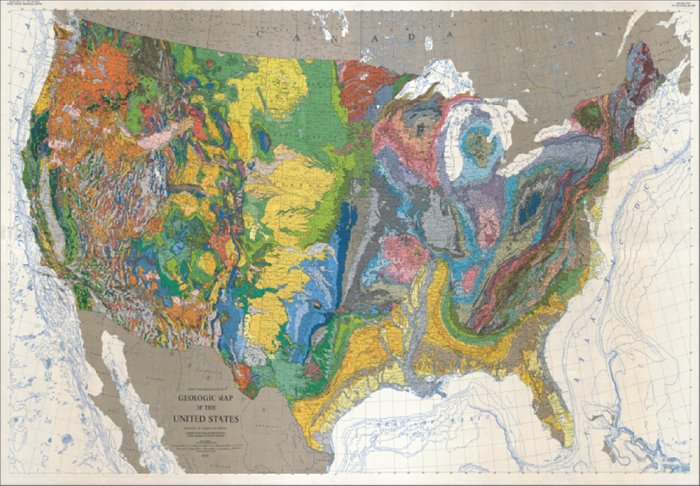
I was quickly scanning through my favorite blogs and such last night and saw this map posted at Wired Science. For a half a second I thought I was looking at a new geologic map, but it is actually a map produced by the USGS’s Gap Analysis Program (GAP) showing ecosystems. Check out GAP’s website to dive into the data and learn more.
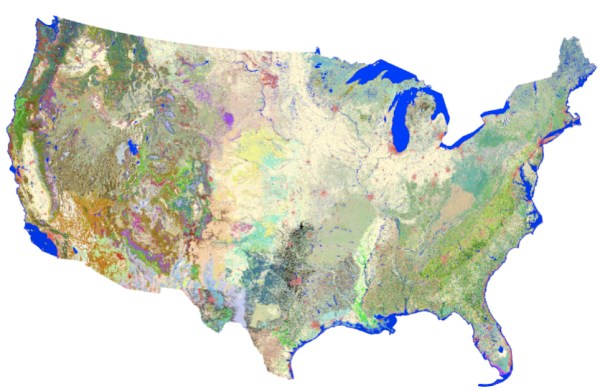
map image from WiredScience.com -- information credit: http://www.gap.uidaho.edu/landcoverviewer.html
For comparison, here’s a geologic map of the lower 48 states.
Geoblogosphere week in review (June 7-13, 2010)
Here are several posts from the geoscience blogosphere last week highlighting some interesting writing*:
- Michael Welland, author of the book Sand: The Neverending Story and the blog Through the Sandglass, continues his great writing about plans to construct sand berms in the Gulf coast to help mitigate the ongoing oil well blowout disaster. Michael takes a closer look at what we might learn from Dauphin barrier island, offshore Alabama.
- David Bressan from the blog cryology and co. started another blog a couple months ago called History of Geology. David revisits some of the ideas of 19th Century geologists about how the Alps mountain range came to be. David includes some great line-drawing diagrams from some of these old publications in addition to photographs from his own visits.
- Silver Fox from the blog Looking For Detachment writes about her thoughts while traveling throughout the basins and ranges of Nevada some years ago looking for geologically appropriate areas for future research.
- Matt Wedel, who contributes to the blog Sauropod Vertebra Picture of the Week, writes this excellent review of the brouhaha that ensued last week when the University of California system threatened to boycott Nature Publishing Group over their business practices (i.e., 7% annual increase in cost to academic libraries.) If you want to get the big picture on this story, complete with links to all the gory details, then this is the post.
- Finally, this post by Callan Bentley at his blog Mountain Beltway is notable for the discussion that is ongoing in the comment thread about oversimplified (and sometimes just plain wrong) concepts in geology and how, or if, to teach them to novices.
–
* this is the first post in this series so please bear with me while I experiment with the title, format, etc. over the coming weeks; as always, feel free to provide feedback in the comment thread


 Clastic Detritus