Sea-Floor Sunday #12: Submarine fault scarp, Scotian continental slope
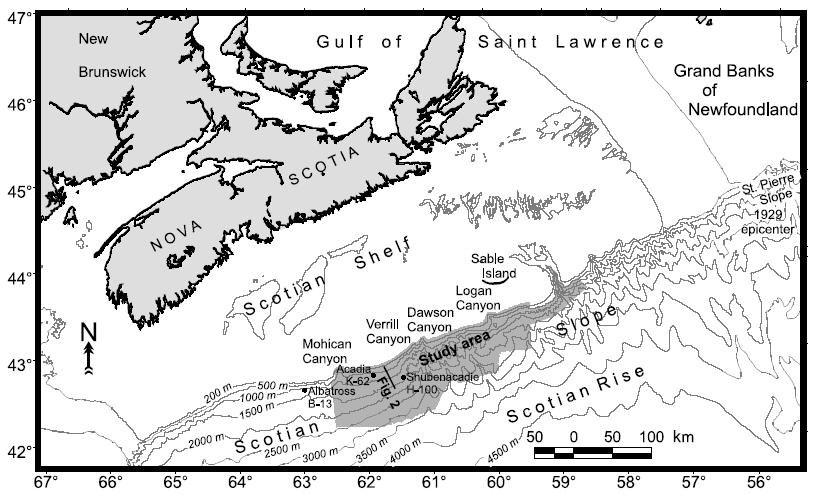
This week’s image highlights some structural features on the sea floor. These images are from a 2004 paper by Mosher et al. titled Near-surface geology and sediment-failure geohazards of the central Scotian Slope.
The first image (below) is a map showing the study area and some regional context. The Scotian continental slope is offshore Nova Scotia, Canada.
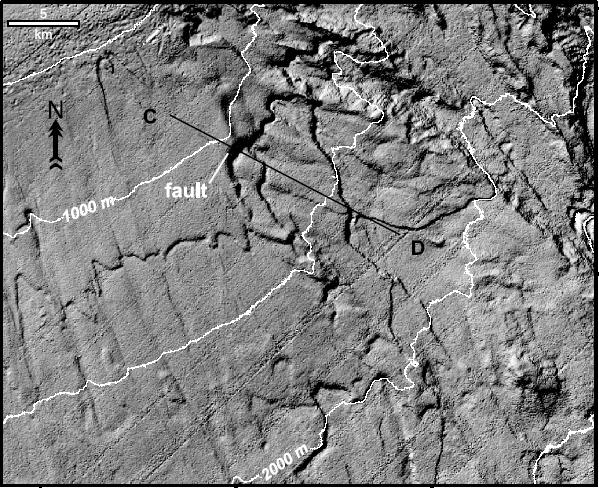
The image below is a multibeam sonar image of the sea floor (scale in upper left corner). Note the continuous escarpments cutting across the slope…roughly parallel to the bathymetric contours.
The image below is a seismic-reflection profile along line C-D denoted in map above. This type of normal faulting on steep submarine slopes is quite common. In some cases, complete and abrupt failure can create mass flows … in other cases, slower creep and/or faulting occurs.
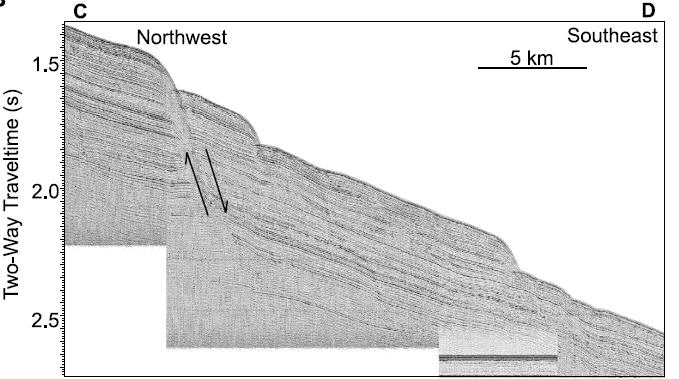
The Scotian Slope received abundant sediment during the Last Glacial Maximum, when sea level was out at the present shelf edge, and during post-glacial transgression from very active glacial outwash systems.
Check out the Mosher et al. (2004) here (subscription required).
~~~~~~~~~~~~~~~~~~~~~~~~~~~~~~~~~~~~~~~~~~~~~~~~~~~~~~~~~~~~~~~~


 Clastic Detritus
Excellent blog of my interest. As I am also a geologist with specialization in Sedimentology and Geochemistry. Recently working on possible impact of sedimentation of Himalayan rivers on earthquakes prediction in North and East Indian States.
regards
Nitish
nitishpriyadarshi.blogspot.com